


North America Smart Pills Market Size
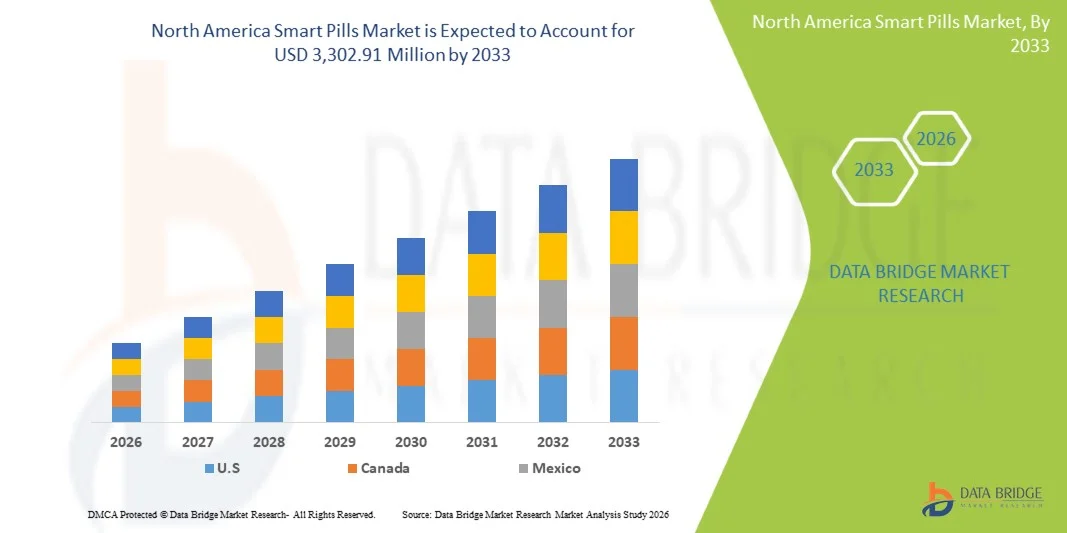
- The North America smart pills market size was valued at USD 960.13 million in 2025 and is expected to reach USD 3,302.91 million by 2033, at a CAGR of 16.70% during the forecast period
- The market growth is largely fueled by the increasing adoption of advanced healthcare monitoring technologies, wearable integration, and digital health solutions, enabling more precise and remote patient management
- Furthermore, rising demand from hospitals, clinics, and home healthcare providers for convenient, real-time, and accurate medication monitoring solutions is positioning smart pills as a critical tool for patient adherence and disease management. These converging factors are accelerating the uptake of smart pills, thereby significantly boosting the industry's growth
North America Smart Pills Market Analysis
- Smart pills, offering ingestible sensors for real-time monitoring of physiological parameters and medication adherence, are increasingly vital components of modern healthcare management in both hospitals and homecare settings due to their enhanced patient compliance tracking, remote monitoring capabilities, and seamless integration with digital health ecosystems
- The escalating demand for smart pills is primarily fueled by the growing adoption of digital health solutions, rising prevalence of chronic and gastrointestinal diseases, and the need for accurate and convenient patient monitoring
- The U.S. dominated the North America smart pills market with the largest revenue share of 81.5% in 2025, characterized by advanced healthcare infrastructure, high adoption of digital therapeutics, and a strong presence of key industry players, experiencing substantial growth in smart pill deployments in hospitals, clinics, and homecare programs, driven by innovations from both established medical device companies and startups focusing on multiparameter monitoring and AI-enabled adherence solutions
- Canada is expected to be the fastest growing country in the North America smart pills market during the forecast period due to increasing healthcare digitization, growing awareness of remote patient monitoring, and rising investments in healthcare infrastructure
- Multiparameter monitoring segment dominated the North America smart pills market with a market share of 44.1% in 2025, driven by its established utility in patient monitoring of cancer, capsule endoscopy, and drug delivery applications, offering comprehensive insights across multiple disease indications such as Crohn’s disease, occult GI bleeding, and mental disorders
Report Scope and North America Smart Pills Market Segmentation
|
Attributes |
North America Smart Pills Key Market Insights |
|
Segments Covered |
|
|
Countries Covered |
North America
|
|
Key Market Players |
|
|
Market Opportunities |
|
|
Value Added Data Infosets |
In addition to the insights on market scenarios such as market value, growth rate, segmentation, geographical coverage, and major players, the market reports curated by the Data Bridge Market Research also include in-depth expert analysis, patient epidemiology, pipeline analysis, pricing analysis, and regulatory framework |
North America Smart Pills Market Trends
“Enhanced Healthcare Monitoring Through AI and Digital Integration”
- A significant and accelerating trend in the North America smart pills market is the integration with artificial intelligence (AI) and digital health platforms, enabling real-time monitoring of patient adherence and physiological parameters
- For instance, Proteus Discover smart pills integrate AI algorithms with mobile apps to track medication intake and provide actionable insights for both patients and healthcare providers
- AI integration in smart pills allows predictive adherence alerts, personalized dosing reminders, and intelligent analysis of patient health patterns. For instance, some Medtronic smart pills use AI to identify irregular gastrointestinal activity and send alerts to clinicians for timely intervention
- The seamless integration of smart pills with digital health records and remote monitoring platforms facilitates centralized patient management. Through a single interface, healthcare providers can monitor medication adherence, vital signs, and treatment response, improving outcomes and reducing hospital readmissions
- This trend towards more intelligent, connected, and data-driven patient monitoring systems is fundamentally reshaping expectations for chronic disease management. Consequently, companies such as etectRx are developing AI-enabled smart pills with features such as real-time monitoring, cloud integration, and automated adherence notifications
- The demand for smart pills offering AI-driven insights and digital platform compatibility is growing rapidly across hospitals, clinics, and homecare settings, as healthcare providers increasingly prioritize patient adherence and proactive disease management
- Expansion of insurance coverage and reimbursement policies for digital adherence solutions is making smart pills more accessible, further fueling adoption across the U.S. and Canada
North America Smart Pills Market Dynamics
Driver
“Growing Need Due to Rising Chronic Disease Prevalence and Digital Health Adoption”
- The increasing prevalence of chronic and gastrointestinal diseases, coupled with the accelerating adoption of digital health solutions, is a significant driver for the heightened demand for smart pills
- For instance, in March 2025, Proteus Digital Health launched AI-integrated ingestible sensors to enhance medication adherence monitoring in cardiovascular and gastrointestinal patients
- As healthcare providers become more aware of non-adherence risks and the need for proactive interventions, smart pills offer advanced features such as real-time adherence alerts, data dashboards, and patient notifications, providing a compelling upgrade over traditional monitoring methods
- Furthermore, the growing popularity of remote patient monitoring solutions and connected healthcare ecosystems is making smart pills an integral component of treatment protocols, offering seamless integration with other digital health devices and platforms
- The convenience of real-time patient data, remote tracking of medication intake, and AI-driven predictive insights are key factors propelling the adoption of smart pills in hospitals, clinics, and homecare programs. The trend towards digital therapeutics and integration with telehealth platforms further contributes to market growth
- Increasing collaborations with research institutions to validate clinical effectiveness of smart pills in gastrointestinal and mental health disorders are enhancing market credibility and adoption
- Growing demand from homecare providers and telemedicine services for remote patient monitoring is expanding opportunities for smart pill deployment beyond hospital settings
Restraint/Challenge
“Data Privacy Concerns and Regulatory Compliance Hurdles”
- Concerns surrounding the data security and privacy of ingestible sensors pose a significant challenge to broader market adoption. As smart pills rely on network connectivity and cloud-based software, they are susceptible to data breaches and unauthorized access, raising anxieties among healthcare providers and patients
- For instance, high-profile reports of vulnerabilities in connected health devices have made some providers hesitant to deploy AI-enabled smart pill solutions
- Addressing these concerns through robust encryption, secure authentication protocols, and compliance with FDA and HIPAA regulations is crucial for building trust. Companies such as Medtronic and Proteus emphasize advanced encryption methods and regulatory adherence in their product communications to reassure potential users
- Additionally, the relatively high cost of advanced smart pill systems compared to traditional medication monitoring methods can be a barrier to adoption for budget-conscious healthcare providers and smaller clinics. While some devices are becoming more affordable, premium features such as AI analytics and cloud connectivity often come at higher price points
- Overcoming these challenges through enhanced cybersecurity measures, regulatory compliance, user education on data safety, and development of cost-effective solutions will be vital for sustained growth in the North America smart pills market
- Variability in regulatory approval timelines across different states in the U.S. and provinces in Canada can delay market entry for new smart pill products
- Limited patient awareness and acceptance of ingestible sensors in routine healthcare practices can restrict adoption despite technological readiness, requiring education campaigns and physician advocacy
North America Smart Pills Market Scope
The market is segmented on the basis of type, disease indication, application, and end user.
- By Type
On the basis of type, the North America smart pills market is segmented into multiparameter monitoring and single parameter monitoring. The multiparameter monitoring segment dominated the market with the largest revenue share of 44.1% in 2025, driven by its ability to track multiple physiological parameters such as heart rate, temperature, and gastrointestinal activity simultaneously. Hospitals and clinics prefer multiparameter smart pills for comprehensive patient monitoring, particularly in chronic disease management. This segment benefits from integration with AI and digital health platforms, providing clinicians with actionable insights and predictive alerts. Multiparameter pills also enhance clinical trial monitoring by offering reliable adherence and physiological data across multiple metrics. The adoption is further supported by the increasing prevalence of complex gastrointestinal and mental health disorders that require continuous multi-factor assessment. The versatility of multiparameter smart pills in both inpatient and outpatient settings solidifies their leading position in the market.
The single parameter monitoring segment is anticipated to witness the fastest growth rate of 17.8% from 2026 to 2033, fueled by its cost-effectiveness and targeted monitoring capabilities. Single parameter smart pills are widely adopted in outpatient settings where only specific health metrics, such as gastrointestinal pH or bleeding detection, are required. The simplicity of these devices reduces patient burden while maintaining reliable adherence tracking, making them suitable for homecare and telemedicine applications. The rising demand from clinics and homecare providers for quick, focused monitoring solutions drives growth. Additionally, manufacturers are launching compact single parameter pills that are easier to swallow and integrate with mobile apps for patient engagement. Their affordability and targeted functionality make them a preferred choice for smaller healthcare facilities and diagnostic centers, accelerating market adoption.
- By Disease Indication
On the basis of disease indication, the market is segmented into occult GI bleeding, Crohn’s disease, small bowel tumors, celiac disease, inherited polyposis syndromes, and mental disorders. The occult GI bleeding segment dominated the market in 2025 due to the high prevalence of undiagnosed gastrointestinal bleeding and the critical need for early detection. Smart pills for occult GI bleeding provide non-invasive diagnostic capabilities, reducing the reliance on traditional endoscopy and hospitalization. Hospitals and diagnostic centers favor these pills for accurate, real-time monitoring of internal bleeding, which can be life-threatening if not detected early. The growing aging population with associated gastrointestinal conditions drives demand in this segment. Integration with cloud-based data systems allows physicians to analyze trends and adjust treatment plans promptly. The ability to detect bleeding in hard-to-reach areas of the small intestine also enhances clinical decision-making.
The Crohn’s disease segment is expected to witness the fastest growth from 2026 to 2033 due to the rising prevalence of inflammatory bowel disorders in North America. Smart pills help monitor inflammation, mucosal healing, and disease progression without frequent invasive procedures. Patient adherence tracking and real-time data transmission allow gastroenterologists to optimize therapy and prevent complications. Additionally, growing awareness among patients and healthcare providers about non-invasive diagnostic alternatives is increasing adoption. Pharmaceutical and medical device companies are actively investing in Crohn’s-focused smart pill R&D, accelerating innovation and market expansion. Integration with telemedicine platforms further enables remote patient management, supporting growth in both hospitals and outpatient care settings.
- By Application
On the basis of application, the market is segmented into capsule endoscopy, drug delivery, and patient monitoring of cancer. The capsule endoscopy segment dominated the market in 2025 due to its ability to provide minimally invasive visualization of the gastrointestinal tract. Hospitals and diagnostic centers prefer capsule endoscopy for screening and diagnosis of small bowel disorders, including tumors and Crohn’s disease. Smart pills for capsule endoscopy provide high-resolution imaging while reducing patient discomfort compared to traditional procedures. The integration with AI allows automatic detection of abnormalities, improving diagnostic accuracy and reducing physician workload. The rising prevalence of gastrointestinal diseases and the need for early detection are further driving adoption. Additionally, continuous technological advancements in imaging and battery life strengthen its market dominance.
The drug delivery segment is anticipated to witness the fastest growth from 2026 to 2033, fueled by demand for precision medicine and controlled-release therapies. Smart pills in drug delivery enable targeted medication release, improving therapeutic efficacy and minimizing side effects. The increasing adoption of personalized medicine and patient-centric therapies supports rapid growth in hospitals and clinical trials. Pharmaceutical collaborations with smart pill manufacturers are expanding application scope across chronic diseases and oncology. The convenience of remote monitoring and adherence tracking enhances patient compliance, driving acceptance in outpatient care and home settings. Continuous innovation in ingestible microelectronics and biocompatible materials also supports the segment’s accelerating growth.
- By End User
On the basis of end user, the market is segmented into hospitals, diagnostic centers, and others. The hospitals segment dominated the North America smart pills market in 2025, driven by the high adoption of digital health technologies and comprehensive patient monitoring systems. Hospitals leverage smart pills for chronic disease management, clinical trials, and post-operative monitoring. The ability to remotely track multiple parameters and ensure medication adherence enhances patient safety and treatment outcomes. Hospitals also benefit from AI integration for predictive analytics and personalized care plans. The segment is further supported by government initiatives and insurance reimbursements for digital health adoption. Hospitals’ preference for technologically advanced monitoring tools solidifies their leading position.
The diagnostic centers segment is expected to witness the fastest growth from 2026 to 2033 due to the increasing demand for outpatient diagnostic solutions and non-invasive monitoring. Diagnostic centers adopt smart pills for capsule endoscopy, occult GI bleeding detection, and cancer monitoring, providing faster turnaround and reduced patient discomfort. The integration of AI and cloud-based analysis enhances diagnostic accuracy and workflow efficiency. Growing awareness of preventive healthcare and early detection among patients drives demand. Technological advancements enabling compact, easy-to-use smart pills further accelerate adoption in smaller healthcare facilities. Collaboration with telemedicine providers also expands their reach and market growth.
North America Smart Pills Market Regional Analysis
- The U.S. dominated the North America smart pills market with the largest revenue share of 81.5% in 2025, characterized by advanced healthcare infrastructure, high adoption of digital therapeutics, and a strong presence of key industry players
- Patients and healthcare providers in the region highly value the convenience, real-time monitoring, and seamless integration offered by smart pills with electronic health records, mobile apps, and telemedicine platforms
- This widespread adoption is further supported by strong hospital networks, high healthcare spending, and the growing demand for remote patient monitoring, establishing smart pills as a preferred solution for chronic disease management, gastrointestinal diagnostics, and outpatient care programs
The U.S. Smart Pills Market Insight
The U.S. smart pills market captured the largest revenue share of 81.5% in 2025 within North America, fueled by the swift adoption of digital health technologies and the expanding trend of remote patient monitoring. Patients and healthcare providers are increasingly prioritizing medication adherence and real-time monitoring through ingestible sensors. The growing integration of AI-enabled analytics, mobile apps, and electronic health record systems further propels the smart pills industry. Moreover, rising prevalence of chronic gastrointestinal and mental health disorders is significantly contributing to market expansion. The U.S. also benefits from strong hospital infrastructure and favorable insurance reimbursement policies, driving widespread adoption in both inpatient and outpatient care.
Canada Smart Pills Market Insight
The Canada smart pills market is expected to grow at a noteworthy CAGR during the forecast period, driven by increasing adoption of telemedicine and digital therapeutics. Rising awareness about the importance of medication adherence and chronic disease management is encouraging healthcare providers to implement smart pill solutions. Government initiatives supporting digital healthcare infrastructure and remote monitoring also foster market expansion. Canadian hospitals and clinics are adopting AI-integrated smart pills to improve patient outcomes and reduce hospital readmissions. Furthermore, growing partnerships between pharmaceutical companies and smart pill manufacturers are boosting clinical trial applications. The market is experiencing growth across both urban hospitals and homecare programs, reflecting increasing patient-centric healthcare models.
Mexico Smart Pills Market Insight
The Mexico smart pills market is poised to grow at a substantial CAGR during the forecast period, primarily driven by the rising prevalence of gastrointestinal and chronic diseases. Growing investments in healthcare infrastructure, along with government support for digital health solutions, are encouraging the adoption of smart pills. Patients and providers are increasingly leveraging ingestible sensors for remote monitoring and medication adherence. The expanding telemedicine ecosystem further facilitates the integration of smart pills into clinical practice. Awareness campaigns about non-invasive diagnostics and real-time health tracking are boosting consumer confidence. Mexico’s emerging healthcare market, combined with affordability improvements in smart pill technology, is expected to drive market growth in both hospitals and diagnostic centers.
North America Smart Pills Market Share
The North America Smart Pills industry is primarily led by well-established companies, including:
- Medtronic (Ireland)
- CapsoVision, Inc. (U.S.)
- Olympus Corporation (Japan)
- Check‑Cap Ltd. (Israel)
- Koninklijke Philips N.V. (Netherlands)
- Jinshan Science & Technology (Group) Co., Ltd. (China)
- Otsuka Pharmaceutical Co., Ltd. (Japan)
- Proteus Digital Health (U.S.)
- Rani Therapeutics (U.S.)
- etectRx, Inc. (U.S.)
- Ankon Medical Technologies (China)
- PillDrill (U.S.)
- Medimetrics Personalized Drug Delivery B.V. (Netherlands)
- BodyCap (France)
- ANX Robotica (U.S.)
- Pop Test Abuse Deterrent Technology LLC (U.S.)
- Progenity Inc. (U.S.)
- Innurvation Inc. (U.S.)
- IntroMedic Co., Ltd. (South Korea)
What are the Recent Developments in North America Smart Pills Market?
- In January 2026, CapsoVision submitted a 510(k) application to the FDA for an AI‑assisted reading module for its CapsoCam Plus system, aiming to improve diagnostic accuracy and streamline clinician review with advanced image interpretation tools
- In December 2025, CapsoVision submitted a 510(k) application to the U.S. Food and Drug Administration for an AI‑assisted reading module for its CapsoCam Plus system, aimed at improving diagnostic accuracy and reducing clinician review time in capsule endoscopy procedures.
- In January 2025, CapsoVision’s CapsoCam Plus® capsule endoscopy system received FDA clearance for use in pediatric patients aged two and above, enabling non‑invasive, comfortable gastrointestinal diagnostics for children and expanding access to capsule endoscopy imaging
- In January 2025, CapsoVision announced that its CapsoCam Plus® capsule endoscopy system earned FDA clearance for remote ingestion, allowing patients to swallow the diagnostic capsule at home under virtual supervision, enhancing patient convenience and telehealth accessibility
- In January 2024, the U.S. Food and Drug Administration (FDA) cleared AnX Robotica’s NaviCam Small Bowel Video Capsule Endoscopy system for expanded indications to include use in both adults and children aged 2 years and older, enhancing diagnostic capabilities and extending access to AI‑assisted capsule endoscopy technology for a broader patient population

- Interactive Data Analysis Dashboard
- Company Analysis Dashboard for high growth potential opportunities
- Research Analyst Access for customization & queries
- Competitor Analysis with Interactive dashboard
- Latest News, Updates & Trend analysis
- Harness the Power of Benchmark Analysis for Comprehensive Competitor Tracking
Data collection and base year analysis are done using data collection modules with large sample sizes. The stage includes obtaining market information or related data through various sources and strategies. It includes examining and planning all the data acquired from the past in advance. It likewise envelops the examination of information inconsistencies seen across different information sources. The market data is analysed and estimated using market statistical and coherent models. Also, market share analysis and key trend analysis are the major success factors in the market report. To know more, please request an analyst call or drop down your inquiry.
The key research methodology used by DBMR research team is data triangulation which involves data mining, analysis of the impact of data variables on the market and primary (industry expert) validation. Data models include Vendor Positioning Grid, Market Time Line Analysis, Market Overview and Guide, Company Positioning Grid, Patent Analysis, Pricing Analysis, Company Market Share Analysis, Standards of Measurement, Global versus Regional and Vendor Share Analysis. To know more about the research methodology, drop in an inquiry to speak to our industry experts.
Data Bridge Market Research is a leader in advanced formative research. We take pride in servicing our existing and new customers with data and analysis that match and suits their goal. The report can be customized to include price trend analysis of target brands understanding the market for additional countries (ask for the list of countries), clinical trial results data, literature review, refurbished market and product base analysis. Market analysis of target competitors can be analyzed from technology-based analysis to market portfolio strategies. We can add as many competitors that you require data about in the format and data style you are looking for. Our team of analysts can also provide you data in crude raw excel files pivot tables (Fact book) or can assist you in creating presentations from the data sets available in the report.












