


What is the North America Surgical Instrument Tracking Systems Market Size and Growth Rate?
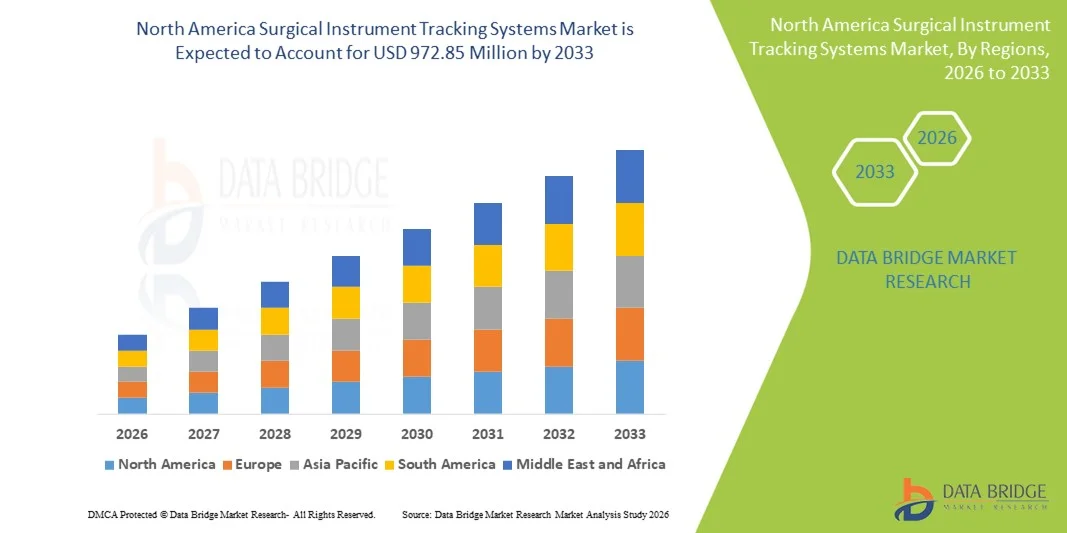
- As per Data Bridge Market Research Analysis the North America surgical instrument tracking systems market size was valued at USD 336.91 Million in 2025 and is expected to reach USD 972.85 Million by 2033, at a CAGR of 13.50% during the forecast period
- The market growth is largely fueled by the increasing adoption of digital healthcare solutions and technological advancements in hospital asset management, leading to improved traceability, accountability, and operational efficiency in surgical environments across hospitals and ambulatory surgical centers
- Furthermore, rising demand for patient safety, regulatory compliance, and efficient surgical workflow management is establishing surgical instrument tracking systems as a critical component of modern operating rooms. These converging factors are accelerating the adoption of Surgical Instrument Tracking Systems solutions, thereby significantly boosting the industry’s growth
Market Size and Forecast:
- Market Value (2025): USD 336.91 Million
- Expected Market Value (2033): USD 972.85 Million
- Forecast CAGR (2026–2033): 13.50%
What are the Major Takeaways of North America Surgical Instrument Tracking Systems Market?
- Surgical Instrument Tracking Systems, which enable real-time identification, location tracking, and lifecycle management of surgical instruments, are becoming increasingly vital components of modern hospital infrastructure due to their ability to enhance patient safety, improve operational efficiency, and ensure compliance with sterilization and regulatory standards across healthcare facilities
- The escalating demand for surgical instrument tracking systems is primarily driven by the rising volume of surgical procedures, increasing focus on reducing surgical site infections (SSIs), and growing regulatory emphasis on instrument traceability and accountability within operating rooms and central sterile departments
- U.S. dominated the Surgical Instrument Tracking Systems market with the largest revenue share of approximately 39.2% in 2025, supported by advanced healthcare infrastructure, high adoption of digital health technologies, and stringent regulatory requirements for surgical safety across hospitals and surgical centers
- Canada is expected to be the fastest-growing region in the Surgical Instrument Tracking Systems market during the forecast period, driven by rapid expansion of healthcare infrastructure, increasing surgical volumes, rising healthcare expenditure, and growing awareness regarding patient safety and infection control, with the market projected to witness strong double-digit CAGR growth
- The Pro Sites segment dominated the market with the largest revenue share of approximately 58.4% in 2025
Report Scope and Surgical Instrument Tracking Systems Market Segmentation
|
Attributes |
Surgical Instrument Tracking Systems Key Market Insights |
|
Segments Covered |
|
|
Countries Covered |
North America
|
|
Key Market Players |
|
|
Market Opportunities |
|
|
Value Added Data Infosets |
In addition to the insights on market scenarios such as market value, growth rate, segmentation, geographical coverage, and major players, the market reports curated by the Data Bridge Market Research also include in-depth expert analysis, patient epidemiology, pipeline analysis, pricing analysis, and regulatory framework. |
What are the North America Surgical Instrument Tracking Systems Market Trends?
Increasing Adoption of RFID and Barcode-Based Tracking Technologies
- A major and steadily advancing trend in the global surgical instrument tracking systems market is the growing adoption of RFID (Radio-Frequency Identification) and barcode-based tracking technologies to enhance instrument traceability and workflow efficiency in healthcare facilities
- Healthcare providers are increasingly implementing RFID-enabled tracking systems to monitor surgical instruments throughout their lifecycle, from sterilization and storage to operating room usage and post-procedure reprocessing
- For instance, RFID-based systems enable real-time visibility of instrument location and status, reducing loss, misplacement, and delays during surgical procedures
- Barcode-based tracking systems are also widely adopted due to their cost-effectiveness and ease of integration with existing hospital inventory management systems
- These technologies help ensure compliance with regulatory standards by maintaining accurate records of instrument usage, sterilization cycles, and maintenance history
- The integration of tracking systems with hospital information systems (HIS) and electronic health records (EHR) further supports streamlined documentation and audit readiness
- Adoption is particularly strong in large hospitals and ambulatory surgical centers seeking to improve operational efficiency and patient safety
- The trend is supported by increasing surgical volumes globally and the growing complexity of surgical instrument sets
- Vendors are continuously enhancing system interoperability and data accuracy to meet hospital requirements
- As healthcare facilities prioritize efficiency, traceability, and regulatory compliance, RFID and barcode-based tracking solutions are becoming standard practice
- This trend is reshaping expectations around surgical workflow optimization and asset management
- Overall, the shift toward advanced tracking technologies is strengthening demand across developed and emerging healthcare markets
North America Surgical Instrument Tracking Systems Market Dynamics
Driver
Rising Surgical Procedures and Emphasis on Patient Safety
- The increasing number of surgical procedures globally, driven by aging populations and chronic disease prevalence, is a key driver of the surgical instrument tracking systems market
- For instance, in 2024, the U.S. Centers for Medicare & Medicaid Services (CMS) reinforced surgical safety and infection control guidelines, encouraging hospitals to adopt instrument traceability systems to reduce retained surgical items and hospital-acquired infections (HAIs)
- Hospitals face growing pressure to ensure patient safety and reduce procedural errors
- Instrument tracking systems help prevent retained surgical instruments and cross-contamination
- Regulatory and accreditation bodies increasingly mandate documentation of sterilization and instrument usage
- Tracking systems improve accountability within central sterile services departments
- Faster instrument turnaround supports higher operating room utilization
- Adoption is strong in tertiary care hospitals and multi-specialty surgical centers
- These systems contribute to improved compliance with patient safety standards
- Government healthcare quality initiatives further support adoption
- Technological improvements enhance reliability and ease of deployment
- Collectively, these factors significantly drive market growth worldwide
Restraint/Challenge
High Implementation Costs and Integration Complexity
- High upfront investment and system integration challenges continue to restrain broader adoption of surgical instrument tracking systems
- For instance, smaller hospitals in emerging economies reported in 2023 that the cost of RFID tags, scanners, and software integration posed significant financial barriers, particularly when retrofitting legacy sterilization workflows, delaying adoption decisions
- The cost of hardware, software licenses, and installation can be substantial. Integration with existing hospital IT and sterilization infrastructure is often complex
- Limited in-house technical expertise can slow deployment. Budget constraints restrict adoption in public and rural healthcare facilities
- Ongoing maintenance and tag replacement add to operational costs. Resistance to workflow changes among staff can hinder implementation success
- Data accuracy issues may arise during early deployment stages. Training requirements increase total cost of ownership
- ROI concerns remain among cost-sensitive healthcare providers. Vendors are responding with scalable and modular pricing models to address these challenges
North America Surgical Instrument Tracking Systems Market Scope
The market is segmented on the basis of type, component, Technology , end user and distribution channel.
- By Type
On the basis of type, the Instrument Tracking Systems market is segmented into Pro Sites and Multi Sites. The Pro Sites segment dominated the market with the largest revenue share of approximately 58.4% in 2025. This dominance is largely attributed to the extensive adoption of single-site tracking solutions by standalone hospitals, specialty clinics, and mid-sized healthcare facilities. Pro site systems are easier to deploy, require lower upfront investment, and integrate smoothly with existing hospital workflows. These systems enable effective tracking of surgical instruments within a single facility, reducing loss, improving utilization, and ensuring compliance with sterilization protocols. Hospitals favor pro site solutions due to their operational simplicity and reduced IT complexity. In addition, growing regulatory pressure to maintain accurate instrument traceability further supports adoption. The rising number of surgical procedures and focus on patient safety also reinforce the strong position of this segment. Pro site solutions continue to be the preferred choice for facilities seeking cost-effective and efficient instrument management.
The Multi Sites segment is expected to witness the fastest growth, registering a CAGR of approximately 22.1% from 2026 to 2033. This rapid growth is driven by the expansion of multi-location hospital chains and integrated healthcare networks. Multi-site tracking systems allow centralized monitoring, standardized workflows, and real-time visibility of instruments across multiple facilities. Healthcare organizations increasingly prefer these systems to optimize inventory sharing, reduce procurement costs, and improve operational efficiency. The growing trend of hospital consolidation and mergers further accelerates adoption. Advanced analytics, cloud-based platforms, and enterprise-level reporting capabilities also enhance the appeal of multi-site solutions. As healthcare systems scale operations, demand for multi-site tracking solutions is expected to rise significantly.
- By Component
On the basis of component, the Instrument Tracking Systems market is segmented into Hardware, Software, and Services. The Hardware segment accounted for the largest market revenue share of approximately 46.7% in 2025. This dominance is driven by the essential requirement for physical tracking components such as RFID tags, barcode labels, scanners, readers, and sensors. Hospitals must invest in hardware infrastructure to enable accurate identification and real-time tracking of surgical instruments. The continuous replacement of tags and scanning devices due to wear and sterilization cycles further sustains demand. In addition, increasing installation of tracking hardware across operating rooms and sterile processing departments supports market growth. Hardware forms the foundation of any tracking system, making it a non-negotiable investment. Regulatory mandates for traceability also contribute to sustained hardware adoption. As healthcare facilities expand, the need for scalable hardware solutions continues to rise.
The Software segment is projected to grow at the fastest CAGR of around 23.4% from 2026 to 2033. This growth is fueled by rising demand for data-driven decision-making, automation, and workflow optimization. Advanced software solutions provide features such as real-time dashboards, compliance reporting, predictive maintenance, and inventory analytics. Increasing adoption of cloud-based platforms and subscription models is further accelerating growth. Healthcare providers are increasingly integrating tracking software with hospital information systems and electronic health records. The push toward digital transformation and smart hospitals strongly supports this segment. Software solutions enhance visibility, efficiency, and cost control, making them critical for future-ready healthcare systems.
- By Technology
On the basis of technology, the Instrument Tracking Systems market is segmented into Barcode Tracking, Radio Frequency Identification (RFID), Electronic Tracking, and Others. The Barcode Tracking segment dominated the market with a revenue share of approximately 41.9% in 2025. This dominance is primarily due to the low cost, ease of use, and widespread familiarity of barcode systems among healthcare professionals. Barcode tracking requires minimal infrastructure and training, making it ideal for small and mid-sized healthcare facilities. Many hospitals continue to rely on barcode systems as legacy solutions due to budget constraints. Barcode technology provides reliable instrument identification and traceability when used within controlled environments. Its compatibility with existing hospital systems further strengthens adoption. In addition, barcode tracking remains a practical solution for facilities with moderate surgical volumes.
The RFID segment is expected to register the fastest CAGR of about 25.6% from 2026 to 2033. RFID technology enables real-time, non-line-of-sight tracking and significantly reduces manual intervention. It improves inventory accuracy, turnaround times, and operational efficiency in sterile processing departments. Declining costs of RFID tags and increasing investment in automation are accelerating adoption. RFID systems are particularly favored by large hospitals and multi-site healthcare networks. The ability to track instruments throughout their lifecycle enhances compliance and patient safety. Growing adoption of smart hospital infrastructure further fuels this segment’s rapid growth.
- By End User
On the basis of end user, the Instrument Tracking Systems market is segmented into Hospitals, Ambulatory Surgical Centers, Research Centers, Clinics, and Others. The Hospitals segment held the largest market revenue share of approximately 62.3% in 2025. Hospitals perform a high volume of surgical procedures and manage complex inventories of surgical instruments. Instrument tracking systems help hospitals reduce loss, ensure sterilization compliance, and improve patient outcomes. Large hospitals have the financial capacity to invest in comprehensive tracking solutions. Increasing regulatory scrutiny and accreditation requirements further drive adoption. Hospitals also benefit from improved workflow efficiency and reduced operational costs. The growing number of surgeries worldwide continues to reinforce hospital dominance.
The Ambulatory Surgical Centers (ASCs) segment is expected to grow at the fastest CAGR of around 21.8% from 2026 to 2033. This growth is driven by the increasing shift toward outpatient and minimally invasive surgeries. ASCs require efficient instrument management to maintain fast turnaround times and cost efficiency. Rising patient preference for same-day procedures further supports ASC expansion. Tracking systems help ASCs comply with safety and sterilization standards. The rapid establishment of new ASCs across emerging and developed markets accelerates adoption. Cost-effective and scalable solutions are particularly attractive to this segment.
- By Distribution Channel
On the basis of distribution channel, the Instrument Tracking Systems market is segmented into Direct Tender and Third Party Distributor. The Direct Tender segment dominated the market with a revenue share of approximately 55.6% in 2025. Large hospitals and government healthcare institutions prefer direct procurement to secure better pricing and customized solutions. Direct tenders allow long-term service agreements and technical support from manufacturers. This channel is commonly used in public healthcare systems and large hospital networks. It ensures transparency and compliance with procurement regulations. Vendors benefit from stable contracts and strong client relationships. The dominance of this channel is supported by large-scale deployments.
The Third Party Distributor segment is anticipated to witness the fastest CAGR of around 20.9% from 2026 to 2033. Growth is driven by increasing penetration in emerging markets and smaller healthcare facilities. Distributors provide localized support, faster delivery, and access to a wider customer base. Manufacturers increasingly rely on distributors to expand global reach without heavy infrastructure investments. This channel is particularly strong in Asia-Pacific, Latin America, and the Middle East. Rising demand from mid-sized hospitals and clinics further accelerates growth. Third-party distribution offers flexibility and scalability, supporting rapid market expansion.
North America Surgical Instrument Tracking Systems Market Regional Analysis
- The North America surgical instrument tracking systems market is poised to grow at the fastest CAGR during the forecast period of 2026 to 2033, driven by the rapid expansion of healthcare infrastructure, increasing surgical volumes, and rising investments in hospital digitalization across emerging economies
- Governments across the region are emphasizing patient safety, infection control, and compliance with surgical traceability standards, which is accelerating the adoption of RFID- and barcode-based surgical instrument tracking solutions
- The growing number of tertiary care hospitals, ambulatory surgical centers, and medical tourism hubs is further supporting market growth. In addition, the presence of cost-effective manufacturing capabilities and increasing adoption of hospital information systems are improving the accessibility of surgical instrument tracking technologies across Asia-Pacific
China Surgical Instrument Tracking Systems Market Insight
China surgical instrument tracking systems market dominated the North America Surgical Instrument Tracking Systems market, accounting for the largest revenue share of approximately 41.5% in 2025, supported by the country’s advanced healthcare infrastructure and early adoption of digital health technologies. Chinese hospitals are increasingly implementing surgical instrument tracking systems to comply with stringent regulatory requirements related to surgical safety, sterilization traceability, and inventory management. The government’s strong push toward smart hospitals and healthcare IT modernization, coupled with significant investments in large public hospitals, is driving widespread deployment of RFID and real-time location tracking solutions. In addition, the presence of strong domestic medical device manufacturers and technology providers enables affordable and scalable tracking solutions, further reinforcing China’s market leadership.
India Surgical Instrument Tracking Systems Market Insight
India surgical instrument tracking systems market is expected to be the fastest-growing country in the North America Surgical Instrument Tracking Systems market during the forecast period, driven by rapid expansion of healthcare infrastructure and a sharp rise in surgical procedures across both public and private hospitals. Increasing healthcare expenditure, growing awareness regarding patient safety, infection prevention, and surgical efficiency, and the adoption of hospital accreditation standards such as NABH are accelerating demand for instrument traceability solutions. Furthermore, government initiatives aimed at strengthening healthcare delivery, along with the digital transformation of hospitals and central sterile services departments (CSSDs), are encouraging the adoption of barcode and RFID-based tracking systems. The growth of medical tourism and multispecialty hospitals is also contributing to sustained market expansion in India.
Which are the Top Companies in North America Surgical Instrument Tracking Systems Market?
The Surgical Instrument Tracking Systems industry is primarily led by well-established companies, including:
- Getinge AB (Sweden)
- STERIS plc (Ireland)
- BD (U.S.)
- 3M Health Care (U.S.)
- Hologic, Inc. (U.S.)
- Stanley Healthcare (U.S.)
- Cantel Medical Corp. (U.S.)
- Key Surgical (U.S.)
- TAGSYS RFID (France)
- Aesculap, Inc. (Germany)
- Scansource Healthcare (U.S.)
- Xerafy (Singapore)
- Censis Technologies (U.S.)
- HGS Healthcare (U.S.)
- SurgiTrack, Inc. (U.S.)
- Integra LifeSciences (U.S.)
- Traxitall, Inc. (U.S.)
- Vizient, Inc. (U.S.)
- Mobile Aspects (U.S.)
- Fujitsu (Japan)
What are the Latest Developments in North America Surgical Instrument Tracking Systems Market?
- In April 2024, Aesculap, Inc. launched the AESCULAP Aicon RTLS integrated with its Aicon sterile container system, deploying real-time location services (RTLS) for surgical instrument sets to automate tracking through sterilization, storage, and OR deployment, transforming central sterile departments into fully digital, paperless environments
- In February 2025, Identiv and Novanta announced a strategic partnership to deliver end-to-end RFID solutions for medical device OEMs, integrating Identiv’s advanced RFID inlays and tags with Novanta’s ThingMagic reader modules and APIs to streamline instrument traceability, assembly verification, and patient safety in surgical environments
- In April 2025, ID Integration partnered with Zebra Technologies at HIMSS 2025 to demonstrate enhanced passive RFID-based hospital asset and surgical instrument tracking, showcasing real-time location visibility for sterile surgical trays, instruments, and related assets via handheld and fixed readers to improve operating room efficiency
- In April 2025, the U.S. Food and Drug Administration (FDA) granted 510(k) clearance to Turbett Surgical’s Instrument Pod systems (TS1500, TS1200, TS1000), validating enhanced weight capacities, expanded lumen compatibility, and ergonomic design improvements intended to streamline instrument handling and reduce blue-wrap waste in sterile processing operations.
- In May 2025, Elucent Medical received Breakthrough Device Designation from the FDA for its EnVisio X1 In-Body Spatial Intelligence System, featuring implantable SmartClips and SmartSensor-equipped staplers designed to enable real-time 3D tracking of both soft-tissue markers and surgical instruments during minimally invasive and robotic-assisted procedures
- In October 2025, MarketsandMarkets Research highlighted that Mobile Aspects launched SurgiCart in July 2024, the first RFID-enabled mobile case cart providing real-time visibility of surgical supplies and instruments across clinical environments, marking a significant innovation in mobile RFID tracking deployment
- In April 2025, Zebra Technologies secured a major contract to deploy a hospital-wide RFID surgical instrument tracking solution across a leading U.S. health system, including RFID-enabled tagging, printers, and workflow software — underscoring growing enterprise-level adoption of automated tracking platforms.
- In February 2025, Avery Dennison announced a strategic partnership with MediTrax to deploy RFID-based surgical instrument tracking across multiple U.S. hospital networks, aimed at improving instrument turnover times and reducing retained item incidents via integrated tagging and software solutions

- Interactive Data Analysis Dashboard
- Company Analysis Dashboard for high growth potential opportunities
- Research Analyst Access for customization & queries
- Competitor Analysis with Interactive dashboard
- Latest News, Updates & Trend analysis
- Harness the Power of Benchmark Analysis for Comprehensive Competitor Tracking
Data collection and base year analysis are done using data collection modules with large sample sizes. The stage includes obtaining market information or related data through various sources and strategies. It includes examining and planning all the data acquired from the past in advance. It likewise envelops the examination of information inconsistencies seen across different information sources. The market data is analysed and estimated using market statistical and coherent models. Also, market share analysis and key trend analysis are the major success factors in the market report. To know more, please request an analyst call or drop down your inquiry.
The key research methodology used by DBMR research team is data triangulation which involves data mining, analysis of the impact of data variables on the market and primary (industry expert) validation. Data models include Vendor Positioning Grid, Market Time Line Analysis, Market Overview and Guide, Company Positioning Grid, Patent Analysis, Pricing Analysis, Company Market Share Analysis, Standards of Measurement, Global versus Regional and Vendor Share Analysis. To know more about the research methodology, drop in an inquiry to speak to our industry experts.
Data Bridge Market Research is a leader in advanced formative research. We take pride in servicing our existing and new customers with data and analysis that match and suits their goal. The report can be customized to include price trend analysis of target brands understanding the market for additional countries (ask for the list of countries), clinical trial results data, literature review, refurbished market and product base analysis. Market analysis of target competitors can be analyzed from technology-based analysis to market portfolio strategies. We can add as many competitors that you require data about in the format and data style you are looking for. Our team of analysts can also provide you data in crude raw excel files pivot tables (Fact book) or can assist you in creating presentations from the data sets available in the report.













