North America Vertical Farming Market Size
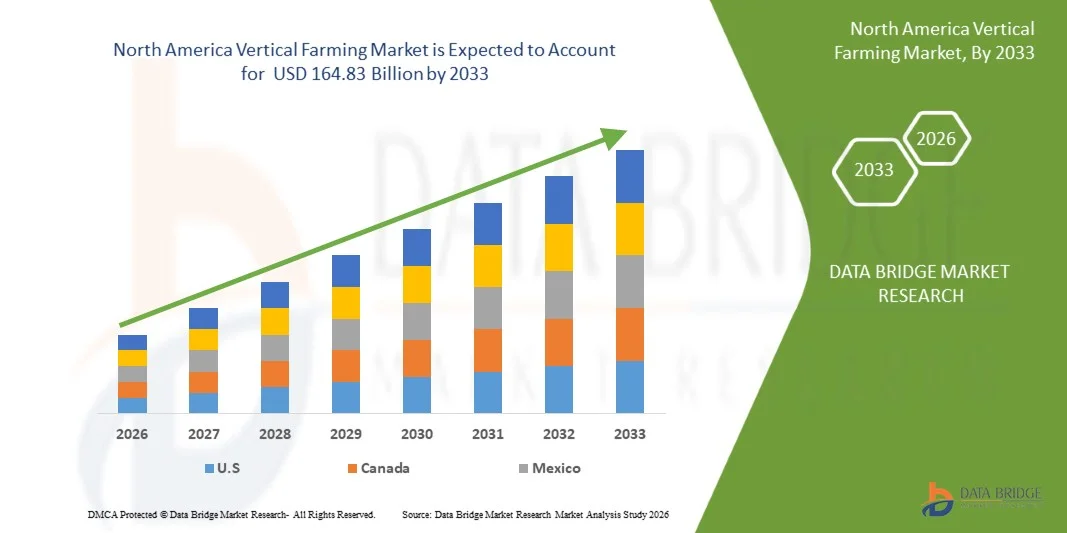
- The North America vertical farming market size was valued at USD 20.58 billion in 2025 and is expected to reach USD 164.83 billion by 2033, at a CAGR of 29.70% during the forecast period
- The market growth is largely fuelled by the rising demand for sustainable food production methods such as controlled environment agriculture, which helps reduce dependency on traditional farmland and seasonal constraints
- In addition, increasing adoption of advanced technologies such as hydroponics, aeroponics, and LED-based indoor farming systems is significantly improving crop yield efficiency and resource utilization
North America Vertical Farming Market Analysis
- The market is witnessing strong expansion due to the growing need for efficient food production systems that can operate in urban and space-constrained environments
- Rising concerns over climate variability and agricultural land scarcity are encouraging investment in controlled environment farming solutions that ensure consistent crop output
- U.S. vertical farming market held the largest market revenue share in 2025, driven by strong integration of advanced technologies such as AI-based crop monitoring, IoT-enabled sensors, and automated climate control systems. Large-scale commercial farms are increasingly leveraging data-driven farming techniques to optimize yield, reduce operational costs, and enhance resource efficiency
- Canada is expected to witness the highest compound annual growth rate (CAGR) in the North America vertical farming market due to increasing focus on food security in extreme climatic conditions, growing adoption of indoor farming technologies, and rising government support for sustainable agricultural practices and urban farming expansion
- The hydroponics segment held the largest market revenue share in 2025 driven by its high efficiency in nutrient delivery, reduced water usage, and ability to support large-scale commercial crop production. Hydroponic systems are widely adopted in vertical farming facilities due to their scalability, consistent yield output, and compatibility with leafy green cultivation
Report Scope and North America Vertical Farming Market Segmentation
|
Attributes |
North America Vertical Farming Key Market Insights |
|
Segments Covered |
|
|
Countries Covered |
North America
Europe
Asia-Pacific
Middle East and Africa
South America
|
|
Key Market Players |
• AeroFarms (U.S.) |
|
Market Opportunities |
• Expansion Of Urban Agriculture Infrastructure |
|
Value Added Data Infosets |
In addition to the insights on market scenarios such as market value, growth rate, segmentation, geographical coverage, and major players, the market reports curated by the Data Bridge Market Research also include import export analysis, production capacity overview, production consumption analysis, price trend analysis, climate change scenario, supply chain analysis, value chain analysis, raw material/consumables overview, vendor selection criteria, PESTLE Analysis, Porter Analysis, and regulatory framework. |
North America Vertical Farming Market Trends
“Rising Adoption Of Controlled Environment Agriculture And Smart Farming Technologies”
• The increasing focus on sustainable food production systems is significantly shaping the North America vertical farming market, as growers adopt controlled environment agriculture to ensure year-round crop production independent of seasonal variations. Vertical farming systems are gaining traction due to their ability to optimize land use efficiency, reduce water consumption, and improve crop yield consistency. This trend is strengthening adoption across urban farming facilities, commercial greenhouses, and indoor farming units, encouraging operators to integrate advanced cultivation methods for improved productivity
• Growing emphasis on food security, urbanization, and supply chain resilience is accelerating the deployment of vertical farming systems across major cities. Urban populations are driving demand for locally produced fresh food, prompting investment in indoor farming infrastructure closer to consumption centers. This shift is also reducing transportation costs and post-harvest losses, while ensuring faster delivery of fresh produce to retail and foodservice channels
• Technological integration such as AI-based crop monitoring, IoT-enabled sensors, robotics, and LED lighting systems is transforming operational efficiency in vertical farming facilities. These innovations are enabling precise control over temperature, humidity, and nutrient delivery, improving crop quality and reducing resource wastage. The increasing digitalization of agriculture is also supporting data-driven decision-making for yield optimization and cost reduction
• For instance, in 2024, AeroFarms in the U.S. and Plenty Unlimited Inc. in the U.S. expanded their indoor farming operations with advanced vertical farming systems using AI-powered monitoring and hydroponic technologies. These expansions were driven by rising demand for locally grown leafy greens and herbs, with distribution focused on retail chains and foodservice providers. The facilities emphasized water efficiency and pesticide-free cultivation, aligning with sustainability goals and consumer preferences
• While adoption is growing, long-term market expansion depends on reducing high operational costs, improving energy efficiency, and scaling production capacity. Continuous innovation in automation, lighting efficiency, and nutrient management systems will be essential to enhance profitability and support large-scale commercialization of vertical farming
North America Vertical Farming Market Dynamics
Driver
“Increasing Demand For Sustainable And Locally Produced Food”
• Rising consumer preference for fresh, pesticide-free, and locally sourced food is a major driver of the North America vertical farming market. Vertical farming enables year-round production of high-quality crops in urban environments, reducing dependence on traditional agriculture and long-distance transportation. This supports food freshness, supply stability, and reduced environmental impact
• Expanding urban population density is increasing pressure on conventional farmland, encouraging the adoption of space-efficient farming solutions. Vertical farming systems allow cultivation in warehouses, rooftops, and indoor facilities, making them suitable for metropolitan areas with limited agricultural land availability. This is further supporting integration into retail supply chains and local distribution networks
• Food retailers and restaurant chains are increasingly partnering with vertical farming operators to ensure consistent supply of fresh produce. These collaborations help improve supply chain reliability, reduce logistics costs, and enhance product traceability. The growing focus on transparency and sustainability is also encouraging brands to adopt controlled environment agriculture for premium product offerings
• For instance, in 2023, Bowery Farming in the U.S. and Infarm in the U.S. expanded partnerships with major grocery retailers such as Walmart and Whole Foods Market to supply vertically grown leafy greens. These initiatives were driven by rising consumer demand for locally produced, fresh, and chemical-free vegetables, supporting higher repeat purchases and brand trust
• Although demand is rising, sustained growth depends on improving cost efficiency, reducing energy consumption, and enhancing scalability of production systems. Investments in renewable energy integration and advanced automation will be critical to achieving long-term profitability and market expansion
Restraint/Challenge
“High Capital Investment And Energy Consumption Costs”
• High initial setup costs for vertical farming infrastructure remain a significant challenge, limiting adoption among small and mid-scale growers. Expenses related to controlled environment systems, LED lighting, automation equipment, and facility construction contribute to substantial capital requirements. This creates barriers to entry and slows large-scale commercialization
• High energy consumption, particularly for artificial lighting and climate control systems, further increases operational costs. Dependence on electricity-intensive technologies makes profitability sensitive to energy price fluctuations, especially in large urban farming facilities. This also raises concerns regarding long-term sustainability and cost competitiveness compared to traditional farming
• Limited technical expertise and operational complexity also restrict market expansion. Efficient management of nutrient cycles, environmental controls, and crop optimization requires skilled personnel and advanced agricultural knowledge. The shortage of trained professionals can impact productivity and increase operational inefficiencies
• For instance, in 2024, several vertical farming operators in the U.S. reported scaling back expansion plans due to rising electricity costs and high facility maintenance expenses. Companies such as AeroFarms and other indoor farming startups highlighted energy-intensive LED systems and HVAC requirements as major cost burdens, affecting profitability in certain urban markets
• Addressing these challenges will require innovation in energy-efficient lighting systems, integration of renewable energy sources, and development of cost-effective automation solutions. Strategic partnerships, technological advancements, and improved operational models will be essential to enhance scalability and ensure long-term market sustainability
North America Vertical Farming Market Scope
The market is segmented on the basis of growth mechanism, structure, type, crop type, application, and component.
• By Growth Mechanism
On the basis of growth mechanism, the North America vertical farming market is segmented into hydroponics, aeroponics, and aquaponics. The hydroponics segment held the largest market revenue share in 2025 driven by its high efficiency in nutrient delivery, reduced water usage, and ability to support large-scale commercial crop production. Hydroponic systems are widely adopted in vertical farming facilities due to their scalability, consistent yield output, and compatibility with leafy green cultivation.
The aeroponics segment is expected to witness the fastest growth rate from 2026 to 2033, driven by its superior resource efficiency and minimal water requirement through mist-based nutrient delivery. Aeroponic systems are increasingly preferred for high-density vertical farming operations due to faster plant growth cycles and improved oxygen exposure to roots, making them highly suitable for advanced controlled environment agriculture systems.
• By Structure
On the basis of structure, the market is segmented into shipping containers and building-based systems. The building-based segment held the largest market revenue share in 2025 driven by its large-scale production capability and ability to integrate advanced automation, lighting systems, and climate control infrastructure. Building-based vertical farms are widely used for commercial production due to higher output capacity and operational flexibility.
The shipping container segment is expected to witness the fastest growth rate from 2026 to 2033, driven by its modular design, portability, and lower initial setup requirements. Container-based vertical farming units are increasingly adopted for urban farming and decentralized food production, offering quick deployment and efficient use of limited space in densely populated areas.
• By Type
On the basis of type, the market is segmented into bio pesticides, bio fertilizers, and bio stimulants. The bio fertilizers segment held the largest market revenue share in 2025 driven by the growing need to enhance crop productivity and soil-less nutrient management systems used in vertical farming setups. Bio fertilizers are widely utilized to improve plant growth efficiency and maintain sustainable production cycles in controlled environments.
The bio stimulants segment is expected to witness the fastest growth rate from 2026 to 2033, driven by increasing demand for enhanced crop yield, stress tolerance, and improved plant metabolism. Bio stimulants are gaining popularity in vertical farming due to their ability to optimize plant health and accelerate growth under controlled environmental conditions.
• By Crop Type
On the basis of crop type, the market is segmented into leafy green, pollinated plants, nutraceutical, and plant. The leafy green segment held the largest market revenue share in 2025 driven by high demand for lettuce, spinach, and kale in urban retail and foodservice channels. Leafy greens are highly suitable for vertical farming due to short growth cycles, high yield efficiency, and consistent demand.
The nutraceutical segment is expected to witness the fastest growth rate from 2026 to 2033, driven by rising consumer preference for functional foods and health-enhancing crops. Vertical farming enables controlled production of high-value nutraceutical plants with improved quality, purity, and nutrient consistency.
• By Application
On the basis of application, the market is segmented into indoor and outdoor. The indoor segment held the largest market revenue share in 2025 driven by widespread adoption of controlled environment agriculture systems that ensure year-round production independent of external climatic conditions. Indoor vertical farming systems provide higher yield stability, resource efficiency, and enhanced crop protection.
The outdoor segment is expected to witness the fastest growth rate from 2026 to 2033, driven by increasing adoption of hybrid farming models that integrate vertical farming structures in open environments. Outdoor systems are gaining traction for their lower energy dependency and cost-effective expansion potential in suitable climatic regions.
• By Component
On the basis of component, the market is segmented into lighting, hydroponic component, climate control, and sensors. The lighting segment held the largest market revenue share in 2025 driven by extensive use of LED grow lights that support photosynthesis and enable year-round cultivation. Advanced lighting systems are essential for optimizing crop yield and growth cycles in vertical farming facilities.
The sensors segment is expected to witness the fastest growth rate from 2026 to 2033, driven by increasing integration of IoT-enabled monitoring systems for real-time data collection. Sensors are widely used to monitor temperature, humidity, nutrient levels, and plant health, enabling precision farming and improved operational efficiency in controlled environment agriculture systems.
North America Vertical Farming Market Regional Analysis
- U.S. vertical farming market held the largest market revenue share in 2025, driven by strong integration of advanced technologies such as AI-based crop monitoring, IoT-enabled sensors, and automated climate control systems. Large-scale commercial farms are increasingly leveraging data-driven farming techniques to optimize yield, reduce operational costs, and enhance resource efficiency
- High consumer demand for locally sourced, pesticide-free produce is further accelerating adoption across urban centers
- In addition, strong investment activity from agritech companies and venture capital firms is supporting rapid expansion of controlled environment agriculture infrastructure across the country
Canada Vertical Farming Market Insight
The Canada vertical farming market is expected to witness the fastest growth rate from 2026 to 2033, supported by increasing focus on sustainable food production and food security in harsh climatic conditions. Limited arable land and long winter seasons are encouraging the adoption of indoor farming systems to ensure year-round crop availability. Growing awareness regarding environmental sustainability and reduced water usage is also supporting market growth. In addition, government support for agri-innovation and increasing adoption of hydroponic and aeroponic systems are contributing to the gradual expansion of vertical farming operations across urban and semi-urban regions.
North America Vertical Farming Market Share
The North America vertical farming industry is primarily led by well-established companies, including:
• AeroFarms (U.S.)
• Plenty Unlimited (U.S.)
• Bowery Farming (U.S.)
• Gotham Greens (U.S.)
• AppHarvest (U.S.)
• 80 Acres Farms (U.S.)
• Vertical Harvest (U.S.)
• Freight Farms (U.S.)
• BrightFarms (U.S.)
• Little Leaf Farms (U.S.)
• Kalera (U.S.)
• GoodLeaf Farms (Canada)
• Elevate Farms (Canada)
• Lufa Farms (Canada)
• MicroHabitat (Canada)

- Interactive Data Analysis Dashboard
- Company Analysis Dashboard for high growth potential opportunities
- Research Analyst Access for customization & queries
- Competitor Analysis with Interactive dashboard
- Latest News, Updates & Trend analysis
- Harness the Power of Benchmark Analysis for Comprehensive Competitor Tracking
Data collection and base year analysis are done using data collection modules with large sample sizes. The stage includes obtaining market information or related data through various sources and strategies. It includes examining and planning all the data acquired from the past in advance. It likewise envelops the examination of information inconsistencies seen across different information sources. The market data is analysed and estimated using market statistical and coherent models. Also, market share analysis and key trend analysis are the major success factors in the market report. To know more, please request an analyst call or drop down your inquiry.
The key research methodology used by DBMR research team is data triangulation which involves data mining, analysis of the impact of data variables on the market and primary (industry expert) validation. Data models include Vendor Positioning Grid, Market Time Line Analysis, Market Overview and Guide, Company Positioning Grid, Patent Analysis, Pricing Analysis, Company Market Share Analysis, Standards of Measurement, Global versus Regional and Vendor Share Analysis. To know more about the research methodology, drop in an inquiry to speak to our industry experts.
Data Bridge Market Research is a leader in advanced formative research. We take pride in servicing our existing and new customers with data and analysis that match and suits their goal. The report can be customized to include price trend analysis of target brands understanding the market for additional countries (ask for the list of countries), clinical trial results data, literature review, refurbished market and product base analysis. Market analysis of target competitors can be analyzed from technology-based analysis to market portfolio strategies. We can add as many competitors that you require data about in the format and data style you are looking for. Our team of analysts can also provide you data in crude raw excel files pivot tables (Fact book) or can assist you in creating presentations from the data sets available in the report.