


What is the Virtual Reality Market Size and Growth Rate?
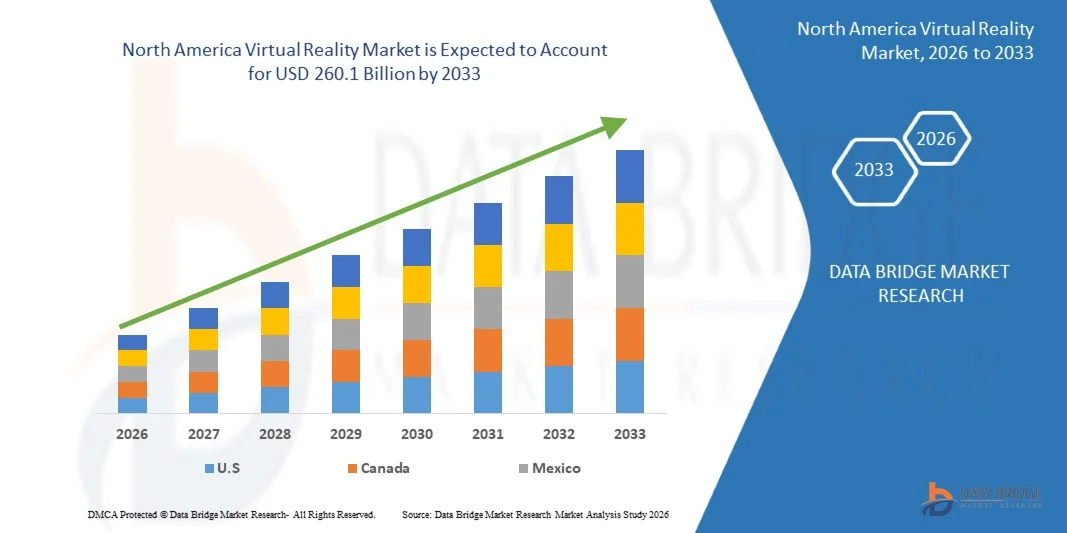
- As per Data Bridge Market Research analysis, the virtual reality market was valued at USD 35.2 Billion in 2025 and is projected to reach USD 260.1 Billion by 2033, growing at a CAGR of 28.5% from 2026 to 2033.
- The market is experiencing consistent growth driven by rising adoption of immersive technologies across gaming, entertainment, healthcare, education, retail, and enterprise applications, along with increasing investments in virtual reality hardware, software, and content development. The strong technology ecosystem and growing adoption of advanced virtual reality solutions across commercial and consumer applications are further supporting market expansion.
- The increasing use of virtual reality for training, simulation, product visualization, remote collaboration, and immersive entertainment, combined with advancements in head-mounted displays, motion tracking, graphics processing, and artificial intelligence, is enabling more realistic and interactive experiences. Expanding applications across enterprises and consumers are further accelerating the adoption of virtual reality solutions in North America.
Market Size & Forecast
- North America Market Value (2025): USD 35.2 Billion
- Expected Market Value (2033): USD 260.1 Billion
- Forecast CAGR (2026–2033): 28.5%
- Leading State in 2025: U.S.
- Fastest Growing State: Mexico
What are the Major Takeaways of the Virtual Reality Market?
- U.S. dominated the virtual reality market with the largest revenue share of 30.00% in 2025, supported by strong technology infrastructure, high adoption of immersive technologies, increasing enterprise digitalization, and widespread applications across gaming, healthcare, training, and entertainment.
- Mexico is expected to be the fastest-growing state at a CAGR of 28.87% from 2026 to 2033, fueled by rapid digitalization, expanding 5g connectivity, increasing investments in immersive technologies, growing gaming and entertainment industries, and rising adoption of virtual reality across enterprise applications.
- Hardware led the component category with a 54.55% revenue share in 2025, supported by increasing demand for headsets, sensors, controllers, and other specialized virtual reality hardware required to deliver immersive experiences.
- Software is expected to be the fastest-growing component segment during the forecast period, driven by increasing demand for virtual environments, immersive applications, simulation platforms, content development, and software solutions supporting enterprise and consumer VR applications.
- Standalone VR headsets dominated the device type category with a 54.55% revenue share in 2025, supported by their portability, simplified setup, wireless functionality, and growing consumer and enterprise adoption of untethered virtual reality experiences.
- Standalone VR headsets are expected to maintain strong growth during the forecast period, supported by continued improvements in display quality, processing capabilities, battery performance, wireless connectivity, and increasing demand for flexible VR experiences.
Report Scope and Virtual Reality Market Segmentation
|
Attributes |
Virtual Reality Key Market Insights |
|
Segments Covered |
|
|
Countries Covered |
North America
|
|
Key Market Players |
|
|
Market Opportunities |
|
|
Value Added Data Infosets |
In addition to the market insights such as market value, growth rate, market segments, geographical coverage, market players, and market scenario, the market report curated by the Data Bridge Market Research team includes in-depth expert analysis, import/export analysis, pricing analysis, production consumption analysis, and pestle analysis. |
What is the Key Trend in the Virtual Reality Market?
- Enterprises are increasingly adopting virtual reality and spatial computing across sectors such as healthcare, manufacturing, aviation, education, retail, and professional training to create immersive workspaces, simulations, product visualizations, and remote-assistance solutions. Apple reported that organizations are using Apple Vision Pro for design, training, sales, education, and other enterprise workflows.
- Artificial intelligence and machine learning are increasingly being integrated into virtual reality platforms to improve spatial awareness, hand tracking, content generation, natural-language interaction, and personalized immersive experiences. Apple has integrated Apple Intelligence and generative AI capabilities into Vision Pro, including AI-enabled spatial scenes and productivity features.
- For instance, in March 2025, Apple introduced Apple Intelligence on Apple Vision Pro through visionOS 2.4, adding features such as Writing Tools, Image Playground, and Genmoji, while also introducing Spatial Gallery for discovering immersive content.
- Virtual reality is increasingly being used for employee training, simulation, product design, and remote collaboration, as enterprises seek immersive alternatives to conventional training and visualization methods. Apple has highlighted applications involving specialized employee training, guided work, 3d design, and remote fieldwork on Vision Pro.
What are the Key Drivers of the Virtual Reality Market?
- Strong adoption of virtual reality in gaming and entertainment is driving market growth across North America, supported by a mature gaming ecosystem, increasing consumer demand for immersive experiences, and continued development of advanced VR headsets and interactive content.
- Increasing adoption of VR for enterprise training, simulation, design, and remote collaboration is creating new demand across manufacturing, aerospace, healthcare, education, and other industries. Enterprises are increasingly using immersive environments to provide simulated training, visualize products and processes, and support collaborative workflows.
- For instance, in June 2025, Apple announced new visionos 26 capabilities for Apple Vision Pro, highlighting enterprise applications across design, training, sales, and education. The company also introduced enhanced enterprise APIs and device-management capabilities to support organizational deployment of spatial computing solutions.
- Growing integration of virtual reality into healthcare and medical training is further supporting market expansion, as VR and spatial computing enable immersive surgical training, medical visualization, rehabilitation, and education. Apple highlights applications of Vision Pro in surgical planning, procedural training, medical imaging, and healthcare education.
- Expansion of education and immersive learning applications is also contributing to demand, as VR enables students and trainees to interact with simulated environments and complex concepts through hands-on experiences. For instance, in February 2025, Meta made its Meta for Education offering generally available, providing educational institutions with managed mixed and virtual reality experiences through Meta Quest devices.
Which Factors are Challenging the Growth of the Virtual Reality Market?
- High initial costs of VR hardware and supporting infrastructure can limit adoption, particularly for price-sensitive consumers and small and medium-sized enterprises. Although standalone devices are becoming more accessible, advanced headsets and enterprise-grade VR systems still require significant investment.
- Privacy and cybersecurity concerns are increasing as VR systems collect sensitive information through eye tracking, hand movements, body movements, voice interactions, behavioral data, and other sensor inputs. These concerns can become particularly important for healthcare, enterprise, and commercial applications where confidential information is processed. The U.S. Government Accountability Office has identified cybersecurity and privacy as key challenges associated with extended-reality technologies.
- Limited availability of high-quality and application-specific VR content can constrain user engagement and enterprise adoption. Developing immersive content requires specialized developers, 3d assets, testing, and continuous software updates, increasing development complexity and costs. Apple has continued expanding enterprise APIs and spatial experiences for design, training, education, and other business applications, highlighting the need for specialized content and software ecosystems to support broader adoption.
- Technical limitations and interoperability issues involving battery life, processing requirements, connectivity, tracking accuracy, device compatibility, and integration with existing enterprise systems can restrict deployment. As VR applications expand across healthcare, manufacturing, education, and enterprise training, organizations increasingly require reliable hardware, software compatibility, and supporting infrastructure to achieve consistent performance.
- Data privacy and regulatory requirements can further increase the complexity of VR deployment because immersive platforms can capture extensive biometric and behavioral information.
How is the Virtual Reality Market Segmented?
The North America virtual reality market is segmented on the basis of component, device type, application, and end-user.
- By Component
On the basis of component, the North America virtual reality market is segmented into hardware, software, and content. The hardware segment dominated the market with 54.55% share in 2025, owing to increasing demand for virtual reality headsets, sensors, controllers, displays, and other physical devices required to deliver immersive experiences. The growing adoption of standalone VR headsets across gaming, entertainment, training, healthcare, and enterprise applications is further supporting hardware demand. Advancements in display technologies, processing capabilities, tracking systems, and haptic devices are also contributing to segment expansion.
The content segment is expected to be the fastest-growing component during the forecast period with CAGR of 6.54% in 2026 t0 2033, supported by increasing demand for immersive games, simulations, virtual training environments, digital experiences, and interactive VR applications. The integration of artificial intelligence, cloud technologies, and advanced 3d content creation is further expanding opportunities for VR content providers.
- By Device Type
On the basis of device type, the North America virtual reality market is segmented into standalone VR headsets, tethered VR headsets, and smartphone-based VR. The standalone VR headsets segment dominated the market with 54.55% share in 2025, supported by increasing consumer preference for wireless and portable VR devices that do not require continuous connection to a personal computer or gaming console. Improvements in processing power, display quality, battery performance, and tracking capabilities are further supporting adoption.
The standalone VR headsets segment is expected to maintain strong growth during the forecast period CAGR of 5.45% in 2026 to 2033, driven by continued product innovation, expanding gaming and entertainment applications, and increasing enterprise adoption for training, simulation, and collaboration.
- By Application
On the basis of application, the North America virtual reality market is segmented into gaming & entertainment, education & training, healthcare, retail & e-commerce, manufacturing & design, tourism & travel, real estate, and others. The gaming & entertainment segment dominated the market with 36.74% share in 2025, supported by strong consumer demand for immersive gaming experiences, interactive entertainment, VR-native content, and location-based virtual reality. The expansion of gaming platforms and availability of advanced standalone headsets are further supporting segment growth.
The education & training and healthcare applications are expected to witness strong growth during the forecast period of CAGR 5.43% in 2026 to 2033, driven by increasing adoption of VR for immersive learning, employee training, medical education, rehabilitation, simulation, and professional skill development. Manufacturing and design applications are also expanding through the use of virtual prototyping, product visualization, engineering simulation, and collaborative design environments.
- By End-User
On the basis of end-user, the North America virtual reality market is segmented into consumer, enterprise, and commercial. The consumer segment includes individual users adopting VR devices primarily for gaming, entertainment, social experiences, and other immersive applications with share of 54.245 in 2025. The enterprise segment covers applications across employee training, simulation, design, collaboration, healthcare, manufacturing, and other business functions. The commercial segment includes VR applications deployed in entertainment venues, retail environments, tourism, real estate, and other customer-facing settings.
The enterprise are expected to witness strong growth during the forecast period of CAGR 7.43% in 2026 to 2033, driven by increasing adoption of VR for immersive learning, employee training, medical education, rehabilitation, simulation, and professional skill development. Manufacturing and design applications are also expanding through the use of virtual prototyping, product visualization, engineering simulation, and collaborative design environments.
Which State Holds the Largest Share of the Virtual Reality Market?
- U.S. dominated the virtual reality market with the largest revenue share of 37.10% in 2025, supported by advanced digital infrastructure, strong insurtech penetration, and widespread adoption of usage-based insurance products.
- Mexico is expected to be the fastest-growing state at a CAGR of 28.87% from 2026 to 2033 , strong consumer acceptance of mobile-based financial services, and a large gig-economy workforce requiring flexible, activation-based coverage. The presence of leading insurtech providers and supportive regulatory frameworks is further strengthening digital policy issuance and personalized insurance offerings
U.S. Virtual Reality Market Insight
The U.S. virtual reality market is witnessing strong growth, supported by rising adoption across gaming, entertainment, healthcare, education, automotive, retail, and enterprise applications. The country benefits from a well-established technology ecosystem, substantial investments in VR hardware and software, and the presence of numerous startups and technology companies developing immersive solutions. Growing demand for virtual training, simulation, healthcare applications, and interactive digital experiences is further supporting market expansion.
Mexico Virtual Reality Market Insight
Mexico’s virtual reality market is expanding as digital infrastructure, consumer interest in immersive entertainment, and enterprise adoption continue to strengthen. Gaming and entertainment remain important applications, while manufacturing, automotive, technical training, education, and real estate are creating additional demand for VR solutions. Mexico’s growing technology ecosystem and improving connectivity are supporting broader adoption across businesses and consumers.
Canada Virtual Reality Market Insight
The Canada virtual reality market is experiencing steady growth, supported by increasing adoption of immersive technologies across gaming, entertainment, healthcare, education, training, retail, and enterprise applications. Growing investments in VR hardware, software, and content development are strengthening the market ecosystem, while advancements in standalone headsets, motion tracking, and immersive computing are improving user experiences. Healthcare institutions are increasingly using VR for medical education, rehabilitation, and simulation, while businesses are adopting the technology for workforce training, product visualization, and virtual collaboration. Rising interest in immersive entertainment and technological innovation is expected to further support market expansion across Canada.
Which are the Top Companies in Virtual Reality Market?
The Virtual Reality industry is primarily led by well-established companies, including:
- Meta Platforms, Inc. (U.S.)
- Apple Inc. (U.S.)
- Microsoft Corporation (U.S.)
- Google LLC (U.S.)
- NVIDIA Corporation (U.S.)
- Qualcomm Incorporated (U.S.)
- Unity Software Inc. (U.S.)
- Magic Leap, Inc. (U.S.)
- Vuzix Corporation (U.S.)
- Valve Corporation (U.S.)
- EON Reality, Inc. (U.S.)
- HP Inc. (U.S.)
- HaptX Inc. (U.S.)
- Immersion Corporation (U.S.)
- StriVR Labs, Inc. (U.S.)
What are Latest Developments in Virtual Reality Market?
- In January 2025, Google agreed to acquire part of HTC’s XR business for USD 250 million, including engineering talent and non-exclusive intellectual property rights, to accelerate development of its Android XR platform.
- In April 2025, Meta released the Passthrough Camera API for Quest 3 and Quest 3S, enabling developers to build applications using camera-based object tracking, machine learning, and computer vision.
- In June 2025, Apple announced visionOS 26 for Apple Vision Pro, adding spatial widgets, generative-AI-powered spatial scenes, improved Personas, expanded immersive video support, and enterprise-focused APIs.
- In June 2025, Meta and Microsoft announced the Meta Quest 3S Xbox Edition, expanding the integration of Xbox Cloud Gaming with Meta Quest headsets and combining mixed-reality capabilities with Xbox gaming.
- In December 2024, Samsung continued developing Project Moohan, its Android XR headset developed in collaboration with Google and Qualcomm. The platform incorporates Gemini-based AI, multimodal interaction, passthrough capabilities, and immersive applications.

- Interactive Data Analysis Dashboard
- Company Analysis Dashboard for high growth potential opportunities
- Research Analyst Access for customization & queries
- Competitor Analysis with Interactive dashboard
- Latest News, Updates & Trend analysis
- Harness the Power of Benchmark Analysis for Comprehensive Competitor Tracking
Data collection and base year analysis are done using data collection modules with large sample sizes. The stage includes obtaining market information or related data through various sources and strategies. It includes examining and planning all the data acquired from the past in advance. It likewise envelops the examination of information inconsistencies seen across different information sources. The market data is analysed and estimated using market statistical and coherent models. Also, market share analysis and key trend analysis are the major success factors in the market report. To know more, please request an analyst call or drop down your inquiry.
The key research methodology used by DBMR research team is data triangulation which involves data mining, analysis of the impact of data variables on the market and primary (industry expert) validation. Data models include Vendor Positioning Grid, Market Time Line Analysis, Market Overview and Guide, Company Positioning Grid, Patent Analysis, Pricing Analysis, Company Market Share Analysis, Standards of Measurement, Global versus Regional and Vendor Share Analysis. To know more about the research methodology, drop in an inquiry to speak to our industry experts.
Data Bridge Market Research is a leader in advanced formative research. We take pride in servicing our existing and new customers with data and analysis that match and suits their goal. The report can be customized to include price trend analysis of target brands understanding the market for additional countries (ask for the list of countries), clinical trial results data, literature review, refurbished market and product base analysis. Market analysis of target competitors can be analyzed from technology-based analysis to market portfolio strategies. We can add as many competitors that you require data about in the format and data style you are looking for. Our team of analysts can also provide you data in crude raw excel files pivot tables (Fact book) or can assist you in creating presentations from the data sets available in the report.













