


Western Blotting Market Size
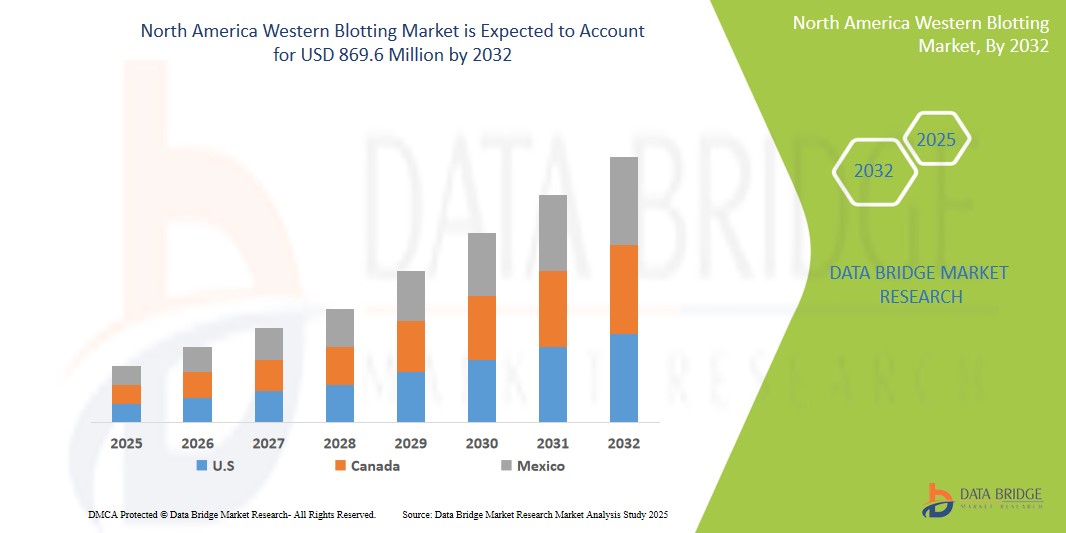
- The North America Western Blotting market size was valued at USD 592.6 million in 2024 and is expected to reach USD 869.6 million by 2032, at a CAGR of 4.90% during the forecast period
- The market growth is largely fueled by increasing proteomics research activities, the growing prevalence of chronic diseases, and advancements in detection technologies.
- The ongoing expansion of the biotechnology and pharmaceutical industries, coupled with the rising demand for personalized medicine, is further accelerating the adoption of western blotting techniques. These converging factors are significantly boosting the industry's growth.
Western Blotting Market Analysis
- Western blotting is a fundamental technique in molecular biology, used to detect specific proteins in a complex mixture. It involves separating proteins by size, transferring them to a membrane, and then using antibodies to identify the protein of interest. The technique's sensitivity and specificity have made it indispensable in various research areas.
- The escalating demand for western blotting is primarily fueled by the increasing focus on biomarker discovery, the need for accurate and reliable protein analysis, and the development of more efficient and high-throughput blotting systems.
- The U.S. dominates the Western Blotting market in North America, holding the largest revenue share of 84.6% in 2025, driven by its advanced biomedical research ecosystem, strong presence of academic and research institutions, and significant investments in proteomics and molecular biology. The widespread adoption of Western blotting in disease diagnostics, drug development, and antibody validation further reinforces the country’s leading position.
- The Canada is expected to be the fastest-growing country in the North America Western Blotting market during the forecast period. Growth is fueled by increasing demand for targeted and personalized therapies, rising incidence of chronic and infectious diseases, and growing applications of Western blotting in clinical diagnostics, especially for conditions like HIV, Lyme disease, and certain cancers. Moreover, the continuous launch of innovative and automated blotting systems by key players such as Bio-Rad, Thermo Fisher Scientific, and GE Healthcare enhances market performance by improving workflow efficiency and reproducibility.
- Consumable’s segment is expected to dominate the Western Blotting market with a market share of 47.62% in 2025, driven by the recurring need for reagents, antibodies, and membranes in western blotting procedures.
Report Scope and Western Blotting Market Segmentation
|
Attributes |
Western Blotting Key Market Insights |
|
Segments Covered |
|
|
Countries Covered |
North America
|
|
Key Market Players |
|
|
Market Opportunities |
|
|
Value Added Data Infosets |
In addition to the insights on market scenarios such as market value, growth rate, segmentation, geographical coverage, and major players, the market reports curated by the Data Bridge Market Research also include in-depth expert analysis, pricing analysis, brand share analysis, consumer survey, demography analysis, supply chain analysis, value chain analysis, raw material/consumables overview, vendor selection criteria, PESTLE Analysis, Porter Analysis, and regulatory framework. |
Western Blotting Market Trends
“Rising demand in drug discovery and development”
- A significant and accelerating trend in the western blotting market is the development and adoption of automated western blotting systems and high-throughput platforms. This evolution is significantly enhancing laboratory efficiency, reducing turnaround times, and improving the reproducibility of results.
- For instance, companies are developing automated systems that can perform all steps of the western blotting process, from protein separation to detection, in a single integrated platform. Similarly, the integration of software solutions for data analysis and reporting streamlines laboratory operations and facilitates the interpretation of complex results.
- The adoption of microfluidic technologies and multiplexing techniques enables high-throughput screening, which is crucial for processing large volumes of samples in proteomics research and drug discovery. Digitalization also allows for the seamless transfer of data to Laboratory Information Management Systems (LIMS), improving data integrity and accessibility.
- The seamless integration of automated western blotting systems with laboratory networks and digital platforms facilitates centralized control over experimental processes and enables real-time monitoring of equipment and workflows.
- This trend towards more automated and digitalized western blotting is fundamentally reshaping laboratory operations and quality control practices. Consequently, companies are investing in the development of advanced automation solutions and software platforms to meet the evolving needs of modern research and clinical laboratories.
- The demand for western blotting solutions that offer seamless automation and digital integration is growing rapidly across various industries, as researchers increasingly prioritize efficiency, accuracy, and data management capabilities.
Western Blotting Market Dynamics
Driver
“Increasing proteomics research”
- Growing Need Due to Rising Proteomics Research and Drug Discovery: The increasing emphasis on proteomics research and the growing demand for protein analysis in drug discovery and development are significant drivers for the heightened demand for western blotting.
- For instance, western blotting is extensively used to validate protein expression levels, confirm antibody specificity, and study protein-protein interactions. Similarly, in clinical diagnostics, western blotting plays a crucial role in the detection of disease biomarkers and the identification of infectious agents
- As researchers worldwide focus on understanding complex biological processes and developing novel therapeutics, the role of western blotting in providing accurate and reliable protein quantification becomes increasingly vital. This demand is further driven by the increasing prevalence of chronic diseases and the growing need for personalized medicine.
- Furthermore, technological advancements in western blotting, such as improved sensitivity, specificity, and ease of use, are making it an increasingly essential tool in life science research.
Restraint/Challenge
“Technical complexity of the procedure”
- Technical Complexity and Variability in Results: The western blotting procedure is technically demanding and can be prone to variability, which poses a significant challenge to broader market adoption.
- For instance, inconsistencies in sample preparation, transfer efficiency, and antibody performance can affect the accuracy and reproducibility of results. Similarly, the semi-quantitative nature of traditional western blotting can limit its use in applications requiring precise protein quantification.
- Addressing these technical challenges requires researchers to optimize experimental protocols, use validated reagents, and employ appropriate controls. The development of standardized protocols and guidelines, along with the availability of more robust and user-friendly systems, will be crucial for improving the reliability and reproducibility of western blotting.
- Moreover, the emergence of alternative protein analysis techniques, such as mass spectrometry and ELISA, presents a competitive challenge to western blotting, particularly in applications where high throughput and quantitative accuracy are essential.
- Overcoming these challenges through technological innovations, improved standardization, and enhanced user training will be vital for sustaining the widespread use of western blotting in life science research and clinical diagnostics.
Western Blotting Market Scope
The market is segmented on the basis product, application and end user.
- By Product
On the basis of Product, the Western Blotting market is segmented into consumables, instrument. The consumables segment dominates the largest market revenue share of 47.62% in 2025, driven by the recurring need for reagents, antibodies, and membranes in western blotting procedures. The routine nature of western blotting across various research and diagnostic applications ensures a consistent demand for consumables. The increasing volume of research activities and the growing number of western blotting assays performed globally fuel the growth of the consumables segment.
The instruments segment is anticipated to witness the fastest growth rate of 5.8% from 2025 to 2032 driven by the increasing adoption of advanced and automated western blotting systems. Instruments such as automated blot processors and imaging systems offer higher throughput, faster turnaround times, and improved reproducibility compared to traditional manual methods. The growing need for efficient and high-throughput protein analysis in research and clinical laboratories is driving the demand for these advanced instruments.
- By Application
On the basis of application, the Western Blotting market is segmented into into Biomedical and Biochemical Research, Disease Diagnostics, Agriculture, Others. The Biomedical and Biochemical Research held the largest market revenue share in 2025 driven by the widespread use of western blotting in various areas of life science research. Western blotting is a fundamental tool for studying protein expression, function, and interactions in academic and research institutions. The increasing funding for research activities and the growing number of publications citing western blotting contribute to the dominance of this segment.
The Disease Diagnostics is expected to witness the fastest CAGR from 2025 to 2032, driven by the increasing use of western blotting in the detection of disease biomarkers and the diagnosis of infectious diseases. Western blotting assays are used to confirm the presence of specific proteins associated with various diseases, enabling accurate and reliable diagnosis. The rising prevalence of chronic diseases and the growing demand for personalized medicine are fueling the growth of this segment.
- By End users
On the basis of end users, the Western Blotting market is segmented into Academic and Research Institutes, Pharmaceutical and Biotechnology Companies, Diagnostic Centers, Others. The Academic and Research Institutes segment accounted for the largest market revenue share in 2025 driven by the extensive use of western blotting in basic research and life science studies. Universities, research institutions, and government agencies employ western blotting techniques to investigate protein-related phenomena. The increasing funding for research activities and the growing emphasis on scientific discoveries contribute to the dominance of this segment.
The Pharmaceutical and Biotechnology Companies segment is expected to witness the fastest CAGR from 2025 to 2032, driven by the increasing use of western blotting in drug discovery, development, and quality control. Western blotting is employed to validate drug targets, assess protein expression levels, and ensure the quality of biopharmaceuticals. The expanding pharmaceutical and biotechnology industry, along with the growing investment in R&D, is fueling the growth of this segment.
Western Blotting Market Regional Analysis
- U.S. dominates the Western Blotting market with the largest revenue share of 84.6% in 2025, driven by the high volume of academic and clinical research, the increasing prevalence of chronic and infectious diseases, and strong funding support for proteomics and molecular biology studies.
- The presence of advanced laboratory infrastructure, coupled with initiatives by the National Institutes of Health (NIH) and other public and private bodies to support biomedical research, significantly boosts the demand for Western blotting systems and reagents.
- Moreover, leading biotechnology and pharmaceutical companies are heavily invested in the U.S., driving commercial use of Western blotting in drug development, target validation, and diagnostic research.
- The adoption of automated and digital Western blotting platforms is rising rapidly across academic and clinical labs, owing to their efficiency, reproducibility, and ease of use. The presence of major players like Bio-Rad, Thermo Fisher Scientific, and GE Healthcare further strengthens the U.S. market.
Canada Western Blotting Market Insight
The Canada Western Blotting market is projected to grow at a steady CAGR during the forecast period, fueled by expanding research activities in oncology, immunology, and virology, particularly within major research universities and healthcare institutions. Canada’s national strategy to invest in biomedical research, along with collaborative funding from organizations such as CIHR (Canadian Institutes of Health Research), is promoting the adoption of protein analysis techniques including Western blotting. With Health Canada's regulatory support and the integration of high-throughput automated blotting systems, the use of Western blotting in clinical labs and biotech firms is becoming increasingly standardized.
Mexico Western Blotting Market Insight
The Mexico Western Blotting market is expected to grow at a notable CAGR, driven by increasing investments in life sciences research, public health diagnostics, and biotechnology infrastructure. National health programs targeting diseases such as HIV, hepatitis, and cancer are incorporating Western blotting techniques as confirmatory tests, particularly in reference and academic laboratories. However, market growth is currently concentrated in urban research centers and private diagnostic labs, with limited access in rural regions due to infrastructure and training challenges.
Western Blotting Market Share
The Western Blotting industry is primarily led by well-established companies, including:
- Thermo Fisher Scientific (U.S.)
- Bio-Rad Laboratories (U.S.)
- Merck KGaA (Germany)
- GE Healthcare (U.S.)
- Roche Diagnostics (Switzerland)
- Abcam plc (U.K.)
- LI-COR Biosciences (U.S.)
- Cytiva (U.S.)
- PerkinElmer (U.S.)
- Takara Bio (Japan)
- BioLegend (U.S.)
- Cell Signaling Technology (U.S.)
- Santa Cruz Biotechnology (U.S.)
- Agilent Technologies (U.S.)
- Abnova Corporation (Taiwan)
Latest Developments in North America Western Blotting Market
- In March 2024, Thermo Fisher Scientific launched the iBlot 7 Western Blotting System, a new instrument designed to automate and accelerate the western blotting workflow. This innovative system offers improved speed, reproducibility, and ease of use, enhancing efficiency in research and clinical laboratories.
- In February 2024, Bio-Rad Laboratories introduced a new line of stain-free western blotting reagents, enabling faster visualization and quantification of proteins. These new reagents eliminate the need for traditional staining steps, reducing turnaround times and improving workflow efficiency.
- In January 2024, Merck KGaA announced a collaboration with a leading antibody manufacturer to develop highly specific and validated antibodies for western blotting applications. This collaboration aims to improve the reliability and reproducibility of western blotting assays.
- In December 2023, GE Healthcare launched a new high-resolution imaging system for western blotting, offering enhanced sensitivity and quantification capabilities. This advanced imaging system enables researchers to obtain more accurate and precise results.
- In November 2023, Roche Diagnostics expanded its portfolio of western blotting reagents with the launch of a new range of pre-optimized buffers and solutions. These ready-to-use reagents simplify the western blotting procedure and improve the consistency of results.

- Interactive Data Analysis Dashboard
- Company Analysis Dashboard for high growth potential opportunities
- Research Analyst Access for customization & queries
- Competitor Analysis with Interactive dashboard
- Latest News, Updates & Trend analysis
- Harness the Power of Benchmark Analysis for Comprehensive Competitor Tracking
Data collection and base year analysis are done using data collection modules with large sample sizes. The stage includes obtaining market information or related data through various sources and strategies. It includes examining and planning all the data acquired from the past in advance. It likewise envelops the examination of information inconsistencies seen across different information sources. The market data is analysed and estimated using market statistical and coherent models. Also, market share analysis and key trend analysis are the major success factors in the market report. To know more, please request an analyst call or drop down your inquiry.
The key research methodology used by DBMR research team is data triangulation which involves data mining, analysis of the impact of data variables on the market and primary (industry expert) validation. Data models include Vendor Positioning Grid, Market Time Line Analysis, Market Overview and Guide, Company Positioning Grid, Patent Analysis, Pricing Analysis, Company Market Share Analysis, Standards of Measurement, Global versus Regional and Vendor Share Analysis. To know more about the research methodology, drop in an inquiry to speak to our industry experts.
Data Bridge Market Research is a leader in advanced formative research. We take pride in servicing our existing and new customers with data and analysis that match and suits their goal. The report can be customized to include price trend analysis of target brands understanding the market for additional countries (ask for the list of countries), clinical trial results data, literature review, refurbished market and product base analysis. Market analysis of target competitors can be analyzed from technology-based analysis to market portfolio strategies. We can add as many competitors that you require data about in the format and data style you are looking for. Our team of analysts can also provide you data in crude raw excel files pivot tables (Fact book) or can assist you in creating presentations from the data sets available in the report.













