


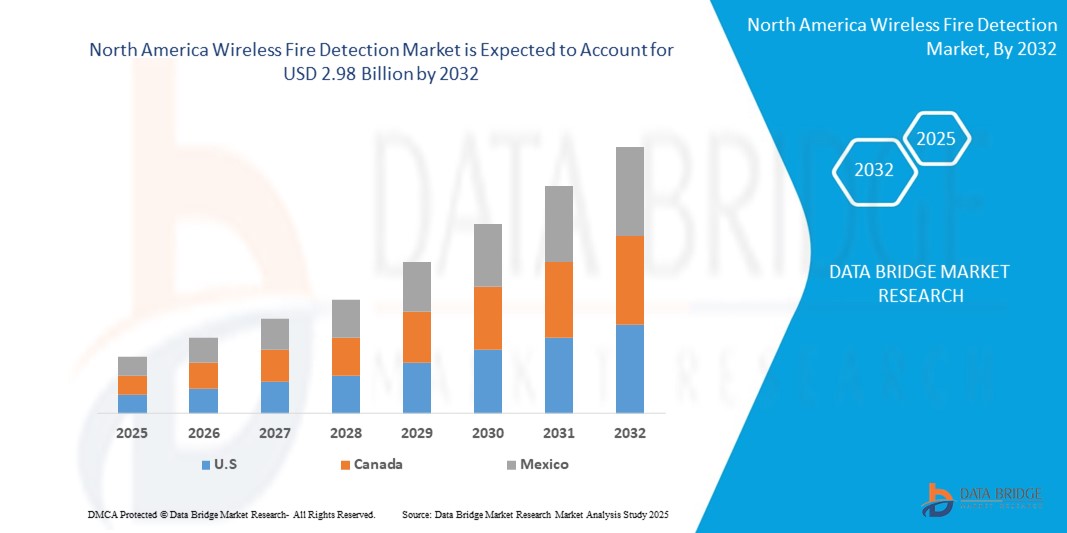
Wireless Fire Detection Market Size – North America
- The North America Wireless Fire Detection Market was valued at USD 1.26 billion in 2025 and is projected to reach USD 2.98 billion by 2032, growing at a CAGR of 13.08% during the forecast period.
- This growth is driven by increasing investments in smart building infrastructure, rising demand for wireless safety technologies in retrofit projects, and stricter regional fire safety regulations across commercial and residential spaces in the U.S., Canada, and Mexico. The flexibility, cost-efficiency, and ease of installation of wireless fire detection systems continue to replace traditional wired systems across urban and industrial sectors.
Wireless Fire Detection Market Analysis – North America
- Wireless fire detection systems use radio frequency (RF) communication to transmit signals between detectors, control panels, and alarm devices, offering a scalable and cable-free solution for fire safety. These systems are especially beneficial in retrofit scenarios, heritage buildings, or complex architectural spaces where wired installation is impractical or costly.
- The U.S. leads the North American market, driven by NFPA codes, smart city initiatives, and widespread adoption in high-rise buildings, healthcare facilities, and educational campuses. Canada follows with growing investments in intelligent fire detection in commercial and multi-residential properties.
- Commercial and industrial sectors remain dominant in 2025 due to their large-scale safety compliance needs, while residential applications are rapidly expanding due to rising awareness, insurance incentives, and the integration of fire detection with home automation systems.
- Advances in multi-sensor technology, lithium battery longevity, mesh networking, and IoT-enabled control panels are enhancing the performance and reliability of wireless fire systems. As North American cities prioritize life safety technologies, wireless solutions are increasingly seen as a critical part of building automation and smart infrastructure design.
Report Scope and North America Wireless Fire Detection Market Segmentation
|
Attributes |
North America Wireless Fire Detection Market Key Insights |
|
Segments Covered |
By Product Type : Smoke Detectors, Heat Detectors, Multi-Sensor Detectors, Control Panels, Modules & Accessories.
|
|
Countries Covered |
North America
|
|
Key Market Players |
|
|
Market Opportunities |
|
|
Value Added Data Infosets |
In addition to insights on market value, CAGR, segmentation, and regional breakdown, the North America Wireless Fire Detection Market report includes detailed analysis of NFPA code updates, UL/ULC certification trends and retrofit installation benchmarks across various building types. The report also features signal range testing metrics, battery performance lifecycle assessments, and wireless vs. wired ROI comparisons in both residential and commercial deployments. Case studies highlight multi-sensor adoption in hospitals, mesh network scalability in high-rises and IoT integration with building automation systems. Strategic tools such as PESTLE Analysis, Porter’s Five Forces, and regional fire safety incentive policy reviews are provided to help stakeholders evaluate regulatory impact, supplier dynamics, and investment feasibility across North American jurisdictions. |
North America Wireless Fire Detection Market Trends
“Smart Integration and Multi-Sensor Advancements Drive Wireless Fire Adoption”
- A key trend in the North America wireless fire detection market is the integration of wireless detectors with smart building systems, allowing real-time data sharing, cloud connectivity, and remote alerts through IoT platforms and mobile apps.
- Leading providers such as Honeywell, Siemens, and Johnson Controls are equipping their wireless detectors with multi-sensor capabilities that combine smoke, heat, and CO detection to reduce false alarms and improve accuracy.
- Adoption of mesh networking architectures is growing, enabling systems to maintain signal strength and reliability even in complex or multi-floor environments.
- Wireless fire systems are also being integrated with energy management and security platforms, creating unified safety ecosystems in commercial buildings, hospitals, and educational institutions.
- In the residential sector, demand is increasing for battery-operated, app-connected detectors that offer voice alerts, self-diagnostics, and inter-device communication, driven by growing awareness and home automation trends across the U.S. and Canada.
- These advancements are transforming wireless fire detection from a niche retrofit option into a mainstream, code-compliant life safety solution across North America.
Market Dynamics – North America Wireless Fire Detection Market
Driver
“Favorable Building Codes, Smart Infrastructure, and Growing Retrofit Demand Fuel Adoption”
- The growing enforcement of fire safety regulations across commercial, residential, and institutional buildings is a major driver propelling the adoption of wireless fire detection systems across North America. Cities and municipalities are updating codes such as NFPA 72 and UL 268 to mandate more responsive, scalable, and technology-driven safety systems.
- Building owners and operators are increasingly choosing wireless fire detection for retrofit projects, where the installation of wired systems would be costly or disruptive. This is especially relevant in older high-rise buildings, healthcare institutions, and heritage properties where structural modifications are limited.
- Leading players such as Honeywell, Johnson Controls, and Siemens are innovating to offer multi-sensor wireless detectors, extended battery life, and seamless integration with smart building platforms—allowing centralized monitoring and cloud-based alert management.
- Additionally, the demand for cost-effective, quick-to-install, and low-maintenance systems is increasing among schools, retail centers, and government facilities, where uptime and compliance are critical. As building automation expands across North America, wireless fire detection is becoming an essential layer of intelligent infrastructure.
Restraint/Challenge
“Perceived Reliability Risks and Signal Interference in Complex Structures”
- A key challenge limiting broader adoption of wireless fire detection systems is the perceived reliability risk compared to traditional wired alternatives. Concerns about signal dropout, latency and battery failure in mission-critical environments like hospitals or data centers contribute to hesitation among some stakeholders.
- In high-density or complex architectural environments—such as large commercial complexes, concrete-intensive structures, or underground facilities—RF signal propagation can be inconsistent, requiring advanced planning, testing, and sometimes hybrid systems to maintain coverage integrity.
- Furthermore, education and training gaps among installers and facility managers regarding wireless configuration, network maintenance and interference mitigation pose barriers to confident adoption—especially in facilities with legacy equipment or no prior experience with wireless systems.
- To overcome these restraints, vendors must continue to invest in robust signal reliability, long-range mesh networking and auto-calibration technologies. Industry growth also depends on efforts to standardize performance testing, provide hands-on training, and demonstrate long-term cost savings compared to wired alternatives.
Wireless Fire Detection Market Scope – North America
The market is segmented on the basis of product type, system type, installation type, and end user.
• By Product Type
The wireless fire detection market in North America includes smoke detectors, heat detectors, multi-sensor detectors, control panels, and modules & accessories.
Smoke detectors dominate in 2025 due to widespread code requirements for residential and commercial properties. However, multi-sensor detectors are gaining momentum for their ability to reduce false alarms and enhance accuracy, especially in healthcare, education, and industrial settings.
• By System Type
System types include fully wireless systems and hybrid wireless systems.
Hybrid systems lead in terms of market share in 2025, particularly in large commercial installations where combining existing wired infrastructure with wireless expansions offers flexibility and cost-effectiveness. Fully wireless systems are seeing rapid growth in retrofit projects and residential applications.
• By Installation Type
This includes new installations and retrofits.
Retrofit installations dominate in 2025, supported by growing demand in older buildings, historical landmarks, and multi-unit residential properties where rewiring is disruptive or cost-prohibitive. New installations, particularly in smart commercial buildings and infrastructure projects, are driving adoption of advanced IoT-compatible wireless systems.
• By End User
End users include residential, commercial, industrial, government, education, healthcare, and others.
The commercial sector leads the market due to fire code compliance needs across office buildings, malls, and retail complexes. Meanwhile, the residential segment is expected to grow fastest, fueled by increased smart home integration, renter-friendly wireless systems, and regulatory incentives.
Regional Insights
United States
The U.S. holds the largest share of the North America wireless fire detection market in 2025, driven by strict adherence to NFPA codes, widespread adoption of smart building technologies, and a mature ecosystem of safety equipment manufacturers.
Wireless fire systems are being widely adopted across commercial buildings, healthcare facilities, airports, and multifamily housing, with increasing integration into IoT platforms for real-time alerting and diagnostics.
Canada
Canada is witnessing strong growth due to updated CAN/ULC-S524 and CAN/ULC-S537 standards for fire alarm systems, along with growing investments in public infrastructure and smart city projects.
Wireless systems are gaining traction in multi-unit residences, campuses, and heritage buildings, where retrofitting wired solutions is expensive or structurally disruptive.
Mexico
Mexico represents an emerging market, with rising demand for wireless fire systems in newly constructed commercial spaces, industrial parks, and urban redevelopment zones.
Government-led initiatives to modernize building codes and infrastructure safety are encouraging adoption, particularly in areas with rising real estate activity and foreign investment.
Wireless Fire Detection Market Share – North America
The competitive landscape includes insights into product portfolios, regional market penetration, regulatory certifications, innovation pipelines and system integration capabilities. Market share is shaped by each company's ability to deliver compliant, scalable, and interoperable fire detection systems that meet evolving building safety codes across both retrofit and new installations.
Companies like Honeywell, Johnson Controls and Siemens lead due to their broad North American footprint, multi-sensor technology leadership, and strong alignment with NFPA and UL standards. These vendors provide full-suite platforms combining wireless detectors, control panels, remote monitoring and smart building integration tools.
Meanwhile, regional specialists and emerging providers are gaining momentum by delivering code-compliant, easy-to-deploy solutions tailored for educational institutions, residential towers and heritage building retrofits—especially where wired systems are impractical. These vendors are also introducing mesh-enabled networks, long-life battery solutions and mobile diagnostics tools to improve installer and facility manager confidence.
The following companies are recognized as major players in the North America Wireless Fire Detection market:
• Honeywell International Inc. (US)
• Johnson Controls (US/Ireland)
• Siemens AG (Germany – North American operations)
• Bosch Security Systems (Germany – US presence)
• Hochiki America Corporation (US)
• Kidde Fire Systems (US)
• Space Age Electronics, Inc. (US)
• Napco Security Technologies, Inc. (US)
• Fike Corporation (US)
• Halma plc / Apollo Fire Detectors Ltd. (UK – US division)
Latest Developments in Global Precision Harvesting Market
- In April 2025, Honeywell International Inc. launched its next-gen wireless fire detector line, featuring IoT-enabled monitoring, AI-powered false alarm reduction, and compatibility with Honeywell’s cloud-based life safety platform.
- In March 2025, Johnson Controls announced the expansion of its Hybrid Fire Detection System in North America, combining wired and wireless detectors for flexible deployment in large commercial buildings.
- In February 2025, Hochiki America introduced an updated mesh-network wireless fire panel that integrates with mobile apps and building management systems, aimed at simplifying retrofits in commercial and healthcare environments.
- In January 2025, Bosch Security Systems rolled out new battery-optimized smoke sensors for wireless environments, reducing maintenance needs in office towers and large institutions.
- In December 2024, Siemens announced a strategic collaboration with a major North American real estate developer to install fully wireless fire detection systems across 30+ smart buildings under construction by 2027.

- Interactive Data Analysis Dashboard
- Company Analysis Dashboard for high growth potential opportunities
- Research Analyst Access for customization & queries
- Competitor Analysis with Interactive dashboard
- Latest News, Updates & Trend analysis
- Harness the Power of Benchmark Analysis for Comprehensive Competitor Tracking
North America Wireless Fire Detection Market, Supply Chain Analysis and Ecosystem Framework
To support market growth and help clients navigate the impact of geopolitical shifts, DBMR has integrated in-depth supply chain analysis into its North America Wireless Fire Detection Market research reports. This addition empowers clients to respond effectively to global changes affecting their industries. The supply chain analysis section includes detailed insights such as North America Wireless Fire Detection Market consumption and production by country, price trend analysis, the impact of tariffs and geopolitical developments, and import and export trends by country and HSN code. It also highlights major suppliers with data on production capacity and company profiles, as well as key importers and exporters. In addition to research, DBMR offers specialized supply chain consulting services backed by over a decade of experience, providing solutions like supplier discovery, supplier risk assessment, price trend analysis, impact evaluation of inflation and trade route changes, and comprehensive market trend analysis.
Data collection and base year analysis are done using data collection modules with large sample sizes. The stage includes obtaining market information or related data through various sources and strategies. It includes examining and planning all the data acquired from the past in advance. It likewise envelops the examination of information inconsistencies seen across different information sources. The market data is analysed and estimated using market statistical and coherent models. Also, market share analysis and key trend analysis are the major success factors in the market report. To know more, please request an analyst call or drop down your inquiry.
The key research methodology used by DBMR research team is data triangulation which involves data mining, analysis of the impact of data variables on the market and primary (industry expert) validation. Data models include Vendor Positioning Grid, Market Time Line Analysis, Market Overview and Guide, Company Positioning Grid, Patent Analysis, Pricing Analysis, Company Market Share Analysis, Standards of Measurement, Global versus Regional and Vendor Share Analysis. To know more about the research methodology, drop in an inquiry to speak to our industry experts.
Data Bridge Market Research is a leader in advanced formative research. We take pride in servicing our existing and new customers with data and analysis that match and suits their goal. The report can be customized to include price trend analysis of target brands understanding the market for additional countries (ask for the list of countries), clinical trial results data, literature review, refurbished market and product base analysis. Market analysis of target competitors can be analyzed from technology-based analysis to market portfolio strategies. We can add as many competitors that you require data about in the format and data style you are looking for. Our team of analysts can also provide you data in crude raw excel files pivot tables (Fact book) or can assist you in creating presentations from the data sets available in the report.













