Poland HVAC Market Overview
The Poland HVAC market size was valued at USD 1.62 billion in 2025 and is projected to reach USD 2.58 billion by 2033, growing at a CAGR of 6.1% from 2026 to 2033. The market is witnessing growth due to rising construction activity, increasing renovation of residential buildings, growing adoption of heat pumps, and stricter energy-efficiency regulations.
Furthermore, increasing investments in commercial infrastructure, smart building technologies, and decarbonization initiatives are supporting long-term market expansion.
Key Market Trends & Insights
- The Poland HVAC market is experiencing steady growth, driven by increasing demand for energy-efficient heating, ventilation, and air conditioning solutions across residential, commercial, and industrial sectors. Rising energy costs, stringent European Union energy-efficiency regulations, and growing awareness regarding sustainable building practices are encouraging consumers and businesses to replace conventional HVAC systems with advanced, energy-saving alternatives.
- Government incentives for heat pumps and building energy modernization are accelerating HVAC installations.
- Rising adoption of smart HVAC controls, IoT-enabled systems, and advanced ventilation technologies is improving system efficiency and indoor air quality.
- Commercial buildings, logistics facilities, data centers, and industrial projects are creating additional demand for advanced HVAC solutions.
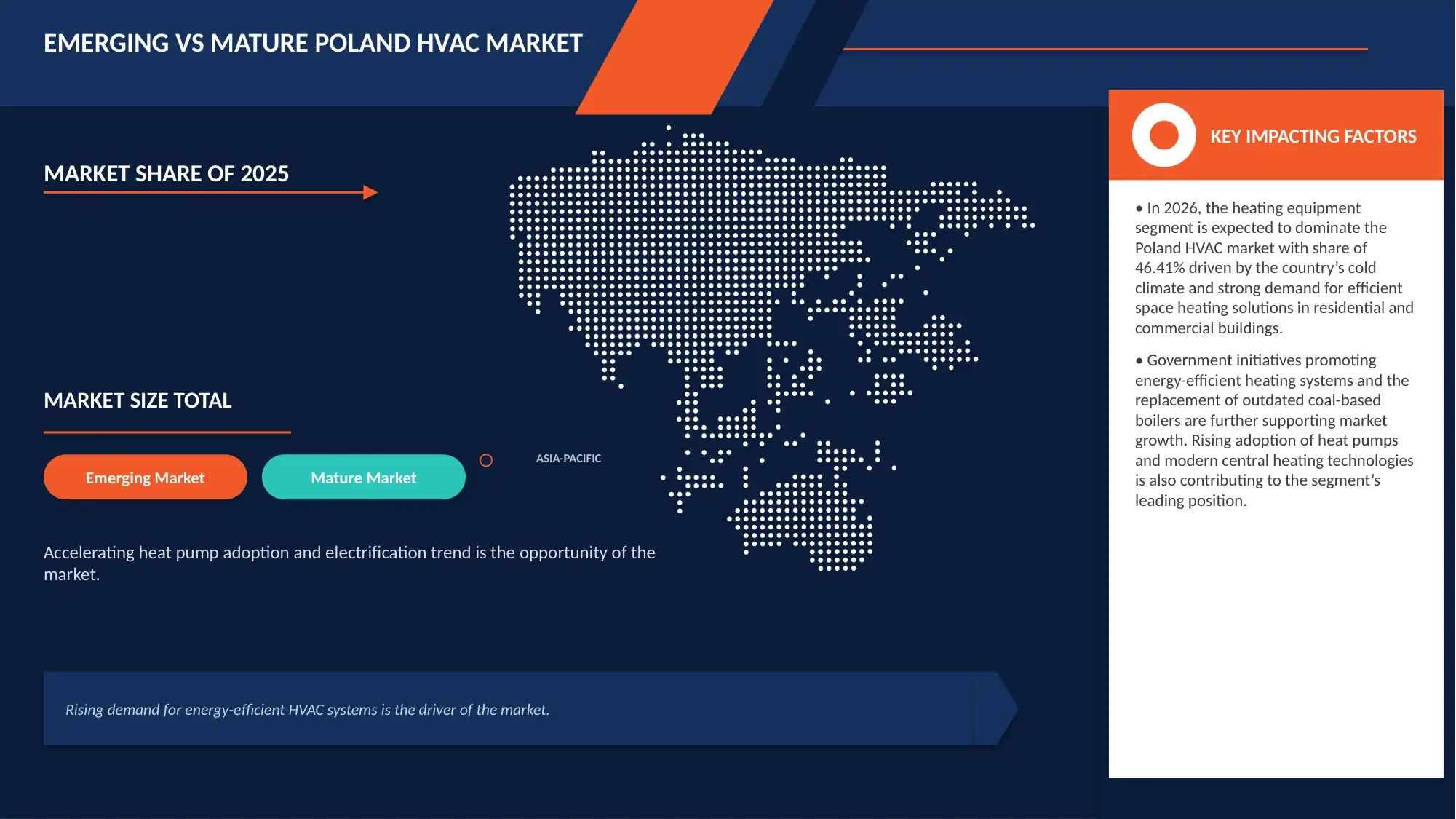
- In 2025, the Heating Equipment segment dominates the Poland HVAC market with 46.38% share, accounting for the largest share due to the country’s long heating season, cold climatic conditions, and strong replacement demand for aging heating infrastructure. The increasing deployment of heat pumps, condensing boilers, district heating integration technologies, and other high-efficiency heating systems is further strengthening segment growth.
Market Size & Forecast
- Global Market Value (2025): USD 1.62 Billion
- Expected Market Value (2033): USD 2.58 Billion
- Forecast CAGR (2026–2033): 6.1%
Report Scope and Poland HVAC Market Segmentation
|
Attributes |
Poland HVAC Market |
|
Segments Covered |
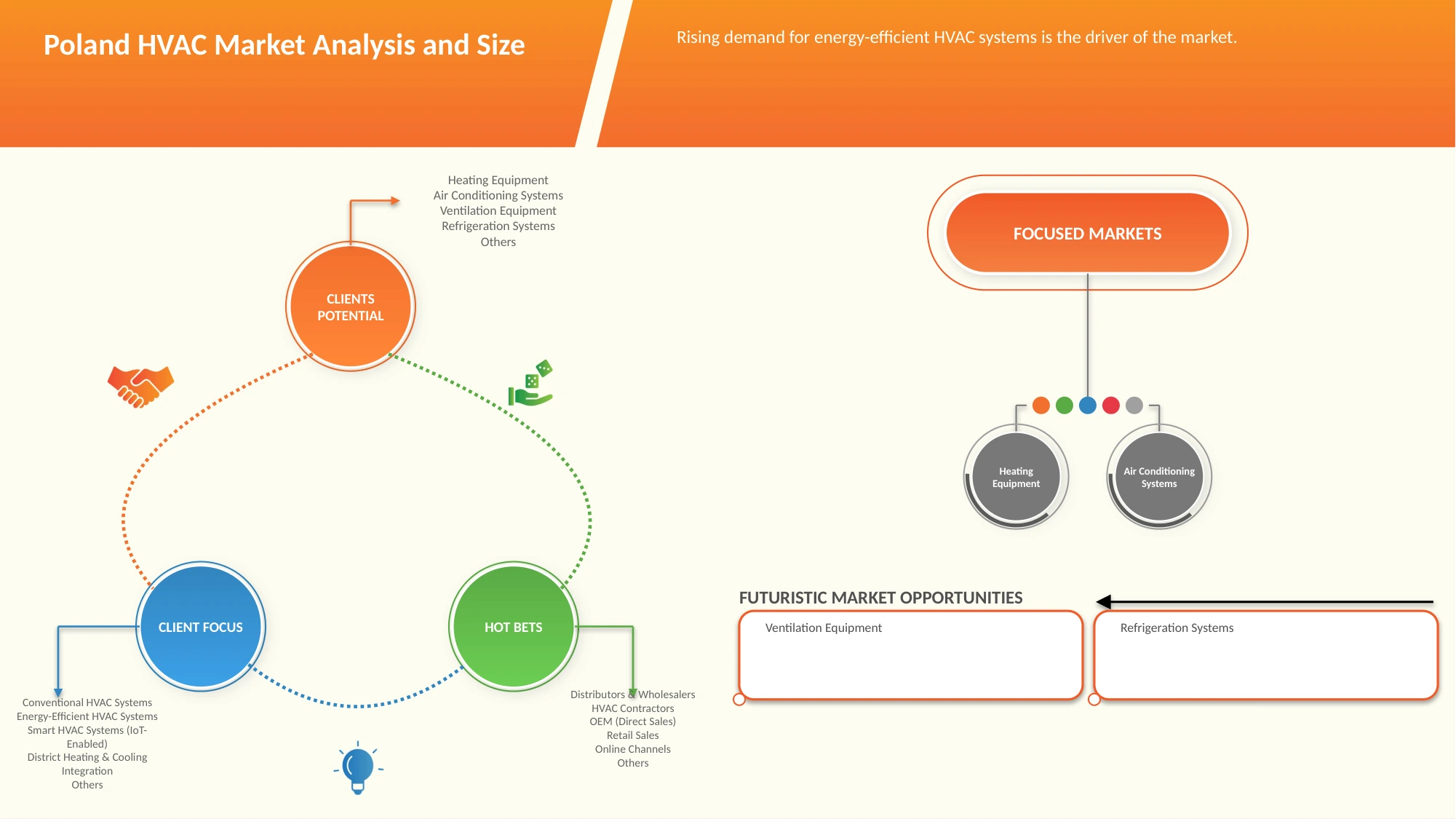
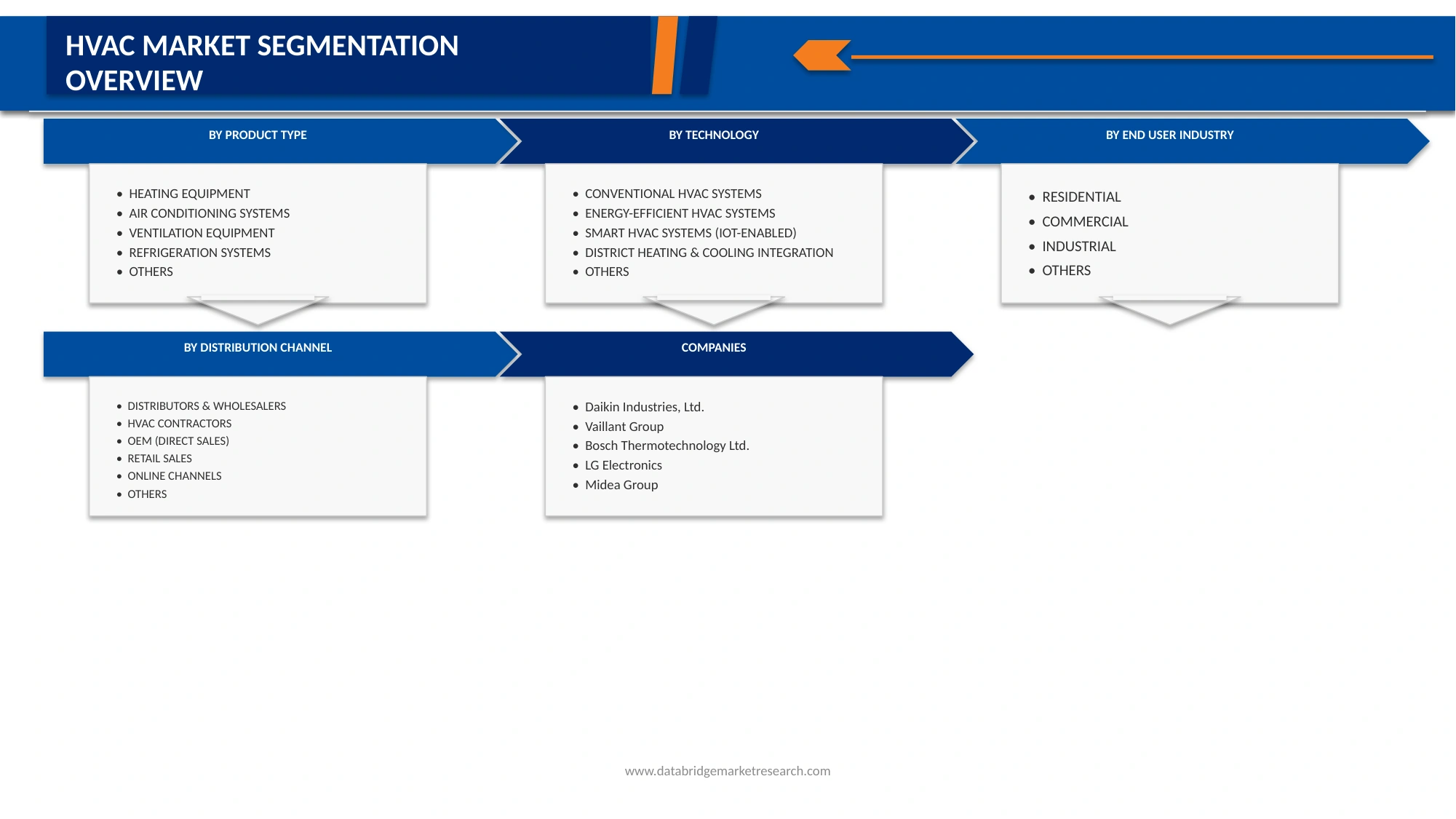
· By Product Type: Heating Equipment, Air Conditioning Systems, Ventilation Equipment and Refrigeration Systems · By End User: Residential, Commercial, Industrial and Others · By Technology: Conventional HVAC Systems, Energy-Efficient HVAC, Smart HVAC Systems (IoT-Enabled), District Heating & Cooling Integration and Others · By Distribution Channel: Distributors & Wholesalers, HVAC Contractors, OEM (Direct Sales), Retail Sales, Online Channels and Others |
|
Countries Covered |
· Poland |
|
Key Market Players |
· Daikin Industries, Ltd. (Japan) · Vaillant Group (Germany) · Bosch Thermotechnology Ltd. (U.K.) · LG Electronics (South Korea) · Midea Group (China) · Cooper&Hunter (U.S.) · GREE Electric Appliances Inc. (China) · VBW Engineering sp. z o.o. (Poland) · Klimor (Poland) · Flexit AS (Norway) · Samsung (South Korea) |
|
Market Opportunities |
· Accelerating Heat Pump Adoption and Electrification Trend · Growing Adoption of Smart and Connected HVAC Technologies |
|
Value Added Data Infosets |
In addition to the insights on market scenarios such as market value, growth rate, segmentation, geographical coverage, and major players, the market reports curated by the Data Bridge Market Research also include in-depth expert analysis, pricing analysis, brand share analysis, consumer survey, demography analysis, supply chain analysis, value chain analysis, raw material/consumables overview, vendor selection criteria, PESTLE Analysis, Porter Analysis, and regulatory framework. |
Poland HVAC Market Trends
Trend: Rising Demand for Energy-Efficient HVAC Systems
Growing adoption of heat pumps and low-carbon heating technologies as consumers and businesses seek to reduce energy costs, improve efficiency, and comply with decarbonization targets. Increasing integration of smart thermostats, IoT-enabled HVAC controls, and building automation systems to enable real-time monitoring, predictive maintenance, and optimized energy consumption. Rising focus on indoor air quality (IAQ) is driving demand for advanced ventilation systems, air purification technologies, and heat recovery solutions across residential, commercial, and institutional buildings. Expansion of green building developments and energy-efficient construction projects is supporting the deployment of high-performance HVAC systems that meet EU sustainability and environmental standards. Strong replacement demand for aging HVAC infrastructure is encouraging upgrades to modern, energy-efficient heating, cooling, and ventilation equipment with enhanced performance and lower operating costs.
Poland HVAC Market Dynamics
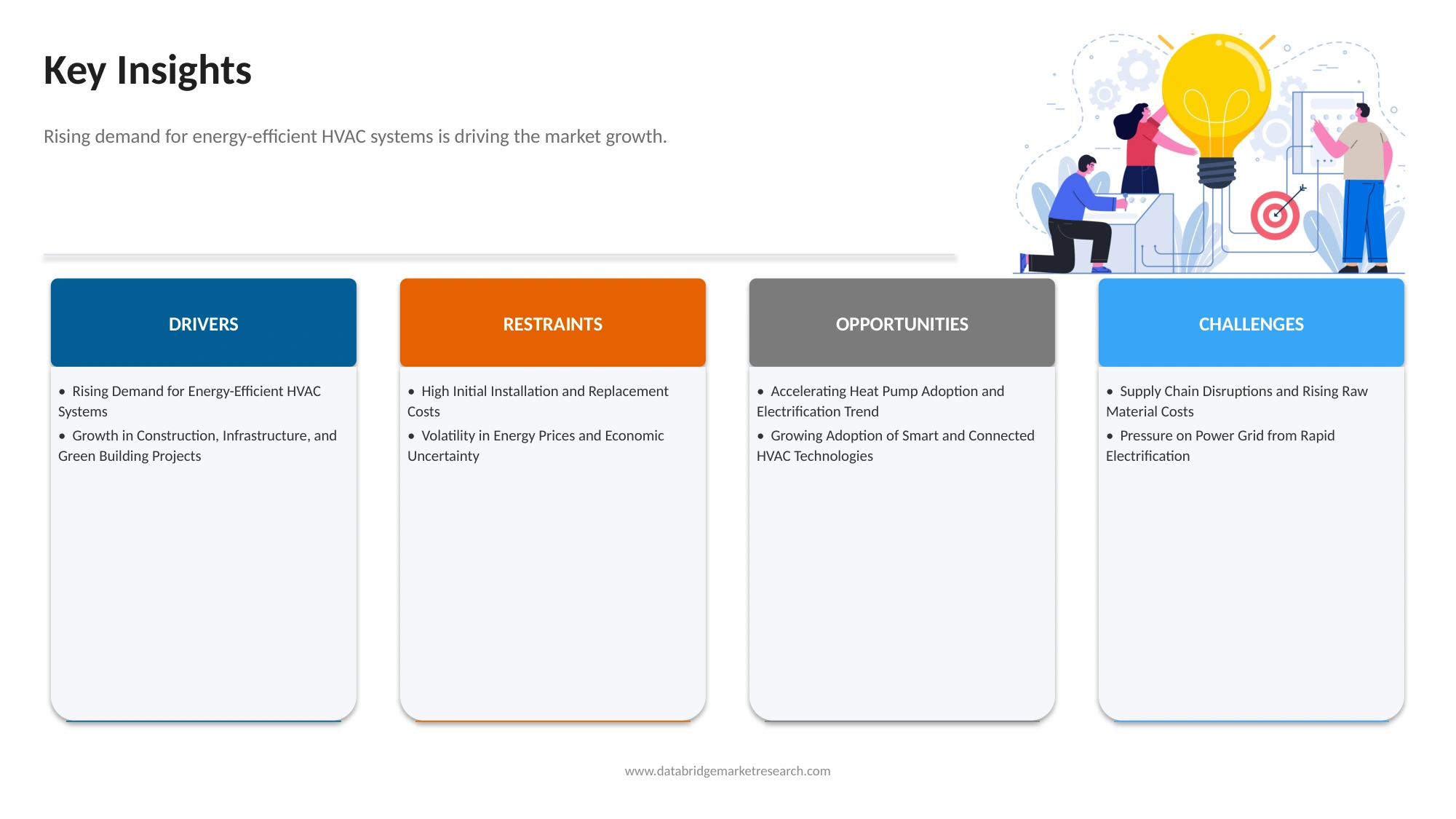
Key Market Driver: Rising Demand for Energy-Efficient HVAC Systems
The rising demand for energy-efficient HVAC systems has emerged as a major growth driver for the Poland HVAC market, supported by stricter European energy-efficiency regulations, increasing building renovation activities, and the country’s transition toward low-emission heating technologies. Poland’s building stock is among the oldest and least energy-efficient in Europe, with a large proportion of residential and commercial buildings constructed before modern insulation standards were introduced. As energy costs continue to rise and decarbonization targets become more stringent, consumers, businesses, and public authorities are increasingly investing in high-efficiency HVAC technologies such as heat pumps, smart ventilation systems, energy-efficient air conditioning, and advanced thermal management solutions.
In December 2025, SET Foundation published a report highlighting that Poland may require nearly PLN 2.5 trillion to adapt buildings to the revised EU EPBD standards, including thermal modernization, replacement of heating sources, and installation of energy-efficient systems such as heat pumps and photovoltaics. The report emphasized that modernization of heating infrastructure and energy-efficient technologies will become essential to comply with EU regulations. The report demonstrates how regulatory pressure and large-scale building modernization plans are directly increasing the need for energy-efficient HVAC systems across Poland.
In October 2025, Poland Insight reported that buildings account for nearly 40% of Poland’s total energy consumption, while most buildings were constructed before 1990 and require deep thermal renovation. The article noted that the EPBD directive mandates zero-emission buildings by 2050, accelerating investments in renewable-based heating systems, heat pumps, and efficient HVAC technologies. Aging infrastructure and decarbonization mandates are pushing residential and commercial sectors toward adoption of energy-efficient HVAC equipment.
Key Restraint/Challenge: High Initial Installation and Replacement Costs
High initial installation and replacement costs remain a major restraint for the Poland HVAC market, particularly in the transition toward energy-efficient heating technologies such as heat pumps and modern HVAC systems. Although Poland has been aggressively promoting decarbonization and cleaner residential heating through subsidy programs and energy-efficiency initiatives, the upfront financial burden associated with purchasing, installing, and replacing HVAC systems continues to discourage many households and small commercial users.
In June 2025, Porozumienie Branżowe na rzecz Efektywności Energetycznej (POBE), cited by Top-Oze, reported that heat pumps remain one of the most economical heating technologies in terms of operating costs, yet installation economics continue to depend heavily on subsidies and building modernization requirements. The report highlighted that consumers still face significant investment costs for purchasing and integrating heat pumps into residential buildings. Even though operational savings are attractive, the substantial upfront installation expenditure discourages mass adoption of advanced HVAC systems in Poland.
In January 2026, Budowax reported that the total cost of heat pump installation in Poland ranged from PLN 35,000 to over PLN 80,000 depending on the building condition, type of system, and modernization requirements. The publication also noted that older buildings often require additional heating system upgrades, increasing project expenses further. high capital expenditure creates affordability barriers for homeowners and delays replacement decisions within the Polish HVAC market.
Key Market Opportunity: Accelerating Heat Pump Adoption and Electrification Trend
The Polish HVAC market is undergoing a structural shift driven by rapid electrification of heating systems and accelerating adoption of heat pumps, positioning it as one of the fastest-transforming segments in Central and Eastern Europe. This transition is strongly supported by EU decarbonization targets, energy security concerns, and Poland’s need to reduce reliance on coal-based heating, which still dominates residential buildings. Heat pumps are increasingly viewed as a cornerstone technology because they are significantly more energy efficient than fossil-fuel boilers and can integrate with renewable electricity systems, enabling both heating and cooling applications in residential, commercial, and district energy systems.
In April 2022, National Fund for Environmental Protection and Water Management (NFOŚiGW), Poland launched the “My Heat (Moje Ciepło)” program. The program provides direct subsidies for heat pumps in new single-family homes, with funding covering up to tens of thousands of PLN depending on system type and efficiency class, significantly lowering upfront investment barriers for households. This policy directly supports heat pump penetration in newly constructed residential buildings, accelerating electrification in the HVAC segment by making electric heating systems financially viable at scale.
In May 2025, European Heat Pump Association (EHPA) reported on Poland’s heat pump market development. The report highlighted that heat pumps in Poland are increasingly replacing fossil-fuel heating systems and contributing to emission reductions and gas savings, but still have relatively low penetration compared to Western Europe. With only a small share of households currently using heat pumps, there is significant untapped demand, indicating strong future growth potential for HVAC electrification and retrofit opportunities.
Poland HVAC Market Scope
The Poland HVAC market is segmented into four notable segments based on product type, end user industry, technology and distribution channel.
- By product type
On the basis of product type, the Poland HVAC market is segmented into Heating Equipment, Air Conditioning Systems, Ventilation Equipment, and Refrigeration Systems. In 2026, the Heating Equipment segment is expected to dominate the market with a 46.41% market share, driven by Poland’s cold climatic conditions, long heating season, increasing replacement of aging heating systems, and growing adoption of high-efficiency heat pumps and condensing boilers. Government initiatives supporting building energy modernization and carbon-emission reduction are further accelerating demand for advanced heating solutions across residential and commercial sectors.
In 2026, the Air Conditioning Systems segment is expected to witness the highest growth rate of 6.5% in the Poland HVAC market, driven by rising summer temperatures, increasing demand for indoor comfort, growing commercial construction activities, and expanding adoption of energy-efficient cooling technologies. The segment is also benefiting from the integration of smart controls, inverter technology, and connected climate management systems.
- By End-User Industry
On the basis of end-user industry, the Poland HVAC market is segmented into Residential, Commercial, Industrial, and Others. In 2026, the Residential segment is expected to dominate the market with a 48.68% market share, driven by increasing residential construction activity, rising renovation and retrofit projects, growing consumer awareness regarding energy-efficient HVAC systems, and government support for sustainable heating solutions. The segment is further supported by strong demand for heat pumps, ventilation systems, and smart home climate-control technologies.
In 2026, the Commercial segment is expected to witness the highest growth rate of 6.5% in the Poland HVAC market, driven by expanding office developments, retail establishments, logistics warehouses, hospitality projects, healthcare facilities, and data centers. Increasing investments in green buildings and energy-efficient infrastructure are also accelerating the adoption of advanced HVAC systems across commercial applications.
- By Technology
On the basis of technology, the Poland HVAC market is segmented into Conventional HVAC Systems, Energy-Efficient HVAC, Smart HVAC Systems (IoT-Enabled), District Heating & Cooling Integration, and Others. In 2026, the Conventional HVAC Systems segment is expected to dominate the market with a 44.58% market share, driven by its extensive installed base, lower upfront costs, widespread availability, and continued adoption across residential and small commercial applications. The segment remains important in retrofit projects where complete system modernization may not be economically feasible.
In 2026, the Smart HVAC Systems (IoT-Enabled) segment is expected to witness the highest growth rate of 6.9% in the Poland HVAC market, driven by increasing adoption of connected building technologies, real-time energy monitoring, predictive maintenance capabilities, and automated climate-control solutions. Growing demand for energy optimization and smart building management systems is further supporting segment expansion.
- By Distribution Channel
On the basis of distribution channel, the Poland HVAC market is segmented into Distributors & Wholesalers, HVAC Contractors, OEM (Direct Sales), Retail Sales, Online Channels, and Others. In 2026, the Distributors & Wholesalers segment is expected to dominate the market with a 34.87% market share, driven by their extensive distribution networks, strong relationships with contractors and installers, broad product portfolios, and ability to provide technical support and after-sales services. The segment plays a critical role in ensuring efficient product availability across both urban and regional markets.
In 2026, the Online Channels segment is expected to witness the highest growth rate of 6.9% in the Poland HVAC market, driven by increasing digitalization of procurement processes, expanding e-commerce platforms, greater product transparency, and growing preference for convenient purchasing options among residential and small business customers. The segment is also benefiting from enhanced digital marketing strategies and improved logistics infrastructure.
Poland HVAC Market Share
The Poland HVAC market is primarily led by well-established companies, including:
- Daikin Industries, Ltd. (Japan)
- Vaillant Group (Germany)
- Bosch Thermotechnology Ltd. (U.K.)
- LG Electronics (South Korea)
- Midea Group (China)
- Cooper&Hunter (U.S.)
- GREE Electric Appliances Inc. (China)
- VBW Engineering sp. z o.o. (Poland)
- Klimor (Poland)
- Flexit AS (Norway)
- Samsung (South Korea)
Latest Developments in Poland HVAC Market
- In May 2026, Daikin officially inaugurated its new heat pump production facility, Daikin Manufacturing Poland Sp. z o.o., in the Łódź region of Poland. The company invested nearly USD 300 million in the plant to strengthen its European manufacturing network and support the rising demand for sustainable heating solutions across Europe. The facility will mainly produce residential heat pump systems and aligns with Daikin’s “local for local” strategy. The project is also expected to support Europe’s energy transition, improve supply chain resilience, create skilled employment opportunities, and contribute to regional industrial development.
- In March 2025, Vaillant Group strengthened its European heat pump business strategy through the expansion of its next-generation heat pump portfolio and intelligent energy management ecosystem showcased at ISH 2025.
- In April 2026, Bosch Thermotechnology expanded its HVAC portfolio by launching the new Hitachi AC 2026 lineup in India, featuring over 80 models. The range is designed specifically for high-temperature environments, with operating capability of up to around 54°C, making it suitable for extreme summer conditions in Indian markets. These air conditioners integrate advanced inverter technology, smart cooling features, and energy-efficient performance to enhance user comfort while reducing power consumption. The launch strengthens Bosch’s strategy to expand its presence in Asia-Pacific by offering climate-resilient, connected, and energy-efficient HVAC solutions tailored to local climatic needs.
- In May 2026, LG continued expanding its smart appliance and climate solution portfolio in India with additional premium appliance and cooling product launches aimed at energy efficiency and consumer convenience.
- In September 2025, Midea Group expanded its global brand and market visibility through a strategic sponsorship partnership with FC Barcelona under a five-season agreement.

- Interactive Data Analysis Dashboard
- Company Analysis Dashboard for high growth potential opportunities
- Research Analyst Access for customization & queries
- Competitor Analysis with Interactive dashboard
- Latest News, Updates & Trend analysis
- Harness the Power of Benchmark Analysis for Comprehensive Competitor Tracking
Table of Content
1 INTRODUCTION
1.1 OBJECTIVES OF THE STUDY
1.2 MARKET DEFINITION
1.3 OVERVIEW OF POLAND HVAC MARKET
1.4 LIMITATIONS
1.5 MARKETS COVERED
2 MARKET SEGMENTATION
2.1 MARKETS COVERED
2.2 GEOGRAPHICAL SCOPE
2.3 YEARS CONSIDERED FOR THE STUDY
2.4 CURRENCY AND PRICING
2.5 DBMR TRIPOD DATA VALIDATION MODEL
2.6 MULTIVARIATE MODELING
2.7 PRIMARY INTERVIEWS WITH KEY OPINION LEADERS
2.8 DBMR MARKET POSITION GRID
2.9 MARKET END USER INDUSTRY COVERAGE GRID
2.1 VENDOR SHARE ANALYSIS
2.11 SECONDARY SOURCES
2.12 ASSUMPTIONS
3 EXECUTIVE SUMMARY
4 PREMIUM INSIGHTS
4.1 PORTER’S FIVE FORCES ANALYSIS
4.1.1 THREAT OF NEW ENTRANTS (MODERATE)
4.1.2 BARGAINING POWER OF SUPPLIERS (MODERATE TO HIGH)
4.1.3 BARGAINING POWER OF BUYERS (HIGH)
4.1.4 THREAT OF SUBSTITUTES (MODERATE)
4.1.5 INDUSTRY RIVALRY (HIGH)
4.2 VENDOR SELECTION CRITERIA
4.2.1 VENDOR EVALUATION CRITERIA
4.2.1.1 REGULATORY & COMPLIANCE CAPABILITY
4.2.1.2 ENERGY EFFICIENCY PERFORMANCE
4.2.1.3 TOTAL COST OF OWNERSHIP (TCO)
4.2.1.4 LOCAL SERVICE & DISTRIBUTION NETWORK
4.2.1.5 PRODUCT PORTFOLIO SUITABILITY
4.2.1.6 SUSTAINABILITY & ESG ALIGNMENT
4.2.1.7 DIGITALIZATION & SMART BUILDING READINESS
4.2.1.8 FINANCIAL & COMMERCIAL STABILITY
4.2.2 WEIGHTED VENDOR EVALUATION MATRIX
4.3 TECHNOLOGICAL ADVANCEMENTS
4.3.1 SMART HVAC SYSTEMS
4.3.2 VARIABLE REFRIGERANT FLOW (VRF) SYSTEMS
4.3.3 ENERGY-EFFICIENT HVAC TECHNOLOGIES
4.3.4 GREEN REFRIGERANTS
4.3.5 BUILDING AUTOMATION SYSTEMS (BAS)
4.3.6 AI AND PREDICTIVE MAINTENANCE
4.3.7 IMPROVED INDOOR AIR QUALITY (IAQ)
4.3.8 GEOTHERMAL HVAC SYSTEMS
4.3.9 SOLAR-POWERED HVAC SYSTEMS
4.3.10 DUCTLESS MINI-SPLIT SYSTEMS
4.3.11 CONCLUSION
4.4 VALUE CHAIN ANALYSIS
4.4.1 OVERVIEW
4.4.2 RAW MATERIAL SUPPLIERS
4.4.3 HVAC COMPONENT MANUFACTURING
4.4.4 SYSTEM DESIGN & ENGINEERING
4.4.5 DISTRIBUTION & WHOLESALE NETWORK
4.4.6 INSTALLATION & CONSTRUCTION CONTRACTORS
4.4.7 END USERS
4.4.8 OPERATION & MAINTENANCE (O&M SERVICES LAYER)
4.4.9 DIGITAL HVAC & SMART BUILDING ECOSYSTEM (EMERGING LAYER)
4.4.10 CONCLUSION
4.5 PRICING ANALYSIS
4.6 COST ANALYSIS BREAKDOWN
4.6.1 INTRODUCTION
4.6.2 IMPACT OF TECHNOLOGY INTEGRATION ON PROCUREMENT COSTS
4.6.3 COST PRESSURE FROM REFRIGERANT TRANSITION REGULATIONS
4.6.4 ASIAN MANUFACTURING INFLUENCE ON COST COMPETITIVENESS
4.6.5 DISTRIBUTION-DRIVEN COST EFFICIENCY IN POLAND
4.6.6 KEY FACTORS INCREASING PROCUREMENT COSTS IN HVAC MARKET
4.6.7 CONCLUSION
4.7 PROFIT MARGINS SCENARIO
4.7.1 INTRODUCTION
4.7.2 IMPACT OF ENERGY-EFFICIENT HVAC SYSTEMS ON PROFIT MARGINS
4.7.3 HEAT PUMP BOOM AND ITS EFFECT ON MARKET PROFITABILITY
4.7.4 ROLE OF LABOR COSTS IN HVAC PROFITABILITY
4.7.5 EFFECT OF RAW MATERIAL COSTS ON PROFITABILITY
4.7.6 REGULATORY COMPLIANCE AND ITS IMPACT ON MARGINS
4.7.7 IMPACT OF ENERGY PRICES ON HVAC MARKET MARGINS
4.7.8 DIFFERENCE IN PROFITABILITY BY HVAC SEGMENT
4.7.8.1 RESIDENTIAL HVAC
4.7.8.2 COMMERCIAL HVAC
4.7.8.3 INDUSTRIAL HVAC
4.7.9 CONCLUSION
4.8 SUPPLY CHAIN ANALYSIS
4.8.1 INTRODUCTION
4.8.2 RAW MATERIAL PROCUREMENT
4.8.3 HVAC MANUFACTURING & ASSEMBLY
4.8.4 DISTRIBUTION & LOGISTICS
4.8.5 END-USER CONSUMPTION
4.8.6 CONCLUSION
4.9 BRAND OUTLOOK
4.9.1 COMPANY VS BRAND OVERVIEW
4.1 INNOVATION TRACKER AND STRATEGIC ANALYSIS
4.10.1 MAJOR DEALS AND STRATEGIC ALLIANCES ANALYSIS
4.10.1.1 JOINT VENTURES
4.10.1.2 MERGERS AND ACQUISITIONS
4.10.1.3 LICENSING AND PARTNERSHIP
4.10.1.4 TECHNOLOGY COLLABORATIONS
4.10.1.5 STRATEGIC DIVESTMENTS
4.10.2 NUMBER OF PRODUCTS IN DEVELOPMENT
4.10.3 STAGE OF DEVELOPMENT
4.10.4 TIMELINES AND MILESTONES
4.10.5 INNOVATION STRATEGIES AND METHODOLOGIES
4.10.6 RISK ASSESSMENT AND MITIGATION
4.10.7 FUTURE OUTLOOK
4.10.8 YEARLY NUMBER OF DEALS AND COMPANIES
4.11 GREE-CENTRIC COMPETITIVE POSITIONING
4.11.1 OVERVIEW
4.11.2 BENCHMARKING VS KEY PLAYERS
4.11.2.1 BENCHMARKING VS DAIKIN INDUSTRIES
4.11.2.2 BENCHMARKING VS MITSUBISHI ELECTRIC
4.11.2.3 BENCHMARKING VS LG ELECTRONICS
4.11.2.4 BENCHMARKING VS SAMSUNG ELECTRONICS
4.11.2.5 BENCHMARKING VS PANASONIC HOLDINGS CORPORATION
4.11.3 PRODUCT PORTFOLIO & TECHNOLOGY ANALYSIS
4.11.4 TECHNOLOGY BENCHMARKING VS COMPETITORS
4.11.4.1 PRODUCT GAP ANALYSIS
4.11.4.2 POLAND MARKET NEEDS VS GREE PORTFOLIO
4.11.5 PRICING & MARGIN BENCHMARKING
4.11.5.1 PRICE POSITIONING
4.11.5.2 COMPETITOR PRICING COMPARISON
4.11.5.3 DISTRIBUTOR MARGIN ANALYSIS
4.11.5.4 DISCOUNTING & TENDER PRICING DYNAMICS
4.11.6 DISTRIBUTION & CHANNEL STRATEGY
4.11.6.1 HVAC DISTRIBUTION STRUCTURE IN POLAND
4.11.6.2 GREE DISTRIBUTION MODEL
4.11.6.3 COMPETITOR CHANNEL STRATEGIES
4.11.6.4 AFTER-SALES SERVICE BENCHMARKING
4.11.7 MARKET TRENDS & FUTURE OUTLOOK
4.11.7.1 SHIFT TOWARD HEAT PUMPS
4.11.7.2 SMART & CONNECTED HVAC SYSTEMS
4.11.7.3 DIGITALIZATION IN HVAC SALES & SERVICE
4.11.7.4 STRATEGIC RECOMMENDATIONS
4.11.7.5 SHORT-TERM ACTIONS (0–1 YEAR)
4.11.7.6 MEDIUM-TERM STRATEGY (1–3 YEARS)
4.11.7.7 LONG-TERM GROWTH ROADMAP (3–5 YEARS)
4.11.8 CONCLUSION
5 MARKET OVERVIEW
5.1 DRIVERS
5.1.1 RISING DEMAND FOR ENERGY-EFFICIENT HVAC SYSTEMS
5.1.2 GROWTH IN CONSTRUCTION, INFRASTRUCTURE, AND GREEN BUILDING PROJECTS
5.2 RESTRAINTS
5.2.1 HIGH INITIAL INSTALLATION AND REPLACEMENT COSTS
5.2.2 VOLATILITY IN ENERGY PRICES AND ECONOMIC UNCERTAINTY
5.3 OPPORTUNITIES
5.3.1 ACCELERATING HEAT PUMP ADOPTION AND ELECTRIFICATION TREND
5.3.2 GROWING ADOPTION OF SMART AND CONNECTED HVAC TECHNOLOGIES
5.4 CHALLENGES
5.4.1 SUPPLY CHAIN DISRUPTIONS AND RISING RAW MATERIAL COSTS
5.4.2 PRESSURE ON POWER GRID FROM RAPID ELECTRIFICATION
6 POLAND HVAC MARKET, BY PRODUCT TYPE
6.1 OVERVIEW
6.2 HEATING EQUIPMENT
6.3 AIR CONDITIONING SYSTEMS
6.4 VENTILATION EQUIPMENT
6.5 REFRIGERATION SYSTEMS
6.6 POLAND HVAC MARKET, BY PRODUCT TYPE, 2018-2033 (UNITS)
6.6.1 HEATING EQUIPMENT
6.6.2 AIR CONDITIONING SYSTEMS
6.6.3 VENTILATION EQUIPMENT
6.6.4 REFRIGERATION SYSTEMS
6.7 POLAND HEATING EQUIPMENT IN HVAC MARKET, BY TYPE, 2018-2033 (USD THOUSAND)
6.7.1 HEAT PUMPS
6.7.2 BOILERS
6.7.3 FURNACES
6.7.4 SOLAR HEATING SYSTEMS
6.7.5 OTHERS
6.8 POLAND AIR CONDITIONING SYSTEMS IN HVAC MARKET, BY TYPE, 2018-2033 (USD THOUSAND)
6.8.1 VARIABLE REFRIGERANT FLOW (VRF) SYSTEMS
6.8.2 UNITARY AIR CONDITIONERS
6.8.3 CHILLERS
6.8.4 FAN COIL UNITS (FCUS)
6.8.5 WINDOW ACS
6.8.6 PORTABLE ACS
6.8.7 OTHERS
6.9 POLAND UNITARY AIR CONDITIONERS IN HVAC MARKET, BY TYPE, 2018-2033 (USD THOUSAND)
6.9.1 SPLIT ACS
6.9.2 PACKAGED TERMINAL ACS (PTACS)
6.9.3 ROOFTOP UNITS (RTUS)
6.1 POLAND CHILLERS IN HVAC MARKET, BY TYPE, 2018-2033 (USD THOUSAND)
6.10.1 AIR-COOLED CHILLERS
6.10.2 WATER-COOLED CHILLERS
6.11 POLAND VENTILATION EQUIPMENT IN HVAC MARKET, BY TYPE, 2018-2033 (USD THOUSAND)
6.11.1 AIR HANDLING UNITS (AHUS)
6.11.2 ENERGY RECOVERY VENTILATORS (ERVS)
6.11.3 HEAT RECOVERY VENTILATORS (HRVS)
6.11.4 EXHAUST FANS
6.11.5 SUPPLY FANS
6.11.6 DEHUMIDIFIERS
6.11.7 HUMIDIFIERS
6.11.8 OTHERS
7 POLAND HVAC MARKET, BY END USER INDUSTRY
7.1 OVERVIEW
7.2 RESIDENTIAL
7.3 COMMERCIAL
7.4 INDUSTRIAL
7.5 OTHERS
7.6 POLAND HVAC MARKET, BY END USER INDUSTRY, 2018-2033 (UNITS)
7.6.1 RESIDENTIAL
7.6.2 COMMERCIAL
7.6.3 INDUSTRIAL
7.6.4 OTHERS
7.7 POLAND RESIDENTIAL IN HVAC MARKET, BY TYPE, 2018-2033 (USD THOUSAND)
7.7.1 SINGLE-FAMILY HOMES
7.7.2 MULTI-FAMILY APARTMENTS
7.8 POLAND COMMERCIAL IN HVAC MARKET, BY TYPE, 2018-2033 (USD THOUSAND)
7.8.1 OFFICES
7.8.2 RETAIL & SHOPPING MALLS
7.8.3 HEALTHCARE FACILITIES
7.8.4 HOSPITALITY
7.8.5 EDUCATIONAL INSTITUTIONS
7.8.6 OTHERS
7.9 POLAND HOSPITALITY IN HVAC MARKET, BY TYPE, 2018-2033 (USD THOUSAND)
7.9.1 HOTELS
7.9.2 RESTAURANTS
7.9.3 OTHERS
7.1 POLAND INDUSTRIAL IN HVAC MARKET, BY TYPE, 2018-2033 (USD THOUSAND)
7.10.1 MANUFACTURING PLANTS
7.10.2 WAREHOUSES
7.10.3 PROCESS INDUSTRIES
8 POLAND HVAC MARKET, BY TECHNOLOGY
8.1 OVERVIEW
8.2 CONVENTIONAL HVAC SYSTEMS
8.3 ENERGY-EFFICIENT HVAC
8.4 SMART HVAC SYSTEMS (IOT-ENABLED)
8.5 DISTRICT HEATING & COOLING INTEGRATION
8.6 OTHERS
8.7 POLAND HVAC MARKET, BY TECHNOLOGY, 2018-2033 (UNITS)
8.7.1 CONVENTIONAL HVAC SYSTEMS
8.7.2 ENERGY-EFFICIENT HVAC
8.7.3 SMART HVAC SYSTEMS (IOT-ENABLED)
8.7.4 DISTRICT HEATING & COOLING INTEGRATION
8.7.5 OTHERS
9 POLAND HVAC MARKET, BY DISTRIBUTION CHANNEL
9.1 OVERVIEW
9.2 DISTRIBUTORS & WHOLESALERS
9.3 HVAC CONTRACTORS
9.4 OEM (DIRECT SALES)
9.5 RETAIL SALES
9.6 ONLINE CHANNELS
9.7 OTHERS
9.8 POLAND HVAC MARKET, BY DISTRIBUTION CHANNEL, 2018-2033 (UNITS)
9.8.1 DISTRIBUTORS & WHOLESALERS
9.8.2 HVAC CONTRACTORS
9.8.3 OEM (DIRECT SALES)
9.8.4 RETAIL SALES
9.8.5 ONLINE CHANNELS
9.8.6 OTHERS
10 POLAND HVAC MARKET: COMPANY LANDSCAPE
10.1 MANUFACTURER COMPANY SHARE ANALYSIS: POLAND
11 SWOT ANALYSIS
11.1 DBMR ANALYSIS
12 COMAPANY PROFILES MANUFACTURERS
12.1 DAIKIN INDUSTRIES, LTD.
12.1.1 COMPANY SNAPSHOT
12.1.2 REVENUE ANALYSIS
12.1.3 PRODUCT PORTFOLIO
12.1.4 RECENT DEVELOPMENT
12.2 VAILLANT GROUP INTERNATIONAL GMBH
12.2.1 COMPANY SNAPSHOT
12.2.2 PRODUCT PORTFOLIO
12.2.3 RECENT DEVELOPMENT
12.3 BOSCH THERMOTECHNOLOGY LTD.
12.3.1 COMPANY SNAPSHOT
12.3.2 PRODUCT PORTFOLIO
12.3.3 RECENT DEVELOPMENT
12.4 LG ELECTRONICS
12.4.1 COMPANY SNAPSHOT
12.4.2 REVENUE ANALYSIS
12.4.3 PRODUCT PORTFOLIO
12.4.4 RECENT DEVELOPMENT/NEWS
12.5 MIDEA GROUP
12.5.1 COMPANY SNAPSHOT
12.5.2 REVENUE ANALYSIS
12.5.3 PRODUCT PORTFOLIO
12.5.4 RECENT DEVELOPMENT
12.6 COOPER&HUNTER
12.6.1 COMPANY SNAPSHOT
12.6.2 PRODUCT PORTFOLIO
12.6.3 RECENT DEVELOPMENT
12.7 FLEXIT AS.
12.7.1 COMPANY SNAPSHOT
12.7.2 PRODUCT PORTFOLIO
12.7.3 RECENT DEVELOPMENT
12.8 GREE ELECTRIC APPLIANCES, INC.
12.8.1 COMPANY SNAPSHOT
12.8.2 REVENUE ANALYSIS
12.8.3 PRODUCT PORTFOLIO
12.8.4 RECENT DEVELOPMENT
12.9 KLIMOR
12.9.1 COMPANY SNAPSHOTS
12.9.2 PRODUCT PORTFOLIO
12.9.3 RECENT DEVELOPMENT
12.1 SAMSUNG
12.10.1 COMPANY SNAPSHOT
12.10.2 REVENUE ANALYSIS
12.10.3 PRODUCT PORTFOLIO
12.10.4 RECENT DEVELOPMENT
12.11 VBW ENGINEERING SP Z.O.O.
12.11.1 COMPANY SNAPSHOT
12.11.2 PRODUCT PORTFOLIO
12.11.3 RECENT DEVELOPMENT
13 COMAPANY PROFILES DISTRIBUTOR
13.1 IGLOTECH
13.1.1 COMPANY SNAPSHOT
13.1.2 PRODUCT PORTFOLIO
13.1.3 RECENT DEVELOPMENT
13.2 ONNINEN SP. Z O. O.
13.2.1 COMPANY SNAPSHOT
13.2.2 PRODUCT PORTFOLIO
13.2.3 RECENT DEVELOPMENT/NEWS
13.3 VENTIA
13.3.1 COMPANY SNAPSHOT
13.3.2 PRODUCT PORTFOLIO
13.3.3 RECENT DEVELOPMENT
14 QUESTIONNAIRE
15 RELATED REPORT
List of Table
TABLE 1 SUMMARY TABLE:
TABLE 2 WEIGHTED VENDOR EVALUATION MATRIX
TABLE 3 KEY PROFITABILITY STRUCTURE OBSERVED IN THE POLAND HVAC MARKET
TABLE 4 BRAND COMPARATIVE ANALYSIS
TABLE 5 COMPANY VS BRAND OVERVIEW
TABLE 6 NUMBER OF ESTIMATED STRATEGIC DEALS FROM 2022 TO 2026
TABLE 7 POLAND HVAC MARKET, BY PRODUCT TYPE, 2018-2033 (USD THOUSAND)
TABLE 8 POLAND HVAC MARKET, BY PRODUCT TYPE, 2018-2033 (UNITS)
TABLE 9 POLAND HEATING EQUIPMENT IN HVAC MARKET, BY TYPE, 2018-2033 (USD THOUSAND)
TABLE 10 POLAND AIR CONDITIONING SYSTEMS IN HVAC MARKET, BY TYPE, 2018-2033 (USD THOUSAND)
TABLE 11 POLAND UNITARY AIR CONDITIONERS IN HVAC MARKET, BY TYPE, 2018-2033 (USD THOUSAND)
TABLE 12 POLAND CHILLERS IN HVAC MARKET, BY TYPE, 2018-2033 (USD THOUSAND)
TABLE 13 POLAND VENTILATION EQUIPMENT IN HVAC MARKET, BY TYPE, 2018-2033 (USD THOUSAND)
TABLE 14 POLAND HVAC MARKET, BY END USER INDUSTRY, 2018-2033 (USD THOUSAND)
TABLE 15 POLAND HVAC MARKET, BY END USER INDUSTRY, 2018-2033 (UNITS)
TABLE 16 POLAND RESIDENTIAL IN HVAC MARKET, BY TYPE, 2018-2033 (USD THOUSAND)
TABLE 17 POLAND COMMERCIAL IN HVAC MARKET, BY TYPE, 2018-2033 (USD THOUSAND)
TABLE 18 POLAND HOSPITALITY IN HVAC MARKET, BY TYPE, 2018-2033 (USD THOUSAND)
TABLE 19 POLAND INDUSTRIAL IN HVAC MARKET, BY TYPE, 2018-2033 (USD THOUSAND)
TABLE 20 POLAND HVAC MARKET, BY TECHNOLOGY, 2018-2033 (USD THOUSAND)
TABLE 21 POLAND HVAC MARKET, BY TECHNOLOGY, 2018-2033 (UNITS)
TABLE 22 POLAND HVAC MARKET, BY DISTRIBUTION CHANNEL, 2018-2033 (USD THOUSAND)
TABLE 23 POLAND HVAC MARKET, BY DISTRIBUTION CHANNEL, 2018-2033 (UNITS)
List of Figure
FIGURE 1 POLAND HVAC MARKET: SEGMENTATION
FIGURE 2 POLAND HVAC MARKET: DATA TRIANGULATION
FIGURE 3 POLAND HVAC MARKET: DRIVERS, RESTRAINS, OPPORTUNITY AND CHALLENGES (DROC) ANALYSIS
FIGURE 4 POLAND HVAC MARKET: GLOBAL VS REGIONAL MARKET ANALYSIS
FIGURE 5 POLAND HVAC MARKET: COMPANY RESEARCH ANALYSIS
FIGURE 6 POLAND HVAC MARKET: MULTIVARIATE MODELLING
FIGURE 7 POLAND HVAC MARKET: INTERVIEW DEMOGRAPHICS
FIGURE 8 POLAND HVAC MARKET: DBMR MARKET POSITION GRID
FIGURE 9 POLAND HVAC MARKET: MARKET END USER INDUSTRY COVERAGE GRID
FIGURE 10 POLAND HVAC MARKET: VENDOR SHARE ANALYSIS
FIGURE 11 POLAND HVAC MARKET: SEGMENTATION
FIGURE 12 EXECUTIVE SUMMARY
FIGURE 13 FOUR SEGMENTS COMPRISE THE POLAND HVAC MARKET, BY PRODUCT TYPE (2025)
FIGURE 14 STRATEGIC DECISIONS
FIGURE 15 RISING DEMAND FOR ENERGY-EFFICIENT HVAC SYSTEMS IS DRIVING THE POLAND HVAC MARKET FROM 2026 TO 2033
FIGURE 16 HEATING EQUIPMENT SEGMENT IS EXPECTED TO ACCOUNT FOR THE LARGEST SHARE OF THE POLAND HVAC MARKET IN 2026 & 2033
FIGURE 17 VALUE CHAIN ANALYSIS
FIGURE 18 PRICING ANALYSIS BY PRODUCT TYPE, 2020–2025 (USD PER UNIT)
FIGURE 19 SUPPLY CHAIN ANALYSIS
FIGURE 20 POLAND GDP FROM CONSTRUCTION (IN K PLN MILLION), Q1–Q4 2025
FIGURE 21 POLAND HVAC MARKET, BY PRODUCT TYPE, 2025
FIGURE 22 POLAND HVAC MARKET, BY END USER INDUSTRY, 2025
FIGURE 23 POLAND HVAC MARKET, BY TECHNOLOGY, 2025
FIGURE 24 POLAND HVAC MARKET, BY DISTRIBUTION CHANNEL, 2025
FIGURE 25 POLAND HVAC MARKET: COMPANY SHARE 2025 (%)
FIGURE 26 POLAND HVAC MARKET, SWOT SNAPSHOT (2025)

Data collection and base year analysis are done using data collection modules with large sample sizes. The stage includes obtaining market information or related data through various sources and strategies. It includes examining and planning all the data acquired from the past in advance. It likewise envelops the examination of information inconsistencies seen across different information sources. The market data is analysed and estimated using market statistical and coherent models. Also, market share analysis and key trend analysis are the major success factors in the market report. To know more, please request an analyst call or drop down your inquiry.
The key research methodology used by DBMR research team is data triangulation which involves data mining, analysis of the impact of data variables on the market and primary (industry expert) validation. Data models include Vendor Positioning Grid, Market Time Line Analysis, Market Overview and Guide, Company Positioning Grid, Patent Analysis, Pricing Analysis, Company Market Share Analysis, Standards of Measurement, Global versus Regional and Vendor Share Analysis. To know more about the research methodology, drop in an inquiry to speak to our industry experts.
Data Bridge Market Research is a leader in advanced formative research. We take pride in servicing our existing and new customers with data and analysis that match and suits their goal. The report can be customized to include price trend analysis of target brands understanding the market for additional countries (ask for the list of countries), clinical trial results data, literature review, refurbished market and product base analysis. Market analysis of target competitors can be analyzed from technology-based analysis to market portfolio strategies. We can add as many competitors that you require data about in the format and data style you are looking for. Our team of analysts can also provide you data in crude raw excel files pivot tables (Fact book) or can assist you in creating presentations from the data sets available in the report.