The global flexible packaging market is witnessing significant growth, primarily driven by the increasing demand for packaged and convenience food products. Rapid urbanization and shifting lifestyle patterns are leading consumers to seek ready-to-eat, easy-to-carry, and longer-lasting food options, creating a strong need for innovative packaging solutions. Flexible packaging, which includes pouches, bags, wrappers, and films, offers several advantages over traditional rigid packaging, such as lightweight design, improved durability, and enhanced shelf life, making it ideally suited for modern food consumption habits. Additionally, the convenience factor of flexible packaging aligns with the fast-paced urban lifestyle, enabling consumers to store, transport, and consume food products with ease.
Manufacturers are also focusing on sustainability by developing recyclable and eco-friendly flexible packaging materials, responding to growing environmental concerns and regulatory pressures worldwide. Technological advancements, such as improved barrier properties, customization options, and aesthetic appeal, are further boosting the adoption of flexible packaging in sectors beyond food, including pharmaceuticals, personal care, and consumer goods. Overall, the convergence of urbanization, lifestyle changes, technological innovation, and sustainability considerations is driving the rapid expansion of the global flexible packaging market, positioning it as a critical component in modern product delivery and consumer convenience.
Access Full Report @ https://www.databridgemarketresearch.com/reports/global-flexible-packaging-market
Data Bridge market research analyzes that The Global Flexible Packaging Market is expected to reach USD 266,36 Billion by 2032 from USD 164.64 Billion in 2024, growing with a substantial CAGR of 6.3% in the forecast period of 2025 to 2032.
Key Findings of the Study
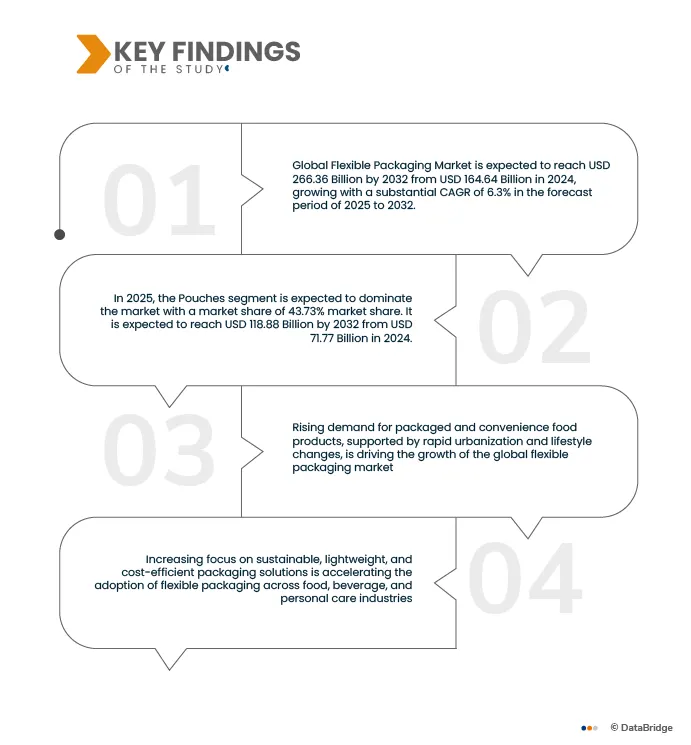
Increasing focus on sustainable, lightweight, and cost-efficient packaging solutions is accelerating the adoption of flexible packaging across food, beverage, and personal care industries.
Increasing focus on sustainable, lightweight, and cost-efficient packaging solutions is driving the rapid adoption of flexible packaging across food, beverage, and personal care industries. Manufacturers are seeking innovative ways to reduce material usage, lower transportation costs, and minimize environmental impact, which has made flexible packaging an attractive alternative to traditional rigid options. Flexible packaging materials such as pouches, films, and bags are not only lighter but also highly durable, providing improved product protection, extended shelf life, and convenience for consumers. In addition, growing consumer awareness about sustainability and eco-friendly products has pushed companies to develop recyclable, compostable, and biodegradable packaging options. The versatility of flexible packaging also allows for customization in shape, size, and design, enhancing brand appeal and consumer engagement. Across sectors like ready-to-eat meals, beverages, snacks, personal care items, and pharmaceuticals, these packaging solutions are meeting the demands of modern lifestyles that prioritize convenience, portability, and safety. As companies increasingly balance cost efficiency with environmental responsibility, the global flexible packaging market is expanding rapidly, reflecting the convergence of innovation, sustainability, and consumer-centric design.
Report Scope and Market Segmentation
|
Report Metric
|
Details
|
|
Forecast Period
|
2025 to 2032
|
|
Base Year
|
2024
|
|
Historic Years
|
2023 (Customizable to 2018-2022)
|
|
Quantitative Units
|
Revenue in USD Billion
|
|
Segments Covered
|
By Product (Pouches, Bags And Sacks, Tubes, Liners, Sachets And Stick Packs, Labels, Tapes, Films And Wraps), Material (Plastic, Paper, Metal, Inorganic Oxides, Adhesives and Coatings, Others), End Use (Food and Beverages), Technology (Flexography, Rotogravure, Digital, and Others)
|
|
Countries Covered
|
U.S., Canada, Mexico, Germany, U.K., France, Italy, Spain, Russia, Turkey, Netherlands, Norway, Finland, Denmark, Sweden, Poland, Switzerland, Belgium, Rest of Europe, China, Japan, India, South Korea, Australia, Indonesia, Thailand, Malaysia, Singapore, Philippines, Rest of Asia-Pacific, Brazil, Argentina, Rest of South America. U.A.E., Saudi Arabia, South Africa, Egypt, Israel, and Rest of the Middle East and Africa
|
|
Market Players Covered
|
ProAmpac (USA), Amcor plc (Australia), Goglio SpA (Italy), Graphic Packaging Holding Company (USA), Constantia Flexibles (Austria), ALTANA (Germany), Sonoco Products Company (USA), Flair Flexible Packaging Corporation (USA), Mondi (UK/Austria), WestRock Company (USA), Transcontinental Inc. (Canada), Wipak Group (Finland), Sealed Air (USA), BBC Cellpack Packaging (Switzerland), Schur Flexibles, now renamed Adapa Group (Austria), Coveris (Austria), Huhtamäki (Finland), Bischof + Klein SE & Co. KG (Germany), and Südpac (Germany).
|
|
Data Points Covered in the Report
|
In addition to the insights on market scenarios such as market value, growth rate, segmentation, geographical coverage, and major players, the market reports curated by the Data Bridge Market Research also include in-depth expert analysis, geographically represented company-wise production and capacity, network layouts of distributors and partners, detailed and updated price trend analysis and deficit analysis of supply chain and demand.
|
Segment Analysis
The Global Flexible Packaging market is segmented into four notable segments based on the Products, Materials, End User Industry, technology.
- On the basis of Products, the Global Flexible Packaging market is segmented into Pouches, Bags and Sacks, Tubes, Liners, Sachets and Stick Packs, Labels, Tapes, Films And Wraps.
In 2025, the Pouch segment is expected to dominate the market
In 2025, the pouch segment is expected to dominate the global flexible packaging market due to versatility, lightweight design, and cost efficiency across food and beverage applications. Pouches offer superior barrier properties that help preserve freshness, prevent contamination, and extend shelf life, making them ideal for ready-to-eat foods, snacks, sauces, and pet food. The resealable and stand-up formats of these pouches appeal strongly to consumers seeking convenience, portability, and reduced waste.
In 2025, the Pouches segment is expected to dominate the market with a market share of 43.73% due to their versatility, convenience, and cost-effectiveness. Pouches offer excellent protection for food and beverage products by providing strong barriers against moisture, oxygen, and contaminants, which helps extend shelf life. Their lightweight and space-saving design reduces transportation and storage costs, making them attractive to manufacturers and retailer.
- On the basis of Materials, the market is segmented into plastic, paper, metal, inorganic oxides, adhesives and coatings, and others.
In 2025, the On-Plastics segment is expected to dominate the market
In 2025, the Plastics segment is expected to dominate the market with a market share of 69.37% due to its exceptional combination of flexibility, strength, lightweight properties, and cost efficiency, which make it indispensable across industries such as food and beverages, pharmaceuticals, and personal care. Moreover, the versatility of plastics allows for a variety of packaging formats, including pouches, sachets, and wraps, all of which can be easily sealed, printed, and laminated.
- On the basis of End User Industry, the market is segmented into ready to food and beverage.
In 2025, the Foods segment is expected to dominate the market
In 2025, the Foods segment is expected to dominate the market with a market share of 83.78% due due to growing demand for convenience foods, ready-to-eat meals, and on-the-go snacks, which have made flexible packaging the preferred solution due to its lightweight, resealable, and extended shelf-life properties.
- On the basis of technology, the market is segmented flexography, rotogravure, digital, and others.
In 2025, the flexography segment is expected to dominate the market
In 2025, the flexography segment is expected to dominate the market with a market share of 46.61% due to its high-speed production, cost efficiency, and ability to print on a wide range of substrates, including plastic films, paper, and metallic foils. It is especially suited for large-scale packaging applications such as pouches, bags, labels, and corrugated containers. The process uses flexible photopolymer plates, which can be reused, making it both economical and sustainable for high-volume runs.
Major Players
ProAmpac (USA), Amcor plc (Australia), Goglio SpA (Italy), Graphic Packaging Holding Company (USA), Constantia Flexibles (Austria), ALTANA (Germany), Sonoco Products Company (USA), Flair Flexible Packaging Corporation (USA), Mondi (UK/Austria), WestRock Company (USA), Transcontinental Inc. (Canada), Wipak Group (Finland), Sealed Air (USA), BBC Cellpack Packaging (Switzerland), Schur Flexibles, now renamed Adapa Group (Austria), Coveris (Austria), Huhtamäki (Finland), Bischof + Klein SE & Co. KG (Germany), and Südpac (Germany).
Market Developments
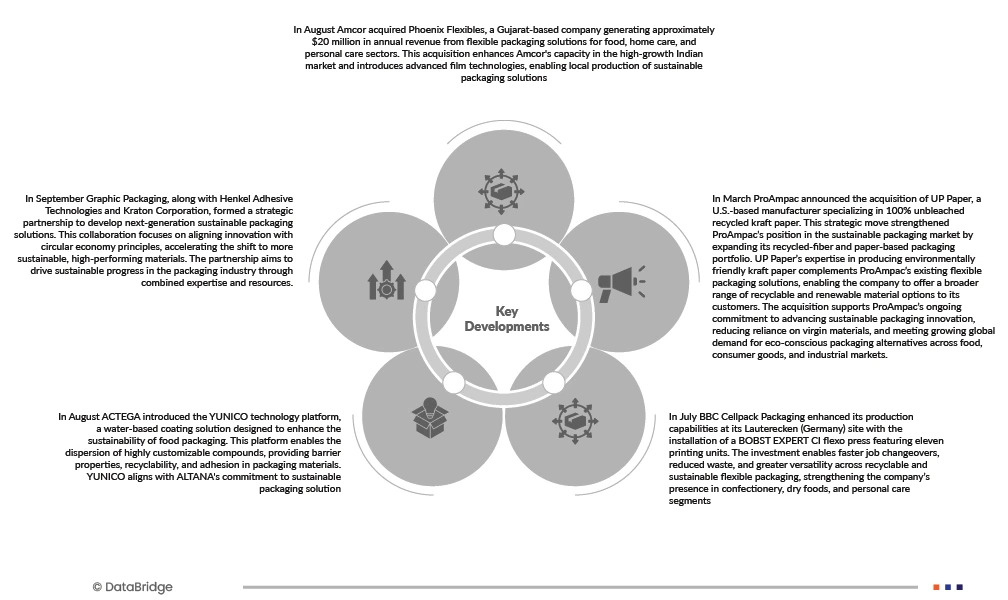
- In August 2023, Amcor acquired Phoenix Flexibles, a Gujarat-based company generating approximately USD 20 million in annual revenue from flexible packaging solutions for food, home care, and personal care sectors. This acquisition enhances Amcor's capacity in the high-growth Indian market and introduces advanced film technologies, enabling local production of sustainable packaging solutions.
- In September 2025, Graphic Packaging, along with Henkel Adhesive Technologies and Kraton Corporation, formed a strategic partnership to develop next-generation sustainable packaging solutions. This collaboration focuses on aligning innovation with circular economy principles, accelerating the shift to more sustainable, high-performing materials. The partnership aims to drive sustainable progress in the packaging industry through combined expertise and resources
- In September 2025, Sealed Air introduced the AUTOBAG® 850HB Hybrid Bagging Machine, designed for fulfillment operations that use either paper or poly mailers. The machine provides flexibility to run both substrate types, helping customers streamline equipment needs and support curb-side recyclable formats.
- In August 2024, ACTEGA introduced the YUNICO technology platform, a water-based coating solution designed to enhance the sustainability of food packaging. This platform enables the dispersion of highly customizable compounds, providing barrier properties, recyclability, and adhesion in packaging materials. YUNICO aligns with ALTANA's commitment to sustainable packaging solution.
- In July 2025, BBC Cellpack Packaging enhanced its production capabilities at its Lauterecken (Germany) site with the installation of a BOBST EXPERT CI flexo press featuring eleven printing units. The investment enables faster job changeovers, reduced waste, and greater versatility across recyclable and sustainable flexible packaging, strengthening the company’s presence in confectionery, dry foods, and personal care segments
As per Data Bridge Market Research analysis:
For more detailed information about the Global Flexible Packaging Market report, click here – https://www.databridgemarketresearch.com/reports/global-flexible-packaging-market