


Asia-Pacific Antiblock Additive Market Segmentation, By Form (Inorganic and Organic), Target Polymer (Polyethylene (PE), Polyvinyl Chloride (PVC), Biaxially-Oriented Polypropylene (BOPP), Polyethylene Terephthalate (PET), Polystyrene (PS), and Others), End-Use Industry (Packaging, Industrial, Agriculture, Medical and Healthcare, Electronics and Solar, Printing and Optics and Others) – Industry Trends and Forecast to 2032
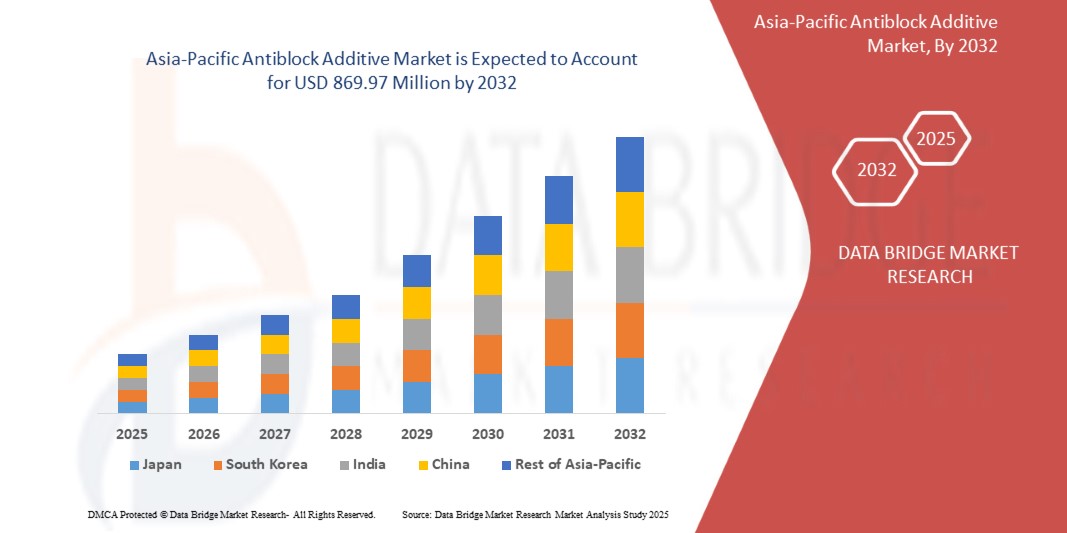
Asia-Pacific Antiblock Additive Market Analysis
The Asia-Pacific antiblock additive market is experiencing robust growth, driven by growing demand for plastic packaging. As the global antiblock additive industry continues to expand, the surge in innovations and advancements in polymer packaging has increased. Growing demand for development of bio-based antiblock additives are creating opportunities for the market. Market dynamics are also influenced by fluctuating raw material prices. Overall, the market is expected to continue expanding, with a focus on innovation and sustainability to meet evolving industrial demands.
Global Antiblock Additive Market Size
Asia-Pacific antiblock additive market size was valued at USD 570.23 million in 2024 and is projected to reach USD 869.97 million by 2032, with a CAGR of 5.44% during the forecast period of 2025 to 2032. In addition to the insights on market scenarios such as market value, growth rate, segmentation, geographical coverage, and major players, the market reports curated by the Data Bridge Market Research also include in-depth expert analysis, pricing analysis, brand share analysis, consumer survey, demography analysis, supply chain analysis, value chain analysis, raw material/consumables overview, vendor selection criteria, PESTLE Analysis, Porter Analysis, and regulatory framework.
Asia-Pacific Antiblock Additive Market Trends
“Growing Demand for Plastic Packaging”
The growing demand for plastic packaging is a significant driver for the global antiblock additive market. As industries such as food and beverage, pharmaceuticals, consumer goods, and e-commerce expand, the need for efficient, durable, and functional packaging solutions increases. Plastic packaging, being lightweight, cost-effective, and versatile, has become the preferred choice across various sectors. This increased reliance on plastic packaging drives the demand for additives that enhance the performance of plastic materials. Antiblock additives play a critical role in improving the processing and performance of plastic films used in packaging. These additives prevent the layers of plastic films from sticking together during manufacturing, handling, and storage. Without antiblock agents, plastic films would adhere to one another, leading to production issues, compromised packaging integrity, and inefficiencies. By reducing such problems, antiblock additives ensure smooth production processes, higher quality products, and more efficient packaging systems.
The surge in demand for flexible plastic packaging, especially in the food industry, further propels the growth of the antiblock additive market. With consumers demanding longer shelf lives, better product preservation, and user-friendly packaging, antiblock additives contribute to improving the functionality and appeal of plastic packaging. In addition, as sustainability becomes a growing concern, the development of environmentally friendly antiblock additives further supports this trend, providing opportunities for innovation in the packaging sector.
Report Scope and Market Segmentation
|
Attributes |
Asia-Pacific Antiblock Additive Key Market Insights |
|
Segments Covered |
|
|
Countries Covered |
China, Japan, India, South Korea, Singapore, Thailand, Indonesia, Malaysia, Philippines, Australia & New Zealand, and Rest of Asia-Pacific |
|
Key Market Players |
Imerys (France), Ampacet CORPORATION (U.S.), ALTANA (Germany), Dow (U.S.), Lyondellbasell Industries Holdings B.V. (Netherlands), Astra Polymers (Saudi Arabia), Avient Corporation (U.S.), BASF (Germany), Cargill, Incorporated (U.S.), Covia Holdings LLC. (U.S.), Evonik (Germany), Fine Organic Industries Limited (India), Honeywell International Inc (U.S.), Inerals Technologies Inc. (U.S.), Momentive Performance Materials (U.S.), National Plastics Color, Inc. (U.S.), plasmix pvt ltd (India), SABIC (Saudi Arabia), Sukano AG (Switzerland), W. R. Grace & Co.-Conn (U.S.), and Wells Plastics (U.K.) |
|
Market Opportunities |
|
|
Value Added Data Infosets |
In addition to the insights on market scenarios such as market value, growth rate, segmentation, geographical coverage, and major players, the market reports curated by the Data Bridge Market Research also include in-depth expert analysis, pricing analysis, brand share analysis, consumer survey, demography analysis, supply chain analysis, value chain analysis, raw material/consumables overview, vendor selection criteria, PESTLE Analysis, Porter Analysis, and regulatory framework. |
Asia-Pacific Antiblock Additive Market Definition
Antiblock additives are chemical compounds used in polymer films, particularly in polyethylene and polypropylene, to reduce the adhesion between film layers. These additives work by creating microscopic rough surfaces that minimize the contact area between layers, preventing them from sticking together. Common antiblock agents include silica, talc, and synthetic silicates. They are widely used in packaging films, agricultural films, and industrial applications to improve handling, processing, and machinability. By reducing blocking, these additives enhance productivity, facilitate film separation, and ensure efficient packaging operations without compromising transparency, mechanical properties, or printability of the final plastic film product.
Asia-Pacific Antiblock Additive Market Dynamics
Drivers
- Booming Automotive and Industrial Sectors
Antiblock additives, which are primarily used in plastic films to prevent them from sticking together during processing, are increasingly vital as industries such as automotive and manufacturing expand. In the automotive sector, there is a growing demand for lightweight, durable, and cost-effective materials for packaging, interiors, and automotive components. Antiblock additives are used in the production of plastic films, which find applications in automotive packaging, protective coatings, and composite materials. With the increasing production of vehicles globally, manufacturers are focusing on improving the performance and appearance of automotive plastics, further boosting the need for antiblock additives. The automotive industry's demand for more efficient, recyclable, and functional materials directly contributes to the market's growth.
Similarly, the industrial sector, which encompasses a wide range of applications, including packaging, construction, and machinery, is a significant driver. As industries demand high-quality plastic films for packaging and machinery, the need for antiblock additives has surged. In the packaging industry, antiblock additives are essential for preventing film layers from sticking together, enhancing the ease of processing, and improving the end product's quality. Furthermore, antiblock additives are integral to industrial packaging solutions, especially in sectors dealing with bulk goods and sensitive materials.
For instance,
- In May 2022, according to an article published by Squarespace, The blog explores the use of plastics in automotive applications, highlighting both the benefits and environmental challenges. Plastics make vehicles lightweight, fuel-efficient, and customizable, but issues such as toxic PVC and poor recyclability can harm the environment. The article calls for more sustainable polymers to address these concerns.
- In May 2023, according to an article published by American Chemistry Council, Inc. A 2023 report from the American Chemistry Council highlights how plastics in automobiles have increased by 16% from 2012 to 2021. Plastics improve fuel efficiency, safety, and performance, especially in Electric Vehicles (EVs), by offsetting the weight of batteries. The report emphasizes plastics' role in sustainability and recycling efforts.
Both sectors' emphasis on reducing costs, improving material properties, and ensuring sustainability leads to increased adoption of antiblock additives. As global automotive and industrial production continues to rise, the demand for these additives is expected to follow suit, reinforcing the positive growth trajectory for the antiblock additive market in the coming years.
- Innovations and Advancements in Polymer Packaging
Innovations in polymer packaging have significantly influenced the growth of the antilock additives market, driving new developments in packaging materials and enhancing product performance. Antilock additives, primarily used in packaging to improve the durability, stability, and performance of polymers, are seeing increased demand due to the evolving needs of the packaging industry. As packaging requirements shift towards more sustainable, efficient, and high-performance materials, antilock additives are playing a key role in enhancing polymer formulations. One of the primary drivers is the growing demand for polymers that are more resistant to friction and wear. Antilock additives help reduce friction between polymer surfaces, minimizing the risk of damage during the packaging process, particularly in industries such as food and pharmaceuticals, where product integrity is crucial. These additives also improve the processing characteristics of polymers, allowing for smoother production processes and extending the life of packaging materials.
As sustainability becomes a critical focus, there is a rise in demand for biodegradable or recyclable packaging materials. Antilock additives are helping make these eco-friendly polymers more effective and durable, ensuring they perform well without compromising the environment. This shift towards greener packaging solutions has led to innovations in the formulation of antilock additives that are not only efficient in reducing friction but also safe for the environment. In addition, the rise of e-commerce has heightened the need for robust packaging solutions that can withstand the rigors of global shipping. Antilock additives contribute to this by improving the performance of polymer packaging, ensuring that products remain intact during transit while reducing the risk of packaging failure.
For instance,
- According to an article published by CarePac., The Packaging Polymers Guide provides detailed insights into various types of polymer packaging materials, including synthetic and biodegradable plastics. It explores common polymers such as polyethylene, PET, and bioplastics, their applications, benefits, risks, and environmental impacts while emphasizing the shift towards sustainable, eco-friendly alternatives in the packaging industry.
- In 2020, according to an article published by Elsevier B.V., This chapter explores food packaging materials, focusing on conventional polymers, bioplastics, and nanopolymers. It highlights the advantages of bioplastics—such as renewability and biodegradability—while addressing challenges such as nonrenewability in traditional polymers. The research aims to improve packaging solutions through technological advancements such as nanotechnology to enhance material performance.
- In February 2024, according to an article published by Michigan State University, This article from Michigan State University examines plastic and polymer-based packaging, highlighting its benefits such as protection, cost-effectiveness, and versatility. It addresses concerns about potential health risks, microplastics, and environmental impact while emphasizing ongoing research to improve packaging materials, sustainability, and consumer safety.
- In January 2024, according to an article published by Polymart, PolyMart provides a comprehensive overview of polymers used in food packaging, highlighting their types, properties, and benefits, such as protecting food, extending shelf life, and being cost-effective. The platform offers seamless procurement options through its Buyer App, connecting buyers with trusted suppliers and providing real-time price trends.
Innovations in polymer packaging, driven by advances in antilock additives, are meeting the growing demand for high-performance, sustainable, and durable packaging solutions, thus fostering the expansion of the antilock additives market.
Opportunities
- Advancements in Bio-Based Antiblock Additives
The development of bio-based antiblock additives represents a significant advancement in the field of polymer processing, particularly in addressing the challenges associated with film adhesion. Traditionally, inorganic antiblock additives such as silica or talc have been employed to mitigate blocking—the undesirable sticking together of polymer film layers. While effective, these inorganic additives can compromise the optical clarity of films, especially at higher concentrations. In contrast, bio-based antiblock additives offer a sustainable and efficient alternative, enhancing film performance without sacrificing clarity.
Bio-based antiblock additives, such as those derived from natural amides, function by migrating to the polymer surface, forming a lubricating layer that reduces the coefficient of friction between film layers. This mechanism not only prevents blocking but also maintains the transparency of the film, which is crucial for applications such as food packaging where product visibility is important.
The shift towards bio-based solutions is also driven by environmental considerations. As industries seek to reduce their ecological footprint, the demand for sustainable additives has increased. Bio-based antiblock additives, being derived from renewable resources, align with these sustainability goals. Companies such as Fine Organics have developed products such as Finawax B, a refined vegetable-based behenamide that offers optimal antiblocking properties in polyolefin-based films. When used in combination with inorganic antiblock agents at suitable dosages, it effectively balances performance with environmental responsibility.
For instance,
- According to a blog published by Cargill, Incorporated, Optislip™ BR (behenamide) is a bio-based antiblock additive designed for polymer films. It reduces blocking by forming a lubricating surface layer while maintaining film clarity. Suitable for various polymers, it offers a sustainable alternative to inorganic additives, aligning with industry demands for high-performance and eco-friendly packaging solutions.
- According to Fine Organic Industries Limited, Finawax B, a vegetable-based behenamide, is an effective bio-based antiblock additive for polyolefin films. It minimizes film adhesion while maintaining transparency, reducing reliance on inorganic antiblock agents. This sustainable solution enhances packaging performance and aligns with the industry's shift toward eco-friendly polymer additives.
The development of bio-based antiblock additives marks a pivotal shift in polymer additive technology. By providing effective antiblocking solutions that do not compromise film clarity and support sustainability initiatives, these additives are poised to play a crucial role in the future of packaging and other industries reliant on polymer films.
- Surge in Online Shopping and Growth in E-Commerce Packaging
The rapid expansion of e-commerce has significantly transformed consumer purchasing behaviors, leading to a substantial increase in online shopping. This surge necessitates efficient and reliable packaging solutions to ensure products are delivered intact and presentable. Consequently, there is a heightened demand for high-quality packaging films that prevent issues such as blocking, where film layers stick together, hindering packaging processes and compromising product integrity.
Anti-block additives play a crucial role in addressing these challenges by reducing the adhesion between film layers, thereby enhancing the efficiency of packaging operations. These additives are incorporated into polymer films to create a micro-rough surface, minimizing contact points between layers and facilitating smoother handling during manufacturing and product packaging.
This growth is attributed to the rising consumption of packaged goods, particularly in the food, beverage, and pharmaceutical industries, which are integral components of the e-commerce ecosystem. As consumers increasingly rely on online platforms for their purchases, the demand for packaging films that maintain product quality and safety during transit has become paramount.
For instance,
- According to Plastiblends, Polyaddit Anti-Block Masterbatches prevent film adhesion by introducing fine particles that create a micro-rough surface, reducing contact between layers. This enhances handling efficiency during manufacturing and packaging, ensuring smoother processing and improved product performance in industries such as food packaging, pharmaceuticals, and consumer goods.
- In March 2024, according to an article by Flex-Pack Engineering, Inc., the surge in online shopping and the growth of e-commerce have significantly increased the demand for efficient and reliable packaging solutions. Flexible plastic films are commonly used in packaging due to their lightweight and protective properties. However, these films can stick together—a phenomenon known as "blocking"—which can hinder packaging processes and affect product quality. To address this issue, anti-block additives are incorporated into plastic films to create a micro-rough surface, reducing adhesion between film layers and facilitating smoother handling and processing. This enhancement is crucial for maintaining efficiency in high-speed packaging operations, which are typical in e-commerce.
- In November 2019, according to an article published by Furion Analytics Research & Consulting LLP, the growing demand for packaging films across sectors such as food & beverage, pharmaceuticals, and consumer goods has been a major driver of the packaging film market's expansion. This growth has particularly increased the demand for anti-block additives, which are crucial for the handling and performance of films—especially polyolefin films such as Polyethylene (PE) and Polypropylene (PP), which are prone to blocking issues.
結論として、オンライン ショッピングの急増とそれに伴う e コマース パッケージの成長は、アンチブロック添加剤市場にとって極めて重要な機会です。e コマース セクターが拡大し続けるにつれて、製品の完全性と顧客満足度を保証する効果的なパッケージ ソリューションの重要性は高まるばかりであり、パッケージング業界におけるアンチブロック添加剤の重要な役割が強調されます。
制約/課題
- 代替添加剤およびソリューションの入手可能性
代替添加剤やソリューションの可用性は、世界のアンチロック添加剤市場における大きな制約となっています。新しい技術や材料が登場するにつれて、メーカーはコスト効率、持続可能性、性能向上の要望に駆り立てられて、従来のアンチロック添加剤の代替品をますます模索しています。類似または強化された特性を提供する可能性のあるこれらの代替添加剤は、従来のアンチロックソリューションの需要に挑戦し、競争の激化と従来製品の市場シェアの減少につながります。
代替品が利用できることによる主な制約の 1 つは、環境に優しい添加剤や生分解性添加剤への好みがシフトしていることです。多くの業界で持続可能性への関心が高まるにつれて、メーカーは環境への影響を最小限に抑えるソリューションを求めています。従来のアンチロック添加剤は効果的ですが、天然ベースまたは生物由来の添加剤などの代替品が注目を集めており、市場の需要に潜在的な変化が生じています。これらの代替品は、より環境に配慮していると認識されることが多く、従来の化学添加剤よりも好まれています。さらに、材料科学の進歩により、従来のアンチロック添加剤を必要とせずに摩擦低減特性を強化する革新的なポリマーベースのソリューションが開発されました。これらの新しいソリューションは優れたパフォーマンスを提供し、添加剤への依存を減らし、ひいてはアンチロック製品の需要に影響を与える可能性があります。
さらに、コストの考慮も重要な役割を果たします。特に価格に対する敏感性が高い地域では、コスト効率がより高い代替添加剤を選択するメーカーもいます。代替ソリューションが低コストで同等またはそれ以上の性能を発揮した場合、この価格主導のシフトがさらに悪化する可能性があります。
例えば、
- Plastics Technology が発表した記事によると、2019 年 5 月にデュポンは、PE フィルムの加工性を向上させるためにアンチブロック添加剤とスリップ添加剤を組み合わせた Dow Corning AMB-12235 マスターバッチを発売しました。このシリコンベースの配合は、低摩擦係数を提供し、フィルムのブロッキングを防ぎ、移行を減らします。これらはすべて低負荷 (4 ~ 6%) で実現され、生産を合理化し、複雑さを軽減し、サプライ チェーンのスペースを節約します。
- ChemPoint が発表した記事によると、Momentive Tospearl シリコンビーズは、ポリオレフィンフィルム用の高度なアンチブロックおよびスリップ添加剤で、層間の接着を防ぎ、押し出し時の摩擦係数を低減するように設計されています。これらの添加剤は、フィルムの透明性と処理効率を向上させ、ダウンタイムを削減するとともに、食品接触用途で FDA 承認されており、400°C までの熱安定性を備えています。
全体的に、代替添加剤やソリューションの可用性は、メーカーがより新しく、より持続可能で、コスト効率の高いオプションを優先し、従来のアンチロック製品の市場の可能性を制限する可能性があるため、アンチロック添加剤市場の成長にとって課題となります。
- 規制コンプライアンスとテスト基準
アンチブロック添加剤市場は、製品の安全性と環境保護を確保するために、厳格な規制遵守とテスト基準の対象となっています。米国では、食品医薬品局 (FDA) が、包装材料に使用されるアンチブロック添加剤など、食品との接触を目的とした物質を監督しています。製造業者は、これらの添加剤が意図された用途に対して安全であることを実証する必要があり、これには原材料と食品製品への潜在的な移行の徹底的な評価が含まれます。
アジア太平洋地域では、アジア太平洋化学品庁 (ECHA) とアジア太平洋食品安全機関 (EFSA) が、固化防止剤を含む化学物質の安全性評価において重要な役割を果たしています。REACH 規制では、製造業者と輸入業者に、意図された用途と安全性データを含む化学物質の登録を義務付けています。この厳格な規制環境により、食品と接触するすべての物質が安全であり、公衆衛生を危険にさらさないことが保証されます。
アンチブロック添加剤を取り巻く規制の枠組みは、製品の安全性、環境保護、業界基準への準拠を保証するために不可欠です。アンチブロック添加剤は、通常、包装材料、特にポリエチレンフィルムに使用され、シート同士がくっつくのを防ぎ、使いやすさと製品の品質を大幅に向上させます。しかし、アンチブロック添加剤は広く使用されているため、その使用を規制するための包括的な規制ガイドラインの策定が必要となっています。
さまざまな国や地域で規制ガイドラインが制定されています。たとえば、米国では、食品医薬品局 (FDA) が、食品包装に使用される添加物など、食品と接触する物質の使用を監督しています。FDA は、すべての食品接触物質が意図された用途に対して安全であることを要求しており、これには原材料の徹底的な調査と添加物が食品製品に移行する可能性の調査が含まれます。
例えば、
- アジア太平洋食品安全機関が公開したブログによると、2025年1月、EFSAはアジア太平洋連合における安全性評価と規制枠組みに焦点を当てた食品添加物に関する詳細な情報を提供した。同機関の評価は、アンチブロック剤などの食品包装に使用される添加物が消費者にとって安全であり、公衆衛生を守るための厳しい環境・健康基準に準拠していることを保証するのに役立つ。
- アジア太平洋化学物質庁 (ECHA) は、食品接触を目的とした活性物質およびインテリジェント物質に関する法律の包括的な概要を提供しています。これには、包装に使用されるアンチブロック剤などの物質の安全性を保証する規制が含まれます。ECHA のフレームワークは、消費者の健康を保護し、食品の安全性に関する EU 基準への準拠を保証します。
アンチブロック添加剤市場にとって、製品の安全性、環境の持続可能性、消費者の健康を確保するには、規制遵守とテスト基準の遵守が不可欠です。FDA、ECHA、EFSA などの当局による厳格な監視により、業界の健全性が維持され、包装材料における添加剤のより安全で効果的な使用が促進されます。
原材料不足と出荷遅延の影響と現在の市場シナリオ
Data Bridge Market Research は、市場の高水準な分析を提供し、原材料不足や出荷遅延の影響と現在の市場環境を考慮した情報を提供します。これは、戦略的な可能性を評価し、効果的な行動計画を作成し、企業が重要な決定を下すのを支援することにつながります。
標準レポートの他に、予測される出荷遅延からの調達レベルの詳細な分析、地域別の販売代理店マッピング、商品分析、生産分析、価格マッピングの傾向、調達、カテゴリパフォーマンス分析、サプライチェーンリスク管理ソリューション、高度なベンチマーク、その他の調達および戦略サポートのサービスも提供しています。
経済減速が製品の価格と入手可能性に及ぼす予想される影響
経済活動が減速すると、業界は打撃を受け始めます。DBMR が提供する市場分析レポートとインテリジェンス サービスでは、景気後退が製品の価格設定と入手しやすさに及ぼす予測される影響が考慮されています。これにより、当社のクライアントは通常、競合他社より一歩先を行き、売上と収益を予測し、損益支出を見積もることができます。
アジア太平洋地域のアンチブロック添加剤市場の範囲
市場は、タイプ、対象ポリマー、および最終用途産業に基づいてセグメント化されています。これらのセグメント間の成長は、業界のわずかな成長セグメントを分析するのに役立ち、ユーザーに貴重な市場概要と市場洞察を提供し、コア市場アプリケーションを特定するための戦略的決定を下すのに役立ちます。
形状
- 無機
- オーガニック
ターゲットポリマー
- ポリエチレン(PE)
- ポリ塩化ビニル(PVC)
- 二軸延伸ポリプロピレン(BOPP)
- ポリエチレンテレフタレート(PET)
- ポリスチレン(PS)
- その他
最終用途産業
- パッケージ
- 産業
- 農業
- 医療とヘルスケア
- エレクトロニクスと太陽光
- 印刷と光学
- その他
アジア太平洋地域のアンチブロック添加剤市場地域分析
市場は分析され、市場規模の洞察と傾向は、上記のように国、タイプ、対象ポリマー、および最終用途産業別に提供されます。
市場対象となる国は、中国、日本、インド、韓国、シンガポール、タイ、インドネシア、マレーシア、フィリピン、オーストラリア、ニュージーランド、およびその他のアジア太平洋諸国です。
中国は、農業部門の急速な拡大と高性能フィルムの需要増加により、市場を独占する見込みです。先進的な農業技術、政府の支援、技術革新が成長を牽引し、地域全体の農業用途における効率性、耐久性、持続可能性を確保しています。
中国は、急速な工業化、包装および農業部門の拡大、高品質のプラスチックフィルムの需要増加により、この地域でアンチブロック添加剤の市場が最も急速に成長しています。政府の取り組み、技術の進歩、消費者の意識の高まりにより、市場の拡大と革新がさらに促進されています。
レポートの国別セクションでは、市場の現在および将来の動向に影響を与える国内市場における個別の市場影響要因と規制の変更も提供しています。下流および上流のバリュー チェーン分析、技術動向、ポーターの 5 つの力の分析、ケース スタディなどのデータ ポイントは、各国の市場シナリオを予測するために使用される指標の一部です。また、国別データの予測分析を提供する際には、グローバル ブランドの存在と可用性、および地元および国内ブランドとの競争が激しいか少ないために直面する課題、国内関税と貿易ルートの影響も考慮されます。
アジア太平洋地域のアンチブロック添加剤市場シェア
市場競争環境では、競合他社の詳細が提供されます。含まれる詳細には、会社概要、会社の財務状況、収益、市場の可能性、研究開発への投資、新しい市場への取り組み、世界的なプレゼンス、生産拠点と施設、生産能力、会社の強みと弱み、製品の発売、製品の幅と広さ、アプリケーションの優位性などがあります。提供される上記のデータ ポイントは、市場に関連する会社の焦点にのみ関連しています。
アジア太平洋地域のアンチブロック添加剤市場リーダーは以下のとおりです。
- イメリー(フランス)
- アンパセットコーポレーション(米国)
- アルタナ(ドイツ)
- ダウ(米国)
- Lyondellbasell Industries Holdings BV(オランダ)
- アストラポリマーズ(サウジアラビア)
- アビエントコーポレーション(米国)
- BASF(ドイツ)
- カーギル社(米国)
- Covia Holdings LLC. (米国)
- エボニック(ドイツ)
- ファインオーガニックインダストリーズリミテッド(インド)
- ハネウェル・インターナショナル(米国)
- インナールステクノロジーズ社(米国)
- モメンティブ・パフォーマンス・マテリアルズ(米国)
- ナショナルプラスチックカラー社(米国)
- プラスミックス株式会社(インド)
- SABIC(サウジアラビア)
- スカノAG(スイス)
- W. R. Grace & Co.-Conn (U.S.)
- Wells Plastics (U.K.)
Latest Developments in Asia-Pacific Antiblock Additive Market
- In December 2024, SABIC introduced LNP ELCRES CXL polycarbonate copolymer resins, offering exceptional chemical resistance, ideal for mobility, electronics, industrial, and infrastructure applications. These materials provide improved durability, weatherability, and low-temperature impact resistance. Available in bio-renewable versions under SABIC's TRUCIRCLE program, they contribute to sustainability and enhance part performance, even under harsh chemical exposure
- In November2024, SABIC has renewed its honorary strategic partnership with the Boao Forum for Asia (BFA), marking 17 consecutive years of sponsorship. This partnership highlights SABIC's commitment to sustainable development through cross-regional collaboration. The company continues to leverage BFA as a platform for enhancing influence and driving inclusive development globally
- In January 2025, Evonik Industries AG and Fuhua Tongda Chemicals Companyhave established a joint venture in Leshan, China, to produce specialty hydrogen peroxide (H2O2) for applications such as solar panels, semiconductors, and food packaging. With Evonik holding 51% and Fuhua 49%, the venture will start supplying the market in 2026. This partnership strengthens Evonik's presence in the Asia Pacific region
- On June 2024, Covia Holdings LLC finalized the separation of its Energy and Industrial businesses into two independent entities: Covia Energy, LLC, headquartered in The Woodlands, Texas, and Covia Solutions, based in Independence, Ohio. This strategic move allows each company to focus on its respective market opportunities
SKU-
Получите онлайн-доступ к отчету на первой в мире облачной платформе рыночной аналитики

- Интерактивная панель анализа данных
- Панель анализа компании для возможностей с высоким потенциалом роста
- Доступ аналитика-исследователя для настройки и запросов
- Анализ конкурентов с помощью интерактивной панели
- Последние новости, обновления и анализ тенденций
- Используйте возможности сравнительного анализа для комплексного отслеживания конкурентов
Методология исследования
Сбор данных и анализ базового года выполняются с использованием модулей сбора данных с большими размерами выборки. Этап включает получение рыночной информации или связанных данных из различных источников и стратегий. Он включает изучение и планирование всех данных, полученных из прошлого заранее. Он также охватывает изучение несоответствий информации, наблюдаемых в различных источниках информации. Рыночные данные анализируются и оцениваются с использованием статистических и последовательных моделей рынка. Кроме того, анализ доли рынка и анализ ключевых тенденций являются основными факторами успеха в отчете о рынке. Чтобы узнать больше, пожалуйста, запросите звонок аналитика или оставьте свой запрос.
Ключевой методологией исследования, используемой исследовательской группой DBMR, является триангуляция данных, которая включает в себя интеллектуальный анализ данных, анализ влияния переменных данных на рынок и первичную (отраслевую экспертную) проверку. Модели данных включают сетку позиционирования поставщиков, анализ временной линии рынка, обзор рынка и руководство, сетку позиционирования компании, патентный анализ, анализ цен, анализ доли рынка компании, стандарты измерения, глобальный и региональный анализ и анализ доли поставщика. Чтобы узнать больше о методологии исследования, отправьте запрос, чтобы поговорить с нашими отраслевыми экспертами.
Доступна настройка
Data Bridge Market Research является лидером в области передовых формативных исследований. Мы гордимся тем, что предоставляем нашим существующим и новым клиентам данные и анализ, которые соответствуют и подходят их целям. Отчет можно настроить, включив в него анализ ценовых тенденций целевых брендов, понимание рынка для дополнительных стран (запросите список стран), данные о результатах клинических испытаний, обзор литературы, обновленный анализ рынка и продуктовой базы. Анализ рынка целевых конкурентов можно проанализировать от анализа на основе технологий до стратегий портфеля рынка. Мы можем добавить столько конкурентов, о которых вам нужны данные в нужном вам формате и стиле данных. Наша команда аналитиков также может предоставить вам данные в сырых файлах Excel, сводных таблицах (книга фактов) или помочь вам в создании презентаций из наборов данных, доступных в отчете.











