



Global Food Blender and Mixer Equipment Market, By Type (High Shear Mixers, Shaft Mixers, Ribbon Blenders, Double Cone Blenders, Planetary Mixers, Screw Blenders and Mixers, Others), Mode of Operation (Automatic, Semi-automatic), Application (Bakery Products, Dairy Products, Beverages, Confectioneries, Other Applications), Technology (Batch, Continuous), Brand (Speedmix Dfml, Sanimix Mrma, GEA Unimix, Vitomix VX, Stein Promix, Innopro Paramix C, Contiflow, Carboflow, and Sypro B, Flex-Mix, Salomix, Tetra Almix, Albatch, Hoyer Promix, Alfast) - Industry Trends and Forecast to 2030.
Food Blender and Mixer Equipment Market Analysis and Size
The factors such as the surging growth in food and beverages processing industry along with the advancement of new and improvised technology are the major factors fostering the growth of the food blender and mixer equipment market. In addition, the people's changing lifestyle and bust schedule are other important factors acting as food blender and mixer equipment market growth determinants. Moreover, the rising consumption of bakery and dairy food products in developing countries and the advanced production facilities with automated machineries and systems are estimated to accelerate the market's overall growth. On the other hand, the rising power and energy cost is supposed to hamper the market’s growth. Moreover, the high cost associated with the usage of machine and the rising need for a large amount of capital investment might hinder the overall growth of the market.
The increasing availability of funds from the government sector for small and medium sector enterprises will further generate various profitable opportunities for the food blender and mixer equipment market. However, the limited awareness of food blenders and their benefits in some underdeveloped regions might also pose a major challenge for the market growth rate as it disrupted the production and supply within the market.
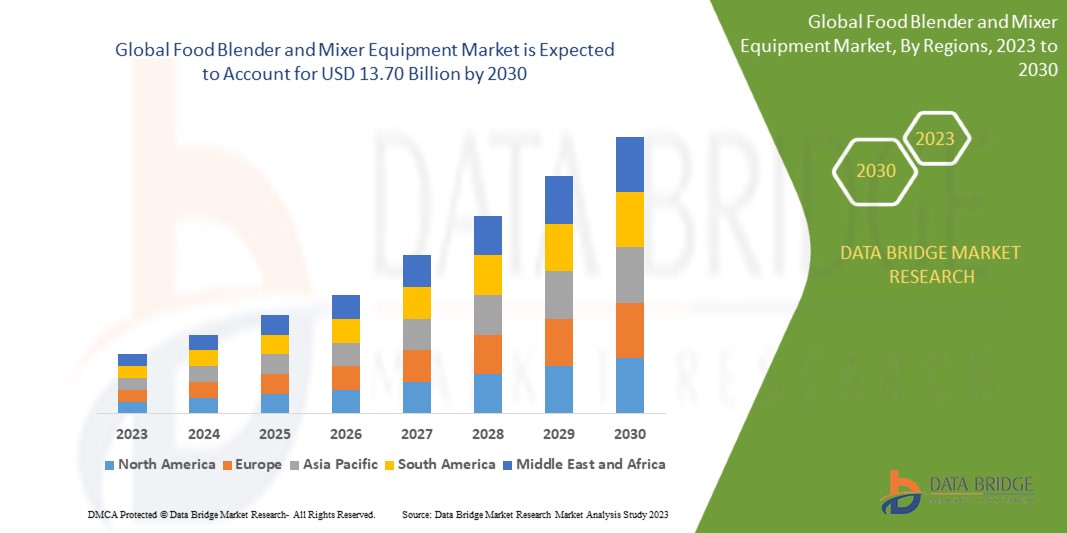
Data Bridge Market Research analyses that the food blender and mixer equipment market which was USD 8.52 billion in 2022, is likely to reach USD 13.70 billion by 2030, and is expected to undergo a CAGR of 6.12 % during the forecast period. This indicates the market value. "High Shear Mixer" dominates the type segment of the food blender and mixer equipment market due to them being widely used in food processing tasks like emulsification and particle size reduction, making them a key component of food production lines.
In addition to the insights on market scenarios such as market value, growth rate, segmentation, geographical coverage, and major players, the market reports curated by the Data Bridge Market Research also include in-depth expert analysis, geographically represented company-wise production and capacity, network layouts of distributors and partners, detailed and updated price trend analysis and deficit analysis of supply chain and demand.
Report Scope and Market Segmentation
|
Report Metric |
Details |
|
Forecast Period |
2023 to 2030 |
|
Base Year |
2022 |
|
Historic Years |
2021(Customizable to 2015-2020) |
|
Quantitative Units |
Revenue in USD Billion, Volumes in Units, Pricing in USD |
|
Segments Covered |
By Type (High Shear Mixers, Shaft Mixers, Ribbon Blenders, Double Cone Blenders, Planetary Mixers, Screw Blenders and Mixers, Others), Mode of Operation (Automatic, Semi-automatic), Application (Bakery Products, Dairy Products, Beverages, Confectioneries, Other Applications), Technology (Batch, Continuous), Brand (Speedmix Dfml, Sanimix Mrma, GEA Unimix, Vitomix VX, Stein Promix, Innopro Paramix C, Contiflow, Carboflow, and Sypro B, Flex-Mix, Salomix, Tetra Almix, Albatch, Hoyer Promix, Alfast) |
|
Countries Covered |
U.S., Canada, Mexico, Germany, Sweden, Poland, Denmark, Italy, U.K., France, Spain, Netherlands, Belgium, Switzerland, Turkey, Russia, Rest of Europe, Japan, China, India, South Korea, New Zealand, Vietnam, Australia, Singapore, Malaysia, Thailand, Indonesia, Philippines, Rest of Asia-Pacific, Brazil, Argentina, Rest of South America, UAE, Saudi Arabia, Oman, Qatar, Kuwait, South Africa, Rest of Middle East and Africa |
|
Market Players Covered |
GEA Group Aktiengesellschaft (Germany), Tetra Pak (Switzerland), Krones AG (Germany), SPX FLOW (United States), Sulzer Ltd (Switzerland), BühlerGroup (Switzerland), JBT (United States), KHS Group (Germany), Marel (Iceland), HOSOKAWA MICRON B.V., Hosokawa Micron Group (Netherlands), amixon GmbH (Germany), PRIMIX B.V. (Netherlands), Q-Pumps (Spain), Technosilos AP (Spain), ADMIX INC. (United States), Automated Process Equipment Corporation (United States), STK MAKINA (Turkey), Ross Process Equipment Pvt. Ltd. (India), J R Boone Ltd. (United Kingdom)
|
|
Market Opportunities |
|
Market Definition.
The food blender and mixer equipment are basically the appliances that are used to mix, grind, and blend food products in both commercial and domestic settings. The mixer basically prepares foods that require mixing and beating, while a blender on the other hand is used to combine food and other ingredients, resulting in a thick consistency that is consistent and smooth.
Food Blender and Mixer Equipment market dynamics
Drivers
- Changing Lifestyles and Dietary Preferences
The market benefits from evolving consumer lifestyles and dietary choices. As more people adopt healthier eating habits, demand for food blenders and mixers grows to prepare smoothies, health shakes, and nutritious meals conveniently.
- Foodservice Industry Growth
The burgeoning foodservice industry, including restaurants, cafes, and catering businesses, is a significant driver. These establishments rely on industrial-grade blenders and mixers for efficient food preparation, which fuels market expansion.
Opportunity
- Technological Advancements
There's an opportunity for manufacturers to develop more advanced and versatile blender and mixer equipment, incorporating features like precision control, automation, and safety enhancements to meet the evolving demands of both consumers and professional chefs.
Restraints/Challenges
Cost and Price Sensitivity
The cost of high-quality commercial-grade blender and mixer equipment can be a barrier for smaller foodservice businesses and budget-conscious consumers. Market players must address pricing concerns while maintaining quality.
Regulatory Compliance and Safety Standards
Adherence to stringent food safety regulations and certifications can be a challenge for manufacturers, adding to the cost and complexity of producing these appliances. Compliance with these standards is vital to ensure the safety of food processing equipment.
This food blender and mixer equipment market report provides details of new recent developments, trade regulations, import-export analysis, production analysis, value chain optimization, market share, impact of domestic and localized market players, analyses opportunities in terms of emerging revenue pockets, changes in market regulations, strategic market growth analysis, market size, category market growths, application niches and dominance, product approvals, product launches, geographic expansions, technological innovations in the market. To gain more info on the Food Blender and Mixer Equipment market contact Data Bridge Market Research for an Analyst Brief, our team will help you take an informed market decision to achieve market growth.
Global Food Blender and Mixer Equipment Market Scope
The food blender and mixer equipment market is segmented on the basis of type, mode of operation, application, technology and brand. The growth amongst these segments will help you analyse meagre growth segments in the industries and provide the users with a valuable market overview and market insights to help them make strategic decisions for identifying core market applications.
Type
- High Shear Mixers
- Shaft Mixers
- Ribbon Blenders
- Double Cone Blenders
- Planetary Mixers
- Screw Blenders
- Others
Operation
- Automatic
- Semi-automatic
Operations
- Semi-Automatic
- Automatic
Application
- Bakery Products
- Dairy Products
- Beverages
- Confectioneries
- Others
Technology
- Batch
- Continuous
Brand
- SpeedMix DFML
- SaniMix MRMA
- GEA UniMix
- VitoMix VX
- Stein ProMix
- InnoPro ParaMix C
- ContiFlow
- CarboFlow
- Sypro B
- Flex-Mix
- SaloMix
- Tetra AlMix
- AlBatch
- Hoyer ProMix
- AlFast
Food Blender and Mixer Equipment Market Regional Analysis/Insights
The food blender and mixer equipment market is analysed and market size insights and trends are provided by country, type, mode of operation, application, technology and brand as referenced above.
The countries covered in the food blender and mixer equipment market report are U.S., Canada, Mexico in North America, Germany, Sweden, Poland, Denmark, Italy, U.K., France, Spain, Netherlands, Belgium, Switzerland, Turkey, Russia, rest of Europe in Europe, Japan, China, India, South Korea, New Zealand, Vietnam, Australia, Singapore, Malaysia, Thailand, Indonesia, Philippines, rest of Asia-Pacific (APAC) in Asia-Pacific (APAC), Brazil, Argentina, rest of South America as a part of South America, UAE, Saudi Arabia, Oman, Qatar, Kuwait, South Africa, rest of Middle East and Africa(MEA) as a part of Middle East and Africa (MEA).
Europe region is expected to dominate the food blender and mixer equipment market and will continue to flourish its trend of dominance during the forecast period owing to the increasing consumption of food products such as snacks, bakery and others within the region. Asia-Pacific, on the other hand is expected to show growth due to growing demand of food products in the region.
The country section of the report also provides individual market impacting factors and changes in regulation in the market domestically that impacts the current and future trends of the market. Data points like down-stream and upstream value chain analysis, technical trends and porter's five forces analysis, case studies are some of the pointers used to forecast the market scenario for individual countries. Also, the presence and availability of global brands and their challenges faced due to large or scarce competition from local and domestic brands, impact of domestic tariffs and trade routes are considered while providing forecast analysis of the country data.
Rising Demand for Convenience and Time-Saving Kitchen Appliances
The food blender and mixer equipment market also provides you with detailed market analysis for every country growth in expenditure for capital equipment, installed base of different kind of products for Food Blender and Mixer Equipment market, impact of technology using life line curves and changes in regulatory scenarios and their impact on the Food Blender and Mixer Equipment market. The data is available for historic period 2010-2020.
Competitive Landscape and Food Blender and Mixer Equipment Market Share Analysis
The food blender and mixer equipment market competitive landscape provides details by competitor. Details included are company overview, company financials, revenue generated, market potential, investment in research and development, new market initiatives, global presence, production sites and facilities, production capacities, company strengths and weaknesses, product launch, product width and breadth, application dominance. The above data points provided are only related to the companies focus related to Food Blender and Mixer Equipment market.
Some of the major players operating in the Food Blender and Mixer Equipment market are:
- GEA Group Aktiengesellschaft (Germany)
- Tetra Pak (Switzerland)
- Krones AG (Germany)
- SPX FLOW (United States)
- Sulzer Ltd (Switzerland)
- BühlerGroup (Switzerland)
- JBT (U.S.)
- KHS Group (Germany)
- Marel (Iceland)
- HOSOKAWA MICRON B.V., Hosokawa Micron Group (Netherlands)
- amixon GmbH (Germany)
- PRIMIX B.V. (Netherlands)
- Q-Pumps (Spain)
- Technosilos AP (Spain)
- ADMIX INC. (U.S.)
- Automated Process Equipment Corporation (U.S.)
SKU-
Получите онлайн-доступ к отчету на первой в мире облачной платформе рыночной аналитики

- Интерактивная панель анализа данных
- Панель анализа компании для возможностей с высоким потенциалом роста
- Доступ аналитика-исследователя для настройки и запросов
- Анализ конкурентов с помощью интерактивной панели
- Последние новости, обновления и анализ тенденций
- Используйте возможности сравнительного анализа для комплексного отслеживания конкурентов
Методология исследования
Сбор данных и анализ базового года выполняются с использованием модулей сбора данных с большими размерами выборки. Этап включает получение рыночной информации или связанных данных из различных источников и стратегий. Он включает изучение и планирование всех данных, полученных из прошлого заранее. Он также охватывает изучение несоответствий информации, наблюдаемых в различных источниках информации. Рыночные данные анализируются и оцениваются с использованием статистических и последовательных моделей рынка. Кроме того, анализ доли рынка и анализ ключевых тенденций являются основными факторами успеха в отчете о рынке. Чтобы узнать больше, пожалуйста, запросите звонок аналитика или оставьте свой запрос.
Ключевой методологией исследования, используемой исследовательской группой DBMR, является триангуляция данных, которая включает в себя интеллектуальный анализ данных, анализ влияния переменных данных на рынок и первичную (отраслевую экспертную) проверку. Модели данных включают сетку позиционирования поставщиков, анализ временной линии рынка, обзор рынка и руководство, сетку позиционирования компании, патентный анализ, анализ цен, анализ доли рынка компании, стандарты измерения, глобальный и региональный анализ и анализ доли поставщика. Чтобы узнать больше о методологии исследования, отправьте запрос, чтобы поговорить с нашими отраслевыми экспертами.
Доступна настройка
Data Bridge Market Research является лидером в области передовых формативных исследований. Мы гордимся тем, что предоставляем нашим существующим и новым клиентам данные и анализ, которые соответствуют и подходят их целям. Отчет можно настроить, включив в него анализ ценовых тенденций целевых брендов, понимание рынка для дополнительных стран (запросите список стран), данные о результатах клинических испытаний, обзор литературы, обновленный анализ рынка и продуктовой базы. Анализ рынка целевых конкурентов можно проанализировать от анализа на основе технологий до стратегий портфеля рынка. Мы можем добавить столько конкурентов, о которых вам нужны данные в нужном вам формате и стиле данных. Наша команда аналитиков также может предоставить вам данные в сырых файлах Excel, сводных таблицах (книга фактов) или помочь вам в создании презентаций из наборов данных, доступных в отчете.











