



Global Healthcare Business Intelligence Market Segmentation, By Component (Platforms, Software, and Services), Function (Query and Reporting, Online Analytical Processing (OLAP) and Visualization, and Performance Management), Application (Financial Analysis, Operational Analysis, and Clinical Analysis), Deployment (On-premise Model, Cloud-based Model, and Hybrid Model), End-User (Payers, Providers, Health Information Exchanges (HIEs), Accountable Care Organizations (ACOs), Managed Care Organizations (MCOs), and Third-Party Administrators (TPAs))– Industry Trends and Forecast to 2033
Healthcare Business Intelligence Market Size
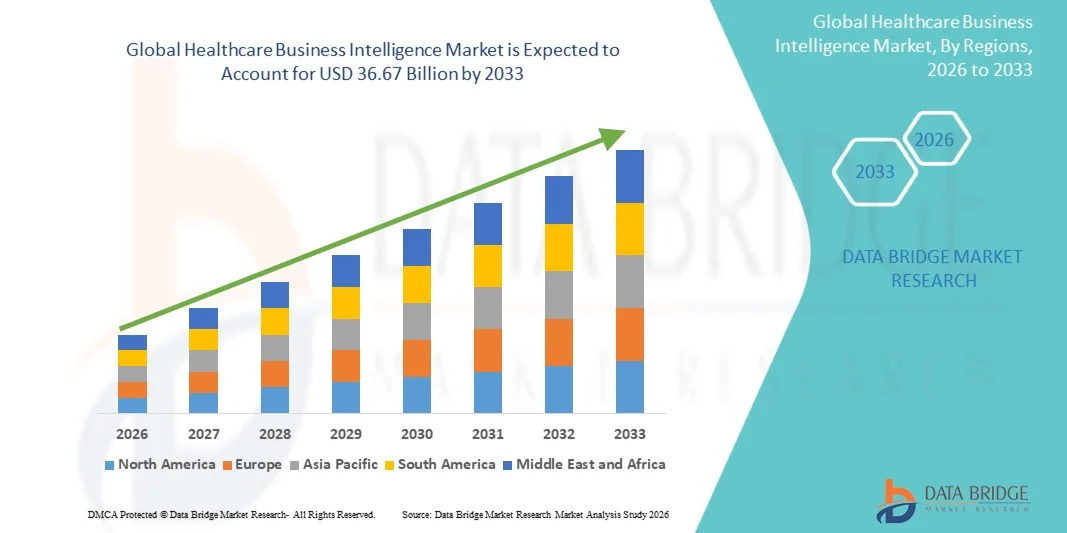
- The global healthcare business intelligence market size was valued at USD 12.37 billion in 2025 and is expected to reach USD 36.67 billion by 2033, at a CAGR of 14.55% during the forecast period
- The market growth is largely fueled by the growing adoption of data‑driven decision‑making, increasing penetration of cloud‑based BI tools, and the rising need to reduce healthcare operational costs and improve patient outcomes across providers, payers, and life sciences organizations
- Furthermore, the expansion of electronic health records (EHR) systems, stronger emphasis on analytics for financial, clinical, and operational insights, and investments in advanced technologies such as AI and machine learning are prompting healthcare stakeholders to deploy comprehensive BI solutions accelerating market uptake and significantly boosting industry growth
Healthcare Business Intelligence Market Analysis
- Healthcare business intelligence (BI) solutions, providing data-driven insights and analytics for clinical, operational, and financial decision-making, are increasingly essential in modern healthcare systems across hospitals, clinics, payers, and life sciences organizations due to their ability to improve patient outcomes, optimize workflows, and enhance cost-efficiency
- The escalating demand for healthcare business intelligence is primarily fueled by the growing adoption of electronic health records (EHRs), the need for data-driven decision-making, and the increasing emphasis on value-based care and regulatory compliance
- North America dominated the healthcare business intelligence market with the largest revenue share of 40.7% in 2025, characterized by early adoption of advanced analytics solutions, strong IT infrastructure, and the presence of key market players, with the U.S. experiencing substantial growth driven by investments in cloud-based platforms, performance management tools, and OLAP & visualization solutions
- Asia-Pacific is expected to be the fastest-growing region in the healthcare business intelligence market during the forecast period due to increasing digitization of healthcare systems, rising healthcare IT budgets, and growing awareness of analytics benefits among providers, payers, and health information exchanges (HIEs)
- Platform segment dominated the healthcare business intelligence market with a market share of 44.2% in 2025, driven by its critical role in integrating data sources, enabling query & reporting, and supporting operational, financial, and clinical analytics across diverse end-users such as providers, payers, and accountable care organizations (ACOs)
Report Scope and Healthcare Business Intelligence Market Segmentation
|
Attributes |
Healthcare Business Intelligence Key Market Insights |
|
Segments Covered |
|
|
Countries Covered |
North America
Europe
Asia-Pacific
Middle East and Africa
South America
|
|
Key Market Players |
|
|
Market Opportunities |
|
|
Value Added Data Infosets |
In addition to the insights on market scenarios such as market value, growth rate, segmentation, geographical coverage, and major players, the market reports curated by the Data Bridge Market Research also include in-depth expert analysis, patient epidemiology, pipeline analysis, pricing analysis, and regulatory framework |
Healthcare Business Intelligence Market Trends
“Advanced Analytics and AI-Driven Insights”
- A significant and accelerating trend in the global healthcare business intelligence market is the growing integration of artificial intelligence (AI) and machine learning into analytics platforms, enabling predictive insights and enhanced clinical, operational, and financial decision-making
- For instance, healthcare BI platforms now leverage AI to predict patient readmissions and optimize resource allocation, providing administrators and providers with actionable insights for improved patient outcomes
- AI integration enables features such as predictive modeling for disease management, anomaly detection in operational workflows, and automated report generation, while visualization tools allow stakeholders to interpret complex datasets more effectively
- The seamless integration of healthcare BI platforms with electronic health records (EHRs), laboratory systems, and payer databases facilitates centralized, real-time analytics across hospitals, clinics, and insurance organizations
- This trend toward more intelligent, data-driven, and interconnected healthcare analytics is reshaping decision-making processes, with companies developing AI-enabled solutions that provide predictive risk scores, operational dashboards, and automated alerts for clinical and financial management
- The demand for healthcare BI platforms offering AI and advanced analytics integration is rapidly growing across providers, payers, and HIEs, as organizations increasingly prioritize precision, efficiency, and cost-effective patient care
- Integration of natural language processing (NLP) in BI platforms is allowing providers to extract insights from unstructured clinical data, such as physician notes, enhancing both operational and clinical decision-making
Healthcare Business Intelligence Market Dynamics
Driver
“Rising Need for Data-Driven Decision-Making and Operational Efficiency”
- The increasing demand for improved patient outcomes, operational efficiency, and regulatory compliance is a significant driver for the adoption of healthcare business intelligence platforms
- For instance, in 2025, several U.S. hospitals implemented cloud-based BI platforms to monitor clinical quality metrics and reduce operational bottlenecks, enhancing resource allocation
- As healthcare providers and payers seek actionable insights from large volumes of clinical, financial, and operational data, BI platforms offer advanced reporting, visualization, and predictive modeling capabilities
- Furthermore, the adoption of EHRs and interoperability standards is making healthcare BI an essential tool for extracting meaningful insights from fragmented data sources across organizations
- Automated dashboards, real-time analytics, and decision-support tools enable providers, ACOs, and MCOs to optimize workflows, manage costs, and improve patient satisfaction, further propelling market growth
- The increasing focus on population health management and value-based care models is driving the need for advanced BI solutions to track outcomes and costs effectively
- Collaboration between payers and providers to share data securely for improved care coordination is further boosting adoption of integrated BI platforms
- The rising prevalence of chronic diseases is prompting healthcare organizations to adopt predictive analytics and BI tools to proactively manage patient care and resource utilization
Restraint/Challenge
“Data Privacy Concerns and Integration Complexities”
- Concerns regarding data privacy, security, and regulatory compliance present a significant challenge to the broader adoption of healthcare business intelligence solutions
- For instance, high-profile reports of healthcare data breaches have made some providers and payers hesitant to fully deploy cloud-based BI platforms due to fears of sensitive patient information exposure
- Ensuring HIPAA compliance, robust encryption, and secure authentication protocols is critical to build trust among healthcare organizations while addressing cybersecurity risks
- Additionally, integrating disparate data sources from hospitals, payers, and HIEs poses technical and operational challenges that can slow implementation and reduce efficiency gains
- The high initial cost of enterprise-grade BI platforms and the need for specialized IT personnel to manage complex deployments can also limit adoption, particularly in smaller healthcare facilities or in developing regions
- Lack of standardized data formats and inconsistent reporting across multiple healthcare systems can reduce the accuracy and effectiveness of BI analytics
- Resistance to change from clinical and administrative staff due to workflow disruptions or learning curves can delay adoption and limit the ROI of BI implementations
- Rapidly evolving healthcare regulations and compliance requirements can increase implementation complexity and necessitate frequent software updates, adding to operational challenges
Healthcare Business Intelligence Market Scope
The market is segmented on the basis of component, function, application, deployment, and end-user.
- By Component
On the basis of component, the healthcare business intelligence market is segmented into platforms, software, and services. The platform segment dominated the market with the largest market revenue share of 44.2% in 2025, driven by its ability to integrate multiple data sources, enable advanced analytics, and provide centralized dashboards for providers, payers, and HIEs. Platforms facilitate real-time monitoring of clinical, operational, and financial metrics, helping stakeholders optimize resource allocation and improve patient outcomes. Healthcare organizations often prefer platform solutions for their scalability, interoperability, and ability to support AI-driven insights. The growing need for centralized decision-making and predictive analytics further reinforces the dominance of platform-based BI solutions. Key vendors are continuously enhancing platform capabilities with cloud integration, advanced reporting tools, and AI-powered analytics to maintain their market leadership.
The services segment is anticipated to witness the fastest growth from 2026 to 2033, fueled by rising demand for implementation, consulting, and support services in healthcare BI deployments. Services help healthcare organizations with system integration, customization, training, and maintenance, ensuring that BI platforms and software deliver optimal value. The growth is also supported by the increasing adoption of cloud-based BI solutions, which require professional services for deployment, configuration, and data migration. Managed services enable smaller hospitals, ACOs, and MCOs to leverage BI tools without heavy upfront investments, accelerating adoption across multiple regions. The expansion of services also includes analytics-as-a-service offerings that deliver actionable insights without extensive internal IT infrastructure.
- By Function
On the basis of function, the market is segmented into query and reporting, online analytical processing (OLAP) and visualization, and performance management. The OLAP and visualization segment dominated the market with the largest share in 2025, driven by its ability to provide multidimensional data analysis, interactive dashboards, and intuitive visual representations of complex datasets. OLAP tools allow healthcare administrators to slice and dice clinical, operational, and financial data to identify trends, inefficiencies, and opportunities. Visualization enhances the interpretability of large-scale data, helping decision-makers quickly identify patterns in patient outcomes, cost centers, and resource utilization. Hospitals and payers increasingly rely on visualization tools for compliance reporting, performance tracking, and predictive modeling. Vendors continuously innovate OLAP platforms with AI-enhanced dashboards, interactive charts, and customizable reporting modules to strengthen market dominance. The combination of OLAP with predictive analytics supports real-time monitoring and evidence-based decisions, further driving adoption.
The performance management segment is expected to witness the fastest CAGR from 2026 to 2033, fueled by the growing need to measure and optimize clinical, financial, and operational performance. Performance management tools help providers, ACOs, and MCOs track KPIs, monitor care quality, and ensure alignment with value-based care initiatives. The rise of population health management and pay-for-performance programs further drives adoption, as organizations seek to improve outcomes while reducing costs. Performance management also supports strategic planning, budget allocation, and staff productivity optimization. Integration with EHRs and BI platforms enables real-time performance monitoring and automated reporting.
- By Application
On the basis of application, the market is segmented into financial analysis, operational analysis, and clinical analysis. The clinical analysis segment dominated the market in 2025 with a share of 42%, driven by the growing need for data-driven insights in patient care, treatment optimization, and population health management. Clinical analytics help providers reduce medical errors, monitor patient outcomes, and implement preventive care strategies effectively. Hospitals and HIEs increasingly rely on clinical analysis to identify high-risk patients, track disease trends, and improve the quality of care. Advanced clinical BI solutions integrate EHRs, lab results, and imaging data to generate actionable insights for physicians and care teams. Vendors are continuously enhancing clinical analytics with AI and predictive modeling to support personalized medicine. The emphasis on value-based care and regulatory compliance further strengthens the dominance of clinical analysis.
The financial analysis segment is expected to witness the fastest growth from 2026 to 2033, fueled by the need for cost optimization, revenue cycle management, and financial risk assessment. Financial BI tools help hospitals, payers, and MCOs analyze billing, reimbursements, and operational expenses. The shift toward value-based care and accountable care models increases demand for financial analytics to monitor performance against budgets and contracts. Integration with operational and clinical data provides holistic insights into cost-effectiveness and resource utilization. Growing adoption of cloud-based financial BI solutions enables real-time tracking and scenario planning. Financial analytics also supports strategic planning, procurement decisions, and capital investments in healthcare facilities.
- By Deployment
On the basis of deployment, the market is segmented into on-premise model, cloud-based model, and hybrid model. The on-premise segment dominated the market in 2025, driven by concerns regarding data security, compliance, and control over sensitive patient information. On-premise deployments allow hospitals and large providers to maintain data internally while leveraging BI tools for analytics and reporting. Organizations with established IT infrastructure often prefer on-premise solutions for customization, integration, and performance optimization. On-premise BI solutions also support complex workflows and legacy system compatibility in large healthcare networks. Vendors offer enhanced support, security protocols, and integration capabilities to strengthen on-premise adoption. The dominance of this segment is reinforced by the preference of large-scale healthcare organizations for stable, secure, and customizable BI environments.
The cloud-based deployment segment is expected to witness the fastest CAGR from 2026 to 2033, fueled by rising adoption among small and mid-sized hospitals, ACOs, and TPAs seeking scalable, cost-effective, and real-time analytics. Cloud-based BI reduces upfront IT infrastructure costs and enables rapid deployment, remote access, and easier system upgrades. Cloud solutions also support interoperability with EHRs, payer systems, and HIEs. The trend toward AI-enabled, real-time analytics and data-sharing capabilities accelerates cloud adoption. Growing confidence in cloud security, compliance certifications, and managed services further drives this segment. Hybrid models combining on-premise and cloud are emerging but cloud-only solutions remain the fastest-growing deployment model.
- By End-User
On the basis of end-user, the market is segmented into payers, providers, HIEs, ACOs, MCOs, and TPAs. The providers segment dominated the market in 2025 with the largest share, driven by the need to monitor clinical operations, improve patient care, and optimize hospital resource utilization. Hospitals and clinics deploy BI platforms to track performance metrics, identify operational inefficiencies, and implement evidence-based clinical practices. Providers increasingly adopt predictive analytics and dashboards for real-time decision-making and patient management. Integration with EHRs and laboratory systems enhances operational visibility and care coordination. Vendor solutions tailored for providers include AI-enabled clinical insights, population health monitoring, and workflow automation. The dominance is further strengthened by increasing digital transformation initiatives in large hospitals and health systems.
The payers segment is expected to witness the fastest growth from 2026 to 2033, fueled by the increasing demand for cost optimization, claims management, and fraud detection. Payers leverage BI tools to analyze large volumes of claims and member data to identify trends, reduce errors, and improve reimbursement efficiency. The shift toward value-based care and accountable care programs increases reliance on BI analytics for monitoring provider performance and managing population health outcomes. Cloud-based BI solutions facilitate real-time reporting and collaboration with providers and TPAs. Growth in managed care organizations and third-party administrators adopting BI further accelerates this segment.
Healthcare Business Intelligence Market Regional Analysis
- North America dominated the healthcare business intelligence market with the largest revenue share of 40.7% in 2025, characterized by early adoption of advanced analytics solutions, strong IT infrastructure, and the presence of key market players
- Healthcare organizations in the region highly value the ability of BI solutions to improve clinical decision-making, optimize operational efficiency, and enhance financial performance through real-time analytics and predictive insights
- This widespread adoption is further supported by high healthcare IT budgets, a technology-savvy workforce, and growing emphasis on value-based care and regulatory compliance, establishing healthcare BI platforms as essential tools for providers, payers, and health information exchanges (HIEs)
U.S. Healthcare Business Intelligence Market Insight
The U.S. healthcare business intelligence market captured the largest revenue share of 42% in 2025 within North America, fueled by the rapid adoption of advanced analytics platforms and widespread deployment of electronic health records (EHRs). Providers, payers, and health information exchanges (HIEs) are increasingly prioritizing data-driven decision-making to improve patient outcomes, reduce operational inefficiencies, and manage costs. The growing demand for cloud-based solutions, predictive analytics, and AI-enabled BI tools further propels market growth. Moreover, strong investments in healthcare IT infrastructure and the push toward value-based care are significantly contributing to the expansion of the U.S. healthcare BI market.
Europe Healthcare Business Intelligence Market Insight
The Europe healthcare business intelligence market is projected to expand at a substantial CAGR throughout the forecast period, primarily driven by stringent regulatory requirements, the increasing emphasis on patient care quality, and the need for cost-efficient operations. The growing adoption of connected hospital systems and interoperability standards is fostering the use of BI platforms. European providers and payers are also leveraging advanced analytics for population health management, clinical quality monitoring, and financial performance optimization. The region is witnessing significant growth across hospitals, clinics, and ACOs, with BI solutions being integrated into both existing IT infrastructure and new healthcare projects.
U.K. Healthcare Business Intelligence Market Insight
The U.K. healthcare business intelligence market is anticipated to grow at a noteworthy CAGR during the forecast period, driven by the adoption of data-driven clinical and operational decision-making and the increasing focus on reducing healthcare costs. Additionally, the shift toward value-based care and regulatory compliance is encouraging providers, payers, and managed care organizations to implement advanced BI solutions. The U.K.’s well-established healthcare IT ecosystem and increasing use of cloud-based platforms are expected to continue stimulating market growth. Adoption is also supported by robust healthcare IT infrastructure and rising investments in AI-powered analytics tools.
Germany Healthcare Business Intelligence Market Insight
The Germany healthcare business intelligence market is expected to expand at a considerable CAGR during the forecast period, fueled by the country’s focus on digital healthcare transformation and adoption of interoperable analytics solutions. Providers, payers, and hospitals are increasingly leveraging BI tools to optimize clinical outcomes, financial management, and operational efficiency. Germany’s advanced healthcare infrastructure, emphasis on innovation, and regulatory support for digitalization promote adoption, particularly in large hospitals and multi-site healthcare systems. The integration of BI platforms with EHRs and other digital systems is becoming increasingly prevalent, aligning with local priorities on data security, compliance, and quality of care.
Asia-Pacific Healthcare Business Intelligence Market Insight
The Asia-Pacific healthcare business intelligence market is poised to grow at the fastest CAGR of 23% during the forecast period of 2026 to 2033, driven by rapid urbanization, rising healthcare IT budgets, and increasing digitization in countries such as China, Japan, and India. The region's growing focus on smart hospitals, government initiatives promoting healthcare analytics, and adoption of cloud-based BI platforms are driving market growth. Furthermore, increasing awareness of data-driven decision-making for improving patient outcomes and operational efficiency is accelerating adoption across providers, payers, and health systems. The expansion of regional IT infrastructure and the availability of cost-effective BI solutions are further enabling market penetration.
Japan Healthcare Business Intelligence Market Insight
The Japan healthcare business intelligence market is gaining momentum due to the country’s advanced healthcare IT infrastructure, emphasis on quality care, and aging population driving demand for predictive and operational analytics. Providers and payers are increasingly adopting BI solutions to monitor clinical performance, manage costs, and optimize resource allocation. The integration of BI platforms with EHRs, laboratory systems, and IoT-enabled hospital devices is fueling growth. Additionally, the country’s focus on innovative digital health initiatives and smart hospital programs is supporting adoption in both residential and institutional healthcare settings.
India Healthcare Business Intelligence Market Insight
The India healthcare business intelligence market accounted for the largest market revenue share in Asia-Pacific in 2025, attributed to the country’s expanding healthcare IT adoption, increasing hospital digitization, and government initiatives promoting smart healthcare. India stands as one of the largest emerging markets for healthcare analytics, with providers, payers, and TPAs increasingly leveraging BI platforms for operational, clinical, and financial decision-making. The push toward smart hospitals, affordable BI solutions, and growing awareness of data-driven healthcare management are key factors propelling market growth. The presence of domestic IT service providers and cloud-based offerings further accelerates adoption across urban and semi-urban regions.
Healthcare Business Intelligence Market Share
The Healthcare Business Intelligence industry is primarily led by well-established companies, including:
- Microsoft Corporation (U.S.)
- International Business Machines Corporation (U.S.)
- Oracle Corporation (U.S.)
- SAP SE (Germany)
- SAS Institute Inc. (U.S.)
- Tableau Software LLC (U.S.)
- QlikTech International AB (U.S.)
- MicroStrategy Incorporated (U.S.)
- Sisense Inc. (U.S.)
- Domo, Inc. (U.S.)
- Health Catalyst, Inc. (U.S.)
- MedeAnalytics, Inc. (U.S.)
- Infor, Inc. (U.S.)
- Yellowfin BI Pty Ltd (Australia)
- BOARD International SA (Switzerland)
- CitiusTech Inc. (India)
- Truveta, Inc. (U.S.)
- CareCloud, Inc. (U.S.)
- IQVIA Holdings, Inc. (U.S.)
- Optum, Inc. (U.S.)
What are the Recent Developments in Global Healthcare Business Intelligence Market?
- In July 2025, Waystar, a major healthcare software solutions provider, announced the acquisition of Iodine Software for about USD 1.25 billion, expanding its AI‑driven documentation, revenue cycle, and claims analytics capabilities a move that strengthens analytics and BI tools for hospitals and healthcare providers
- In May 2025, Innovaccer launched Innovaccer Gravity™, a new cloud‑agnostic healthcare intelligence platform designed to unify clinical, financial, and operational data, accelerate AI adoption in healthcare analytics, and help organizations drive faster ROI and more scalable BI deployment across systems
- In April 2025, Microsoft unveiled Copilot Health, a new AI‑powered health tool that can interpret medical records and provide personalized health insights blending BI, AI, and healthcare data to support clinical and patient engagement workflows at scale.
- In January 2025, Innovaccer secured a large Series F funding round led by Kaiser Permanente and including Microsoft’s venture arm, boosting its healthcare intelligence cloud capabilities and signaling strong investment momentum in BI and data platforms for healthcare providers and payers
- In October 2023, Truveta launched its Truveta Language Model, a large‑language AI model to structure and interpret clinical data from electronic health records, enabling improved BI‑like analytics for research and data‑driven decision‑making across health systems
SKU-
Получите онлайн-доступ к отчету на первой в мире облачной платформе рыночной аналитики

- Интерактивная панель анализа данных
- Панель анализа компании для возможностей с высоким потенциалом роста
- Доступ аналитика-исследователя для настройки и запросов
- Анализ конкурентов с помощью интерактивной панели
- Последние новости, обновления и анализ тенденций
- Используйте возможности сравнительного анализа для комплексного отслеживания конкурентов
Методология исследования
Сбор данных и анализ базового года выполняются с использованием модулей сбора данных с большими размерами выборки. Этап включает получение рыночной информации или связанных данных из различных источников и стратегий. Он включает изучение и планирование всех данных, полученных из прошлого заранее. Он также охватывает изучение несоответствий информации, наблюдаемых в различных источниках информации. Рыночные данные анализируются и оцениваются с использованием статистических и последовательных моделей рынка. Кроме того, анализ доли рынка и анализ ключевых тенденций являются основными факторами успеха в отчете о рынке. Чтобы узнать больше, пожалуйста, запросите звонок аналитика или оставьте свой запрос.
Ключевой методологией исследования, используемой исследовательской группой DBMR, является триангуляция данных, которая включает в себя интеллектуальный анализ данных, анализ влияния переменных данных на рынок и первичную (отраслевую экспертную) проверку. Модели данных включают сетку позиционирования поставщиков, анализ временной линии рынка, обзор рынка и руководство, сетку позиционирования компании, патентный анализ, анализ цен, анализ доли рынка компании, стандарты измерения, глобальный и региональный анализ и анализ доли поставщика. Чтобы узнать больше о методологии исследования, отправьте запрос, чтобы поговорить с нашими отраслевыми экспертами.
Доступна настройка
Data Bridge Market Research является лидером в области передовых формативных исследований. Мы гордимся тем, что предоставляем нашим существующим и новым клиентам данные и анализ, которые соответствуют и подходят их целям. Отчет можно настроить, включив в него анализ ценовых тенденций целевых брендов, понимание рынка для дополнительных стран (запросите список стран), данные о результатах клинических испытаний, обзор литературы, обновленный анализ рынка и продуктовой базы. Анализ рынка целевых конкурентов можно проанализировать от анализа на основе технологий до стратегий портфеля рынка. Мы можем добавить столько конкурентов, о которых вам нужны данные в нужном вам формате и стиле данных. Наша команда аналитиков также может предоставить вам данные в сырых файлах Excel, сводных таблицах (книга фактов) или помочь вам в создании презентаций из наборов данных, доступных в отчете.











