



Global Industrial Wearable Devices Market Segmentation, By Product Type (Wrist Computers, Ring Scanners, Smart Terminals, and Smart Glasses), Application (Warehouse Management, Training and Simulation, and Service and Maintenance), End Users (Transport and logistics, Retail, Manufacturing, Healthcare, and Others) – Industry Trends and Forecast to 2032
Industrial Wearable Devices Market Analysis
The industrial wearable devices market is experiencing robust growth, driven by advancements in technology and the increasing adoption of automation across industries. These devices, including smart glasses, wearable scanners, and wrist computers, enhance worker productivity, safety, and efficiency by providing real-time data, hands-free operation, and remote communication capabilities. Industries such as manufacturing, logistics, construction, and healthcare are leveraging wearable devices to streamline operations, reduce errors, and ensure compliance with safety standards. Recent advancements in the market include the integration of artificial intelligence (AI), augmented reality (AR), and the Internet of Things (IoT) into wearable devices. For instance, smart glasses equipped with AR provide on-site workers with visual guidance, reducing downtime and improving task accuracy. Similarly, wearable barcode scanners and smart terminals enhance inventory management in warehouses. These innovations have transformed industrial workflows by enabling faster decision-making and improving operational efficiency. Geographically, North America leads the market due to technological advancements and extensive industrial applications, while Asia-Pacific is the fastest-growing region, fueled by rapid industrialization and government initiatives promoting smart manufacturing. These trends highlight the pivotal role of wearable devices in modernizing industrial processes.
Industrial Wearable Devices Market Size
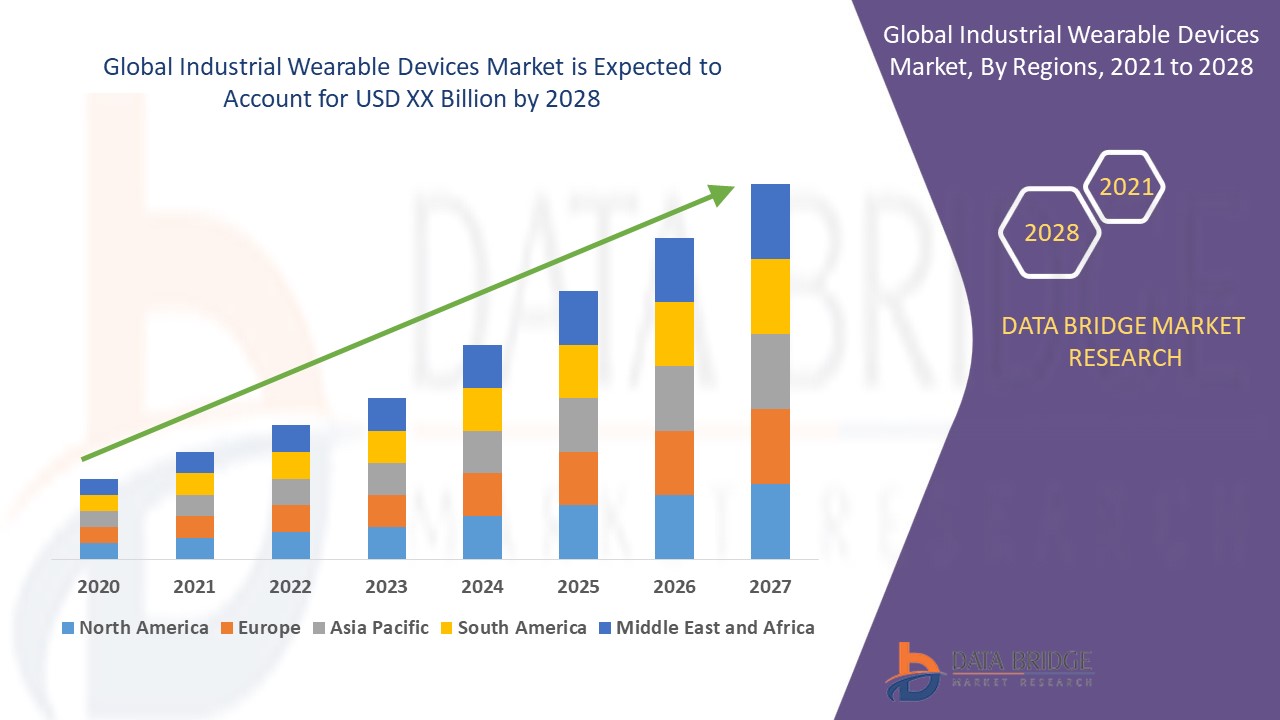
The global industrial wearable devices market size was valued at USD 11.29 billion in 2024 and is projected to reach USD 36.50 billion by 2032, with a CAGR of 18.24% during the forecast period of 2025 to 2032. In addition to the insights on market scenarios such as market value, growth rate, segmentation, geographical coverage, and major players, the market reports curated by the Data Bridge Market Research also include in-depth expert analysis, pricing analysis, brand share analysis, consumer survey, demography analysis, supply chain analysis, value chain analysis, raw material/consumables overview, vendor selection criteria, PESTLE Analysis, Porter Analysis, and regulatory framework.
Industrial Wearable Devices Market Trends
“Adoption of Augmented Reality (AR)-Enabled Smart Glasses”
The industrial wearable devices market is witnessing a significant trend in the adoption of augmented reality (AR)-enabled smart glasses, transforming operational workflows across industries. These devices combine hands-free functionality with real-time visual guidance, making them indispensable in sectors such as manufacturing, logistics, and maintenance. For instance, Vuzix smart glasses, equipped with AR, allow technicians to access digital schematics and step-by-step instructions directly in their field of vision, reducing downtime and improving task accuracy. This integration of AR technology enhances worker productivity, minimizes errors, and supports remote assistance, addressing the growing demand for efficient and streamlined industrial operations. In addition, the rise of Industry 4.0 has amplified the role of AR-enabled wearables, as companies focus on digital transformation to meet competitive pressures. This trend highlights the increasing reliance on innovative technologies such as smart glasses to optimize processes, ensuring the industrial wearable devices market continues to expand at a robust pace.
Report Scope and Industrial Wearable Devices Market Segmentation
|
Attributes |
Industrial Wearable Devices Key Market Insights |
|
Segments Covered |
|
|
Countries Covered |
U.S., Canada and Mexico in North America, Germany, France, U.K., Netherlands, Switzerland, Belgium, Russia, Italy, Spain, Turkey, Rest of Europe in Europe, China, Japan, India, South Korea, Singapore, Malaysia, Australia, Thailand, Indonesia, Philippines, Rest of Asia-Pacific (APAC) in the Asia-Pacific (APAC), Saudi Arabia, U.A.E., South Africa, Egypt, Israel, Rest of Middle East and Africa (MEA) as a part of Middle East and Africa (MEA), Brazil, Argentina and Rest of South America as part of South America |
|
Key Market Players |
Epson India Pvt. Ltd. (India), Apple Inc. (U.S.), Fujitsu (Japan), Microsoft (U.S.), Zebra Technologies Corp. (U.S.), Google (U.S.), ASUSTeK Computer Inc. (Taiwan), Vuzix (U.S.), OMRON Corporation (Japan), Fitbit, Inc. (U.S.), Honeywell International Inc. (U.S.), AMIT International Group (United Arab Emirates), Nike, Inc. (U.S.), Motorola Mobility LLC (U.S.), Samsung (South Korea), Koninklijke Philips N.V. (Netherlands), Eurotech S.p.A. (Italy), LG Electronics (South Korea), Sony India (India), and Xiaomi (China) |
|
Market Opportunities |
|
|
Value Added Data Infosets |
In addition to the insights on market scenarios such as market value, growth rate, segmentation, geographical coverage, and major players, the market reports curated by the Data Bridge Market Research also include in-depth expert analysis, pricing analysis, brand share analysis, consumer survey, demography analysis, supply chain analysis, value chain analysis, raw material/consumables overview, vendor selection criteria, PESTLE Analysis, Porter Analysis, and regulatory framework. |
Industrial Wearable Devices Market Definition
Industrial Wearable Devices are technologically advanced wearable gadgets designed to enhance productivity, safety, and efficiency in industrial settings. These devices, which include smart glasses, wrist computers, wearable scanners, and other hands-free tools, provide real-time data, enable seamless communication, and support automation across industries such as manufacturing, logistics, construction, and healthcare.
Industrial Wearable Devices Market Dynamics
Drivers
- Rise of Industry 4.0 and Digital Transformation Initiatives
The rise of Industry 4.0 and digital transformation initiatives across various sectors is a key driver for the growing demand for industrial wearable devices. As companies increasingly integrate automation, IoT, and data analytics into their operations, wearable technologies play a crucial role in optimizing efficiency and productivity. For instance, Zebra Technologies offers wearable scanners and smart devices that allow warehouse workers to access real-time inventory data without needing to pause their tasks, significantly improving speed and accuracy in logistics operations. These advancements in connectivity and automation streamline workflows and enhance decision-making and reduce human error. The need for seamless integration between physical and digital environments has made wearable devices an essential tool for businesses striving to remain competitive in the era of Industry 4.0. This growing reliance on connected, data-driven devices directly links the rapid adoption of wearable technologies to market growth, further solidifying it as a key driver in the industrial sector.
- Rapidly Rising E-Commerce Industry
The rapidly rising e-commerce industry is significantly driving the demand for industrial wearable devices, particularly in logistics and warehouse management. As online shopping continues to grow, e-commerce companies are increasingly turning to wearable technologies to streamline operations, enhance inventory management, and improve delivery efficiency. For instance, Zebra Technologies offers wearable barcode scanners that help warehouse workers quickly process orders and locate products, reducing fulfillment time and increasing accuracy. In addition, wearables equipped with augmented reality (AR) allow employees to navigate large warehouses more efficiently, boosting productivity and reducing errors. With the surge in e-commerce sales, the need for optimized logistics operations has become more urgent, making wearable devices crucial for managing the increased volume of shipments. As e-commerce giants such as Amazon expand their operations globally, the integration of wearable devices has become a pivotal element in ensuring swift and accurate order fulfillment, solidifying the growing role of wearables in the sector and driving market expansion.
Opportunities
- Growing Emphasis on Operational Efficiency
The growing emphasis on operational efficiency in industries such as logistics, manufacturing, and maintenance has created a strong market opportunity for wearable devices that enable seamless communication and hands-free operation. These devices streamline workflows by allowing workers to access real-time data, receive instructions, and communicate without interrupting their tasks. For instance, Honeywell's smart wearable devices provide workers with real-time alerts, sensor data, and communication capabilities directly in their field of vision, improving task efficiency and minimizing errors. In manufacturing, wearable barcode scanners allow employees to track inventory or complete quality checks without needing to pause for manual data entry, which accelerates processes and improves accuracy. This focus on efficiency is driving the adoption of wearable devices, as companies seek ways to optimize operations, reduce downtime, and enhance productivity. As businesses continue to prioritize operational excellence, the demand for wearable technologies that improve workflow efficiency is expected to grow, making it a significant market opportunity.
- Rising Innovations in Technologies
Innovations in augmented reality (AR), artificial intelligence (AI), and the Internet of Things (IoT) are unlocking significant market opportunities for the development of more advanced and sophisticated industrial wearables. These technologies enable companies to improve operational efficiency, enhance productivity, and reduce errors. For instance, Vuzix's AR-enabled smart glasses offer workers real-time visual guidance, such as instructions and system diagnostics, directly in their line of sight, which helps in complex tasks and minimizes the need for constant supervisor intervention. Furthermore, AI algorithms can analyze data from wearables to predict maintenance needs, optimizing equipment performance and preventing costly breakdowns. As IoT integration allows for seamless data sharing between devices and systems, wearables can offer instant feedback and actionable insights, facilitating quicker decision-making. These technological advancements present a major market opportunity, as industries such as manufacturing, logistics, and healthcare increasingly rely on smart wearables to streamline operations, reduce costs, and gain a competitive edge in the digital age.
Restraints/Challenges
- Competition from Alternatives
Competition from alternatives is a significant challenge for the Industrial Wearable Devices market, as consumers increasingly turn to products such as silicone pads, absorbent drinkware, and other protective materials that offer versatility, ease of use, and cost-effectiveness. For instance, silicone drink mats are lightweight, easy to clean, and more flexible in design compared to traditional coasters made from cork, wood, or ceramic, which require more intricate manufacturing processes. In addition, absorbent drinkware, such as cups or mugs with built-in coaster functions, can eliminate the need for a separate coaster altogether, providing a more convenient solution for consumers. These alternatives are often simpler to produce and can be marketed as multi-functional products, leading to increased consumer preference. As a result, traditional coaster manufacturers face pressure to innovate and find ways to differentiate their products, whether through unique designs or the use of more sustainable materials, to maintain their market share. This shift towards more versatile alternatives, combined with their lower production costs, presents a significant market challenge for companies focusing solely on Industrial Wearable Devices.
- Stringent Laws and Regulations
Regulatory compliance is a major challenge in the Industrial Wearable Devices market, as manufacturers face growing demands to adhere to stricter regulations on material sourcing, packaging, and environmental impact. For instance, many countries have introduced more stringent laws regarding the use of non-recyclable or harmful materials, such as certain plastics, which forces coaster producers to seek alternative, eco-friendly materials such as bamboo, cork, or recycled fibers. In addition, regulations around product packaging are becoming more rigid, requiring companies to use biodegradable or recyclable packaging instead of single-use plastics. These changes can lead to increased production costs, as sustainable materials often come at a higher price, and manufacturers must invest in new processes or technologies to meet these standards. Compliance with international environmental regulations, such as the European Union’s REACH (Registration, Evaluation, Authorization, and Restriction of Chemicals) and other local laws, can also complicate export operations and supply chain logistics. These additional costs and operational complexities can create financial strain, particularly for smaller manufacturers, and hinder the ability to compete in a market that is increasingly prioritizing environmental sustainability.
This market report provides details of new recent developments, trade regulations, import-export analysis, production analysis, value chain optimization, market share, impact of domestic and localized market players, analyses opportunities in terms of emerging revenue pockets, changes in market regulations, strategic market growth analysis, market size, category market growths, application niches and dominance, product approvals, product launches, geographic expansions, technological innovations in the market. To gain more info on the market contact Data Bridge Market Research for an Analyst Brief, our team will help you take an informed market decision to achieve market growth.
Impact and Current Market Scenario of Raw Material Shortage and Shipping Delays
Data Bridge Market Research offers a high-level analysis of the market and delivers information by keeping in account the impact and current market environment of raw material shortage and shipping delays. This translates into assessing strategic possibilities, creating effective action plans, and assisting businesses in making important decisions.
Apart from the standard report, we also offer in-depth analysis of the procurement level from forecasted shipping delays, distributor mapping by region, commodity analysis, production analysis, price mapping trends, sourcing, category performance analysis, supply chain risk management solutions, advanced benchmarking, and other services for procurement and strategic support.
Expected Impact of Economic Slowdown on the Pricing and Availability of Products
When economic activity slows, industries begin to suffer. The forecasted effects of the economic downturn on the pricing and accessibility of the products are taken into account in the market insight reports and intelligence services provided by DBMR. With this, our clients can typically keep one step ahead of their competitors, project their sales and revenue, and estimate their profit and loss expenditures.
Industrial Wearable Devices Market Scope
The market is segmented on the basis of product type, application, and end users. The growth amongst these segments will help you analyse meagre growth segments in the industries and provide the users with a valuable market overview and market insights to help them make strategic decisions for identifying core market applications.
Product Type
- Wrist Computers
- Ring Scanners
- Smart Terminals
- Smart Glasses
Application
- Warehouse Management
- Training and Simulation
- Service and Maintenance
End Users
- Transport and Logistics
- Retail
- Manufacturing
- Healthcare
- Others
Industrial Wearable Devices Market Regional Analysis
The market is analysed and market size insights and trends are provided by country, product type, application, and end users as referenced above.
The countries covered in the market report are U.S., Canada and Mexico in North America, Germany, France, U.K., Netherlands, Switzerland, Belgium, Russia, Italy, Spain, Turkey, Rest of Europe in Europe, China, Japan, India, South Korea, Singapore, Malaysia, Australia, Thailand, Indonesia, Philippines, Rest of Asia-Pacific (APAC) in the Asia-Pacific (APAC), Saudi Arabia, U.A.E., South Africa, Egypt, Israel, Rest of Middle East and Africa (MEA) as a part of Middle East and Africa (MEA), Brazil, Argentina and Rest of South America as part of South America.
North America dominates the industrial wearable devices market, driven by a surge in construction activities and advancements in warehouse management technologies. The region has witnessed a significant adoption of wearable devices, such as barcode scanners, to streamline operations in warehousing and storage facilities. These devices enhance efficiency, reduce errors, and improve inventory management, making them indispensable in industrial settings. In addition, the robust infrastructure and technological advancements in North America further support the widespread integration of wearable devices across various industries.
Asia-Pacific is the fastest-growing region in the industrial wearable devices market, fueled by rapid industrialization, technological advancements, and increasing adoption of automation across key sectors. The region's booming manufacturing and logistics industries are driving the demand for wearable technologies that enhance worker productivity and safety. Countries such as China, India, and Japan are at the forefront of this growth, supported by government initiatives to promote smart manufacturing and the integration of advanced technologies. This dynamic market expansion underscores Asia-Pacific's pivotal role in shaping the future of industrial wearables.
The country section of the report also provides individual market impacting factors and changes in regulation in the market domestically that impacts the current and future trends of the market. Data points such as down-stream and upstream value chain analysis, technical trends and porter's five forces analysis, case studies are some of the pointers used to forecast the market scenario for individual countries. Also, the presence and availability of global brands and their challenges faced due to large or scarce competition from local and domestic brands, impact of domestic tariffs and trade routes are considered while providing forecast analysis of the country data.
Industrial Wearable Devices Market Share
The market competitive landscape provides details by competitor. Details included are company overview, company financials, revenue generated, market potential, investment in research and development, new market initiatives, global presence, production sites and facilities, production capacities, company strengths and weaknesses, product launch, product width and breadth, application dominance. The above data points provided are only related to the companies' focus related to market.
Industrial Wearable Devices Market Leaders Operating in the Market Are:
- Epson India Pvt. Ltd. (India)
- Apple Inc. (U.S.)
- Fujitsu (Japan)
- Microsoft (U.S.)
- Zebra Technologies Corp. (U.S.)
- Google (U.S.)
- ASUSTeK Computer Inc. (Taiwan)
- Vuzix (U.S.)
- OMRON Corporation (Japan)
- Fitbit, Inc. (U.S.)
- Honeywell International Inc. (U.S.)
- AMIT International Group (United Arab Emirates)
- Nike, Inc. (U.S.)
- Motorola Mobility LLC (U.S.)
- Samsung (South Korea)
- Koninklijke Philips N.V. (Netherlands)
- Eurotech S.p.A. (Italy)
- LG Electronics (South Korea)
- Sony India (India)
- Xiaomi (China)
Latest Developments in Industrial Wearable Devices Market
- In August 2024, Huawei Technologies Co., Ltd. unveiled the HUAWEI TruSense System, incorporating advancements in electrical, material science, and optical technology. This system can monitor over 60 fitness indicators across six major body systems, including emotional well-being, providing a holistic health monitoring experience
- In April 2024, SKLZ, a leading brand in sports technology and training products, launched the SKLZ Hyper Speed wearable device. This product is designed to assist athletes by accurately tracking and monitoring speed, agility, and vertical jump performance
- In April 2023, QMS MAS (Medical Allied Services), in collaboration with Varanium Cloud Ltd., introduced a range of products under the Q Devices banner, including "Vyana," a groundbreaking medical wearable. Vyana continuously monitors critical health parameters, sends real-time alerts, and connects users to emergency contacts during significant fluctuations
- In April 2023, Xiaomi released the Mi Band 8 smart wearable device, featuring a tablet-shaped AMOLED display. Unlike previous models, the bands attach on both sides of the device, enhancing comfort and design flexibility
- In September 2022, Apple launched the Apple Watch Series 8 and Apple Watch SE, offering upgraded technology, enhanced performance, and improved safety features. The Apple Watch Series 8 boasts a large, durable, shatter-resistant front glass and an always-on Retina display for an elevated user experience
SKU-
Получите онлайн-доступ к отчету на первой в мире облачной платформе рыночной аналитики

- Интерактивная панель анализа данных
- Панель анализа компании для возможностей с высоким потенциалом роста
- Доступ аналитика-исследователя для настройки и запросов
- Анализ конкурентов с помощью интерактивной панели
- Последние новости, обновления и анализ тенденций
- Используйте возможности сравнительного анализа для комплексного отслеживания конкурентов
Методология исследования
Сбор данных и анализ базового года выполняются с использованием модулей сбора данных с большими размерами выборки. Этап включает получение рыночной информации или связанных данных из различных источников и стратегий. Он включает изучение и планирование всех данных, полученных из прошлого заранее. Он также охватывает изучение несоответствий информации, наблюдаемых в различных источниках информации. Рыночные данные анализируются и оцениваются с использованием статистических и последовательных моделей рынка. Кроме того, анализ доли рынка и анализ ключевых тенденций являются основными факторами успеха в отчете о рынке. Чтобы узнать больше, пожалуйста, запросите звонок аналитика или оставьте свой запрос.
Ключевой методологией исследования, используемой исследовательской группой DBMR, является триангуляция данных, которая включает в себя интеллектуальный анализ данных, анализ влияния переменных данных на рынок и первичную (отраслевую экспертную) проверку. Модели данных включают сетку позиционирования поставщиков, анализ временной линии рынка, обзор рынка и руководство, сетку позиционирования компании, патентный анализ, анализ цен, анализ доли рынка компании, стандарты измерения, глобальный и региональный анализ и анализ доли поставщика. Чтобы узнать больше о методологии исследования, отправьте запрос, чтобы поговорить с нашими отраслевыми экспертами.
Доступна настройка
Data Bridge Market Research является лидером в области передовых формативных исследований. Мы гордимся тем, что предоставляем нашим существующим и новым клиентам данные и анализ, которые соответствуют и подходят их целям. Отчет можно настроить, включив в него анализ ценовых тенденций целевых брендов, понимание рынка для дополнительных стран (запросите список стран), данные о результатах клинических испытаний, обзор литературы, обновленный анализ рынка и продуктовой базы. Анализ рынка целевых конкурентов можно проанализировать от анализа на основе технологий до стратегий портфеля рынка. Мы можем добавить столько конкурентов, о которых вам нужны данные в нужном вам формате и стиле данных. Наша команда аналитиков также может предоставить вам данные в сырых файлах Excel, сводных таблицах (книга фактов) или помочь вам в создании презентаций из наборов данных, доступных в отчете.











