



Global Women’s Luxury Footwear Market Segmentation, By Product (Formal Shoes, Casual Shoes, and Athletic), Material (Leather and Non-leather), Distribution Channel (Brand Store, Specialty Store, and Online Sales Channel) - Industry Trends and Forecast to 2032
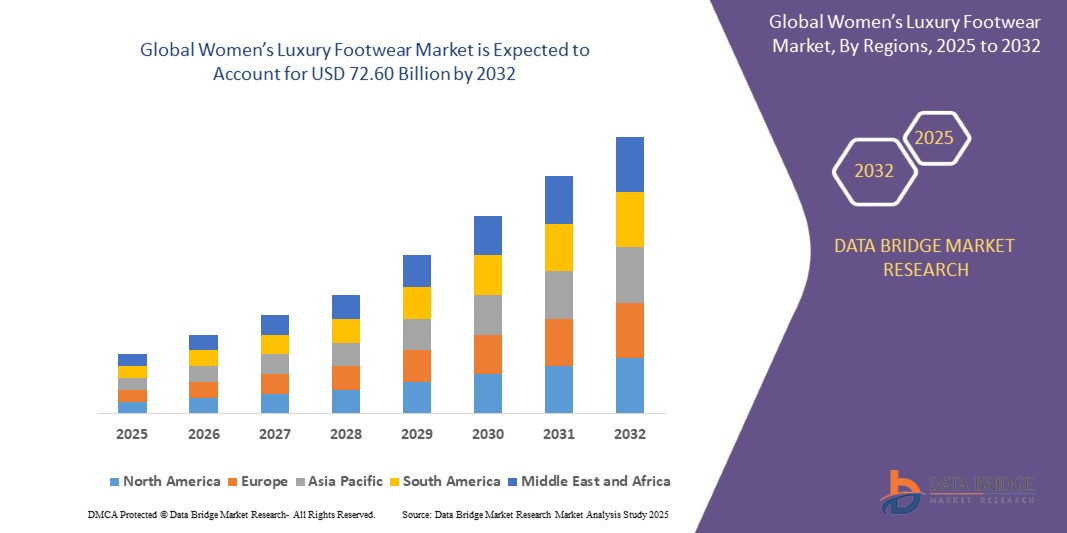
Women’s Luxury Footwear Market Size
- The global women’s luxury footwear market size was valued at USD 38.64 billion in 2024 and is expected to reach USD 72.60 billion by 2032, at a CAGR of 8.20% during the forecast period
- The market growth is largely fueled by the rising consumer inclination toward high-end fashion, increasing disposable incomes, and expanding urban populations seeking premium and statement footwear options for both formal and casual occasions
- Furthermore, the growing influence of social media, celebrity endorsements, and fashion-forward marketing is reinforcing luxury footwear as a key element of personal style and status, thereby accelerating demand across emerging and developed markets
Women’s Luxury Footwear Market Analysis
- Women’s luxury footwear encompasses premium-quality shoes crafted with superior materials, exceptional design, and brand prestige, including formal, casual, and fashion-forward athletic styles. These products are positioned as lifestyle statements, often reflecting exclusivity, craftsmanship, and evolving fashion trends
- The accelerating demand for women’s luxury footwear is driven by a strong focus on aesthetics, sustainability, and comfort, coupled with the expansion of digital retail channels that provide consumers easier access to exclusive collections and limited-edition releases
- North America dominated women’s luxury footwear market with a share of 30.5% in 2024, due to strong consumer spending on high-end fashion and a mature luxury retail ecosystem
- Europe is expected to be the fastest growing region in the women’s luxury footwear market during the forecast period due to the region's deep-rooted fashion heritage and dominance of high-end designer brands
- Leather segment dominated the market with a market share of 68.8% in 2024, due to its long-standing association with premium quality, durability, and timeless appeal. Luxury footwear brands continue to favor leather for its versatility in design and superior finish, especially in formal and high-fashion collections. Consumers often perceive leather footwear as a long-term investment, especially those handcrafted by renowned fashion houses in Italy and France, which enhances the segment’s value proposition
Report Scope and Women’s Luxury Footwear Market Segmentation
|
Attributes |
Women’s Luxury Footwear Key Market Insights |
|
Segments Covered |
|
|
Countries Covered |
North America
Europe
Asia-Pacific
Middle East and Africa
South America
|
|
Key Market Players |
|
|
Market Opportunities |
|
|
Value Added Data Infosets |
In addition to the insights on market scenarios such as market value, growth rate, segmentation, geographical coverage, and major players, the market reports curated by the Data Bridge Market Research also include in-depth expert analysis, pricing analysis, brand share analysis, consumer survey, demography analysis, supply chain analysis, value chain analysis, raw material/consumables overview, vendor selection criteria, PESTLE Analysis, Porter Analysis, and regulatory framework. |
Women’s Luxury Footwear Market Trends
“Growing Demand for Sustainability and Eco-Friendly Materials”
- The market is witnessing a significant shift toward sustainable and eco-friendly materials as consumers, especially Millennials and Gen Z, demand greater transparency about sourcing and environmental impact. Luxury brands are increasingly adopting vegan leather, recycled fabrics, and biodegradable components, responding to heightened scrutiny around carbon footprint and ethical production practices
- For instance, leading brands such as Christian Louboutin, Jimmy Choo, and Manolo Blahnik are introducing limited-edition collections featuring sustainably sourced materials and circular economy initiatives, aiming to maintain luxury appeal while addressing CSR and consumer expectations
- The expansion of premium “capsule” and street-luxury collections is reshaping product portfolios, with brands broadening their ranges to include sneakers, slides, and more casual silhouettes, making luxury more accessible to younger, style-driven audiences
- The rapid growth of online and omni-channel retail—including concierge shopping apps and virtual try-ons—enables brands to engage buyers with personalized experiences, expand global reach, and better adapt to changing consumer behavior
- Digital innovation is playing a central role, with brands incorporating NFT-authenticated provenance and exclusive online releases to maintain exclusivity and drive hype among affluent digital natives
- Regional shifts in demand, particularly the surge of Japan as a luxury footwear hotspot due to favorable currency differentials and tourism trends, are shaping both inventory allocation and in-market marketing strategies for global players
Women’s Luxury Footwear Market Dynamics
Driver
“Growing Fashion Consciousness”
- Increasing fashion consciousness and cultural association of footwear with identity and status are major drivers. Rising global affluence, social media influence, and celebrity endorsements propel high-end footwear as a primary vehicle for personal expression and aspiration
- For instance, the surge of “investment fashion”—where consumers seek long-lasting, high-quality designs—has led brands such as LVMH and Burberry to invest in classical craftsmanship as well as bold seasonal styles, seeking to balance exclusivity, comfort, and trend responsiveness
- Luxury brands are blending advanced materials and custom-made options, introducing features such as cushioning, temperature regulation, and ergonomic designs to meet consumer demands for both style and functionality in premium footwear
- The adoption of digital-first and direct-to-consumer retail models offers faster trend response, personalized shopping, and stronger brand loyalty, especially in markets such as the U.S. and Asia-Pacific where digital engagement is central to luxury buying behavior
- Social media platforms and influencers accelerate brand exposure, shaping fashion preferences and spurring trends—from luxury sneakers to embellished boots—much faster than traditional marketing channels. As high-net-worth and middle-class consumers in emerging markets become more aware of global fashion trends, brands are expanding collections and investing in localized marketing
Restraint/Challenge
“Rapidly Changing Fashion Trends”
- The pace of trend change in luxury footwear can outstrip production cycles, exposing brands to inventory risks, fast obsolescence, and increased costs for smaller runs or slow-moving stock
- For instance, brands face pressure to rapidly adapt collections to shifting consumer tastes—whether responding to a sudden surge in demand for casual luxury sneakers or a pivot back to formal heels after social shifts—necessitating agile supply chains and robust market monitoring
- Maintaining exclusivity while making products more accessible (such as entry-level luxury models for Gen-Z) can dilute brand perception or lead to cannibalization within a brand’s own lines if not managed carefully
- Global macroeconomic fluctuations, currency volatility, and disruptions in consumer travel patterns—exemplified by the shift in luxury consumption from broader Asia to Japan—require constant recalibration of regional strategies and inventory management
- Commitment to sustainability can also increase complexity and costs, as brands must source verifiable eco-materials and maintain transparency without sacrificing luxury quality or consumer trust
Women’s Luxury Footwear Market Scope
The market is segmented on the basis of product, material, and distribution channel.
• By Product
On the basis of product, the women’s luxury footwear market is segmented into formal shoes, casual shoes, and athletic. The formal shoes segment accounted for the largest market revenue share in 2024, primarily driven by the strong demand among working professionals and fashion-conscious consumers in urban regions. High-end formal footwear is often seen as a symbol of status and sophistication, especially among businesswomen and corporate executives. The popularity of designer heels, pumps, and loafers in luxury collections also contributes to the dominance of this segment, with premium brands focusing on craftsmanship, material quality, and brand heritage to appeal to affluent buyers.
The athletic segment is projected to witness the fastest CAGR from 2025 to 2032, spurred by the rising fusion of performance and fashion in luxury sportswear. Growing health consciousness among women, coupled with the surge of athleisure trends, is prompting luxury brands to release high-end sneakers that blend comfort, technology, and style. Celebrity collaborations and limited-edition releases further boost the appeal of luxury athletic shoes, making them aspirational lifestyle products for younger demographics.
• By Material
On the basis of material, the market is segmented into leather and non-leather. The leather segment held the largest market revenue share of 68.8% in 2024, owing to its long-standing association with premium quality, durability, and timeless appeal. Luxury footwear brands continue to favor leather for its versatility in design and superior finish, especially in formal and high-fashion collections. Consumers often perceive leather footwear as a long-term investment, especially those handcrafted by renowned fashion houses in Italy and France, which enhances the segment’s value proposition.
The non-leather segment is expected to grow at the highest rate from 2025 to 2032, driven by the increasing consumer shift toward sustainable and cruelty-free alternatives. Eco-conscious buyers are influencing luxury brands to innovate with vegan leather, recycled materials, and plant-based fabrics without compromising on aesthetics or comfort. The rise of ethical fashion and regulatory pushes for environmental responsibility are accelerating the adoption of non-leather luxury footwear, particularly among Gen Z and millennial consumers.
• By Distribution Channel
On the basis of distribution channel, the market is segmented into brand store, specialty store, and online sales channel. The brand store segment captured the highest revenue share in 2024 due to the immersive, personalized shopping experience it offers. Luxury footwear shoppers often seek exclusivity, in-store customization, and premium service, which flagship and mono-brand stores are well-equipped to deliver. These stores also strengthen brand image and allow better control over pricing, presentation, and inventory.
The online sales channel is projected to record the fastest growth from 2025 to 2032, propelled by the rapid digitalization of luxury retail and growing consumer preference for convenience. Advances in AR/VR fitting tools, improved return policies, and the rise of online-exclusive collections are making e-commerce an attractive platform for luxury footwear purchases. High smartphone penetration and expanding digital reach in emerging markets are further enhancing the growth trajectory of online luxury footwear sales.
Women’s Luxury Footwear Market Regional Analysis
- North America dominated the women’s luxury footwear market with the largest revenue share of 30.5% in 2024, driven by strong consumer spending on high-end fashion and a mature luxury retail ecosystem
- The market benefits from a well-established presence of global and regional luxury brands, with consumers showing a high inclination toward premium products for both fashion and professional use
- The region's affluent population, combined with evolving fashion trends, celebrity endorsements, and social media influence, continues to support market expansion across key cities such as New York, Los Angeles, and Toronto
U.S. Women’s Luxury Footwear Market Insight
The U.S. women’s luxury footwear market captured the largest revenue share in 2024 within North America, bolstered by high disposable income, strong brand affinity, and frequent fashion cycle updates. Consumers in the U.S. increasingly demand seasonal collections, exclusive drops, and sustainable high-end materials. The growth of direct-to-consumer luxury sales channels and e-commerce penetration is further enhancing market performance. Brands are also focusing on personalization and experiential retail to build loyalty and brand prestige among U.S. consumers.
Europe Women’s Luxury Footwear Market Insight
The Europe women’s luxury footwear market is projected to grow at the fastest CAGR during the forecast period, supported by the region's deep-rooted fashion heritage and dominance of high-end designer brands. Countries such as Italy, France, and the U.K. play pivotal roles in shaping global luxury trends and driving innovation in craftsmanship and design. Rising tourism, especially in fashion capitals, and growing demand from younger consumers seeking sustainable and statement footwear are accelerating market momentum across the region.
U.K. Women’s Luxury Footwear Market Insight
The U.K. women’s luxury footwear market is anticipated to expand significantly during the forecast period, driven by a sophisticated consumer base and strong luxury fashion culture. London’s status as a global fashion hub, coupled with a growing preference for online luxury purchases, is fueling demand. Moreover, the increasing popularity of sustainable and vegan luxury footwear options is reshaping the preferences of style-forward British consumers.
Germany Women’s Luxury Footwear Market Insight
The Germany women’s luxury footwear market is expected to grow steadily due to rising income levels, increasing brand awareness, and an evolving retail landscape. Consumers in Germany value quality, functionality, and sustainability, leading to growing interest in premium footwear with ethical sourcing and eco-friendly materials. The expansion of luxury department stores and omnichannel retail strategies are also contributing to wider product accessibility.
Asia-Pacific Women’s Luxury Footwear Market Insight
The Asia-Pacific market is witnessing robust growth, driven by rising disposable incomes, Western fashion influence, and increasing brand consciousness among younger consumers. Major markets such as China, Japan, and South Korea are fueling demand through urbanization and aspirational purchasing behavior. The region’s expanding luxury retail presence, including flagship stores and digital platforms, is enabling greater reach for global brands.
Japan Women’s Luxury Footwear Market Insight
The Japan market is driven by a blend of traditional aesthetics and modern fashion sensibilities. Japanese consumers prioritize minimalism, quality, and brand prestige, making them ideal buyers for high-end, limited-edition footwear. The integration of craftsmanship with technological innovation in luxury retail and the aging population’s demand for comfort-oriented luxury styles are shaping market dynamics.
China Women’s Luxury Footwear Market Insight
China accounted for the largest revenue share in Asia-Pacific in 2024, attributed to the rapid rise of the upper-middle class, tech-savvy luxury consumers, and an expanding online luxury ecosystem. Chinese buyers are highly responsive to trends, digital marketing, and influencer campaigns. Government support for domestic consumption and the growing role of local luxury e-commerce platforms such as Tmall Luxury Pavilion are enhancing access to international and homegrown premium footwear brands.
Women’s Luxury Footwear Market Share
The women’s luxury footwear industry is primarily led by well-established companies, including:
- Adidas AG (Germany)
- LVMH Moët Hennessy (France)
- Chanel (France)
- Burberry (U.K.)
- ZINTALA SRL (Italy)
- Prada S.P.A. (Italy)
- a.testoni spa (Italy)
- Dr. Martens (U.K.)
- Base London (U.K.)
- Salvatore Ferragamo S.P.A. (Italy)
- Lottusse – Mallorca (Spain)
- Caleres (U.S.)
- KERING (France)
- CAPRI HOLDINGS LIMITED (U.K.)
- Under Armour Inc. (U.S.)
- Christian Dior SE (France)
- Hermès (France)
- Christian Louboutin (France)
Latest Developments in Global Women’s Luxury Footwear Market
- In 2025, Journee Collection launched its SuperNaturals collection, featuring five classic styles in a range of neutral shades for the fall season. This launch supports the women’s luxury footwear market by aligning with growing demand for versatile, timeless designs. By focusing on minimalist aesthetics and everyday elegance, the collection reflects shifting consumer preferences and strengthens brand appeal in the premium segmen
- In August 2022, Chanel Ltd. introduced two sneaker styles for its Fall/Winter 2022/2023 Pre-Collection, each offered in two rich autumnal colorways. This release showcased Chanel’s commitment to seasonal fashion trends, combining luxury craftsmanship with contemporary design
- In August 2022, Louis Vuitton Malletier SAS debuted sustainable sneakers designed by Virgil Abloh. This new LV trainer model features a composition of 90% recycled and organic materials, highlighting the brand's dedication to eco-friendly fashion and innovation in sustainable design
- In June 2022, Adidas AG and Guccio Gucci S.p.A. announced plans to launch a highly anticipated footwear collection focused on the Gazelle silhouette. This collaboration aims to blend Adidas’s iconic design with Gucci’s luxury aesthetics, creating a unique and stylish sneaker offering
- In March 2022, Burberry plc unveiled a new flagship store on Rue Saint-Honoré in Paris. This store, the first in the region to embody Burberry’s global design concept, marks a significant expansion for the brand, reflecting its modern vision and commitment to enhancing the customer experience
SKU-
Получите онлайн-доступ к отчету на первой в мире облачной платформе рыночной аналитики

- Интерактивная панель анализа данных
- Панель анализа компании для возможностей с высоким потенциалом роста
- Доступ аналитика-исследователя для настройки и запросов
- Анализ конкурентов с помощью интерактивной панели
- Последние новости, обновления и анализ тенденций
- Используйте возможности сравнительного анализа для комплексного отслеживания конкурентов
Методология исследования
Сбор данных и анализ базового года выполняются с использованием модулей сбора данных с большими размерами выборки. Этап включает получение рыночной информации или связанных данных из различных источников и стратегий. Он включает изучение и планирование всех данных, полученных из прошлого заранее. Он также охватывает изучение несоответствий информации, наблюдаемых в различных источниках информации. Рыночные данные анализируются и оцениваются с использованием статистических и последовательных моделей рынка. Кроме того, анализ доли рынка и анализ ключевых тенденций являются основными факторами успеха в отчете о рынке. Чтобы узнать больше, пожалуйста, запросите звонок аналитика или оставьте свой запрос.
Ключевой методологией исследования, используемой исследовательской группой DBMR, является триангуляция данных, которая включает в себя интеллектуальный анализ данных, анализ влияния переменных данных на рынок и первичную (отраслевую экспертную) проверку. Модели данных включают сетку позиционирования поставщиков, анализ временной линии рынка, обзор рынка и руководство, сетку позиционирования компании, патентный анализ, анализ цен, анализ доли рынка компании, стандарты измерения, глобальный и региональный анализ и анализ доли поставщика. Чтобы узнать больше о методологии исследования, отправьте запрос, чтобы поговорить с нашими отраслевыми экспертами.
Доступна настройка
Data Bridge Market Research является лидером в области передовых формативных исследований. Мы гордимся тем, что предоставляем нашим существующим и новым клиентам данные и анализ, которые соответствуют и подходят их целям. Отчет можно настроить, включив в него анализ ценовых тенденций целевых брендов, понимание рынка для дополнительных стран (запросите список стран), данные о результатах клинических испытаний, обзор литературы, обновленный анализ рынка и продуктовой базы. Анализ рынка целевых конкурентов можно проанализировать от анализа на основе технологий до стратегий портфеля рынка. Мы можем добавить столько конкурентов, о которых вам нужны данные в нужном вам формате и стиле данных. Наша команда аналитиков также может предоставить вам данные в сырых файлах Excel, сводных таблицах (книга фактов) или помочь вам в создании презентаций из наборов данных, доступных в отчете.











