



North America Telehealth Market Segmentation, By Component (Hardware, Telecommunication /Services, Software, and Integrated Systems), Delivery Mode (Cloud-Based Delivery Mode, Web-Based Delivery Mode, and On-Premise Delivery Mode), Mode of Purchase (Group Purchase and Individual Purchase), Application (General Consultation, Pathology, Neurology, Cardiology, Dermatology, Surgery, Gynecology, Orthopedics, Ophthalmology, Radiology, and Others), End User (Hospital Telehealth, Physician Telehealth, Home Telehealth, Payers, Providers, Patients and Others), Modality (Real-time (Synchronous), Store-and-forward (Asynchronous), and Remote Patient Monitoring) - Industry Trends and Forecast to 2032
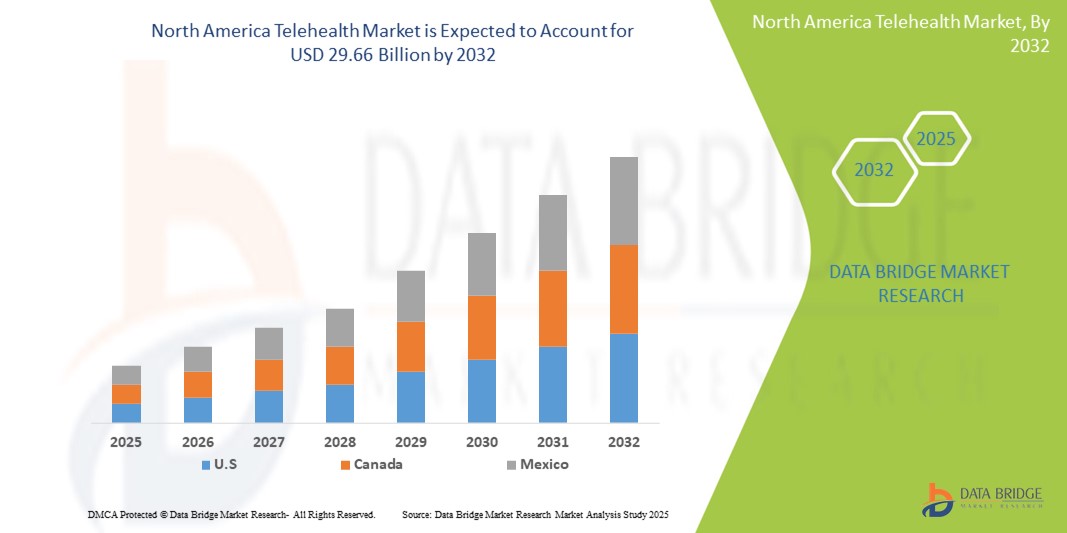
Telehealth Market Size
- The North America telehealth market size was valued atUSD 13.83 billion in 2024and is expected to reachUSD 29.66 billion by 2032, at aCAGR of 10.00%during the forecast period
- This growth is driven by factors such as increasing demand for remote healthcare services, growing prevalence of chronic diseases, advancements in digital communication technologies, and a global shift toward virtual consultations and home-based care, especially in post-pandemic healthcare environments
Telehealth Market Analysis
- Telehealth platforms have become critical tools for delivering healthcare services remotely, enabling virtual consultations, remote monitoring, and digital diagnostics across various medical fields, including mental health, chronic disease management, and primary care
- The demand for telehealth is significantly driven by the aging global population, increasing chronic illness prevalence, and growing acceptance of digital health technologies
- The U.S. is expected to dominate the market, holding a market share of approximately 40% in 2024, due to advanced healthcare infrastructure, widespread digital adoption, and supportive federal policies
- Canada is the fastest-growing country in the region, with a strong CAGR driven by nationwide digital health initiatives, provincial virtual care funding, and increasing telemedicine adoption in remote areas
- The services segment dominated the telehealth market in 2023, accounting for over 50% of the total revenue share. This dominance is attributed to the growing need for telehealth applications in chronic disease management, real-time monitoring, and rapid advancements in digital infrastructure
Report Scope and Telehealth Market Segmentation
|
Attributes |
TelehealthKeyMarket Insights |
|
Segments Covered |
|
|
Countries Covered |
North America
|
|
Key Market Players |
|
|
Market Opportunities |
|
|
Value Added Data Infosets |
In addition to the insights on market scenarios such as market value, growth rate, segmentation, geographical coverage, and major players, the market reports curated by the Data Bridge Market Research also include import export analysis, production capacity overview, production consumption analysis, price trend analysis, climate change scenario, supply chain analysis, value chain analysis, raw material/consumables overview, vendor selection criteria, PESTLE Analysis, Porter Analysis, and regulatory framework. |
Telehealth Market Trends
“Advancements in Telehealth Platforms & AI Integration for Remote Healthcare”
- One prominent trend in the evolution of telehealth platforms is the increasing integration of Artificial Intelligence (AI) and machine learning algorithms to enhance remote healthcare delivery
- These innovations improve diagnostic accuracy, patient monitoring, and treatment customization by analyzing vast amounts of health data in real-time, allowing for more personalized care and early disease detection
- For instance, AI-powered telehealth platforms can assist doctors in interpreting medical imaging, detecting abnormalities, and providing evidence-based treatment recommendations, which is particularly beneficial for chronic disease management and mental health support
- These advancements are transforming the telehealth landscape, improving accessibility to healthcare, reducing patient wait times, and driving the demand for more sophisticated telehealth solutions that integrate AI-driven capabilities
Telehealth Market Dynamics
Driver
“Growing Need Due to Rising Demand for Remote Healthcare Services”
- The growing demand for remote healthcare services is significantly contributing to the increasing adoption of telehealth platforms globally
- As healthcare systems face pressures from rising costs, limited access to healthcare professionals, and the need for more efficient care delivery models, telehealth offers a solution to provide accessible and cost-effective healthcare to patients, particularly in rural and underserved areas
- The COVID-19 pandemic has accelerated the adoption of telehealth services, driving both patients and healthcare providers to embrace virtual consultations and remote monitoring
For instance,
- In June 2022, the U.S. Department of Health and Human Services (HHS) extended telehealth flexibilities, recognizing the role of telehealth in addressing healthcare access challenges during the pandemic and beyond. This policy shift underscores the growing reliance on telehealth for continuous care delivery
- As a result of the increased need for convenient healthcare options, there is a significant rise in the demand for telehealth solutions, driving the market growth for platforms that offer remote consultations, monitoring, and healthcare management
Opportunity
“Advancing Telehealth with Artificial Intelligence Integration”
- AI-powered telehealth platforms have the potential to enhance remote healthcare services by automating diagnostics, improving patient monitoring, and providing personalized treatment recommendations
- AI algorithms can analyze vast amounts of patient data, such as medical histories, lab results, and imaging, to provide accurate diagnostics and treatment options remotely, allowing healthcare providers to make data-driven decisions without in-person consultations
- In addition, AI can enhance virtual consultations by providing real-time insights, such as symptom checkers and predictive models, improving the accuracy of diagnoses and ensuring better patient outcomes
For instance,
- In October 2024, a study published in the Journal of Telemedicine and Telecare highlighted how AI-powered telehealth systems are being utilized to monitor chronic diseases such as diabetes and hypertension. AI can predict disease progression and suggest personalized treatment plans, leading to more proactive healthcare management and reducing hospital visitsse
- The integration of AI in telehealth can also enhance patient engagement by offering personalized recommendations and real-time feedback, improving patient compliance and care outcomes. As a result, AI-driven telehealth platforms present a significant opportunity for expanding access to high-quality healthcare services globally
Restraint/Challenge
“High Operational Costs and Limited Infrastructure Hindering Market Penetration”
- The high cost of telehealth technology and infrastructure poses a significant challenge for market expansion, particularly in developing regions where healthcare budgets are limited
- Advanced telehealth platforms require investments in software, hardware, and secure data storage solutions, which can often range from thousands to millions of dollars, depending on the complexity of the system
- These financial constraints can limit the ability of smaller healthcare providers and clinics, especially in rural and underserved areas, to adopt telehealth services or upgrade their existing technology. As a result, many healthcare facilities may struggle to integrate telehealth into their practices, relying on outdated or less efficient systems
For instance,
- In February 2024, an article published by the World Health Organization (WHO) emphasized that the high initial investment cost for telehealth infrastructure, including reliable internet connectivity and secure patient data management systems, is one of the main barriers to the widespread adoption of telehealth services in low-income countries. This financial burden hinders the ability of healthcare providers to offer remote consultations and comprehensive healthcare services
- Consequently, such financial challenges can limit the availability and accessibility of telehealth, especially in underserved regions, hindering the overall growth of the market
Telehealth Market Scope
The market is segmented on the basis component, delivery mode, mode of purchase, application, end user, and modality.
|
Segmentation |
Sub-Segmentation |
|
By Component |
|
|
By Delivery Mode |
|
|
By Mode of Purchase |
|
|
By Application |
|
|
By End User |
|
|
ByModality
|
|
In 2025, the services is projected to dominate the market with a largest share in Component segment
In 2025, the services segment is projected to dominate the telehealth market, holding the market share over 50% due to the essential role of communication infrastructure in enabling remote healthcare. The demand for reliable and secure telecommunication networks to support telehealth services, including virtual consultations and remote monitoring, drives this growth. The Cloud-Based Delivery Mode will lead the market, offering flexibility, scalability, and cost-efficiency for healthcare providers. North America, particularly the U.S., is expected to dominate the market with a share of 40%, driven by extensive healthcare infrastructure and high telehealth adoption rates
The cloud-based is expected to account for the largest share during the forecast period in delivery Mode segments
In 2025, the cloud-based delivery mode segment is expected to dominate the telehealth market, with the largest market share of 49.72%. The cloud-based approach offers scalability, flexibility, and reduced infrastructure costs, making it ideal for expanding telehealth access, particularly in remote areas. This growth is driven by increased demand for telehealth services, as healthcare providers seek efficient, on-demand, and cost-effective solutions. North America, led by the U.S., is projected to hold the largest share at 42%, due to its advanced healthcare infrastructure and high adoption of cloud-based telehealth solutions
Telehealth Market Regional Analysis
“U.S. Holds the Largest Share in the Telehealth Market”
- The U.S. is expected to dominate the market, holding a market share of approximately 40% in 2024, due to advanced healthcare infrastructure, widespread digital adoption, and supportive federal policies
- The market is driven by growing demand for remote healthcare, especially in rural and underserved areas, alongside a rising burden of chronic diseases requiring continuous care and monitoring
- Favorable initiatives, including CMS telehealth reimbursement policies, and substantial private and public investments in virtual health platforms and AI-powered care tools, significantly strengthen market growth
- The COVID-19 pandemic catalyzed rapid telehealth expansion in the U.S., with continued momentum in virtual consultations, remote patient monitoring, behavioral health services, and chronic condition management
“Canada is Projected to Register the HighestCAGR in the Telehealth Market”
- Canada is expected to witness the fastest growth rate in the North America telehealth market, driven by nationwide expansion of virtual care infrastructure, digital health initiatives, and rising demand for accessible healthcare services
- Increasing adoption of telehealth in remote and underserved communities, along with a growing aging population and rising chronic disease cases, are fueling long-term demand for virtual consultations and remote monitoring
- Government-backed programs like Canada Health Infoway and expanded provincial reimbursement support are enabling healthcare providers to scale digital services across the country
- Canada’s telehealth market is forecasted to grow at a CAGR of over 25% between 2024 and 2030, with strong momentum in mental health services, primary care, and chronic disease management via virtual platforms
Telehealth Market Share
The market competitive landscape provides details by competitor. Details included are company overview, company financials, revenue generated, market potential, investment in research and development, new market initiatives, global presence, production sites and facilities, production capacities, company strengths and weaknesses, product launch, product width and breadth, application dominance. The above data points provided are only related to the companies' focus related to market.
The Major Market Leaders Operating in the Market Are:
- Walmart Health Virtual Care (U.S.)
- Teladoc Health, Inc.(U.S.)
- Medtronic(Ireland)
- Koninklijke Philips N.V.(Netherlands)
- Honeywell International Inc. (U.S.)
- LanguageLine Solutions (U.S.)
- Siemens Healthineers AG(Germany)
- F. Hoffmann-La Roche Ltd.(Switzerland)
- AMN Healthcare Services Inc. (U.S.)
- Included Health Inc. (U.S.)
- American Well (U.S.)
- MDLIVE (U.S.)
- Oracle (U.S.)
- GCX Corporation (U.S.)
- Caregility (U.S.)
- PlushCare (U.S.)
- Teleray.com (U.S.)
- Aerotel Medical Systems Ltd. (Israel)
- GE Healthcare (U.S.)
- Access TeleCare, LLC (U.S.)
- Sesame Inc. (U.S.)
- CyraCom International, Inc. (U.S.)
- Propio Language Services (U.S.)
- Interactive Digital Solutions (U.S.)
- TelMDFirst (U.S.)
- Artisight (U.S.)
- Omron Healthcare Inc. (Japan)
Latest Developments in North America Telehealth Market
- In January 2024, Aramark Healthcare+ introduced an innovative program aimed at enhancing patient care by connecting clinical nutritionists with hospital inpatients. This initiative focuses on providing personalized nutrition services to improve health outcomes and support recovery. By integrating clinical expertise into inpatient care, the program ensures tailored dietary guidance and management for patients during their hospital stay. Aramark Healthcare+ continues to demonstrate its commitment to advancing healthcare services through impactful and patient-centric solutions
- In April 2024, Philips Foundation partnered with March of Dimes to improve prenatal care access in underserved U.S. communities, addressing critical maternal and infant health challenges. Through this collaboration, Philips will provide advanced ultrasound technology with telehealth capabilities for three mobile health centers. The initiative also includes support for staffing, operations, and allowances for local healthcare partners and community workers. This partnership not only aims to enhance healthcare access but also strengthens Philips' brand image and market presence by addressing vital healthcare needs
- In October 2023, Glenn Gaunt MD officially launched its innovative platform, offering a modern alternative to traditional healthcare. This telehealth service provides accessible and convenient medical care, allowing patients to receive attention from the comfort of their homes. By leveraging secure video consultations, the platform ensures timely and efficient healthcare delivery while prioritizing patient privacy. Focused on enhancing accessibility, Glenn Gaunt MD aims to simplify the healthcare experience and improve patient outcome
- In September 2023, Apollo Telehealth launched its Tele-Emergency and Tele-ICU services across nine NTPC plants, significantly enhancing critical care capabilities. This initiative provides remote medical supervision and support during emergencies, utilizing advanced telehealth technologies to bridge the gap between crisis onset and specialized care. The services are available at NTPC locations such as Ramagundam, Korba, and Vindhyachal, among others. By integrating Apollo's expertise with NTPC's infrastructure, the program ensures timely medical intervention and continuous monitoring for critical patients
- In August 2023, Spark Biomedical introduced telehealth services for Sparrow Ascent, aiming to enhance access to opioid withdrawal treatment. Sparrow Ascent, a medication-assisted treatment (MAT) program, offers comprehensive care for individuals battling opioid use disorder. The program integrates medication, counseling, and support services to promote long-term recovery. By leveraging telehealth, Spark Biomedical ensures greater accessibility and flexibility for patients, enabling them to receive treatment remotely. This initiative reflects Spark Biomedical's commitment to addressing the opioid crisis through innovative and patient-centric solutions
SKU-
Получите онлайн-доступ к отчету на первой в мире облачной платформе рыночной аналитики

- Интерактивная панель анализа данных
- Панель анализа компании для возможностей с высоким потенциалом роста
- Доступ аналитика-исследователя для настройки и запросов
- Анализ конкурентов с помощью интерактивной панели
- Последние новости, обновления и анализ тенденций
- Используйте возможности сравнительного анализа для комплексного отслеживания конкурентов
Методология исследования
Сбор данных и анализ базового года выполняются с использованием модулей сбора данных с большими размерами выборки. Этап включает получение рыночной информации или связанных данных из различных источников и стратегий. Он включает изучение и планирование всех данных, полученных из прошлого заранее. Он также охватывает изучение несоответствий информации, наблюдаемых в различных источниках информации. Рыночные данные анализируются и оцениваются с использованием статистических и последовательных моделей рынка. Кроме того, анализ доли рынка и анализ ключевых тенденций являются основными факторами успеха в отчете о рынке. Чтобы узнать больше, пожалуйста, запросите звонок аналитика или оставьте свой запрос.
Ключевой методологией исследования, используемой исследовательской группой DBMR, является триангуляция данных, которая включает в себя интеллектуальный анализ данных, анализ влияния переменных данных на рынок и первичную (отраслевую экспертную) проверку. Модели данных включают сетку позиционирования поставщиков, анализ временной линии рынка, обзор рынка и руководство, сетку позиционирования компании, патентный анализ, анализ цен, анализ доли рынка компании, стандарты измерения, глобальный и региональный анализ и анализ доли поставщика. Чтобы узнать больше о методологии исследования, отправьте запрос, чтобы поговорить с нашими отраслевыми экспертами.
Доступна настройка
Data Bridge Market Research является лидером в области передовых формативных исследований. Мы гордимся тем, что предоставляем нашим существующим и новым клиентам данные и анализ, которые соответствуют и подходят их целям. Отчет можно настроить, включив в него анализ ценовых тенденций целевых брендов, понимание рынка для дополнительных стран (запросите список стран), данные о результатах клинических испытаний, обзор литературы, обновленный анализ рынка и продуктовой базы. Анализ рынка целевых конкурентов можно проанализировать от анализа на основе технологий до стратегий портфеля рынка. Мы можем добавить столько конкурентов, о которых вам нужны данные в нужном вам формате и стиле данных. Наша команда аналитиков также может предоставить вам данные в сырых файлах Excel, сводных таблицах (книга фактов) или помочь вам в создании презентаций из наборов данных, доступных в отчете.











