Global Barge Transportation Market Size, Share and Trends Analysis Report – Industry Overview and Forecast to 2033

请求目录 请求目录 与分析师交谈 与分析师交谈 免费样本报告 免费样本报告 购买前请咨询 提前咨询 立即购买 立即购买

Global Barge Transportation Market Size, Share and Trends Analysis Report – Industry Overview and Forecast to 2033

Global Barge Transportation Market Segmentation, By Product (Dry Cargo, Liquid Cargo, and Gaseous Cargo), Barge Fleet (Open, Covered, and Tank), Application (Coal & Crude Petroleum, Agricultural Products, Coke & Refined Petroleum Products, Metal Ores, Secondary Raw Materials & Wastes, Food Products, Beverages & Tobacco, Basic Metals & Fabricated Metal Products, Chemicals, Rubber & Plastic, and Nuclear Fuel) - Industry Trends and Forecast to 2033

  • Automotive
  • Apr 2021
  • Global
  • 350 页面
  • 桌子數: 220
  • 图号: 60

Global Barge Transportation Market

市场规模(十亿美元)

CAGR :  % Diagram

Chart Image USD 128.18 Billion USD 167.49 Billion 2025 2033
Diagram Forecast Period
2026 –2033
Diagram Market Size (Base Year)
USD 128.18 Billion
Diagram Market Size (Forecast Year)
USD 167.49 Billion
Diagram CAGR
%
Diagram Major Markets Players
  • ABC India Limited
  • American Commercial Barge Line
  • Alter LogisticsContinental AG
  • American Commercial Barge Line
  • Argosy International Inc.

Global Barge Transportation Market Segmentation, By Product (Dry Cargo, Liquid Cargo, and Gaseous Cargo), Barge Fleet (Open, Covered, and Tank), Application (Coal & Crude Petroleum, Agricultural Products, Coke & Refined Petroleum Products, Metal Ores, Secondary Raw Materials & Wastes, Food Products, Beverages & Tobacco, Basic Metals & Fabricated Metal Products, Chemicals, Rubber & Plastic, and Nuclear Fuel) - Industry Trends and Forecast to 2033

What is the Global Barge Transportation Market Size and Growth Rate?

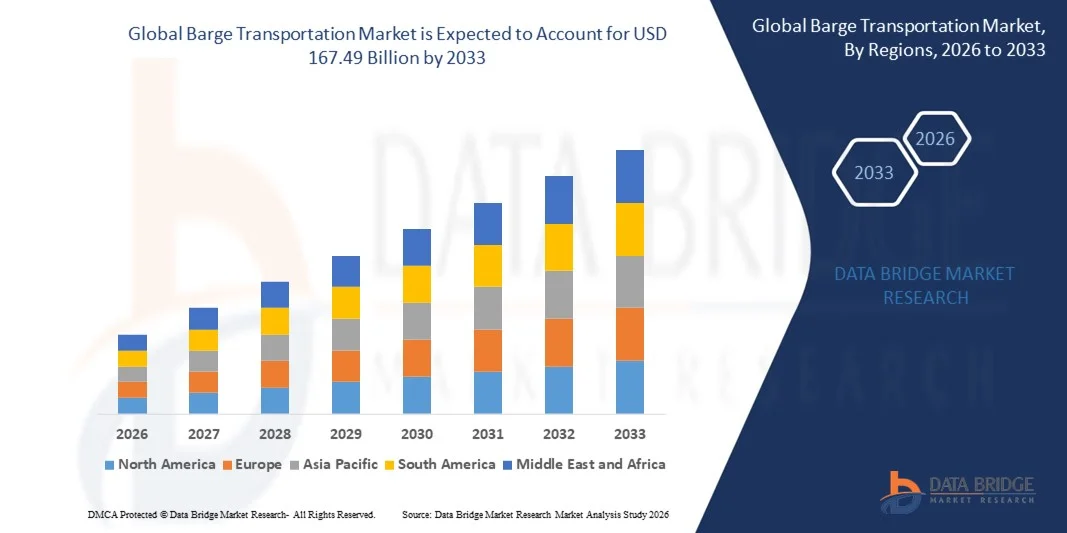
  • The global barge transportation market size was valued at USD 128.18 billion in 2025 and is expected to reach USD 167.49 billion by 2033, at a CAGR of 3.40% during the forecast period
  • Rise in the demand for petrochemical shipments is a crucial factor accelerating the market growth, also increase in the investments in port modernization, rise in the demand for crude oil in developing economies such as India and China, rise in the benefits related to barge transportation such as cost-effectiveness, safety and security, and efficiency and rise in the spending on research and development activities and subsequent advancements in technology are the major factors among others boosting the barge transportation market

What are the Major Takeaways of Barge Transportation Market?

  • Rise in the demand from the emerging economies and increase in the technological advancements and modernization in the machinery will further create new opportunities barge transportation market in the forecast period mentioned above
  • However, increase in the operating expenses in barge transportation, stringent government regulations pertaining to marine transportation and rise in the replacements of barges with pipelines for liquid cargo are the major factors among others restraining the market growth
  • North America dominated the barge transportation market with a 35.26% revenue share in 2025, driven by the extensive inland waterway network across the U.S. and Canada, strong demand for bulk commodity transportation, and high reliance on cost-efficient river-based logistics
  • Asia-Pacific is projected to register the fastest CAGR of 9.14% from 2026 to 2033, driven by rapid industrialization, expanding inland waterway development, and increasing demand for low-cost bulk transportation across China, India, Japan, South Korea, and Southeast Asia
  • The Dry Cargo segment dominated the market with an estimated 48.6% revenue share in 2025, driven by extensive transportation of coal, grains, metal ores, construction materials, and industrial raw materials

Global Barge Transportation Market z

Report Scope and Barge Transportation Market Segmentation       

Attributes

Barge Transportation Key Market Insights

Segments Covered

  • By Product: Dry Cargo, Liquid Cargo, and Gaseous Cargo
  • By Barge Fleet: Open, Covered, and Tank
  • By Application: Coal & Crude Petroleum, Agricultural Products, Coke & Refined Petroleum Products, Metal Ores, Secondary Raw Materials & Wastes, Food Products, Beverages & Tobacco, Basic Metals & Fabricated Metal Products, Chemicals, Rubber & Plastic, and Nuclear Fuel

Countries Covered

North America

  • U.S.
  • Canada
  • Mexico

Europe

  • Germany
  • France
  • U.K.
  • Netherlands
  • Switzerland
  • Belgium
  • Russia
  • Italy
  • Spain
  • Turkey
  • Rest of Europe

Asia-Pacific

  • China
  • Japan
  • India
  • South Korea
  • Singapore
  • Malaysia
  • Australia
  • Thailand
  • Indonesia
  • Philippines
  • Rest of Asia-Pacific

Middle East and Africa

  • Saudi Arabia
  • U.A.E.
  • South Africa
  • Egypt
  • Israel
  • Rest of Middle East and Africa

South America

  • Brazil
  • Argentina
  • Rest of South America

Key Market Players

  • Kirby Corporation (U.S.)
  • Ingram Marine Group (U.S.)
  • SEACOR Holdings Inc. (U.S.)
  • Continental AG (Germany)
  • American Commercial Barge Line (U.S.)
  • ABC India Limited (India)
  • Alter Logistics (U.S.)
  • Argosy International Inc. (U.S.)
  • ATS (U.S.)
  • Blessey Marine Services, Inc. (U.S.)
  • Bouchard Transportation (U.S.)
  • Campbell Transportation Company, Inc. (U.S.)
  • Contargo GmbH & Co. KG (Germany)
  • Crounse Corporation (U.S.)
  • Heartland Barge. (U.S.)
  • Marquette Transportation Company LLC (U.S.)
  • McAllister Towing and Transportation Co., Inc. (U.S.)
  • neska Container Line B.V. (Netherlands)
  • Olson Marine, Inc. (U.S.)
  • POSH (Singapore)
  • Poh Tiong Choon Logistics Ltd (Singapore)

Market Opportunities

  • Rise in the Demand for Petrochemical Shipments
  • Increase in the Investments in Port Modernization

Value Added Data Infosets

In addition to the insights on market scenarios such as market value, growth rate, segmentation, geographical coverage, and major players, the market reports curated by the Data Bridge Market Research also include in-depth expert analysis, pricing analysis, brand share analysis, consumer survey, demography analysis, supply chain analysis, value chain analysis, raw material/consumables overview, vendor selection criteria, PESTLE Analysis, Porter Analysis, and regulatory framework.

What is the Key Trend in the Barge Transportation Market?

Increasing Shift Toward Fuel-Efficient, Digitally Optimized, and Multimodal Barge Transportation

  • The barge transportation market is witnessing a growing shift toward fuel-efficient fleets, larger-capacity barges, and digitally enabled operations to improve cost efficiency and environmental performance
  • Operators are increasingly adopting GPS tracking, fleet management software, automated cargo monitoring, and predictive maintenance systems to enhance route optimization, asset utilization, and safety
  • Rising demand for low-cost, high-volume freight movement is driving greater use of barges for transporting bulk commodities such as coal, petroleum products, agricultural goods, chemicals, and construction materials
    • For instance, leading players such as Kirby Corporation, Ingram Marine Group, and American Commercial Barge Line are investing in modern barge designs, emission-reduction technologies, and digital navigation solutions
  • Growing emphasis on multimodal logistics integration with rail and road transport is accelerating the adoption of inland and coastal barge transportation
  • As sustainability regulations tighten and fuel costs remain volatile, barge transportation will remain a preferred mode for long-distance bulk cargo movement with lower carbon intensity

What are the Key Drivers of Barge Transportation Market?

  • Rising demand for cost-effective transportation of bulk commodities across inland waterways and coastal routes is a major growth driver
    • For instance, during 2024–2025, logistics operators across North America and Europe expanded barge capacity to support increased agricultural exports, energy shipments, and industrial raw material transport
  • Growing focus on reducing carbon emissions compared to road and rail transport is boosting adoption of barges as an environmentally efficient alternative
  • Infrastructure investments in ports, inland waterways, dredging projects, and river navigation systems are improving operational efficiency and capacity
  • Expansion of oil & gas, chemical, mining, and construction industries continues to generate steady demand for large-volume barge transportation
  • Supported by long asset lifecycles, lower fuel consumption, and favorable regulatory support, the Barge Transportation market is expected to witness stable long-term growth

Which Factor is Challenging the Growth of the Barge Transportation Market?

  • Dependence on water levels, seasonal weather conditions, and river navigability creates operational uncertainties and capacity constraints
    • For instance, during 2024–2025, drought conditions and fluctuating river depths disrupted barge traffic across major inland waterways, increasing transit times and freight costs
  • High capital investment requirements for fleet modernization, port infrastructure, and environmental compliance pose challenges for smaller operators
  • Slow transit speeds compared to road and rail limit suitability for time-sensitive cargo
  • Regulatory compliance related to emissions, safety standards, and waterway usage increases operational complexity
  • To mitigate these challenges, companies are investing in fleet optimization, digital route planning, hybrid propulsion systems, and strategic partnerships to strengthen the global adoption of Barge Transportation

How is the Barge Transportation Market Segmented?

The market is segmented on the basis of product, barge fleet, and application.

  • By Product

On the basis of product, the barge transportation market is segmented into Dry Cargo, Liquid Cargo, and Gaseous Cargo. The Dry Cargo segment dominated the market with an estimated 48.6% revenue share in 2025, driven by extensive transportation of coal, grains, metal ores, construction materials, and industrial raw materials. Dry cargo barges offer high load capacity, low operating costs, and suitability for long-distance inland waterway transport, making them the preferred choice for bulk commodity movement across North America, Europe, and Asia-Pacific. Strong demand from power generation, mining, agriculture, and infrastructure development continues to support segment dominance.

The Liquid Cargo segment is expected to grow at the fastest CAGR from 2026 to 2033, supported by rising transportation of crude oil, refined petroleum products, chemicals, and liquid fertilizers. Increasing energy demand, expansion of petrochemical industries, and safety advantages of waterborne liquid transport are accelerating adoption of liquid cargo barges globally.

  • By Barge Fleet

On the basis of barge fleet, the market is segmented into Open, Covered, and Tank barges. The Open barge segment dominated the market with approximately 44.2% share in 2025, owing to its widespread use in transporting dry bulk commodities such as coal, sand, gravel, ores, and agricultural products. Open barges are cost-effective, easy to load and unload, and highly suitable for short- and medium-haul inland transportation, making them a staple across river and canal networks. Strong deployment in construction, mining, and agricultural logistics reinforces segment leadership.

The Tank barge segment is projected to register the fastest CAGR from 2026 to 2033, driven by growing demand for safe and efficient transport of liquid chemicals, petroleum products, and hazardous materials. Stricter safety regulations, increasing chemical trade volumes, and investments in modern tank barge fleets are supporting rapid growth of this segment.

  • By Application

On the basis of application, the barge transportation market is segmented into Coal & Crude Petroleum, Agricultural Products, Coke & Refined Petroleum Products, Metal Ores, Secondary Raw Materials & Wastes, Food Products, Beverages & Tobacco, Basic Metals & Fabricated Metal Products, Chemicals, Rubber & Plastic, and Nuclear Fuel. The Coal & Crude Petroleum segment dominated the market with a 35.7% share in 2025, supported by large-scale movement of energy commodities for power generation, refining, and industrial consumption. Barges remain a cost-efficient and environmentally favorable mode for transporting heavy energy cargo across inland waterways.

The Agricultural Products segment is expected to grow at the fastest CAGR from 2026 to 2033, driven by rising global food demand, expanding grain exports, and increasing use of barges for sustainable agricultural logistics. Seasonal harvest volumes, export-oriented supply chains, and lower transportation costs are accelerating growth in this segment.

Which Region Holds the Largest Share of the Barge Transportation Market?

  • North America dominated the barge transportation market with a 35.26% revenue share in 2025, driven by the extensive inland waterway network across the U.S. and Canada, strong demand for bulk commodity transportation, and high reliance on cost-efficient river-based logistics. Large-scale movement of coal, crude oil, agricultural products, chemicals, and construction materials along the Mississippi River system and Great Lakes continues to support regional leadership
  • Presence of established barge operators, advanced fleet management systems, and consistent investment in port infrastructure and river dredging strengthens North America’s competitive advantage
  • Strong regulatory frameworks, environmental benefits of inland shipping, and lower fuel consumption compared to road and rail further reinforce regional dominance

U.S. Barge Transportation Market Insight

The U.S. is the largest contributor in North America, supported by one of the world’s most developed inland waterway systems. High volumes of agricultural exports, petroleum products, coal, and industrial raw materials transported via rivers drive sustained demand. Continuous investments in fleet modernization, navigation infrastructure, and intermodal connectivity further enhance market growth.

Canada Barge Transportation Market Insight

Canada contributes significantly through barge operations across the Great Lakes–St. Lawrence Seaway system. Growing movement of grain, minerals, petroleum products, and industrial cargo, along with cross-border trade with the U.S., supports steady market expansion.

Asia-Pacific Barge Transportation Market

Asia-Pacific is projected to register the fastest CAGR of 9.14% from 2026 to 2033, driven by rapid industrialization, expanding inland waterway development, and increasing demand for low-cost bulk transportation across China, India, Japan, South Korea, and Southeast Asia. Rising trade volumes, infrastructure investments, and government initiatives to promote inland water transport as a sustainable alternative are accelerating market growth. Expanding energy, agriculture, and construction sectors further boost barge transportation demand.

China Barge Transportation Market Insight

China is the largest contributor in Asia-Pacific due to extensive river networks such as the Yangtze River, high industrial output, and strong government investment in inland shipping infrastructure.

Japan Barge Transportation Market Insight

Japan shows steady growth supported by coastal and inland barge operations for industrial materials, chemicals, and construction cargo, alongside modernization of port logistics.

India Barge Transportation Market Insight

India is emerging as a high-growth market, driven by national inland waterway development programs, rising agricultural transport, and increasing use of barges for bulk and energy cargo.

South Korea Barge Transportation Market Insight

South Korea contributes through coastal barge transport supporting industrial supply chains, shipbuilding, and energy logistics, reinforced by advanced port infrastructure.

Which are the Top Companies in Barge Transportation Market?

The barge transportation industry is primarily led by well-established companies, including:

  • Kirby Corporation (U.S.)
  • Ingram Marine Group (U.S.)
  • SEACOR Holdings Inc. (U.S.)
  • Continental AG (Germany)
  • American Commercial Barge Line (U.S.)
  • ABC India Limited (India)
  • Alter Logistics (U.S.)
  • Argosy International Inc. (U.S.)
  • ATS (U.S.)
  • Blessey Marine Services, Inc. (U.S.)
  • Bouchard Transportation (U.S.)
  • Campbell Transportation Company, Inc. (U.S.)
  • Contargo GmbH & Co. KG (Germany)
  • Crounse Corporation (U.S.)
  • Heartland Barge. (U.S.)
  • Marquette Transportation Company LLC (U.S.)
  • McAllister Towing and Transportation Co., Inc. (U.S.)
  • neska Container Line B.V. (Netherlands)
  • Olson Marine, Inc. (U.S.)
  • POSH (Singapore)
  • Poh Tiong Choon Logistics Ltd (Singapore)

What are the Recent Developments in Global Barge Transportation Market?

  • In February 2024, Future Proof Shipping launched H2 Barge 2, a hydrogen-powered inland vessel designed for zero-emission operations along the Rhine River between Duisburg, Germany, and Rotterdam, the Netherlands. Supported by the EU-funded Flagships project and the Interreg-backed ZEM Ports NS initiative, the vessel represents a major milestone in sustainable inland shipping. This development highlights the growing shift toward carbon-free propulsion in barge transportation
  • In October 2023, Seacor Holdings announced the sale of its inland water transportation division to Ingram Barge Co., a subsidiary of Ingram Marine Group. The transaction expanded Ingram’s fleet to over 1,000 covered dry cargo barges, eight high-horsepower towboats, and extensive terminal infrastructure along the Mississippi River. This consolidation strengthens operational scale and efficiency in North America’s inland barge market
  • In July 2023, Carbon Sink partnered with Rose Cay Maritime through a memorandum of understanding to develop a low-carbon marine fuel supply chain based on green methanol. The collaboration focuses on expanding fuel production, transportation, storage, and bunkering for the shipping industry. This partnership supports decarbonization efforts across marine and inland water transport sectors
  • In June 2023, the U.S. government marked the expansion of the Lock 25 project on the Mississippi River, aimed at improving navigation efficiency, safety for mariners, and commodity flow across inland waterways. The project is expected to enhance economic activity and logistical reliability. This investment underscores the role of infrastructure modernization in boosting barge transportation efficiency
  • In January 2022, DP World launched a premium barge service connecting the Upper Rhine region with the Port of Rotterdam, offering a sustainable and reliable inland transport alternative. The service supports smoother cargo movement between key European trade corridors. This initiative reinforces the importance of barge services in enabling greener port-to-hinterland logistics


SKU-

Get online access to the report on the World's First Market Intelligence Cloud

  • Interactive Data Analysis Dashboard
  • Company Analysis Dashboard for high growth potential opportunities
  • Research Analyst Access for customization & queries
  • Competitor Analysis with Interactive dashboard
  • Latest News, Updates & Trend analysis
  • Harness the Power of Benchmark Analysis for Comprehensive Competitor Tracking
Request for Demo

研究方法

数据收集和基准年分析是使用具有大样本量的数据收集模块完成的。该阶段包括通过各种来源和策略获取市场信息或相关数据。它包括提前检查和规划从过去获得的所有数据。它同样包括检查不同信息源中出现的信息不一致。使用市场统计和连贯模型分析和估计市场数据。此外,市场份额分析和关键趋势分析是市场报告中的主要成功因素。要了解更多信息,请请求分析师致电或下拉您的询问。

DBMR 研究团队使用的关键研究方法是数据三角测量,其中包括数据挖掘、数据变量对市场影响的分析和主要(行业专家)验证。数据模型包括供应商定位网格、市场时间线分析、市场概览和指南、公司定位网格、专利分析、定价分析、公司市场份额分析、测量标准、全球与区域和供应商份额分析。要了解有关研究方法的更多信息,请向我们的行业专家咨询。

可定制

Data Bridge Market Research 是高级形成性研究领域的领导者。我们为向现有和新客户提供符合其目标的数据和分析而感到自豪。报告可定制,包括目标品牌的价格趋势分析、了解其他国家的市场(索取国家列表)、临床试验结果数据、文献综述、翻新市场和产品基础分析。目标竞争对手的市场分析可以从基于技术的分析到市场组合策略进行分析。我们可以按照您所需的格式和数据样式添加您需要的任意数量的竞争对手数据。我们的分析师团队还可以为您提供原始 Excel 文件数据透视表(事实手册)中的数据,或者可以帮助您根据报告中的数据集创建演示文稿。


Frequently Asked Questions

2025年,驳船运输市场价值为128.18亿美元。
在2025年至2033年的预测期间,驳船运输市场将增长3.40%的CAGR。
驳船运输市场按产品、驳船船队和适用方式分割,根据产品划分,仓储运输市场分为干货、液体货物和气体货物,根据驳船船队划分,市场分为露天、覆盖和坦克驳船,根据应用,市场分为煤炭和原油、农产品、可乐和精炼石油产品、金属矿石、二次原材料和废物、食品产品、饮料和烟草、基本金属和制造金属产品、化学品、橡胶和塑料以及核燃料。
Kirby公司(美国)、Ingram海洋集团(美国)、SEACOR控股公司(美国)和Continate AG公司(德国)等公司是驳船运输市场的主要参与者。
驳船运输市场覆盖的国家有:美国、加拿大、墨西哥、德国、法国、英国、荷兰、瑞士、比利时、俄罗斯、意大利、西班牙、土耳其、欧洲其他国家、中国、日本、印度、韩国、新加坡、马来西亚、澳大利亚、泰国、印度尼西亚、菲律宾、亚太地区其他国家、巴西、阿根廷、南美洲其他国家、沙特阿拉伯、美国、南非、埃及、以色列以及中东和非洲其他国家。
2024年2月,未来校对航运公司发射了H2 Barge 2号,这是一艘氢动力内陆船只,用于德国杜伊斯堡与荷兰鹿特丹之间莱茵河沿岸零排放作业。
预计亚太区域的CAGR速度将最快,从2026年的9.14%增加到2033年的9.14%,其驱动因素是快速工业化、内陆水道开发的扩大以及中国、印度、日本、韩国和东南亚各地对低成本散装运输需求的增加。
美国主导了驳船运输市场,特别是在亚太地区。 这一主导地位归因于世界上最发达的内陆水道系统之一。 大量农业出口、石油产品、煤炭和工业原材料通过河流运输驱动着持续的需求。
北美在2025年以35.26%的收入份额主导驳船运输市场,其驱动力是美国和加拿大的内陆水道网辽阔,对散装商品运输的需求强劲,以及高度依赖成本效益高的河基物流。
中国预计将是驳船运输市场中CAGR最高的国家。 这一增长是由长江等广泛的河流网络、高工业产出和政府对内陆航运基础设施的有力投资所驱动的。
Testimonial