Global Chemical Licensing Market Size, Share and Trends Analysis Report – Industry Overview and Forecast to 2033

请求目录 请求目录 与分析师交谈 与分析师交谈 免费样本报告 免费样本报告 购买前请咨询 提前咨询 立即购买 立即购买

Global Chemical Licensing Market Size, Share and Trends Analysis Report – Industry Overview and Forecast to 2033

Global Chemical Licensing Market Segmentation, By Type (C2 Derivatives, C1 Derivatives, C3 Derivatives, C4 Derivatives, and Others), End-use Industry (Petrochemicals, Oil & Gas, Inorganic Chemicals, Agrochemicals, Organic Chemicals, Pharmaceuticals, and Others)- Industry Trends and Forecast to 2033

  • Chemical and Materials
  • Jan 2026
  • Global
  • 350 页面
  • 桌子數: 220
  • 图号: 60
  • Author : Varun Juyal

Global Chemical Licensing Market

市场规模(十亿美元)

CAGR :  % Diagram

Chart Image USD 14.57 Billion USD 25.31 Billion 2025 2033
Diagram Forecast Period
2026 –2033
Diagram Market Size (Base Year)
USD 14.57 Billion
Diagram Market Size (Forecast Year)
USD 25.31 Billion
Diagram CAGR
%
Diagram Major Markets Players
  • Exxon Mobil Corporation
  • BASF SE
  • Dow Inc.
  • LyondellBasell Industries Holdings B.V.
  • Mitsubishi Chemical Corporation

Global Chemical Licensing Market Segmentation, By Type (C2 Derivatives, C1 Derivatives, C3 Derivatives, C4 Derivatives, and Others), End-use Industry (Petrochemicals, Oil & Gas, Inorganic Chemicals, Agrochemicals, Organic Chemicals, Pharmaceuticals, and Others)- Industry Trends and Forecast to 2033

Chemical Licensing Market

Chemical Licensing Market Size

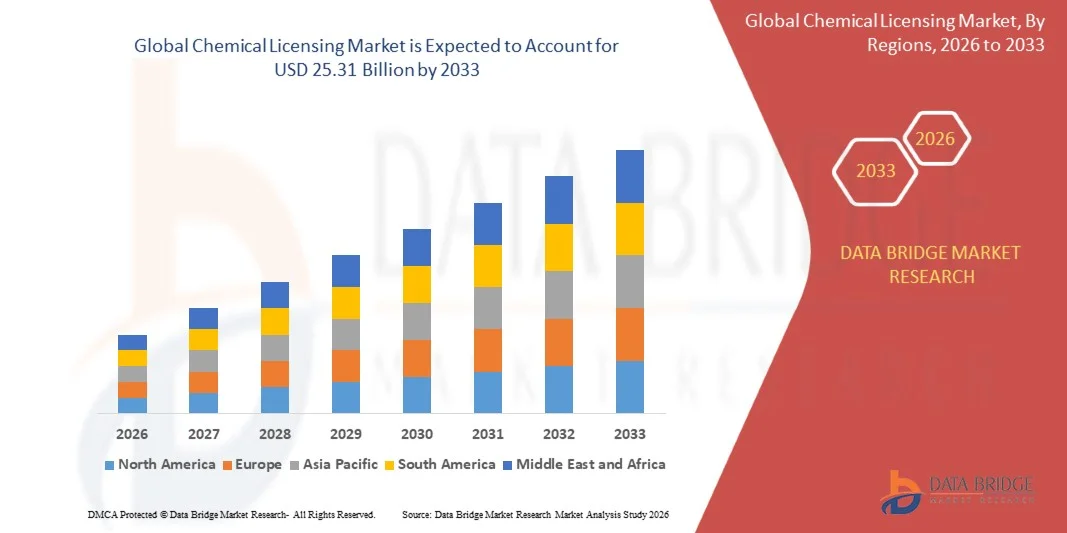
  • The global chemical licensing market size was valued at USD 14.57 billion in 2025 and is expected to reach USD 25.31 billion by 2033, at a CAGR of 7.15% during the forecast period
  • The market growth is largely fuelled by increasing demand for advanced chemical processes, sustainable production technologies, and rapid expansion of specialty and performance chemicals
  • Rising investments in petrochemicals, polymers, and green chemistry, along with the need for cost-effective and efficient manufacturing solutions, are further supporting market growth

Chemical Licensing Market Analysis

  • The chemical licensing market is witnessing steady growth as manufacturers increasingly rely on licensed technologies to reduce R&D costs, shorten commercialization timelines, and improve operational efficiency
  • Growing focus on sustainability, regulatory compliance, and adoption of innovative process technologies is encouraging collaborations between licensors and chemical producers across multiple end-use industries
  • North America dominated the chemical licensing market with the largest revenue share in 2025, driven by the strong presence of major chemical producers, advanced R&D capabilities, and early adoption of licensed technologies across petrochemicals and specialty chemicals
  • Asia-Pacific region is expected to witness the highest growth rate in the global chemical licensing market, driven by rising chemical production, foreign investments, and growing demand for efficient and sustainable technologies
  • The C2 derivatives segment held the largest market revenue share in 2025, driven by extensive demand for ethylene-based products such as polyethylene and ethylene oxide across petrochemicals and plastics manufacturing. Licensed C2 derivative technologies are widely adopted due to their proven efficiency, scalability, and strong integration with downstream chemical value chains

Report Scope and Chemical Licensing Market Segmentation  

Attributes

Chemical Licensing Key Market Insights

Segments Covered

  • By Type: C2 Derivatives, C1 Derivatives, C3 Derivatives, C4 Derivatives, and Others
  • By End-use Industry: Petrochemicals, Oil & Gas, Inorganic Chemicals, Agrochemicals, Organic Chemicals, Pharmaceuticals, and Others

Countries Covered

North America

  • U.S.
  • Canada
  • Mexico

Europe

  • Germany
  • France
  • U.K.
  • Netherlands
  • Switzerland
  • Belgium
  • Russia
  • Italy
  • Spain
  • Turkey
  • Rest of Europe

Asia-Pacific

  • China
  • Japan
  • India
  • South Korea
  • Singapore
  • Malaysia
  • Australia
  • Thailand
  • Indonesia
  • Philippines
  • Rest of Asia-Pacific

Middle East and Africa

  • Saudi Arabia
  • U.A.E.
  • South Africa
  • Egypt
  • Israel
  • Rest of Middle East and Africa

South America

  • Brazil
  • Argentina
  • Rest of South America

Key Market Players

Market Opportunities

  •  Increasing Adoption Of Sustainable And Green Chemical Technologies
  •  Expansion Of Specialty Chemicals And Advanced Process Licensing

Value Added Data Infosets

In addition to the insights on market scenarios such as market value, growth rate, segmentation, geographical coverage, and major players, the market reports curated by the Data Bridge Market Research also include import export analysis, production capacity overview, production consumption analysis, price trend analysis, climate change scenario, supply chain analysis, value chain analysis, raw material/consumables overview, vendor selection criteria, PESTLE Analysis, Porter Analysis, and regulatory framework.

Chemical Licensing Market Trends

“Rising Demand for Advanced, Sustainable, and Cost-Effective Chemical Technologies”

• The increasing focus on efficiency, sustainability, and rapid commercialization is significantly shaping the chemical licensing market, as manufacturers seek proven technologies to reduce capital expenditure and operational risks. Chemical licensing is gaining traction due to its ability to provide access to advanced process technologies, improve yield, and ensure regulatory compliance without extensive in-house R&D. This trend strengthens adoption across petrochemicals, specialty chemicals, and performance materials, encouraging licensors to expand and upgrade their technology portfolios

• Growing emphasis on sustainable manufacturing and emission reduction has accelerated the demand for licensed technologies that support green chemistry, energy efficiency, and lower environmental impact. Chemical producers are increasingly adopting licensed processes to meet stricter environmental regulations and corporate sustainability goals, prompting collaboration between technology providers and chemical manufacturers to develop cleaner and more efficient solutions

• Digitalization and process optimization trends are influencing licensing decisions, with licensors integrating digital tools, process automation, and performance monitoring into licensed packages. These factors help licensees enhance operational efficiency, minimize downtime, and improve overall plant performance, while also enabling licensors to differentiate offerings in a competitive market

• For instance, in 2024, technology licensors in the U.S. and Europe expanded licensing agreements for advanced polymer, hydrogen, and specialty chemical processes to support sustainable production initiatives. These agreements were driven by rising demand for low-emission and high-efficiency technologies, with adoption across new projects and capacity expansion initiatives globally

• While demand for chemical licensing continues to grow, sustained market expansion depends on continuous innovation, protection of intellectual property, and the ability to adapt technologies to diverse feedstocks and regional regulations. Licensors are also focusing on flexible licensing models and long-term technical support to enhance value for licensees

Chemical Licensing Market Dynamics

Driver

“Growing Need for Efficient and Sustainable Chemical Production”

• Rising demand for efficient, scalable, and environmentally compliant chemical processes is a major driver for the chemical licensing market. Manufacturers are increasingly relying on licensed technologies to meet production targets, reduce development timelines, and comply with evolving regulatory standards. This trend is also driving innovation in process intensification and modular plant design

• Expanding applications across petrochemicals, polymers, fertilizers, specialty chemicals, and green hydrogen are influencing market growth. Licensed technologies enable producers to optimize feedstock utilization, improve product quality, and enhance safety, supporting large-scale industrial deployment. The global shift toward sustainable and circular chemical production further reinforces this trend

• Chemical producers are actively engaging in licensing partnerships to access proprietary technologies, technical expertise, and ongoing process support. These collaborations help reduce technological risk and ensure faster project execution, while also encouraging long-term relationships between licensors and licensees

• For instance, in 2023, major chemical companies in Asia and the Middle East entered licensing agreements with European and U.S.-based technology providers for advanced petrochemical and specialty chemical processes. These agreements supported capacity expansions and modernization projects aligned with sustainability and efficiency goals

• Although strong demand supports market growth, wider adoption depends on favorable investment conditions, technology adaptability, and long-term economic viability. Continued investment in innovation, digital integration, and sustainable process development will be critical for maintaining competitiveness in the global chemical licensing market

Restraint/Challenge

“High Licensing Costs and Intellectual Property Risks”

• The high cost associated with licensing fees, royalties, and technology customization remains a key challenge, particularly for small and mid-sized chemical producers. These costs can limit adoption in price-sensitive markets and impact project feasibility, especially during periods of economic uncertainty

• Concerns related to intellectual property protection and technology leakage also restrain market growth. Licensors must ensure robust IP safeguards, while licensees may face restrictions on process modification and technology transfer, affecting operational flexibility

• Regulatory complexity and regional differences in compliance requirements further impact licensing adoption. Adapting licensed technologies to local regulations, feedstock availability, and infrastructure can increase project timelines and costs. Companies often need additional engineering and consulting support to address these challenges

• For instance, in 2024, chemical producers in parts of Southeast Asia and Africa reported delays in licensing adoption due to high upfront costs, regulatory approvals, and concerns over long-term royalty obligations. These factors also influenced investment decisions for new chemical plants and expansions

• Addressing these challenges will require flexible licensing models, improved IP protection frameworks, and stronger collaboration between licensors, regulators, and manufacturers. Developing cost-effective technologies, offering modular and adaptable solutions, and enhancing technical support will be essential for unlocking the long-term growth potential of the global chemical licensing market

Chemical Licensing Market Scope

The market is segmented on the basis of type and end-use industry

• By Type

On the basis of type, the chemical licensing market is segmented into C2 derivatives, C1 derivatives, C3 derivatives, C4 derivatives, and others. The C2 derivatives segment held the largest market revenue share in 2025, driven by extensive demand for ethylene-based products such as polyethylene and ethylene oxide across petrochemicals and plastics manufacturing. Licensed C2 derivative technologies are widely adopted due to their proven efficiency, scalability, and strong integration with downstream chemical value chains.

The C1 derivatives segment is expected to witness the fastest growth rate from 2026 to 2033, driven by rising investments in methanol-based chemicals, hydrogen, and sustainable fuels. C1 derivative licensing is gaining traction due to increasing focus on carbon utilization, energy transition initiatives, and demand for flexible technologies that can operate on diverse feedstocks.

• By End-use Industry

On the basis of end-use industry, the chemical licensing market is segmented into petrochemicals, oil & gas, inorganic chemicals, agrochemicals, organic chemicals, pharmaceuticals, and others. The petrochemicals segment held the largest market revenue share in 2025, driven by continuous capacity expansions, modernization of existing plants, and strong demand for polymers and intermediates. Licensing enables petrochemical producers to adopt advanced processes while reducing development risks and time-to-market.

The pharmaceuticals segment is expected to witness the fastest growth rate from 2026 to 2033, driven by increasing demand for high-purity chemicals, active pharmaceutical ingredients, and specialized intermediates. Licensed technologies support compliance with stringent regulatory standards and enable efficient, consistent, and scalable pharmaceutical production.

Chemical Licensing Market Regional Analysis

• North America dominated the chemical licensing market with the largest revenue share in 2025, driven by the strong presence of major chemical producers, advanced R&D capabilities, and early adoption of licensed technologies across petrochemicals and specialty chemicals

• Companies in the region emphasize process efficiency, regulatory compliance, and access to proprietary technologies to maintain competitiveness and reduce time-to-market

• This dominance is further supported by high capital investment, a mature industrial base, and continuous innovation in process technologies, positioning chemical licensing as a critical strategy for large-scale and specialty chemical production

U.S. Chemical Licensing Market Insight

The U.S. chemical licensing market captured the largest revenue share in 2025 within North America, supported by extensive investments in petrochemical capacity expansions and process optimization. Chemical manufacturers increasingly rely on licensed technologies to improve yield, energy efficiency, and sustainability performance. Strong collaboration between technology providers and producers, along with strict environmental regulations, continues to accelerate the adoption of advanced licensed processes across multiple chemical segments.

Europe Chemical Licensing Market Insight

The Europe chemical licensing market is expected to witness the fastest growth rate from 2026 to 2033, primarily driven by stringent environmental regulations and the growing demand for low-emission and energy-efficient chemical processes. European manufacturers are actively adopting licensed technologies to comply with sustainability targets while maintaining high production efficiency. The region shows strong demand across specialty chemicals, pharmaceuticals, and advanced materials industries.

U.K. Chemical Licensing Market Insight

The U.K. chemical licensing market is expected to witness the fastest growth rate from 2026 to 2033, driven by increasing focus on sustainable manufacturing and innovation-led chemical production. The country’s emphasis on specialty chemicals, pharmaceuticals, and green chemistry is encouraging companies to license advanced process technologies. Supportive government initiatives and strong academic–industry collaboration further contribute to market growth.

Germany Chemical Licensing Market Insight

The Germany chemical licensing market is expected to witness the fastest growth rate from 2026 to 2033, fueled by its strong chemical manufacturing base and leadership in process engineering. German companies prioritize high-efficiency, environmentally compliant technologies, driving demand for advanced licensing solutions. The integration of licensed processes with digitalization and automation initiatives further strengthens market adoption across industrial and specialty chemical sectors.

Asia-Pacific Chemical Licensing Market Insight

The Asia-Pacific chemical licensing market is expected to witness the fastest growth rate from 2026 to 2033, driven by rapid industrialization, capacity expansions, and rising demand for chemicals across end-use industries. Countries such as China, India, and Japan are increasingly adopting licensed technologies to scale production, improve quality, and meet environmental standards. The region’s cost advantages and growing manufacturing footprint continue to attract global technology licensors.

Japan Chemical Licensing Market Insight

The Japan chemical licensing market is expected to witness the fastest growth rate from 2026 to 2033 due to the country’s strong focus on high-value specialty chemicals and advanced materials. Japanese manufacturers emphasize precision, efficiency, and sustainability, leading to increased adoption of licensed processes. The integration of licensed technologies with automation and digital control systems is further supporting market growth.

China Chemical Licensing Market Insight

The China chemical licensing market accounted for the largest market revenue share in Asia Pacific in 2025, attributed to massive capacity expansions, rapid industrial growth, and strong demand across petrochemicals and downstream chemicals. The country’s push toward self-sufficiency, cleaner production technologies, and modernization of chemical plants is accelerating the adoption of licensed processes. Strong domestic demand and partnerships with global licensors continue to drive market expansion in China.

Chemical Licensing Market Share

The Chemical Licensing industry is primarily led by well-established companies, including:

  • Exxon Mobil Corporation (U.S.)
  • BASF SE (Germany)
  • Dow Inc. (U.S.)
  • LyondellBasell Industries Holdings B.V. (Netherlands)
  • Mitsubishi Chemical Corporation (Japan)
  • Chevron Phillips Chemical Company LLC (U.S.)
  • Johnson Matthey plc (U.K)
  • Eastman Chemical Company (U.S.)
  • Mitsui Chemicals, Inc. (Japan)
  • Sumitomo Chemical Co., Ltd. (Japan)

Latest Developments in Global Chemical Licensing Market

  •  In May 2025, Mitsubishi Chemical, through its subsidiary MU Ionic Solutions Corporation, entered into a patent licensing agreement with CATL. The development type is technology and patent licensing focused on lithium-ion battery innovation. The agreement allows CATL to access next-generation MP1 cathode interfacial control technology. This supports improved battery performance, efficiency, and durability. The deal strengthens competition and accelerates technological advancement in the global electric vehicle and energy storage market
  •  In May 2025, Himadri Speciality Chemical signed a technology licensing agreement with Australian company Sicona. The development involves exclusive licensing of silicon-carbon anode technology for India. This enables local production and commercialization of advanced lithium-ion battery materials. The agreement supports domestic manufacturing capabilities and reduces reliance on imports. It positively impacts the Indian battery ecosystem and strengthens supply chain resilience
  •  In March 2025, Mitsubishi Chemical Group signed a licensing agreement with SNF Group. The development type is process technology licensing for N-vinylformamide production. The agreement allows SNF to commercially manufacture NVF used in functional polymers. This enhances production capacity for specialty chemicals and downstream polymer applications. The move supports market expansion in high-performance industrial and chemical segments
  •  In November 2024, ExxonMobil entered into a licensing agreement with Neuvokas Corporation. The development focuses on sublicensing composite rebar manufacturing technology outside North America. This enables wider adoption of GFRP rebar in global construction markets. The agreement supports infrastructure modernization and durability improvements. It expands ExxonMobil’s reach in advanced materials and construction solutions
  •  In April 2024, KBR formed an alliance with Sumitomo Chemical to become the exclusive licensing partner for propylene oxide by cumene technology. The development type is strategic technology licensing. This enables broader deployment of advanced propylene oxide production processes. The agreement supports growth in polyurethane applications across construction and automotive sectors. It strengthens technology diffusion and market penetration in specialty chemicals


SKU-

Get online access to the report on the World's First Market Intelligence Cloud

  • Interactive Data Analysis Dashboard
  • Company Analysis Dashboard for high growth potential opportunities
  • Research Analyst Access for customization & queries
  • Competitor Analysis with Interactive dashboard
  • Latest News, Updates & Trend analysis
  • Harness the Power of Benchmark Analysis for Comprehensive Competitor Tracking
Request for Demo

研究方法

数据收集和基准年分析是使用具有大样本量的数据收集模块完成的。该阶段包括通过各种来源和策略获取市场信息或相关数据。它包括提前检查和规划从过去获得的所有数据。它同样包括检查不同信息源中出现的信息不一致。使用市场统计和连贯模型分析和估计市场数据。此外,市场份额分析和关键趋势分析是市场报告中的主要成功因素。要了解更多信息,请请求分析师致电或下拉您的询问。

DBMR 研究团队使用的关键研究方法是数据三角测量,其中包括数据挖掘、数据变量对市场影响的分析和主要(行业专家)验证。数据模型包括供应商定位网格、市场时间线分析、市场概览和指南、公司定位网格、专利分析、定价分析、公司市场份额分析、测量标准、全球与区域和供应商份额分析。要了解有关研究方法的更多信息,请向我们的行业专家咨询。

可定制

Data Bridge Market Research 是高级形成性研究领域的领导者。我们为向现有和新客户提供符合其目标的数据和分析而感到自豪。报告可定制,包括目标品牌的价格趋势分析、了解其他国家的市场(索取国家列表)、临床试验结果数据、文献综述、翻新市场和产品基础分析。目标竞争对手的市场分析可以从基于技术的分析到市场组合策略进行分析。我们可以按照您所需的格式和数据样式添加您需要的任意数量的竞争对手数据。我们的分析师团队还可以为您提供原始 Excel 文件数据透视表(事实手册)中的数据,或者可以帮助您根据报告中的数据集创建演示文稿。


Frequently Asked Questions

市场是基于 Segmentation, By Type (C2 Derivatives, C1 Derivatives, C3 Derivatives, C4 Derivatives, and Others), End-use Industry (Petrochemicals, Oil & Gas, Inorganic Chemicals, Agrochemicals, Organic Chemicals, Pharmaceuticals, and Others)- Industry Trends and Forecast to 2033 进行细分的。
在2025年,Global Chemical Licensing Market的规模估计为14.57 USD Billion美元。
Global Chemical Licensing Market预计将在2026年至2033年的预测期内以CAGR 7.15%的速度增长。
市场上的主要参与者包括Exxon Mobil Corporation ,BASF SE ,Dow Inc. ,LyondellBasell Industries Holdings B.V. ,Mitsubishi Chemical Corporation ,Chevron Phillips Chemical Company LLC。
该市场报告涵盖North America的数据。
Testimonial