Global Premium Messaging Market
市场规模(十亿美元)
CAGR :
%
USD
97.15 Billion
USD
163.35 Billion
2025
2033
| 2026 –2033 | |
| USD 97.15 Billion | |
| USD 163.35 Billion | |
|
|
|
|
Global Premium Messaging Market Segmentation, By Product (A2P SMS, A2P MMS, P2A SMS, and P2A MMS), Application (BFSI, Entertainment & Media, Hospitality, Outsourcing, Retail, and Others) - Industry Trends and Forecast to 2033
What is the Global Premium Messaging Market Size and Growth Rate?
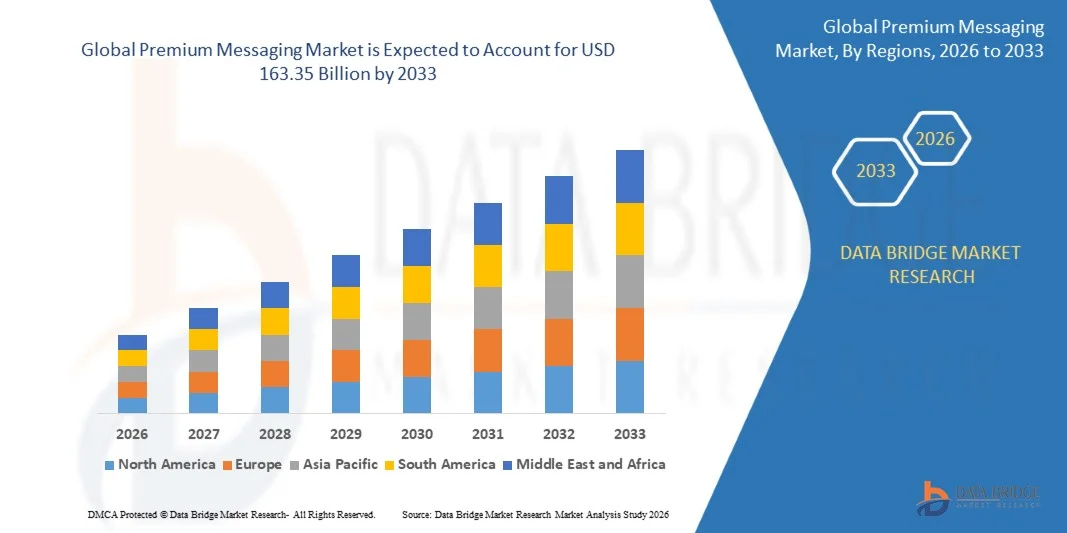
- The global premium messaging market size was valued at USD 97.15 billion in 2025 and is expected to reach USD 163.35 billion by 2033, at a CAGR of6.71% during the forecast period
- Rising adoption of mobile devices, increasing use of application-to-person (A2P) messaging for banking, retail, and media, growing demand for personalized customer engagement, expansion of 5G networks, increasing mobile internet penetration, and rising reliance on digital communication channels are key factors driving the growth of the Premium Messaging market.
What are the Major Takeaways of Premium Messaging Market?
- Growing smartphone penetration, expansion of cloud-based messaging services, and increasing adoption of AI-powered messaging solutions in BFSI, retail, and media sectors are creating significant growth opportunities for the Premium Messaging market
- Regulatory challenges, spam filtering issues, and rising competition from free messaging apps may act as market restraints, limiting adoption in certain regions
- North America dominated the premium messaging market with a 42.65% revenue share in 2025, driven by widespread adoption of A2P and P2A messaging across BFSI, retail, telecom, and media sectors in the U.S. and Canada
- Asia-Pacific is projected to register the fastest CAGR of 7.69% from 2026 to 2033, led by rising adoption of mobile communications, e-commerce, and fintech solutions across China, Japan, India, South Korea, and Southeast Asia
- The A2P SMS segment dominated the market with a 38.6% share in 2025, driven by high adoption across banking, telecom, retail, and e-commerce sectors for transactional, alert, and promotional messaging
Report Scope and Premium Messaging Market Segmentation
|
Attributes |
Premium Messaging Key Market Insights |
|
Segments Covered |
|
|
Countries Covered |
North America
Europe
Asia-Pacific
Middle East and Africa
South America
|
|
Key Market Players |
|
|
Market Opportunities |
|
|
Value Added Data Infosets |
In addition to the insights on market scenarios such as market value, growth rate, segmentation, geographical coverage, and major players, the market reports curated by the Data Bridge Market Research also include in-depth expert analysis, pricing analysis, brand share analysis, consumer survey, demography analysis, supply chain analysis, value chain analysis, raw material/consumables overview, vendor selection criteria, PESTLE Analysis, Porter Analysis, and regulatory framework. |
What is the Key Trend in the Premium Messaging Market?
“Increasing Adoption of AI-Driven, Multi-Channel, and Enterprise-Grade Messaging Solutions”
- The premium messaging market is witnessing strong adoption of AI-enabled, automated messaging platforms designed to enhance customer engagement, provide personalized notifications, and support omnichannel communication
- Providers are introducing multi-channel messaging solutions integrating SMS, MMS, RCS, and push notifications to improve reach, reliability, and user experience
- Growing demand for cost-efficient, scalable, and cloud-based messaging platforms is driving adoption across BFSI, retail, entertainment, and healthcare sectors
- For instance, companies such as Twilio, Sinch, MessageBird, and Infobip have upgraded their platforms with AI-based routing, analytics, and personalized messaging capabilities to improve delivery rates and engagement
- Increasing need for instant communication, customer loyalty programs, and transactional notifications is accelerating the shift toward enterprise-grade, cloud-integrated messaging platforms
- As businesses expand digital communication channels, Premium Messaging will remain essential for real-time engagement, customer retention, and marketing automation
What are the Key Drivers of Premium Messaging Market?
- Rising demand for automated, high-delivery messaging solutions to support personalized customer communication and marketing campaigns across enterprises
- For instance, in 2025, leading companies such as Twilio, Sinch, and Infobip enhanced AI-driven messaging features, multi-language support, and integration with CRM systems
- Growing adoption of smartphones, mobile internet, and digital payment systems is boosting demand for transactional and promotional messaging across the U.S., Europe, and Asia-Pacific
- Advancements in cloud computing, AI-based analytics, and multi-channel orchestration have strengthened platform efficiency, scalability, and reliability
- Rising use of IoT-enabled devices, smart applications, and automated notification systems is creating demand for multi-channel premium messaging platforms
- Supported by steady enterprise digital transformation, increased e-commerce adoption, and focus on customer experience, the Premium Messaging market is expected to witness strong long-term growth
Which Factor is Challenging the Growth of the Premium Messaging Market?
- High implementation and subscription costs for enterprise-grade messaging platforms may limit adoption among SMEs and small businesses
- For instance, during 2024–2025, stringent compliance regulations, cross-border messaging restrictions, and premium carrier pricing increased operational costs for global vendors
- Complexity in integrating messaging platforms with legacy systems, CRM solutions, and analytics dashboards requires skilled personnel and technical expertise
- Limited awareness of advanced messaging solutions and benefits in emerging markets slows adoption
- Competition from free OTT messaging apps, social media platforms, and push notification channels creates pricing pressure and reduces differentiation
- To address these challenges, companies are focusing on cost-optimized cloud offerings, easy-to-integrate APIs, AI-driven analytics, and flexible subscription models to increase global adoption of premium messaging
How is the Premium Messaging Market Segmented?
The market is segmented on the basis of product and application.
• By Product
On the basis of product, the premium messaging market is segmented into A2P SMS, A2P MMS, P2A SMS, and P2A MMS. The A2P SMS segment dominated the market with a 38.6% share in 2025, driven by high adoption across banking, telecom, retail, and e-commerce sectors for transactional, alert, and promotional messaging. A2P SMS offers reliability, widespread mobile network compatibility, and cost-effectiveness, making it the preferred choice for businesses communicating with large user bases. Enterprises increasingly rely on automated messaging for OTPs, alerts, reminders, and marketing campaigns, further strengthening market dominance.
The P2A MMS segment is projected to grow at the fastest CAGR from 2026 to 2033, fueled by rising adoption of multimedia-rich communication, interactive messaging, and enhanced marketing campaigns. Increasing smartphone penetration, consumer preference for visual content, and innovations in rich communication services (RCS) are accelerating the shift toward MMS-based Premium Messaging solutions across multiple industries.
• By Application
On the basis of application, the premium messaging market is segmented into BFSI, Entertainment & Media, Hospitality, Outsourcing, Retail, and Others. The BFSI segment dominated the market with a 41.2% share in 2025, driven by heavy use of transactional alerts, OTPs, fraud notifications, and payment confirmations. Financial institutions, insurance companies, and fintech firms rely on secure and reliable messaging solutions to maintain customer engagement and trust.
The Entertainment & Media segment is expected to grow at the fastest CAGR from 2026 to 2033, fueled by increasing demand for ticketing notifications, content alerts, subscription renewals, and interactive campaigns. Growth is supported by the rising consumption of digital media, streaming platforms, and online gaming services, which require high-volume, real-time messaging to improve customer engagement and retention. Expansion in personalized messaging and integration with marketing automation tools further drives growth in this application segment.
Which Region Holds the Largest Share of the Premium Messaging Market?
- North America dominated the premium messaging market with a 42.65% revenue share in 2025, driven by widespread adoption of A2P and P2A messaging across BFSI, retail, telecom, and media sectors in the U.S. and Canada. High demand for secure, real-time, and automated messaging for alerts, OTPs, and promotional campaigns continues to boost market growth. Advanced messaging platforms, cloud-based solutions, and strong digital infrastructure further strengthen the region’s leadership
- Leading players in North America are introducing scalable messaging APIs, multi-channel integration, and cloud-enabled analytics, enhancing service reliability and enterprise adoption. Continuous investments in 5G, IoT communication, and AI-driven marketing solutions are expected to sustain market expansion
- Strong talent pool, mature telecommunications networks, and innovation-driven ecosystems reinforce North America’s position as the largest contributor to the global Premium Messaging market
U.S. Premium Messaging Market Insight
The U.S. is the key contributor in North America, supported by widespread adoption of A2P SMS, transactional messaging, and automated marketing solutions across BFSI, retail, and telecom sectors. Enterprises are leveraging cloud-based messaging, AI-driven analytics, and API integrations for high-volume, real-time communication. Growing demand for secure, multi-channel messaging and personalized notifications is driving Premium Messaging adoption. Major telecom operators, fintechs, and e-commerce platforms contribute significantly to regional revenue.
Canada Premium Messaging Market Insight
Canada contributes steadily to North America’s market, driven by increasing use of A2P messaging in BFSI, healthcare, and retail sectors. Telecom companies and enterprises rely on secure and efficient messaging for transactional alerts, notifications, and marketing campaigns. Government initiatives supporting digital communication infrastructure, strong enterprise adoption, and growing cloud-based messaging integration strengthen market penetration. Canadian startups and SMEs increasingly adopt Premium Messaging platforms for enhanced customer engagement and automated communications.
Asia-Pacific Premium Messaging Market
Asia-Pacific is projected to register the fastest CAGR of 7.69% from 2026 to 2033, led by rising adoption of mobile communications, e-commerce, and fintech solutions across China, Japan, India, South Korea, and Southeast Asia. High-volume messaging requirements in BFSI, entertainment, retail, and telecom sectors drive the need for reliable, scalable, and automated Premium Messaging solutions. Rapid smartphone penetration, growing digital infrastructure, and 5G deployment accelerate the adoption of A2P and P2A messaging across enterprises.
China Premium Messaging Market Insight
China is the largest contributor to Asia-Pacific due to massive mobile subscriber base, widespread A2P adoption, and advanced digital infrastructure. Enterprises and telecom operators leverage high-volume messaging for banking alerts, e-commerce notifications, and marketing campaigns. Government support for digitalization, advanced telecom networks, and competitive pricing of messaging platforms further propel adoption across the country.
Japan Premium Messaging Market Insight
Japan shows steady growth with strong demand from BFSI, retail, and telecom sectors. Enterprises rely on reliable and secure messaging for automated alerts, notifications, and marketing. Advanced telecom networks, high smartphone penetration, and integration with AI-based analytics support adoption. Growth is further reinforced by demand for multi-channel and interactive messaging across businesses.
India Premium Messaging Market Insight
India is emerging as a major growth hub for Premium Messaging, fueled by rapid digitalization, smartphone adoption, and booming fintech and e-commerce sectors. Enterprises and startups increasingly adopt A2P SMS, P2A MMS, and cloud-based messaging for transactional alerts, marketing, and customer engagement. Government-backed digital initiatives, expanding telecom infrastructure, and growing 5G adoption further support market expansion.
South Korea Premium Messaging Market Insight
South Korea contributes significantly due to high mobile penetration, widespread enterprise adoption, and strong demand from BFSI, retail, and telecom sectors. Rapid adoption of advanced messaging APIs, multi-channel integrations, and cloud-based communication platforms drives growth. Strong digital infrastructure, technological innovation, and government support for smart communication solutions ensure sustained market expansion.
Which are the Top Companies in Premium Messaging Market?
The premium messaging industry is primarily led by well-established companies, including:
- Deutsche Telekom AG (Germany)
- Orange Business (France)
- NTT DOCOMO (Japan)
- China Telecom Corporation Limited (China)
- Twilio Inc. (U.S.)
- AT&T Intellectual Property (U.S.)
- Vodafone Limited (U.K.)
- Sinch (Sweden)
- SoftBank Corp. (Japan)
- China Unicom (Hong Kong) Limited (China)
- Vonage America, LLC (U.S.)
- KDDI CORPORATION (Japan)
What are the Recent Developments in Global Premium Messaging Market?
- In February 2025, Vonage announced a partnership with the German social commerce platform mydealz, enabling the company to utilize Rich Communication Services (RCS) and offer users a more advanced messaging experience, enhancing personalized, engaging, and interactive communication. This collaboration allows mydealz to send real-time notifications about popular deals, create offers tailored to user preferences, and deliver interactive shopping experiences through rich media such as images and clickable buttons, significantly improving customer engagement and retention
- In September 2024, Twilio announced global availability of Rich Communication Services messaging for its customers via its Programmable Messaging and Verify APIs, allowing businesses to send verified and branded messages to strengthen customer trust and loyalty. Twilio’s RCS automatically upgrades SMS messages to RCS on compatible devices for messages up to 160 characters, including business logos, taglines, and sender verification. Companies can configure their brand and verification through the Twilio Console without coding, ensuring quick, reliable, and trusted communications worldwide
SKU-
Get online access to the report on the World's First Market Intelligence Cloud
- Interactive Data Analysis Dashboard
- Company Analysis Dashboard for high growth potential opportunities
- Research Analyst Access for customization & queries
- Competitor Analysis with Interactive dashboard
- Latest News, Updates & Trend analysis
- Harness the Power of Benchmark Analysis for Comprehensive Competitor Tracking
研究方法
数据收集和基准年分析是使用具有大样本量的数据收集模块完成的。该阶段包括通过各种来源和策略获取市场信息或相关数据。它包括提前检查和规划从过去获得的所有数据。它同样包括检查不同信息源中出现的信息不一致。使用市场统计和连贯模型分析和估计市场数据。此外,市场份额分析和关键趋势分析是市场报告中的主要成功因素。要了解更多信息,请请求分析师致电或下拉您的询问。
DBMR 研究团队使用的关键研究方法是数据三角测量,其中包括数据挖掘、数据变量对市场影响的分析和主要(行业专家)验证。数据模型包括供应商定位网格、市场时间线分析、市场概览和指南、公司定位网格、专利分析、定价分析、公司市场份额分析、测量标准、全球与区域和供应商份额分析。要了解有关研究方法的更多信息,请向我们的行业专家咨询。
可定制
Data Bridge Market Research 是高级形成性研究领域的领导者。我们为向现有和新客户提供符合其目标的数据和分析而感到自豪。报告可定制,包括目标品牌的价格趋势分析、了解其他国家的市场(索取国家列表)、临床试验结果数据、文献综述、翻新市场和产品基础分析。目标竞争对手的市场分析可以从基于技术的分析到市场组合策略进行分析。我们可以按照您所需的格式和数据样式添加您需要的任意数量的竞争对手数据。我们的分析师团队还可以为您提供原始 Excel 文件数据透视表(事实手册)中的数据,或者可以帮助您根据报告中的数据集创建演示文稿。