



North America Wearable Devices Market Segmentation, By Device Type (Diagnostic and Monitoring Devices and Therapeutic Devices), Product Type (Wrist-wear, Eyewear, Footwear, Neckwear, Body wear and Others), Application (Sports and Fitness, Remote Patient Monitoring and Home Healthcare), Industry (Consumer Products, Healthcare, Industrial and Others), End Users (Personal Users and Enterprises) - Industry Trends and Forecast to 2032
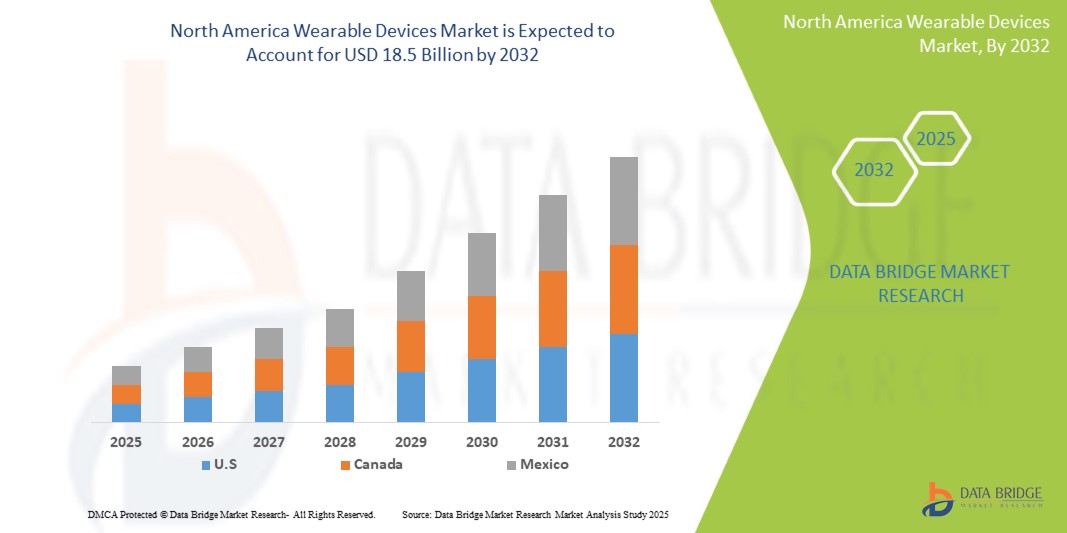
Wearable Devices Market Size
- The North America Wearable Devices Market was valued at USD 8.2 Billion in 2024 and is expected to reach USD 18.5 Billion by 2032.
- During the forecast period of 2025 to 2032, the market is likely to grow at a CAGR of 12.1%, primarily driven by the anticipated launch of new wearable technologies and their integration into healthcare systems.
- •The drivers of the Wearable Devices Market include the rising adoption of health-monitoring devices, advancements in sensors and data analytics, growing consumer interest in fitness tracking, and an increasing focus on personalized healthcare solutions.
North America Wearable Devices Market Analysis
- The North America Wearable Devices Market plays a crucial role in the management and prevention of various chronic diseases, including cardiovascular conditions, diabetes, and metabolic disorders. These devices are essential for early detection, continuous monitoring, and timely intervention, leading to improved patient outcomes.
- • The demand for wearable devices in North America is driven by the rising prevalence of chronic diseases, the increasing aging population, and growing awareness of the importance of proactive health management. The need for advanced, real-time health monitoring and personalized solutions is particularly high in regions with an aging demographic and a significant burden of lifestyle-related diseases.
- North America is a dominant region in the global Wearable Devices Market, supported by its advanced healthcare infrastructure, high adoption of innovative health technologies, and a growing emphasis on preventive care and wellness.
- For instance, fitness trackers and health-monitoring wearables have gained widespread popularity in the U.S., with a significant number of consumers incorporating these devices into their daily routines to track fitness, heart health, and chronic disease management.
- Globally, wearable devices are recognized as key tools in improving the management of chronic conditions and are increasingly integrated into healthcare systems to provide real-time data, ensuring more precise and effective treatment plans.
Report Scope andWearable Devices Market Segmentation
|
Attributes |
Medical Computer Cart Device KeyMarket Insights |
|
Segments Covered |
|
|
Countries Covered |
North America
|
|
Key Market Players |
|
|
Market Opportunities |
|
|
Value Added Data Infosets |
In addition to the insights on market scenarios such as market value, growth rate, segmentation, geographical coverage, and major players, the market reports curated by the Data Bridge Market Research also include import export analysis, production capacity overview, production consumption analysis, price trend analysis, climate change scenario, supply chain analysis, value chain analysis, raw material/consumables overview, vendor selection criteria, PESTLE Analysis, Porter Analysis, and regulatory framework. |
Wearable Devices Market Trends
““Increased Adoption of Health Monitoring Technologies”
- Integration of AI and Machine Learning: There is a growing trend toward integrating artificial intelligence (AI) and machine learning in wearable devices to provide more accurate, real-time health monitoring. These advancements enable predictive analytics, allowing for better early detection and personalized treatment plans for chronic conditions.
- Advancements in Sensor Technologies: The development of more advanced sensors for wearable devices is enabling more precise and comprehensive tracking of health parameters such as heart rate, blood glucose levels, and sleep patterns. These improvements are enhancing the effectiveness of wearables in managing chronic diseases like diabetes, hypertension, and cardiovascular conditions.
- Rise of Connected Ecosystems: Wearable devices are increasingly becoming part of connected health ecosystems, where data from wearables is integrated into broader healthcare platforms. This enables healthcare providers to monitor patients remotely, making it easier to manage chronic diseases and improve patient outcomes.
- Focus on Mental Health and Wellness: There is an increasing shift towards wearable devices that monitor not only physical health but also mental well-being. Devices tracking stress levels, sleep quality, and emotional health are gaining popularity, offering a more holistic approach to personal health management.
Wearable Devices Market Dynamics
Driver
“Rising Prevalence of Chronic Diseases”
- Increased Risk of Health Complications: The growing incidence of chronic conditions such as cardiovascular diseases, diabetes, and obesity is leading to a higher demand for wearable devices that can monitor vital health parameters in real-time, helping with early detection and management of these conditions.
- High Healthcare Demand: As chronic diseases continue to rise, there is an increasing need for effective monitoring tools, driving demand for wearable devices that assist in continuous tracking of health metrics like blood sugar levels, heart rate, and physical activity, which contribute to better disease management.
- Government and Healthcare Investments: Governments and healthcare organizations are prioritizing investments in digital health technologies to improve healthcare outcomes. This growing focus on preventative care, including wearable devices, fuels market growth and innovation in the wearable health tech space.
Opportunity
“Advancements in Personalized Healthcare”
- Tailored Health Monitoring: The rise of personalized medicine presents an opportunity to develop wearable devices that provide customized health insights based on individual factors such as genetics, lifestyle, and specific health conditions. These devices offer the potential for more effective disease management and preventative care strategies.
- Integration of Advanced Sensors and Data Analytics: Personalized healthcare is increasingly supported by the integration of advanced sensors in wearable devices, enabling users to track personalized data points (such as sleep patterns, physical activity, and stress levels) and receive recommendations that are specific to their health needs.
- Increased Investment in Research and Development: The growing demand for personalized health solutions provides a significant opportunity for companies to invest in R&D to develop more sophisticated wearable devices that cater to individual health needs, driving innovation in the market for more effective and targeted healthcare solutions.
Restraint/Challenge
“High Device Costs and Accessibility Issues”
- Expensive Wearable Devices: Many advanced wearable devices, particularly those integrated with cutting-edge technologies such as AI, advanced sensors, and real-time analytics, come with high price points, limiting access for some consumers and healthcare systems, especially in regions with budget constraints.
- Financial Burden on Consumers and Healthcare Systems: The high costs associated with purchasing and maintaining advanced wearable devices may place a financial burden on both consumers and healthcare systems. This could affect the overall affordability and accessibility of wearable technologies, especially in low-income regions.
- Insurance Coverage Limitations: In some regions, insurance plans may not fully cover the cost of wearable devices, particularly for health-related purposes, leading to out-of-pocket expenses for patients. The lack of insurance reimbursement options could hinder widespread adoption of wearable devices.
Wearable Devices Market Scope
The market is segmented on the basis of Device Type, Product type, Application, Industry, End User.
|
Segmentation |
Sub-Segmentation |
|
By Device Type |
|
|
By Product Type |
|
|
By Application |
|
|
By Industry
|
|
|
By End User |
|
Wearable Devices Market Regional Analysis
“U.S. is the Dominant Region in the Medical Computer Cart Device Market”
- North America dominates the Wearable Devices market, driven by advanced healthcare infrastructure, widespread adoption of innovative wearable technologies, and a strong presence of leading tech and healthcare companies.
- The U.S. holds a significant share due to the rising demand for personal health monitoring solutions, increasing prevalence of chronic diseases such as diabetes and heart disease, and continuous advancements in sensor technologies used in wearable devices.
- The availability of well-established healthcare policies and reimbursement frameworks, coupled with growing investments in research & development by prominent wearable device manufacturers, strengthens market growth in the region.
- Furthermore, the increasing adoption of wearable devices for fitness tracking, health monitoring, and disease prevention, along with the rise of health-conscious consumers, is driving market expansion across the U.S.
“U.S. is Projected to Register the Highest Growth Rate”
- The U.S. is expected to experience the highest growth rate in the North America Wearable Devices market, fueled by the increasing consumer demand for personalized health solutions, advancements in AI and machine learning technologies, and the integration of wearables into healthcare ecosystems for remote monitoring and chronic disease management.
- The rapid expansion of digital health technologies, including telemedicine and mobile health applications, further supports the growing adoption of wearable devices, especially in managing conditions like hypertension, diabetes, and obesity.
- The increasing focus on wellness and prevention, coupled with the growing awareness of the benefits of continuous health monitoring, positions the U.S. as a leader in the wearable devices market, particularly for products such as fitness trackers, smartwatches, and health monitoring patches.
- The presence of major companies and continuous innovations in the wearable device space, alongside the growing investment in health tech startups, are expected to fuel the market's expansion and make the U.S. a key driver of market growth in North America.
Wearable Devices Market Share
The market competitive landscape provides details by competitor. Details included are company overview, company financials, revenue generated, market potential, investment in research and development, new market initiatives, global presence, production sites and facilities, production capacities, company strengths and weaknesses, product launch, product width and breadth, application dominance. The above data points provided are only related to the companies' focus related to market.
The Major Market Leaders Operating in the Market Are:
- Apple Inc. (U.S.)
- Fitbit (U.S.)
- Garmin Ltd. (U.S.)
- Samsung Electronics Co., Ltd. (South Korea)
- Huawei Technologies Co., Ltd. (China)
- WHOOP (U.S.)
- Xiaomi Corporation (China)
- Polar Electro (U.S.)
- Oura Health (Finland)
Latest Developments in Wearable Devices Market
- In January 2025, Apple Inc. unveiled the latest iteration of the Apple Watch, featuring advanced health monitoring capabilities, including real-time blood glucose tracking, ECG, and improved sleep analysis. The new model integrates more advanced sensors to offer deeper insights into users' cardiovascular and metabolic health.
- In December 2024, Fitbit launched the Sense 2, a next-generation health and fitness tracker that includes continuous stress monitoring, skin temperature variation tracking, and enhanced heart rate sensors. The device is designed to provide a more holistic view of a user’s overall health and wellness.
- In November 2024, Garmin expanded its smartwatch portfolio with the Forerunner 965, focusing on athletes. This new wearable incorporates a built-in Pulse Ox sensor, advanced heart rate monitoring, and real-time hydration tracking, designed to support elite athletes in managing their physical performance and health metrics.
- In October 2024, WHOOP announced the launch of its new WHOOP 5.0, which features a sleeker design and enhanced battery life. The device integrates more advanced biometric sensors for deeper tracking of recovery, sleep, and overall health, aiming to improve both athletic performance and daily wellness.
- In September 2024, Samsung unveiled its Galaxy Watch 7, incorporating new stress detection features, more accurate ECG functionality, and an AI-powered fitness coach. This smartwatch also includes a range of new fitness and health monitoring tools, including advanced sleep tracking and a personalized wellness program.
SKU-

研究方法
数据收集和基准年分析是使用具有大样本量的数据收集模块完成的。该阶段包括通过各种来源和策略获取市场信息或相关数据。它包括提前检查和规划从过去获得的所有数据。它同样包括检查不同信息源中出现的信息不一致。使用市场统计和连贯模型分析和估计市场数据。此外,市场份额分析和关键趋势分析是市场报告中的主要成功因素。要了解更多信息,请请求分析师致电或下拉您的询问。
DBMR 研究团队使用的关键研究方法是数据三角测量,其中包括数据挖掘、数据变量对市场影响的分析和主要(行业专家)验证。数据模型包括供应商定位网格、市场时间线分析、市场概览和指南、公司定位网格、专利分析、定价分析、公司市场份额分析、测量标准、全球与区域和供应商份额分析。要了解有关研究方法的更多信息,请向我们的行业专家咨询。
可定制
Data Bridge Market Research 是高级形成性研究领域的领导者。我们为向现有和新客户提供符合其目标的数据和分析而感到自豪。报告可定制,包括目标品牌的价格趋势分析、了解其他国家的市场(索取国家列表)、临床试验结果数据、文献综述、翻新市场和产品基础分析。目标竞争对手的市场分析可以从基于技术的分析到市场组合策略进行分析。我们可以按照您所需的格式和数据样式添加您需要的任意数量的竞争对手数据。我们的分析师团队还可以为您提供原始 Excel 文件数据透视表(事实手册)中的数据,或者可以帮助您根据报告中的数据集创建演示文稿。











