


What is the Radar Absorbing Materials (RAM) Market Size and Growth Rate?
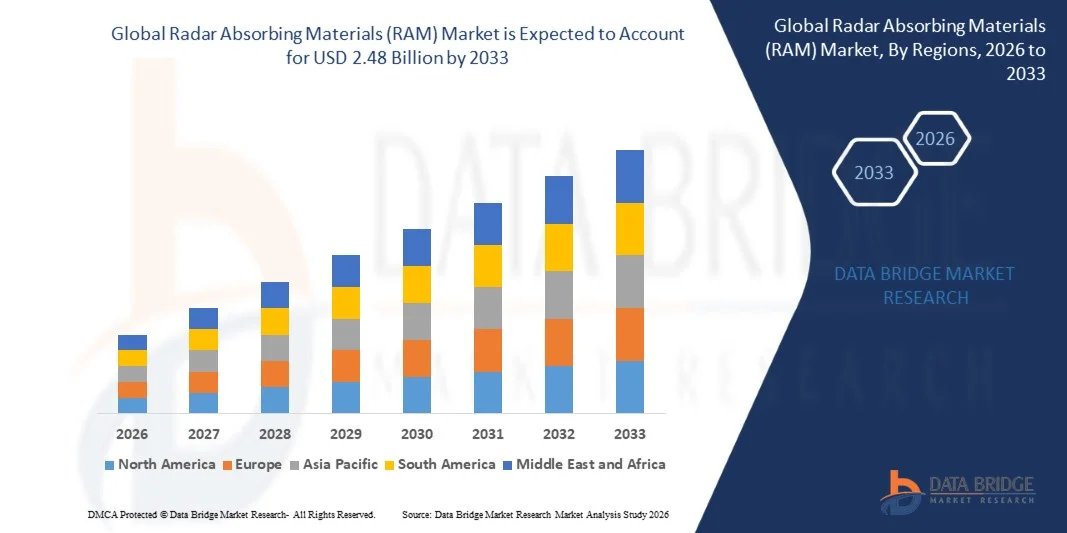
- As per Data Bridge Market Research analysis, the radar absorbing materials (RAM) market was valued at USD 2.40 billion in 2025 and is projected to reach USD 2.48 billion by 2033, growing at a CAGR of 7.60% from 2026 to 2033.
- The market is witnessing steady growth driven by increasing investments in stealth technologies, rising defense modernization programs, and growing demand for advanced electromagnetic interference (EMI) and radar signature reduction solutions across military and aerospace applications.
- The expanding deployment of next-generation aircraft, naval vessels, unmanned systems, and missile defense platforms, coupled with continuous advancements in lightweight, high-performance absorber materials, is accelerating the adoption of radar absorbing materials across defense, aerospace, automotive, and telecommunications sectors.
Market Size & Forecast
- Market Value (2025): USD 2.40 Billion
- Expected Market Value (2033): USD 2.48 Billion
- Forecast CAGR (2026–2033): 7.60%
- Leading Region in 2025: North America
- Fastest Growing Region: Asia-Pacific
What are the Major Takeaways of the Radar Absorbing Materials (RAM) Market?
- North America dominated the radar absorbing materials (RAM) market with the largest revenue share in 2025, supported by substantial defense spending, ongoing military modernization programs, and the presence of leading aerospace and defense manufacturers.
- Asia-Pacific radar absorbing materials (RAM) market is expected to witness the fastest growth rate from 2026 to 2033, supported by increasing defense modernization initiatives, rising military expenditure, and expanding aerospace industries across major economies.
- The hybrid and multilayer absorber materials segment held the largest market revenue share in 2025 driven by its superior broadband absorption capability, lightweight characteristics, and high effectiveness across multiple radar frequency ranges. These materials are extensively utilized in advanced military aircraft, naval vessels, missile systems, and stealth platforms where low observability is a critical requirement.
- The carbon-based dielectric and conductive materials segment is projected to register the fastest growth from 2026 to 2033, driven by increasing utilization of graphene, carbon nanotubes, and advanced carbon composites in aerospace and defense applications. These materials provide excellent conductivity, low weight, and improved electromagnetic absorption characteristics. Rising investments in nanotechnology research and next-generation stealth systems are further accelerating demand. Expanding adoption in electronic warfare equipment and high-frequency communication systems is also contributing to segment growth.
- The coatings and liquid-applied systems segment accounted for the largest market revenue share in 2025 due to their widespread use on aircraft exteriors, naval structures, military vehicles, and radar-sensitive equipment. These solutions offer ease of application, scalability, and compatibility with complex surfaces while providing effective radar signature reduction. Continuous advancements in durable and weather-resistant coating technologies have further enhanced adoption. Increasing investments in stealth aircraft programs are also supporting market expansion.
- The structural absorber products segment is projected to register the fastest growth from 2026 to 2033 owing to increasing demand for multifunctional materials capable of combining structural strength and electromagnetic absorption properties. Defense manufacturers are increasingly integrating RAM directly into platform structures to reduce weight and improve performance. Growing emphasis on fuel efficiency and payload optimization in aerospace applications is further encouraging adoption. Advancements in composite manufacturing technologies are expected to accelerate segment growth.
Report Scope and Radar Absorbing Materials (RAM) Market Segmentation
|
Attributes |
Radar Absorbing Materials (RAM) Key Market Insights |
|
Segments Covered |
|
|
Countries Covered |
North America
Europe
Asia-Pacific
Middle East and Africa
South America
|
|
Key Market Players |
|
|
Market Opportunities |
|
|
Value Added Data Infosets |
In addition to the market insights such as market value, growth rate, market segments, geographical coverage, market players, and market scenario, the market report curated by the Data Bridge Market Research team includes in-depth expert analysis, import/export analysis, pricing analysis, production consumption analysis, and pestle analysis. |
What is the Key Trend in the Radar Absorbing Materials (RAM) Market?
- The market is witnessing a strong shift toward advanced lightweight radar absorbing materials, metamaterials, and multifunctional stealth coatings that deliver superior radar cross-section (RCS) reduction while minimizing weight and maintenance requirements for next-generation defense platforms.
- For instance, in March 2025, reports related to India's TEJAS Mk-2 program highlighted the incorporation of advanced radar absorbing materials and multiple RCS-reduction measures to enhance stealth performance and improve survivability in contested environments.
- Defense manufacturers are increasingly focusing on nanomaterials, conductive polymers, and frequency-selective surface technologies that provide broadband absorption capabilities across multiple radar frequency bands.
- For instance, in June 2025, researchers published advancements in electromagnetic interference shielding and stealth technologies, emphasizing the growing use of innovative radar absorbent materials and next-generation material architectures for improved radar signature management.
- As military modernization programs continue to prioritize low-observable platforms and advanced electronic warfare capabilities, the adoption of lightweight, high-performance radar absorbing materials is expected to accelerate, reinforcing stealth technology as a critical component of future defense systems.
What are the Key Drivers of the Radar Absorbing Materials (RAM) Market?
- The increasing procurement of stealth aircraft, naval vessels, missile systems, and unmanned platforms is significantly driving demand for radar absorbing materials that can reduce radar detectability and enhance mission effectiveness.
- For instance, in August 2025, BAE Systems secured continued production contracts for advanced RF sensor technologies supporting the Long-Range Anti-Ship Missile (LRASM) program, reflecting ongoing investments in stealth-enabled defense capabilities and survivable weapons platforms.
- Governments worldwide are expanding defense budgets and accelerating military modernization initiatives to strengthen air defense, electronic warfare, and strategic deterrence capabilities, creating sustained demand for advanced RAM solutions.
- For instance, in May 2025, India delivered its indigenous Surya VHF radar designed to detect stealth aircraft, highlighting the growing global emphasis on stealth and counter-stealth technologies that is driving innovation and deployment of radar absorbing materials.
- With defense agencies increasingly prioritizing survivability, low observability, and electronic dominance across modern battlefields, radar absorbing materials will remain a critical enabling technology for next-generation military platforms.
Which Factors are Challenging the Growth of the Radar Absorbing Materials (RAM) Market?
- Advanced radar absorbing materials require highly specialized raw materials, precision manufacturing processes, and extensive testing to achieve reliable performance across multiple frequency bands and operating environments.
- The complexity associated with developing durable, lightweight, and broadband absorption solutions increases production costs and creates barriers for large-scale commercialization beyond defense applications.
- For instance, in March 2026, research on lightweight auxetic metamaterial-based radar absorbing structures highlighted the engineering challenges involved in balancing weight reduction, thermal stability, and radar absorption performance for aerospace applications.
- In addition, stringent military qualification requirements, classified technology restrictions, and lengthy procurement cycles often delay product approvals and limit market accessibility for new suppliers.
- The high development costs, technical complexity, and rigorous defense certification processes continue to restrain market expansion, particularly for emerging manufacturers seeking to enter highly specialized military and aerospace supply chains.
How is the Radar Absorbing Materials (RAM) Market Segmented?
The market is segmented on the basis of material type, product form, application, primary operating frequency band, bandwidth coverage, end user, dominant absorption mechanism, absorber architecture, thickness, rated reflection-loss magnitude, platform, and sales and procurement channel.
- By Material Type
On the basis of material type, the radar absorbing materials (RAM) market is segmented into magnetic-loss materials, carbon-based dielectric and conductive materials, conductive polymers, ceramic and semiconducting absorber materials, non-magnetic metallic and resistive materials, hybrid and multilayer absorber materials, and others. The hybrid and multilayer absorber materials segment held the largest market revenue share in 2025 driven by its superior broadband absorption capability, lightweight characteristics, and high effectiveness across multiple radar frequency ranges. These materials are extensively utilized in advanced military aircraft, naval vessels, missile systems, and stealth platforms where low observability is a critical requirement. Their ability to combine multiple absorption mechanisms within a single structure significantly enhances radar attenuation performance. In addition, growing defense modernization programs across major economies are supporting increased deployment of multilayer RAM technologies.
The carbon-based dielectric and conductive materials segment is projected to register the fastest growth from 2026 to 2033, driven by increasing utilization of graphene, carbon nanotubes, and advanced carbon composites in aerospace and defense applications. These materials provide excellent conductivity, low weight, and improved electromagnetic absorption characteristics. Rising investments in nanotechnology research and next-generation stealth systems are further accelerating demand. Expanding adoption in electronic warfare equipment and high-frequency communication systems is also contributing to segment growth.
- By Product Form
On the basis of product form, the market is segmented into coatings and liquid-applied systems, flexible sheets and elastomeric absorbers, films and tapes, foam and pyramidal absorbers, structural absorber products, molded and prefabricated components, powders, fillers and masterbatches, and others. The coatings and liquid-applied systems segment accounted for the largest market revenue share in 2025 due to their widespread use on aircraft exteriors, naval structures, military vehicles, and radar-sensitive equipment. These solutions offer ease of application, scalability, and compatibility with complex surfaces while providing effective radar signature reduction. Continuous advancements in durable and weather-resistant coating technologies have further enhanced adoption. Increasing investments in stealth aircraft programs are also supporting market expansion.
The structural absorber products segment i is projected to register the fastest growth from 2026 to 2033 owing to increasing demand for multifunctional materials capable of combining structural strength and electromagnetic absorption properties. Defense manufacturers are increasingly integrating RAM directly into platform structures to reduce weight and improve performance. Growing emphasis on fuel efficiency and payload optimization in aerospace applications is further encouraging adoption. Advancements in composite manufacturing technologies are expected to accelerate segment growth.
- By Application
On the basis of application, the market is segmented into radar cross-section (RCS) reduction, antenna, radome and RF system management, anechoic chambers and electromagnetic testing, electronic equipment absorption and cavity suppression, automotive radar interference management, telecommunication and millimeter-wave systems, and others. The radar cross-section (RCS) reduction segment dominated the market in 2025 driven by growing deployment of stealth aircraft, naval vessels, missile systems, and unmanned platforms. Reducing radar detectability remains a top priority for military organizations seeking improved survivability and operational effectiveness. Increased defense spending and ongoing procurement of fifth-generation combat aircraft are strengthening demand for advanced RAM solutions. Technological advancements in stealth platform design are further supporting segment growth.
The automotive radar interference management segment is projected to register the fastest growth from 2026 to 2033 due to increasing integration of radar sensors in ADAS and autonomous vehicles. The rising number of radar-equipped vehicles is creating demand for materials capable of minimizing signal interference and enhancing detection accuracy. Automotive manufacturers are increasingly investing in advanced electromagnetic management solutions to improve safety performance. Growth in autonomous mobility technologies is expected to further accelerate segment expansion.
- By Primary Operating Frequency Band
On the basis of primary operating frequency band, the market is segmented into P band, L band, S band, C band, X band, Ku band, K band, Ka band, V band, and W band. The X band segment held the largest market revenue share in 2025 owing to its extensive use in military surveillance systems, airborne radar platforms, fire-control systems, and naval radar applications. Many modern defense radar systems operate within this frequency range, driving consistent demand for specialized absorption materials. The segment also benefits from extensive deployment in threat detection and target tracking applications. Increasing military modernization initiatives continue to support growth.
The Ka band segment is projected to register the fastest growth from 2026 to 2033 driven by rising adoption in satellite communications, advanced military radar systems, and high-frequency sensing technologies. Increasing investments in space-based surveillance and next-generation communication infrastructure are supporting demand. The growing importance of high-frequency radar applications in defense and aerospace sectors is creating additional opportunities. Technological advancements in millimeter-wave systems are further accelerating growth.
- By Bandwidth Coverage
On the basis of bandwidth coverage, the market is segmented into narrowband absorbers, broadband absorbers, multiband absorbers, and ultra-wideband absorbers. The broadband absorbers segment accounted for the largest market share in 2025 due to their capability to provide effective absorption across a broad range of frequencies. These materials are widely used in stealth applications where protection against multiple radar systems is required. Their versatility and operational reliability have made them the preferred choice across aerospace and defense sectors. Increasing demand for advanced military platforms is supporting continued segment dominance.
The ultra-wideband absorbers segment is projected to register the fastest growth from 2026 to 2033 driven by the need for enhanced stealth performance against increasingly sophisticated radar technologies. Defense organizations are investing heavily in materials capable of delivering superior multi-frequency absorption. Rising adoption in electronic warfare and intelligence systems is also supporting growth. Continued innovation in absorber design is expected to strengthen market demand.
- By End User
On the basis of end user, the market is segmented into defense platforms OEMs and prime contractors, government defense and security organizations, commercial aerospace and space organizations, automotive OEMs and radar system suppliers, electronics and telecommunication equipment manufacturers, testing, measurement and certification organizations, and research and academic institutions. The defense platforms OEMs and prime contractors segment held the largest market revenue share in 2025 due to substantial investments in stealth aircraft, naval vessels, missile defense systems, and advanced military technologies. These organizations represent the primary purchasers of high-performance RAM solutions globally. Long-term defense procurement contracts and modernization programs continue to support segment growth. The increasing focus on low-observable technologies further strengthens demand.
The commercial aerospace and space organizations segment is projected to register the fastest growth from 2026 to 2033 owing to expanding investments in satellite systems, launch vehicles, and advanced aerospace technologies. Growing interest in electromagnetic interference management within commercial aerospace applications is supporting adoption. Increasing commercialization of space activities is also generating new opportunities. Technological innovation across the space sector continues to drive market expansion.
- By Dominant Absorption Mechanism
On the basis of dominant absorption mechanism, the market is segmented into magnetic-loss-dominant absorption, dielectric-polarization-loss-dominant absorption, conductive-loss-dominant absorption, resonant and interference-based absorption, and hybrid or multiple-loss absorption. The hybrid or multiple-loss absorption segment dominated the market in 2025 owing to its ability to combine multiple electromagnetic attenuation mechanisms within a single material system. This enables superior performance across diverse frequency ranges and operating environments. The segment is increasingly utilized in advanced stealth platforms requiring maximum radar signature reduction. Growing defense investments are further strengthening demand.
The dielectric-polarization-loss-dominant absorption segment is projected to register the fastest growth from 2026 to 2033 due to ongoing advancements in ceramic composites, nanomaterials, and lightweight absorber technologies. These materials offer improved efficiency while reducing overall system weight. Increasing demand for compact and high-performance absorber solutions is driving adoption. Continued material science innovation is expected to support strong growth.
- By Absorber Architecture
On the basis of absorber architecture, the market is segmented into homogeneous single-layer absorbers, multilayer impedance-matched absorbers, graded and gradient absorbers, resistive-screen absorbers, frequency-selective surface absorbers, metamaterial and metasurface absorbers, structural and cellular absorbers, and others. The multilayer impedance-matched absorbers segment accounted for the largest market share in 2025 due to their superior broadband performance and high absorption efficiency. These architectures are widely deployed in military platforms where effective radar signature management is essential. Their ability to reduce reflections across multiple frequency bands has increased adoption. Continuous technological improvements are further enhancing performance capabilities.
The metamaterial and metasurface absorbers segment is projected to register the fastest growth from 2026 to 2033 driven by increasing research activities and commercialization of next-generation stealth technologies. These advanced architectures provide unprecedented control over electromagnetic wave behavior. Growing investments in defense innovation programs are supporting market development. Their lightweight design and high efficiency are expected to accelerate future adoption.
- By Thickness
On the basis of thickness, the market is segmented into below 0.5 mm, 0.5 mm to below 1 mm, 1 mm to below 5 mm, 5 mm to below 10 mm, 10 mm to below 25 mm, and 25 mm and above. The 1 mm to below 5 mm segment held the largest market revenue share in 2025 owing to its optimal balance between radar absorption performance, weight, flexibility, and durability. This thickness range is widely used across aerospace, naval, and defense applications where space and weight constraints are critical. Manufacturers favor this category due to its versatility and compatibility with various platform designs. Strong demand from military programs continues to support growth.
The below 0.5 mm segment is projected to register the fastest growth from 2026 to 2033 due to increasing demand for ultra-lightweight stealth materials. Next-generation aircraft, unmanned aerial systems, and compact electronic platforms are driving adoption. Continuous advancements in nanotechnology and thin-film manufacturing are supporting development. The trend toward miniaturization across defense systems is expected to strengthen demand.
- By Rated Reflection-Loss Magnitude
On the basis of rated reflection-loss magnitude, the market is segmented into below 10 dB, 10 dB to below 20 dB, 20 dB to below 30 dB, 30 dB to below 40 dB, and 40 dB and above. The 20 dB to below 30 dB segment dominated the market in 2025 as it provides an effective balance between performance, operational efficiency, and cost. These materials are suitable for a broad range of military and aerospace applications where reliable radar attenuation is required. Their widespread availability and proven effectiveness support strong adoption. Increasing defense procurement activities are contributing to market growth.
The 40 dB and above segment is projected to register the fastest growth from 2026 to 2033 driven by growing demand for high-performance stealth systems. Military organizations are increasingly seeking advanced solutions capable of delivering maximum radar signature reduction. Expanding deployment of next-generation combat platforms is supporting adoption. Continuous technological innovation is expected to accelerate segment growth.
- By Platform
On the basis of platform, the market is segmented into airborne platforms, naval platforms, land-based mobile platforms, missile and weapon systems, space and launch platforms, fixed systems and installations, and automotive and civil-mobility platforms. The airborne platforms segment accounted for the largest market revenue share in 2025 due to extensive deployment of RAM in fighter aircraft, military transport aircraft, helicopters, and unmanned aerial vehicles. Air superiority strategies and stealth aircraft programs remain major demand drivers. Increasing procurement of advanced combat aircraft globally continues to strengthen market growth. Ongoing upgrades to existing fleets are further supporting adoption.
The space and launch platforms segment is projected to register the fastest growth from 2026 to 2033 owing to rising investments in satellite systems, launch vehicles, and space surveillance technologies. Governments and private organizations are increasingly investing in space programs requiring advanced electromagnetic management capabilities. Expanding defense space initiatives are creating new growth opportunities. The commercialization of space activities is expected to further accelerate adoption.
- By Sales and Procurement Channel
On the basis of sales and procurement channel, the market is segmented into direct OEM and end-user contracts, prime contractor and system integrator procurement, authorized distributors and stocking representatives, specialized converters and fabricators, government and defense procurement programs, digital catalog and e-procurement channels, and others. The government and defense procurement programs segment held the largest market revenue share in 2025 driven by large-scale military acquisition projects and long-term defense modernization initiatives. These programs account for the majority of global RAM purchases due to the strategic importance of stealth technologies. Increasing defense budgets across major economies continue to support segment growth. Long procurement cycles also contribute to stable demand.
The digital catalog and e-procurement channels segment is projected to register the fastest growth from 2026 to 2033 owing to increasing digitalization of procurement processes and supply chain operations. Organizations are adopting digital sourcing platforms to improve efficiency, transparency, and supplier access. The trend toward streamlined procurement management is supporting growth. Expanding adoption of digital procurement technologies across industrial sectors is expected to create additional opportunities.
Which Region Holds the Largest Share of the Radar Absorbing Materials (RAM) Market?
- North America dominated the radar absorbing materials (RAM) market with the largest revenue share in 2025, supported by substantial defense spending, ongoing military modernization programs, and the presence of leading aerospace and defense manufacturers.
- The region has witnessed strong demand for advanced stealth technologies across fighter aircraft, naval vessels, missile systems, and unmanned platforms. Continuous investments in next-generation defense capabilities, electronic warfare systems, and radar signature reduction technologies are further driving market growth.
- The presence of extensive research and development activities and established defense procurement programs continues to strengthen North America's leadership position in the market.
U.S. Radar Absorbing Materials (RAM) Market Insight
The U.S. radar absorbing materials (RAM) market captured the largest revenue share in 2025 within North America, fueled by extensive investments in stealth aircraft, advanced missile systems, and military modernization initiatives. The country remains a global leader in the development and deployment of low-observable technologies across air, naval, and land defense platforms. Growing procurement of next-generation fighter aircraft, including stealth-enabled platforms, and increasing investments in defense research programs are contributing significantly to market expansion. The strong presence of major defense contractors and advanced materials manufacturers further supports industry growth.
Europe Radar Absorbing Materials (RAM) Market Insight
The Europe radar absorbing materials (RAM) market is expected to witness significant growth from 2026 to 2033, primarily driven by rising defense budgets, increasing geopolitical tensions, and expanding investments in advanced military technologies. Countries across the region are strengthening their defense capabilities through modernization of air and naval fleets, creating strong demand for stealth and radar signature management solutions. Growing collaboration among European defense organizations and increased focus on indigenous defense manufacturing are further supporting market development. The adoption of advanced electromagnetic management technologies is expected to accelerate across multiple defense applications.
U.K. Radar Absorbing Materials (RAM) Market Insight
The U.K. radar absorbing materials (RAM) market is expected to witness strong growth from 2026 to 2033, driven by increasing investments in advanced combat aircraft, naval defense systems, and future military modernization programs. The country's focus on strengthening defense readiness and enhancing electronic warfare capabilities is supporting the adoption of advanced RAM solutions. Ongoing participation in next-generation fighter aircraft programs and defense innovation initiatives is further contributing to market growth. The increasing emphasis on low-observable technologies is expected to sustain long-term demand.
Germany Radar Absorbing Materials (RAM) Market Insight
The Germany radar absorbing materials (RAM) market is expected to witness substantial growth from 2026 to 2033, fueled by rising defense expenditure, technological innovation, and increasing investments in aerospace and military modernization projects. Germany's strong engineering and manufacturing capabilities support the development and integration of advanced radar absorption technologies across defense platforms. The country's growing involvement in European defense collaboration programs is further driving market opportunities. Increasing adoption of advanced materials for aerospace and security applications is expected to strengthen market expansion.
Asia-Pacific Radar Absorbing Materials (RAM) Market Insight
The Asia-Pacific radar absorbing materials (RAM) market is expected to witness the fastest growth rate from 2026 to 2033, supported by increasing defense modernization initiatives, rising military expenditure, and expanding aerospace industries across major economies. Countries such as China, India, Japan, and South Korea are investing heavily in stealth aircraft, missile systems, naval platforms, and advanced surveillance technologies. Rapid advancements in domestic defense manufacturing capabilities and increasing government support for indigenous military programs are accelerating market growth. The region's expanding role in global defense production is further creating significant opportunities for RAM manufacturers.
Japan Radar Absorbing Materials (RAM) Market Insight
The Japan radar absorbing materials (RAM) market is expected to witness strong growth from 2026 to 2033 due to increasing investments in defense modernization, aerospace innovation, and advanced security technologies. The country's focus on strengthening air defense capabilities and enhancing surveillance systems is driving demand for radar absorption solutions. Growing deployment of advanced military aircraft and maritime defense assets is contributing to market expansion. In addition, Japan's expertise in advanced materials science and precision manufacturing supports the development of high-performance RAM technologies.
China Radar Absorbing Materials (RAM) Market Insight
The China radar absorbing materials (RAM) market accounted for the largest market revenue share in Asia-Pacific in 2025, attributed to substantial investments in military modernization, indigenous stealth aircraft programs, and advanced defense manufacturing capabilities. China continues to expand its fleet of stealth fighters, naval vessels, and strategic defense systems, creating significant demand for radar absorbing materials. Strong government support for defense technology development and increasing focus on aerospace innovation are further driving market growth. The presence of a large domestic manufacturing base and ongoing advancements in material science continue to position China as a key market for radar absorbing materials in the region.
Which are the Top Companies in Radar Absorbing Materials (RAM) Market?
The radar absorbing materials (RAM) industry is primarily led by well-established companies, including:
- 3M (U.S.)
- Albatross Projects GmbH (Germany)
- DMAS B.V. (Netherlands)
- Envirotech Systems Private Limited (India)
- ESCO Technologies Inc. (U.S.)
- Frankonia EMC Test-Systems GmbH (Germany)
- HEICO Corporation (U.S.)
- Hexcel Corporation (U.S.)
- J.V. Micronics (India)
- Jayaraj Microwaves (India)
- MAST Technologies, LLC (U.S.)
- Microwave Absorbers Inc. (U.S.)
- Microwave Factory Co., Ltd. (Japan)
- Microwave Vision Group SA (France)
- Nolato AB (Sweden)
- Parker-Hannifin Corporation (U.S.)
- PPG Industries, Inc. (U.S.)
- Qnity Electronics, Inc. (U.S.)
- Siepel SAS (France)
- Soliani EMC S.r.l. (Italy)
- TDK Corporation (Japan)
What are Latest Developments in Radar Absorbing Materials (RAM) Market?
- In March 2026, Trelleborg AB strengthened its aerospace and defense materials portfolio by expanding its advanced electromagnetic shielding and stealth technology solutions. The initiative focused on the development of lightweight composite materials engineered to enhance radar signature reduction and improve platform survivability. The expanded offering is expected to support next-generation military aircraft, naval systems, and defense platforms while advancing innovation in radar absorbing material technologies.
- In October 2025, PPG Industries, Inc. enhanced its aerospace materials portfolio through the introduction of advanced coating technologies designed for military aviation applications. These next-generation coatings aim to improve durability, environmental resistance, and electromagnetic performance while supporting aircraft protection and operational efficiency. The development is expected to increase the adoption of high-performance aerospace coatings and contribute to advancements in stealth and defense-related material solutions.

- Interactive Data Analysis Dashboard
- Company Analysis Dashboard for high growth potential opportunities
- Research Analyst Access for customization & queries
- Competitor Analysis with Interactive dashboard
- Latest News, Updates & Trend analysis
- Harness the Power of Benchmark Analysis for Comprehensive Competitor Tracking
Data collection and base year analysis are done using data collection modules with large sample sizes. The stage includes obtaining market information or related data through various sources and strategies. It includes examining and planning all the data acquired from the past in advance. It likewise envelops the examination of information inconsistencies seen across different information sources. The market data is analysed and estimated using market statistical and coherent models. Also, market share analysis and key trend analysis are the major success factors in the market report. To know more, please request an analyst call or drop down your inquiry.
The key research methodology used by DBMR research team is data triangulation which involves data mining, analysis of the impact of data variables on the market and primary (industry expert) validation. Data models include Vendor Positioning Grid, Market Time Line Analysis, Market Overview and Guide, Company Positioning Grid, Patent Analysis, Pricing Analysis, Company Market Share Analysis, Standards of Measurement, Global versus Regional and Vendor Share Analysis. To know more about the research methodology, drop in an inquiry to speak to our industry experts.
Data Bridge Market Research is a leader in advanced formative research. We take pride in servicing our existing and new customers with data and analysis that match and suits their goal. The report can be customized to include price trend analysis of target brands understanding the market for additional countries (ask for the list of countries), clinical trial results data, literature review, refurbished market and product base analysis. Market analysis of target competitors can be analyzed from technology-based analysis to market portfolio strategies. We can add as many competitors that you require data about in the format and data style you are looking for. Our team of analysts can also provide you data in crude raw excel files pivot tables (Fact book) or can assist you in creating presentations from the data sets available in the report.












