The global industrial gases equipment market is witnessing steady growth, driven by the expanding application of industrial gases across manufacturing, healthcare, chemicals, electronics, metallurgy, and energy industries. Increasing demand for oxygen, nitrogen, hydrogen, argon, and carbon dioxide is encouraging investments in advanced gas production, separation, compression, purification, and storage equipment. In the healthcare sector, industrial gases are essential for medical oxygen supply and specialized treatment applications, while the electronics industry requires high-purity gases for semiconductor fabrication and other precision manufacturing processes. Furthermore, the expansion of steel production, petrochemical processing, and food preservation activities is increasing the need for reliable gas supply systems. Growing adoption of on-site gas generation technologies is enabling industrial facilities to improve supply reliability, reduce transportation dependency, and optimize operating costs. These expanding applications are expected to support continued demand for industrial gases equipment across diverse end-use industries.
Access Full Report @ https://www.databridgemarketresearch.com/reports/global-industrial-gases-equipment-market
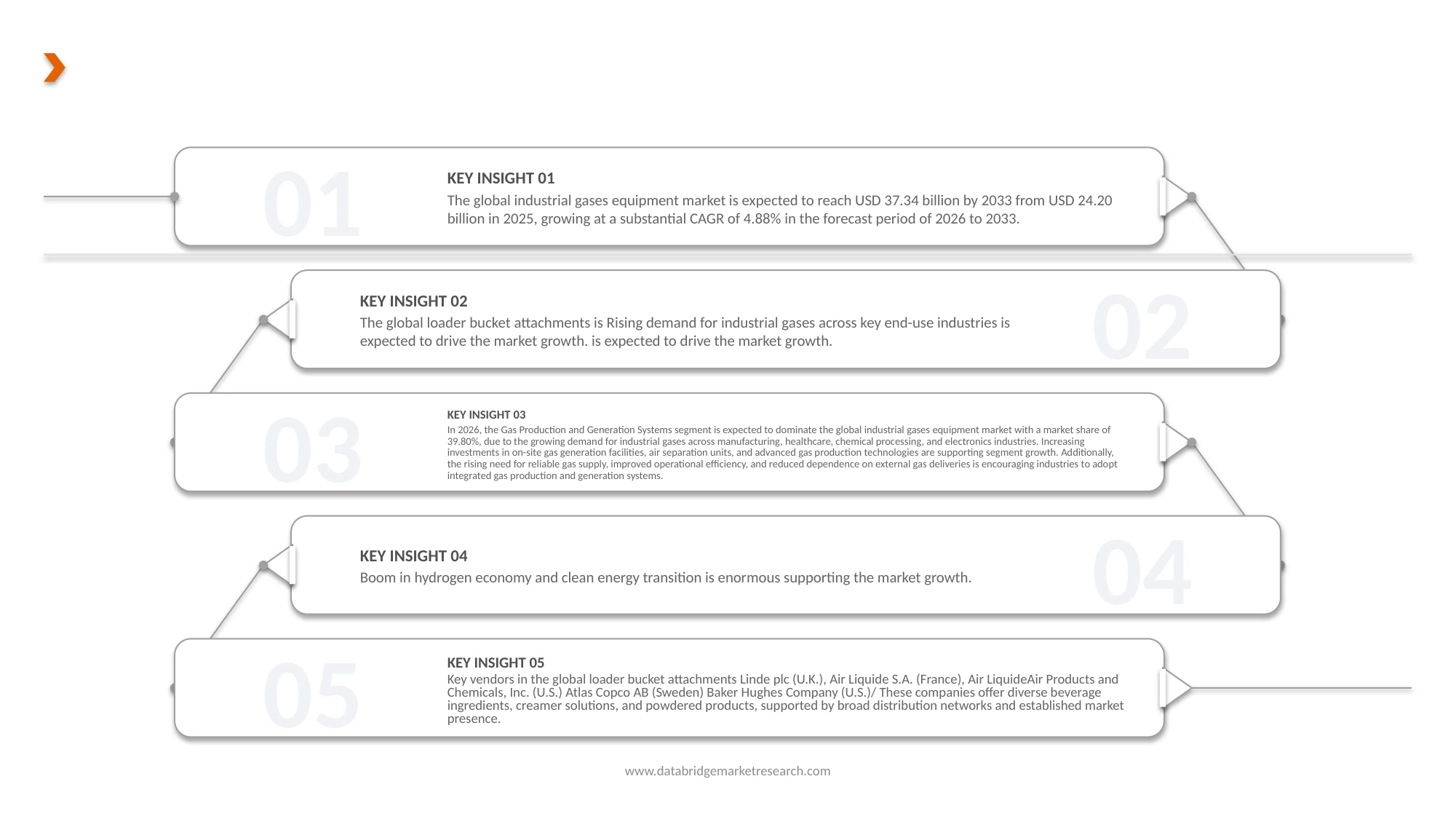
Data Bridge market research analyzes that the Global Industrial Gases Equipment Market is expected to reach USD 37.34 billion by 2033 from USD 24.20 billion in 2025, growing at a substantial CAGR of 4.88% in the forecast period of 2026 to 2033.
Key Findings of the Study
Rising Demand for Industrial Gases Across Key End-Use Industries
The global industrial gases equipment market is experiencing growth due to increasing demand for industrial gases across manufacturing, healthcare, chemicals, electronics, metallurgy, and food processing industries. Industrial gases such as oxygen, nitrogen, hydrogen, argon, and carbon dioxide play an essential role in supporting production processes, improving product quality, and maintaining operational efficiency. The expansion of steel manufacturing and chemical processing is increasing the need for gas separation units, compressors, purification systems, and storage equipment. Similarly, growing semiconductor production is driving demand for high-purity gas delivery systems, while the healthcare sector requires reliable oxygen generation and supply infrastructure. In addition, food processing and preservation applications are supporting demand for gas packaging and distribution equipment. As industries expand production capacities and prioritize uninterrupted gas availability, investments in advanced gas production, compression, liquefaction, and storage technologies are increasing, thereby supporting the growth of the global industrial gases equipment market.
Report Scope and Market Segmentation
|
Report Metric
|
Details
|
|
Forecast Period
|
2026 to 2033
|
|
Base Year
|
2025
|
|
Historic Years
|
2018-2024 (Customizable to 2013-2017)
|
|
Quantitative Units
|
Revenue in USD millions
|
|
Segments Covered
|
By Product Type (Gas Production and Generation Systems, Compression and Expansion Equipment, Cryogenic Process Equipment, Gas Storage Equipment, Gas Transportation and Mobile Delivery Equipment, Vaporization and Gas Warming Equipment, Gas Purification, Drying and Conditioning Equipment, Gas Recovery, Capture and Recycling Equipment, Gas Distribution and Pressure-Control Equipment, Gas Filling and Packaged-Gas Processing Equipment, Cylinder Handling and Plant Material-Handling Equipment, Measurement, Analytical and Detection Equipment, Process Control, Safety and Automation Systems, Hydrogen Refueling and Dispensing Equipment, Other Equipment), By Gas Family (Atmospheric Gases, Hydrogen and Hydrogen-Rich Gases, Carbon Dioxide, Helium, Fuel and Process Gases, Medical and Anaesthetic Gases, Rare Gases, Electronic and Specialty Gases, Other Gases), By Process Function (Gas Production and Separation, Gas Purification and Conditioning, Gas Compression and Pressure Management, Gas Liquefaction, Refrigeration and Vaporization, Gas Storage, Gas Transportation and Transfer, Gas Filling and Blending, Gas Distribution and Point-of-Use Delivery, Gas Recovery and Recycling, Gas Measurement, Analysis and Detection, Process Control and Safety), By Installation Configuration (Stationary Equipment, Mobile and Transportable Equipment), By Automation Level (Manually Operated Equipment, Semi-Automated Equipment, Fully Automated Equipment), By Project Scale (Component and Packaged-Equipment Projects, Small-Scale Modular Projects, Medium-Scale Industrial Projects, Large-Scale Industrial Projects, Mega and Integrated Complex Projects), By End-Use Industry (Iron, Steel and Non-Ferrous Metallurgy, Chemicals and Petrochemicals, Oil and Gas, Food and Beverage, Healthcare, Pharmaceuticals and Biotechnology, Electronics and Semiconductors, Power Generation and Energy Storage, Water, Wastewater and Environmental Services, Mining and Mineral Processing, Automotive and Ground Transportation Manufacturing, Aerospace, Space and Defense, Marine and Shipbuilding, Glass and Ceramics, Cement, Lime and Other Non-Metallic Minerals, Pulp, Paper and Printing, Rubber and Plastics Processing, Construction and Infrastructure, Research, Education and Testing Laboratories, Other End-Use Industries), By Sales Channel (Direct OEM Sales, EPC and Turnkey Project Procurement, System Integrators and Packagers, Authorized Distributors and Representatives, Independent Industrial Equipment Distributors, Digital and E-Procurement Channels)
|
|
Countries Covered
|
China, Japan, India, South Korea, Thailand, Malaysia, Indonesia, Vietnam, Taiwan, Philippines, Singapore, New Zealand, Australia, Rest of Asia-Pacific, Germany, France, Spain, U.K., Italy, Turkey, Poland, Belgium, Netherlands, Sweden, Russia, Switzerland, Denmark, Finland, Norway, Rest of Europe, U.S., Mexico, Canada, Brazil, Argentina, Colombia, Chile, Peru, Ecuador, Uruguay, Paraguay, Bolivia, Venezuela, Rest of South America, South Africa, Egypt, Saudi Arabia, U.A.E, Israel, Kuwait, Oman, Qatar, Bahrain, Rest of Middle East & Africa
|
|
Market Players Covered
|
|
|
Data Points Covered in the Report
|
In addition to the insights on market scenarios such as market value, growth rate, segmentation, geographical coverage, and major players, the market reports curated by the Data Bridge Market Research also include in-depth expert analysis, patient epidemiology, pipeline analysis, pricing analysis, and regulatory framework.
|
Segment Analysis
The global industrial gases equipment market is segmented into notable segments based on product type, process function, automation level, end-use industry, gas family, installation configuration, project scale, and sales channel.
- On the basis of product type, the global industrial gases equipment market is segmented into gas production and generation systems, compression and expansion equipment, cryogenic process equipment, gas storage equipment, gas transportation and mobile delivery equipment, vaporization and gas warming equipment, gas purification, drying and conditioning equipment, gas recovery, capture and recycling equipment, gas distribution and pressure-control equipment, gas filling and packaged-gas processing equipment, cylinder handling and plant material-handling equipment, measurement, analytical and detection equipment, process control, safety and automation systems, hydrogen refueling and dispensing equipment, and other equipment.
In 2026, the gas production and generation systems segment is expected to dominate the market.
In 2026, the gas production and generation systems segment is expected to dominate the global industrial gases equipment market due to the increasing demand for reliable industrial gas supply across manufacturing, healthcare, chemical processing, and electronics industries. Growing investments in on-site gas generation facilities, air separation units, and advanced gas production technologies are supporting segment growth. Additionally, the need for uninterrupted gas availability, improved operational efficiency, and reduced dependence on external gas suppliers is encouraging industries to adopt integrated gas production and generation systems.
- On the basis of process function, the global industrial gases equipment market is segmented into gas production and separation, gas purification and conditioning, gas compression and pressure management, gas liquefaction, refrigeration and vaporization, gas storage, gas transportation and transfer, gas filling and blending, gas distribution and point-of-use delivery, gas recovery and recycling, gas measurement, analysis and detection, and process control and safety.
In 2026, the gas production and separation segment is expected to dominate the market
in 2026, the gas production and separation segment is expected to dominate the global industrial gases equipment market due to increasing demand for efficient material handling solutions across construction, mining, and industrial operations. The growing use of heavy machinery for excavation, loading, and transportation of bulk materials is supporting demand for durable and high-capacity bucket attachments. In addition, rising infrastructure investments, expanding mining activities, and the need to improve operational productivity are encouraging equipment operators to adopt specialized attachments that enhance efficiency, reduce downtime, and withstand demanding working conditions.
- On the basis of automation level, the global industrial gases equipment market is segmented into manually operated equipment, semi-automated equipment, and fully automated equipment.
In 2026, the fully automated equipment segment is expected to dominate the market
In 2026, the fully automated equipment segment is expected to dominate the global industrial gases equipment market due to the increasing adoption of automation technologies across construction, mining, agriculture, and material handling operations. Fully automated equipment enhances operational efficiency by reducing manual intervention, improving loading accuracy, and enabling consistent performance across repetitive tasks.
- On the basis of end-use industry, the global industrial gases equipment market is segmented into iron, steel and non-ferrous metallurgy, chemicals and petrochemicals, oil and gas, food and beverage, healthcare, pharmaceuticals and biotechnology, electronics and semiconductors, power generation and energy storage, water, wastewater and environmental services, mining and mineral processing, automotive and ground transportation manufacturing, aerospace, space and defense, marine and shipbuilding, glass and ceramics, cement, lime and other non-metallic minerals, pulp, paper and printing, rubber and plastics processing, construction and infrastructure, research, education and testing laboratories, and other end-use industries.
In 2026, the chemicals and petrochemicals segment is expected to dominate the market
In 2026, the chemicals and petrochemicals segment is expected to dominate the global industrial gases equipment market due to the growing demand for efficient material handling solutions across chemical manufacturing facilities, petrochemical plants, and industrial processing units. Industrial gases equipment are used to handle bulk materials, including raw materials, aggregates, and industrial waste, supporting efficient material movement and plant operations.
- On the basis of gas family, the global industrial gases equipment market is segmented into atmospheric gases, hydrogen and hydrogen-rich gases, carbon dioxide, helium, fuel and process gases, medical and anaesthetic gases, rare gases, electronic and specialty gases, and other gases
In 2026, the atmospheric gases segment is anticipated to dominate the market
In 2026, the atmospheric gases segment is expected to dominate the global industrial gases equipment market due to the increasing demand for industrial gases, including oxygen, nitrogen, and argon, across manufacturing, healthcare, metal processing, and chemical industries. The production and separation of these gases require efficient handling of raw materials, industrial waste, and bulk materials used in gas processing facilities.
- On the basis of installation configuration, the global industrial gases equipment market is segmented into stationary equipment, and mobile and transportable equipment.
In 2026, the stationary equipment segment is anticipated to dominate the market
In 2026, the stationary equipment segment is expected to dominate the global industrial gases equipment market due to its widespread use in fixed industrial facilities, material processing plants, and construction-related operations requiring consistent material handling capabilities. Stationary equipment supports efficient loading, transferring, and processing of bulk materials while offering operational stability and reliable performance.
- On the basis of project scale, the global industrial gases equipment market is segmented into component and packaged-equipment projects, small-scale modular projects, medium-scale industrial projects, large-scale industrial projects, and mega and integrated complex projects.
In 2026, the component and packaged-equipment projects segment is anticipated to dominate the market
In 2026, the component and packaged-equipment projects segment is expected to dominate the global industrial gases equipment market due to the growing demand for integrated equipment solutions across construction, mining, agriculture, and industrial material handling applications. These projects require compatible components and specialized attachments to improve equipment functionality, operational efficiency, and material handling capabilities. Increasing investments in infrastructure development, industrial expansion, and equipment modernization are further supporting demand for industrial gases equipment.
- On the basis of sales channel, the global industrial gases equipment market is segmented into direct OEM sales, EPC and turnkey project procurement, system integrators and packagers, authorized distributors and representatives, independent industrial equipment distributors, and digital and e-procurement channels.
In 2026, the direct OEM sales segment is anticipated to dominate the market
In 2026, the direct OEM sales segment is expected to dominate the global industrial gases equipment market due to the growing preference for purchasing attachments directly from original equipment manufacturers (OEMs). Direct sales provide customers with access to compatible products, manufacturer warranties, technical support, and reliable after-sales services. Increasing demand for customized attachments that match specific machinery requirements is further supporting this distribution channel.
Major Players
Linde plc (U.K.), Air Liquide S.A. (France) , Air LiquideAir Products and Chemicals, Inc. (U.S.), Atlas Copco AB (Sweden), Baker Hughes Company (U.S.), among others are the major players dealing in the market.
Regional Analysis
Geographically, the country covered in the global industrial gases equipment market report is China, Japan, India, South Korea, Thailand, Malaysia, Indonesia, Vietnam, Taiwan, Philippines, Singapore, New Zealand, Australia, Rest of Asia-Pacific, Germany, France, Spain, U.K., Italy, Turkey, Poland, Belgium, Netherlands, Sweden, Russia, Switzerland, Denmark, Finland, Norway, Rest of Europe, U.S., Mexico, Canada, Brazil, Argentina, Colombia, Chile, Peru, Ecuador, Uruguay, Paraguay, Bolivia, Venezuela, Rest of South America, South Africa, Egypt, Saudi Arabia, U.A.E, Israel, Kuwait, Oman, Qatar, Bahrain, Rest of Middle East & Africa.
As per Data Bridge Market Research analysis:
Asia-Pacific is the dominant region in the global industrial gases equipment market
Asia-Pacific is the dominant region in the global industrial gases equipment market due to rapid infrastructure development, expanding construction activities, and increasing investments in mining and agricultural mechanization across major economies, including China, India, and Japan. Rising urbanization and government initiatives focused on transportation networks, residential construction, and industrial development are supporting demand for heavy construction equipment and compatible attachments. Additionally, the region's strong manufacturing base, growing adoption of advanced machinery, and increasing demand for efficient material handling solutions are contributing to market growth. The expansion of mining operations and infrastructure modernization projects is further strengthening Asia-Pacific's leading position in the global industrial gases equipment market.
Asia-Pacific is estimated to be the fastest-growing region in the global industrial gases equipment market
Asia-Pacific is expected to be the fastest-growing region in the global industrial gases equipment market due to accelerating urbanization, increasing infrastructure investments, and expanding construction and mining activities across emerging economies such as China and India. Government initiatives focused on smart cities, transportation networks, and industrial development are increasing demand for construction equipment and compatible industrial gases equipment. Additionally, rising mechanization in agriculture, growing investments in mining operations, and increasing adoption of advanced machinery are supporting regional market expansion. The presence of established equipment manufacturers, improving construction capabilities, and the growing need for efficient material handling solutions are further contributing to Asia-Pacific's rapid market growth.
Market Developments
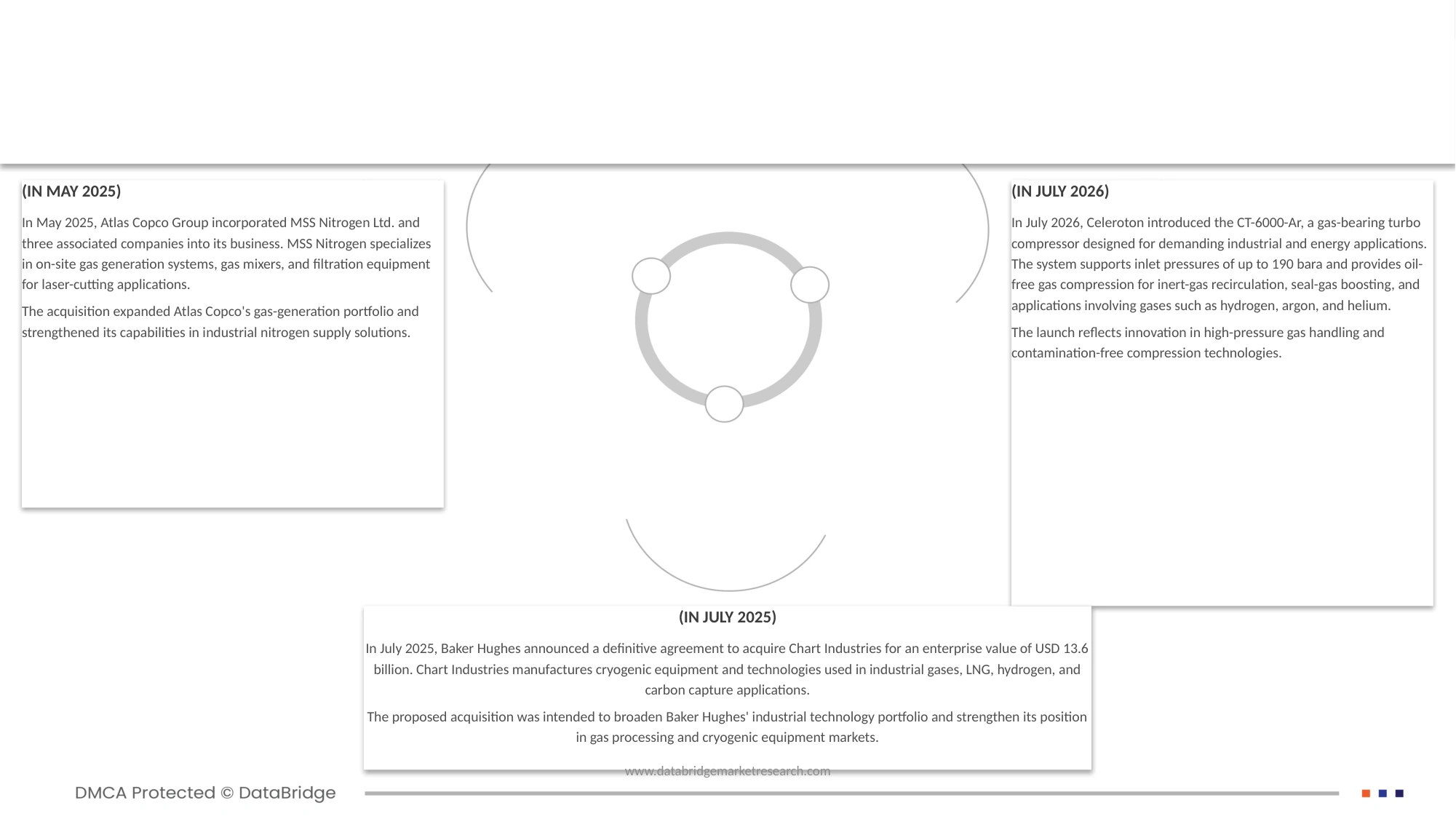
- In May 2025, Atlas Copco Group incorporated MSS Nitrogen Ltd. and three associated companies into its business. MSS Nitrogen specializes in on-site gas generation systems, gas mixers, and filtration equipment for laser-cutting applications. The acquisition expanded Atlas Copco’s gas-generation portfolio and strengthened its capabilities in industrial nitrogen supply solutions.
- In July 2026, Celeroton introduced the CT-6000-Ar, a gas-bearing turbo compressor designed for demanding industrial and energy applications. The system supports inlet pressures of up to 190 bara and provides oil-free gas compression for inert-gas recirculation, seal-gas boosting, and applications involving gases such as hydrogen, argon, and helium. The launch reflects innovation in high-pressure gas handling and contamination-free compression technologies.
- In July 2025, Baker Hughes announced a definitive agreement to acquire Chart Industries for an enterprise value of USD 13.6 billion. Chart Industries manufactures cryogenic equipment and technologies used in industrial gases, LNG, hydrogen, and carbon capture applications. The proposed acquisition was intended to broaden Baker Hughes’ industrial technology portfolio and strengthen its position in gas processing and cryogenic equipment markets..
- In December 2025, Air Liquide announced an agreement to acquire NovaAir, an industrial gas producer providing bulk and specialty gases, on-site services, and engineering, procurement, and construction support. The transaction was intended to expand Air Liquide’s geographical reach in eastern and southern India, complementing its existing operations and strengthening its capacity to serve steel, automotive, electronics, photovoltaic, and healthcare customers..
- In January 2026, Ingersoll Rand and Garrett Motion announced a multiyear strategic partnership to develop next-generation oil-free air compression technologies. The collaboration combines Ingersoll Rand’s compressor systems expertise with Garrett Motion’s oil-free centrifugal compressor modules. Initial products were expected to be introduced to selected customers in 2026, with broader commercial rollout planned for 2027, supporting demand for energy-efficient and high-purity compressed-air systems.
As per Data Bridge Market Research analysis:
For more detailed information about the Global industrial gases equipment market report, click here – https://www.databridgemarketresearch.com/reports/global-industrial-gases-equipment-market