The global caramel color market is witnessing robust growth, primarily driven by rising demand for processed foods and beverages that offer consistent product appearance, appealing color, and enhanced visual appeal. As food and beverage manufacturers increasingly focus on improving product presentation and maintaining uniformity across large-scale production, the demand for caramel color is expanding across diverse applications. Modern consumers place significant emphasis on the appearance and overall appeal of food and beverage products when making purchasing decisions. This has fueled the adoption of caramel color as a versatile coloring ingredient in carbonated soft drinks, alcoholic beverages, bakery products, confectionery, sauces, seasonings, and other processed foods. Caramel color enables manufacturers to achieve consistent brown shades, improve product appearance, and maintain color uniformity across different batches, supporting its widespread use in food processing and beverage manufacturing.
In addition, the industry's increasing focus on product standardization and formulation efficiency is influencing the adoption of caramel color. Food and beverage manufacturers are seeking reliable coloring solutions that provide stable performance, compatibility with different formulations, and consistent results during processing and storage. In response, manufacturers are expanding their caramel color portfolios to meet varying application requirements, including different color intensities and stability characteristics. Growing consumption of packaged foods and beverages, expansion of food processing capabilities, and increasing demand for visually appealing products are further supporting the use of caramel color, strengthening its role in enhancing product consistency and visual appeal across the global food and beverage industry.
Access Full Report @ https://www.databridgemarketresearch.com/reports/global-caramel-color-market
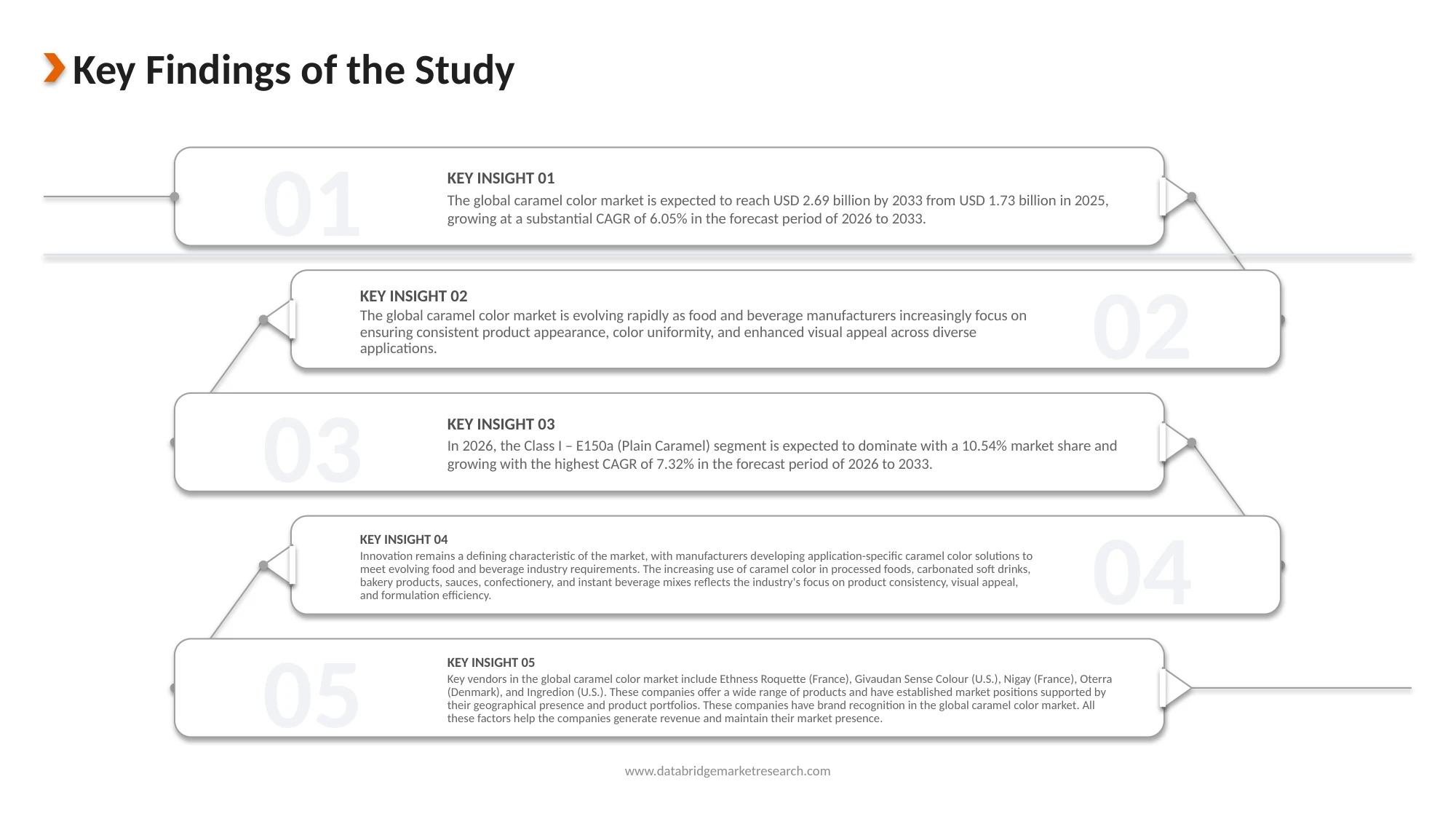
Data Bridge market research analyzes that the Global Caramel Color Market size was valued at USD 2.69 billion by 2033 from USD 1.73 billion in 2025, growing with a CAGR of 6.05% during the forecast period of 2026 to 2033.
Key Findings of the Study
Growing Demand for Processed Foods and Beverages
The growing demand for processed foods and beverages is a major factor driving the growth of the global caramel color market. Rising urbanization, changing dietary preferences, increasing disposable incomes, and expanding consumption of packaged food products are contributing to higher demand for visually appealing and consistent food and beverage formulations across developed and emerging economies. As competition among food and beverage manufacturers intensifies, companies are increasingly focusing on improving product appearance, maintaining color uniformity, and enhancing consumer appeal, thereby driving demand for caramel color. The food and beverage industry continues to expand steadily, particularly in emerging markets such as India, China, Brazil, and Southeast Asia, where growing populations, expanding retail networks, and rising consumption of convenience foods are supporting market growth. At the same time, consumers are placing greater importance on the visual appearance of food and beverage products, influencing purchasing decisions and encouraging manufacturers to maintain consistent color across product batches. This shift in market demand is promoting the adoption of caramel color as a versatile coloring ingredient in carbonated soft drinks, alcoholic beverages, bakery products, confectionery, sauces, seasonings, and other processed foods.
The increasing consumption of ready-to-drink beverages, packaged sauces, and processed food products is further strengthening the role of caramel color in commercial food production. Manufacturers rely on caramel color to achieve specific brown shades, maintain product consistency, and improve the visual characteristics of different formulations. Its compatibility with a wide range of food and beverage applications makes it an important ingredient for manufacturers seeking reliable and cost-effective coloring solutions. In addition, the growing emphasis on product standardization and manufacturing efficiency is influencing the selection of caramel color grades according to application-specific requirements. Food and beverage companies are increasingly focusing on color stability, processing compatibility, and compliance with applicable food safety regulations to ensure consistent product quality. To address these requirements, caramel color manufacturers are expanding their product portfolios and developing specialized formulations with different color intensities and functional properties. These developments, combined with the continued expansion of packaged food production and beverage manufacturing, are supporting the growing adoption of caramel color across the global food and beverage industry.
Report Scope and Market Segmentation
|
Report Metric
|
Details
|
|
Forecast Period
|
2026 to 2033
|
|
Base Year
|
2025
|
|
Historic Years
|
2018-2024 (Customizable to 2013-2017)
|
|
Quantitative Units
|
Revenue in USD thousands
|
|
Segments Covered
|
By Product Class (Class I – E150a (Plain Caramel), Class II – E150b (Caustic Sulphite Caramel), Class III – E150c (Ammonia Caramel), Class IV – E150d (Sulphite Ammonia Caramel)), By Physical Form (Liquid Caramel Color, Powder Caramel Color, Other Commercial Forms), By End Use (3-in-1 Coffee, Tea Premixes, Instant Beverage Mixes, Bubble Tea, Vending, Bakery, Soups, Sauces & Condiments, Confectionery, Beverages / Soft Drinks, Beer & Malt Beverages, Other Industrial Applications), By Customer Segment (Beverage Manufacturers, Coffee & Tea Premix Companies, Vending Companies, Bubble Tea Chains, Bakery Manufacturers, Sauce / Soup / Condiment Manufacturers, Confectionery Manufacturers, HoReCa / Foodservice, Other Industrial Food Users)
|
|
Countries Covered
|
U.S., Canada, Mexico, Germany, U.K., France, Italy, Spain, Rest of Europe, China, Japan, India, South Korea, Australia & New Zealand, Rest of Asia-Pacific, GCC, South Africa, Egypt, Rest of Middle East & Africa,.
|
|
Market Players Covered
|
|
|
Data Points Covered in the Report
|
In addition to the insights on market scenarios such as market value, growth rate, segmentation, geographical coverage, and major players, the market reports curated by the Data Bridge Market Research also include in-depth expert analysis, pricing analysis, brand share analysis, consumer survey, demography analysis, supply chain analysis, value chain analysis, raw material/consumables overview, vendor selection criteria, PESTLE Analysis, Porter Analysis, and regulatory framework.
|
Segment Analysis
The global caramel color market is segmented into four notable segments based on product class, physical form, end use, and customer segment.
- On the basis of product class, the global caramel color market is segmented into Class I – E150a (Plain Caramel), Class II – E150b (Caustic Sulphite Caramel), Class III – E150c (Ammonia Caramel), and Class IV – E150d (Sulphite Ammonia Caramel).
In 2026, the Class I – E150a (Plain Caramel) segment is expected to dominate the market
In 2026, the Class I – E150a (Plain Caramel) segment is expected to dominate due to its wide applicability across food and beverage products, particularly in applications requiring brown coloring without ammonium or sulfite compounds. Its use in spirits, bakery products, sauces, and other processed foods supports its demand. The increasing preference for versatile coloring ingredients and the need for consistent product appearance further strengthen the segment's market position.
- On the basis of physical form, the global caramel color market is segmented into liquid caramel color, powder caramel color, and other commercial forms.
In 2026, the liquid caramel color segment is expected to dominate the market
In 2026, the liquid caramel color segment is expected to dominate due to its ease of handling, convenient integration into liquid formulations, and widespread use in beverage manufacturing. It is extensively utilized in carbonated soft drinks, beer and malt beverages, sauces, and other industrial food applications because it can be readily incorporated into production processes. Increasing demand for consistent color distribution, efficient processing, and uniform product appearance further supports the segment's leading position.
- On the basis of end use, the global caramel color market is segmented into 3-in-1 coffee, tea premixes, instant beverage mixes, bubble tea, vending, bakery, soups, sauces & condiments, confectionery, beverages / soft drinks, beer & malt beverages, and other industrial applications.
In 2026, the beverages / soft drinks segment is expected to dominate the market
In 2026, the beverages / soft drinks segment is expected to dominate due to the extensive use of caramel color in carbonated soft drinks and other beverage formulations. The ingredient helps manufacturers achieve consistent brown shades, maintain visual uniformity, and enhance product appearance across large-scale production. Growing consumption of packaged beverages, expanding beverage manufacturing, and increasing demand for standardized product formulations further strengthen the segment's market position.
- On the basis of customer segment, the global caramel color market is segmented into beverage manufacturers, coffee & tea premix companies, vending companies, bubble tea chains, bakery manufacturers, sauce / soup / condiment manufacturers, confectionery manufacturers, HoReCa / foodservice, and other industrial food users.
In 2026, the beverage manufacturers segment is expected to dominate the market
In 2026, the beverage manufacturers segment is expected to dominate due to the large-scale consumption of caramel color in carbonated soft drinks, beer and malt beverages, and other beverage products. These manufacturers require reliable coloring ingredients to maintain consistent product appearance, meet formulation specifications, and ensure uniformity across production batches. Rising packaged beverage consumption, expanding production capacities, and continued demand for visually appealing beverage products further support the segment's leading position.
Major Players
Ethness Roquette (France), Givaudan Sense Colour (U.S.), Nigay (France), Oterra (Denmark), Ingredion (U.S.), among others are the major players dealing in the market.
Regional Analysis
Geographically, the country covered in the global caramel color market report is U.S., Canada, Mexico, Germany, U.K., France, Italy, Spain, Rest of Europe, China, Japan, India, South Korea, Australia & New Zealand, Rest of Asia-Pacific, GCC, South Africa, Egypt, Rest of Middle East & Africa.
As per Data Bridge Market Research analysis:
Asia-Pacific is the dominant region in the global caramel color market
Asia-Pacific is expected to remain the dominant region in the global caramel color market, supported by its large food and beverage manufacturing base, expanding processed food industry, and rising consumption of packaged beverages. China, India, Japan, and other regional markets generate substantial demand for caramel color across carbonated soft drinks, bakery products, sauces, confectionery, and instant beverage mixes. The growing popularity of convenience foods, ready-to-drink beverages, and premixed coffee and tea products is further encouraging the use of caramel color to maintain consistent product appearance and visual appeal. Additionally, expanding retail distribution networks, increasing urbanization, and rising demand for standardized food formulations are supporting regional market growth. China remains a key contributor, while India is emerging as an important market due to its expanding food processing industry and growing consumption of packaged food and beverage products.
Asia-Pacific is estimated to be the fastest-growing region in the global caramel color market
Asia-Pacific is estimated to be the fastest-growing region in the global caramel color market, supported by the expansion of food and beverage manufacturing, rising consumption of processed foods, and increasing demand for visually appealing packaged products. Rapid growth in beverage production and the increasing popularity of 3-in-1 coffee, tea premixes, instant beverage mixes, and bubble tea are further stimulating demand for caramel color. China and India are expected to remain important growth engines, supported by expanding food processing capabilities, growing consumer markets, and increasing investments in packaged food production. Rising adoption of caramel color in beverages, bakery products, sauces, confectionery, and other industrial food applications is also expected to strengthen regional demand.
Market Developments
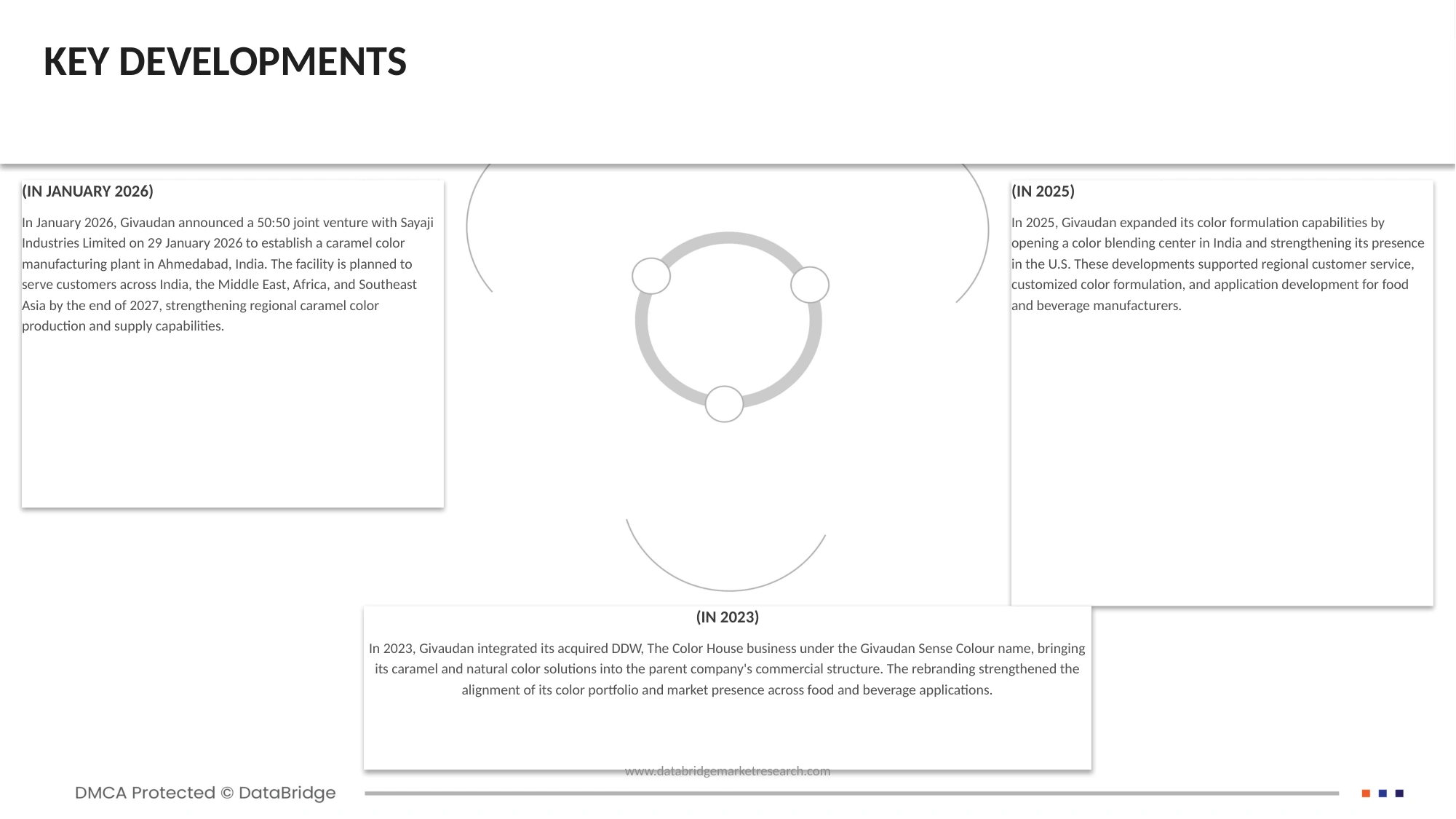
- In October 2021, Givaudan announced the acquisition of DDW, The Color House, and completed the transaction in December 2021, adding approximately USD 140 million in pro forma sales, 12 plants, and 315 employees. The acquisition strengthened Givaudan's natural color solutions portfolio and expanded its capabilities in caramel color for food and beverage applications.
- In 2023, Givaudan integrated its acquired DDW business under the Givaudan Sense Colour name, bringing its caramel and natural color solutions into the parent company's commercial structure. This development strengthened its product portfolio and supported its position in the global food coloring industry.
- In 2025, Givaudan expanded its color formulation capabilities by opening a color blending center in India and strengthening its presence in the U.S. The development supported customized color solutions, regional customer service, and formulation capabilities for food and beverage manufacturers.
- In January 2026, Givaudan announced a 50:50 joint venture with Sayaji Industries Limited to establish a caramel manufacturing plant in Ahmedabad, India. Planned to serve India, the Middle East, Africa, and Southeast Asia by the end of 2027, the facility is expected to strengthen regional production capabilities and improve access to caramel color solutions across key food and beverage markets.
As per Data Bridge Market Research analysis:
For more detailed information about the Global Caramel color Market report, click here – https://www.databridgemarketresearch.com/reports/global-caramel-color-market