Segmentación del mercado global de fármacos de inmunoterapia innovadores, por fármaco (inhibidores de puntos de control inmunitario, anticuerpos monoclonales, anticuerpos biespecíficos, conjugados anticuerpo-fármaco (ADC), terapias con células CAR-T, TCR y otras terapias celulares adoptivas, vacunas contra el cáncer, citocinas y moduladores inmunitarios, terapias con virus oncolíticos y otras inmunoterapias novedosas), vía de administración (intravenosa, subcutánea, intramuscular, intratumoral y otras), usuario final (hospitales, clínicas especializadas y oncológicas, institutos de investigación y académicos, y centros de infusión ambulatoria), canal de distribución (farmacias hospitalarias, farmacias especializadas y en línea): tendencias de la industria y pronóstico hasta 2033.
¿Cuál es el tamaño y tasa de crecimiento del mercado de drogas de inmunoterapia global
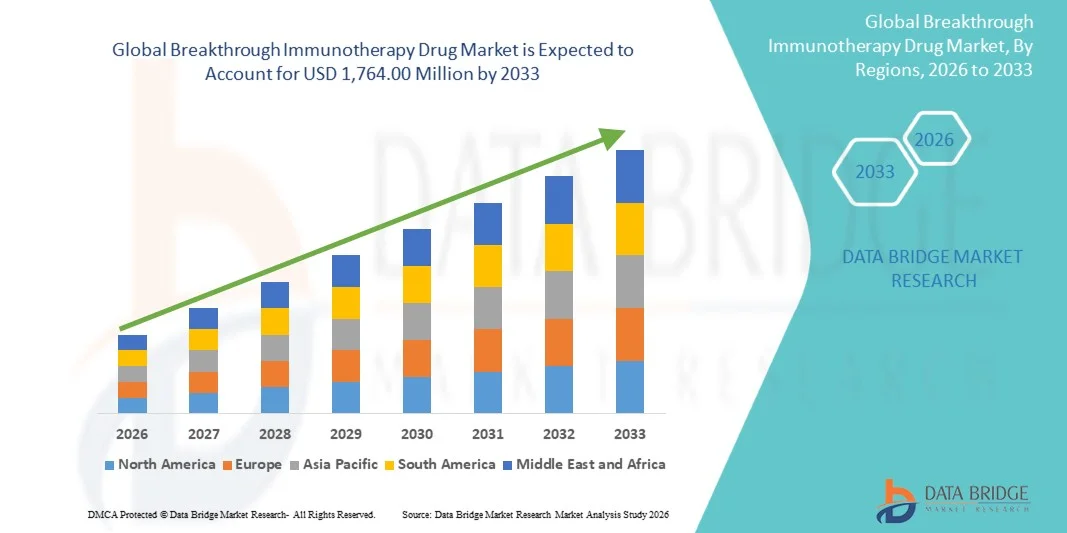
- El tamaño del mercado mundial de drogas de inmunoterapia se valoró enUSD billion in 2025y se espera que alcanceUSD 1,764.00 million by 2033, aCAGR of 10.50%durante el período previsto
- El crecimiento del mercado está impulsado en gran medida por los rápidos avances en la inmunooncología, el aumento de las aprobaciones de terapias de gran avance, y las fuertes inversiones de R limitadaD centradas en los biológicos de próxima generación, terapias celulares y inmunoterapias de precisión
- Además, el aumento de la prevalencia del cáncer y el complejoenfermedades autoinmunitarias, junto con la creciente demanda de opciones de tratamiento orientadas, altamente eficaces y duraderas, está posicionando medicamentos de inmunoterapia de gran avance como piedra angular de estrategias terapéuticas modernas, lo que acelera significativamente el crecimiento general del mercado
¿Cuáles son los principales Takeaways of Breakthrough Immunotherapy Drug Market
- Los fármacos de inmunoterapia avanzada, diseñados para aprovechar y modular el sistema inmunitario del cuerpo para tratar enfermedades complejas y potencialmente mortales, se están convirtiendo en el centro de estrategias terapéuticas modernas, especialmente en oncología y trastornos autoinmunes, debido a sus mecanismos específicos, respuestas clínicas duraderas y potencial para mejorar significativamente los resultados del paciente
- La creciente demanda de fármacos de inmunoterapia de gran alcance se ve impulsada principalmente por la creciente carga mundial del cáncer y las enfermedades inmunitarias, el aumento del apoyo regulatorio para designaciones de terapia de gran avance, y las inversiones sustanciales en biologicos avanzados, terapias celulares y enfoques de medicina de precisión
- América del Norte dominaba el mercado de drogas de inmunoterapia con la mayor cuota de ingresos del 48,6% en 2025, apoyado por un fuertebiofarmacéuticaEcosistema RT, adopción temprana de terapias innovadoras, marcos de reembolso favorables y una alta concentración de productos farmacéuticos ybiotecnologíaempresas, con EE.UU. contando la mayoría de las aprobaciones y la actividad de ensayo clínico
- Se espera que Asia-Pacífico sea la región de mayor crecimiento en el mercado de drogas de inmunoterapia de gran alcance durante el período previsto debido a la expansión de la infraestructura sanitaria, el aumento del gasto sanitario, la creciente incidencia de cáncer y la creciente participación de China, Japón y Corea del Sur en investigación y comercialización de inmunoterapia
- El segmento inmunitario del inhibidor de puntos de control dominaba el mercado de drogas de inmunoterapia con una cuota de mercado del 52,9% en 2025, impulsada por su eficacia clínica demostrada en múltiples indicaciones de cáncer, ampliando las aprobaciones de etiquetas y la adopción fuerte como monoterapia y terapia combinada en regímenes de tratamiento de oncología estándar
Informe Scope and Breakthrough Immunotherapy Drug Market Segmentation
|
Atributos |
Breakthrough Inmunoterapia Drug Key Market Insights |
|
Segmentos cubiertos |
|
|
Países cubiertos |
América del Norte
Europa
Asia y el Pacífico
Oriente Medio y África
América del Sur
|
|
Principales jugadores del mercado |
|
|
Oportunidades de mercado |
|
|
Valor añadido Data Infosets |
Además de las ideas sobre escenarios de mercado como el valor de mercado, la tasa de crecimiento, la segmentación, la cobertura geográfica y los principales actores, los informes de mercado comisariados por Data Bridge Market Research también incluyen análisis profundos de expertos, epidemiología de pacientes, análisis de tuberías, análisis de precios y marco regulatorio |
Tendencias del mercado de drogas de inmunoterapia avanzada
“Expansion of Next-Generation Targets and Precision Immunotherapy”
- Una tendencia significativa y aceleradora en el mercado mundial de drogas de inmunoterapia de gran alcance es el cambio hacia objetivos inmunitarios de próxima generación y enfoques basados en precisión, incluyendo nuevas vías de control, anticuerpos biespecíficos y terapias celulares personalizadas, con el objetivo de mejorar la eficacia y reducir la resistencia al tratamiento
- Por ejemplo, varios inhibidores de puestos de control de próxima generación dirigidos a LAG-3, TIGIT y otras vías emergentes han entrado en ensayos clínicos de última etapa, demostrando mejores resultados cuando se utilizan solos o en combinación con terapias PD-1/PD-L1 establecidas
- Los avances en la selección de pacientes impulsados por biomarcadores y la elaboración de perfiles genómicos están permitiendo un despliegue más preciso de inmunoterapias de gran avance, mejorando las tasas de respuesta y minimizando la exposición innecesaria. Por ejemplo, biomarcador- El uso guiado de inhibidores de puntos de control está influenciando cada vez más las decisiones de tratamiento en varios tipos de cáncer
- La integración de la inteligencia artificial y la analítica avanzada en la investigación de inmunoterapia está racionalizando el descubrimiento de drogas, optimizando el diseño de ensayos clínicos y acelerando las aprobaciones regulatorias, apoyando una comercialización más rápida de terapias de gran avance
- Esta tendencia hacia un desarrollo de inmunoterapia más específico, basado en datos y personalizado está remodelando paradigmas de tratamiento. En consecuencia, las principales empresas biofarmacéuticas están invirtiendo fuertemente en plataformas de inmunooncología de precisión, regímenes combinados y ensayos clínicos adaptativos
- La demanda de inmunoterapias altamente efectivas, duraderas y personalizadas sigue aumentando a través de la oncología y selecciona indicaciones autoinmunes, reforzando esta tendencia como motor central de la evolución del mercado a largo plazo
Dinámica del mercado de drogas de inmunoterapia avanzada
Conductor
“Rising Cancer Burden y Strong Regulatory Support for Breakthrough Therapies”
- La creciente incidencia mundial de cáncer y trastornos inmunitarios, combinados con fuertes incentivos regulatorios para la designación de terapias de gran alcance, es un importante conductor que acelera la demanda de fármacos innovadores de inmunoterapia
- Por ejemplo, organismos reguladores como la FDA y EMA de EE.UU. siguen otorgando a los candidatos a la inmunoterapia que demuestran una mejora sustancial con respecto a los tratamientos existentes, reduciendo significativamente los plazos de desarrollo
- Como las terapias convencionales a menudo muestran una durabilidad limitada o una alta toxicidad, las inmunoterapias de gran avance ofrecen mecanismos específicos, respuestas duraderas y mejores resultados de supervivencia, impulsando la adopción rápida entre los médicos y proveedores de atención médica
- Además, el aumento de la inversión pública y privada en la biofarmacéutica R plagaD, junto con la expansión de la actividad de ensayo clínico, está fortaleciendo el oleoducto de desarrollo para medicamentos avanzados de inmunoterapia en todo el mundo
- La creciente aceptación de la inmunoterapia como opción de primera línea o de tratamiento combinado, respaldada por políticas favorables de reembolso en los mercados desarrollados, favorece aún más el crecimiento del mercado en hospitales y centros especializados de cáncer
Restraint/Challenge
“High Treatment Costs and Complex Manufacturing requirements”
- El alto costo de los fármacos de inmunoterapia de gran alcance, en particular las terapias basadas en células y personalizadas, presenta un desafío importante a la adopción generalizada, especialmente en los mercados de atención de la salud sensibles a los costos y emergentes
- Por ejemplo, las terapias de células CAR-T y los biologicos avanzados requieren fabricación compleja, logística de cadenas frías e infraestructura clínica especializada, lo que conduce a precios elevados de tratamiento y accesibilidad limitada
- La complejidad de la producción y administración también aumenta la carga de los sistemas sanitarios, que requieren personal altamente capacitado, instalaciones avanzadas y controles de calidad estrictos, que pueden frenar la penetración del mercado
- Además, la variabilidad en la respuesta de los pacientes, los eventos adversos relacionados con la inmune y las preocupaciones de seguridad a largo plazo requieren una amplia vigilancia post-marketing y una evaluación clínica en curso, añadiendo los costos generales de desarrollo
- La superación de estos desafíos mediante la innovación en la fabricación, las estrategias de optimización de los costos, la ampliación de la cobertura de los reembolsos y las tecnologías de producción escalables será fundamental para facilitar una adopción mundial más amplia y un crecimiento sostenido del mercado de drogas de inmunoterapia de gran alcance
¿Cómo se aumenta el mercado de drogas de inmunoterapia
El mercado se segmenta sobre la base del tipo de fármaco, la ruta de administración, el usuario final y el canal de distribución.
- Por drogas
Sobre la base de la droga, el mercado global de drogas inmunoterapia se segmenta en inhibidores de puntos de control inmunitarios, anticuerpos monoclonales, anticuerpos biespecíficos, conjugadores anticuerpos (ADCs), terapias de células CAR-T, terapias de células adoptivas, vacunas contra el cáncer, moduladores inmunitarios de citocinas, terapias de virus oncolíticos y otras nuevas. El segmento de inhibidores del control inmunitario dominaba el mercado con la mayor cuota de ingresos del 52,9% en 2025, impulsada por su fuerte eficacia clínica a través de múltiples indicaciones de cáncer y la adopción generalizada como terapias estándar de atención. Estos fármacos han demostrado respuestas duraderas y mejores resultados de supervivencia en cánceres como el cáncer de pulmón, el melanoma y el carcinoma de células renales. Sus amplias aprobaciones reglamentarias, la ampliación de las indicaciones de etiquetas y el aumento del uso en regímenes combinados han fortalecido aún más su dominio. Además, la fuerte familiaridad de los médicos y los marcos establecidos de reembolso en los mercados desarrollados siguen apoyando altas tasas de utilización. La presencia de medicamentos de bloqueo y estrategias de gestión del ciclo de vida en curso también contribuyen a la generación sostenida de ingresos.
Se espera que el segmento de terapias de células CAR-T sea testigo de la tasa de crecimiento más rápida durante el período previsto, alimentada por avances rápidos en ingeniería celular, escalabilidad de fabricación e indicaciones de expansión más allá de los malignos hematológicos. Aumentar el éxito clínico en los cánceres difíciles de tratar y los ensayos en curso dirigidos a tumores sólidos están acelerando la adopción. La creciente inversión de empresas farmacéuticas y colaboraciones estratégicas está mejorando la accesibilidad y reduciendo los plazos de producción. Además, el apoyo regulatorio para terapias celulares innovadoras y el aumento de la conciencia de los pacientes están impulsando un aumento más rápido. A medida que los costos de fabricación disminuyen gradualmente y la infraestructura clínica se expande, se prevé que las terapias CAR-T experimenten un crecimiento sólido a nivel mundial.
- Por Ruta de Administración
Sobre la base de la vía de administración, el mercado se segmenta en intravenoso, subcutáneo, intramuscular, intratumoral y otros. El segmento intravenoso (IV) dominó el mercado en 2025 debido a su uso generalizado para administrar biologicos complejos, anticuerpos monoclonales e inmunoterapias basadas en células. La administración IV permite un control preciso de dosis y una rápida distribución sistémica, que es fundamental para los medicamentos de inmunoterapia de gran avance. Los hospitales y centros de oncología están bien equipados para la infusión IV, apoyando su dominio continuado. Además, la mayoría de los medicamentos de inmunoterapia aprobados se desarrollaron inicialmente para el parto IV, reforzando las prácticas clínicas establecidas. La fiabilidad y la familiaridad de la administración IV entre los profesionales de la salud sostienen aún más la posición líder de este segmento.
Se prevé que el segmento subcutáneo (SC) crecerá en el CAGR más rápido durante el período de previsión, impulsado por el aumento de la demanda de opciones de tratamiento amigables y eficientes para el paciente. Las formulaciones subcutáneas reducen el tiempo de administración, mejoran el confort de los pacientes y reducen la utilización de los recursos sanitarios. Los avances en las tecnologías de la formulación de drogas están permitiendo el desarrollo de versiones eficaces de las terapias IV existentes. Además, el cambio hacia la atención ambulatoria y los modelos de tratamiento basados en el hogar está acelerando la adopción. Estas ventajas son posicionar la entrega subcutánea como un motor clave del crecimiento en el mercado.
- Por Usuario final
Sobre la base del usuario final, el mercado se segmenta en hospitales, clínicas especializadas de oncología, institutos académicos de investigación y centros de infusión ambulatoria. El segmento de hospitales mantuvo la mayor cuota de ingresos del mercado en 2025, impulsada por su infraestructura avanzada y capacidad para gestionar tratamientos complejos de inmunoterapia. Los hospitales sirven como centros primarios para el diagnóstico de cáncer, la administración de inmunoterapia y la gestión de eventos adversos relacionados con el tratamiento. La disponibilidad de equipos multidisciplinarios de atención e instalaciones avanzadas de diagnóstico soporta mayores volúmenes de pacientes. Además, la mayoría de las inmunoterapias de gran alcance requieren un seguimiento cercano durante la administración inicial, favoreciendo el tratamiento hospitalario. Los fuertes mecanismos de reembolso en entornos hospitalarios refuerzan aún más el dominio de este segmento.
Se espera que el segmento de centros de infusión ambulatorios sea testigo del crecimiento más rápido durante el período de previsión debido al creciente cambio hacia modelos de atención rentables y centrados en el paciente. Estos centros ofrecen costos de tratamiento reducidos, tiempos de espera más cortos y mayor comodidad de los pacientes en comparación con los hospitales. La creciente disponibilidad de regímenes de infusión subcutánea y simplificada está apoyando esta transición. Además, los sistemas sanitarios están fomentando el tratamiento ambulatorio para reducir la carga hospitalaria. Como resultado, los centros de infusión ambulatoria están ganando rápidamente tracción para la administración de inmunoterapia.
- Por canal de distribución
Sobre la base del canal de distribución, el mercado se segmenta en farmacias hospitalarias, farmacias especializadas y farmacias en línea. El segmento de farmacias hospitalarias dominaba el mercado en 2025, apoyado por la alta utilización de fármacos de inmunoterapia de gran alcance dentro de los entornos hospitalarios. Estas farmacias garantizan el almacenamiento, manejo y preparación adecuados de biológicos complejos y terapias basadas en células. Su estrecha integración con los departamentos de oncología permite la administración y supervisión oportunas de drogas. Además, el estricto cumplimiento regulatorio y los requisitos de control de calidad favorecen la distribución de farmacia hospitalaria. Los procesos centralizados de adquisición y reembolso refuerzan aún más la posición principal de este segmento.
Se prevé que el segmento de las farmacias especializadas crezca al ritmo más rápido durante el período previsto, impulsado por la creciente complejidad de los medicamentos de inmunoterapia y la necesidad de servicios especializados de manejo y apoyo a los pacientes. Las farmacias especializadas proporcionan servicios de valor añadido, como educación de pacientes, monitoreo de adherencia y coordinación con proveedores de atención médica. Están cada vez más involucrados en la distribución de terapias de alto costo y personalizadas. Además, la expansión de los modelos de tratamiento ambulatorio aumenta la dependencia de las redes de farmacia especializada. Estos factores apoyan colectivamente el rápido crecimiento de este segmento.
Análisis regional del mercado de drogas de inmunoterapia
- América del Norte dominaba el mercado de drogas de inmunoterapia con la mayor cuota de ingresos del 48,6% en 2025, con el apoyo de un fuerte ecosistema biofarmacéutico R plagaD, adopción temprana de terapias innovadoras, marcos de reembolso favorables y una alta concentración de empresas farmacéuticas y biotecnológicas líderes, con la mayor parte de las aprobaciones y la actividad de ensayo clínico
- Los proveedores de atención médica y los pacientes de la región tienen un alto valor en la eficacia clínica superior, las respuestas duraderas al tratamiento y los mecanismos basados en precisión ofrecidos por fármacos de inmunoterapia de gran avance en múltiples cánceres e indicaciones autoinmunitarias
- Esta adopción generalizada está respaldada además por un sólido marco regulatorio que favorece la aprobación de terapias de gran avance, inversiones sustanciales de R plagaD, políticas de reembolso favorables, y la fuerte presencia de las principales empresas farmacéuticas y biotecnológicas, estableciendo fármacos de inmunoterapia como componente principal de los paradigmas de tratamiento modernos en la región
US Breakthrough Immunotherapy Drug Market Insight
El mercado de drogas de inmunoterapia estadounidense capturó la mayor cuota de ingresos en América del Norte en 2025, impulsada por una fuerte adopción clínica, un alto volumen de pacientes de oncología y una rápida absorción de terapias inmunitarias innovadoras. Los proveedores de atención de salud priorizan cada vez más las inmunoterapias avanzadas debido a su eficacia superior, respuestas duraderas y capacidad para atender las necesidades médicas no satisfechas. La presencia de empresas biofarmacéuticas líderes, extensa actividad de ensayo clínico y aprobaciones regulatorias tempranas impulsan el crecimiento del mercado. Además, los marcos de reembolso favorables y la fuerte conciencia del paciente siguen apoyando la utilización generalizada de medicamentos de inmunoterapia de gran alcance en los principales centros de cáncer.
Europe Breakthrough Immunotherapy Drug Market Insight
Se proyecta que el mercado de drogas de inmunoterapia de gran alcance de Europa se expanda en un CAGR sustancial durante el período de previsión, impulsado principalmente por el aumento de la incidencia del cáncer, los sistemas de atención pública sólidos y el aumento del acceso a terapias biológicas avanzadas. La creciente atención a la medicina personalizada y la ampliación del apoyo reglamentario a las drogas innovadoras están fomentando la adopción en toda la región. Los proveedores europeos de atención médica están integrando cada vez más las inmunoterapias en protocolos de tratamiento estándar. La región está experimentando un crecimiento constante en los principales mercados, apoyado por colaboraciones en investigación clínica en curso y mejorando la cobertura de reembolso.
U.K. Breakthrough Immunotherapy Drug Market Insight
Se prevé que el mercado de drogas de inmunoterapia de gran alcance de los EE.UU. crezca en un CAGR notable durante el período previsto, impulsado por un fuerte apoyo gubernamental a medicamentos innovadores y una creciente demanda de tratamientos avanzados de cáncer. El Servicio Nacional de Salud se centra en los programas de acceso anticipado y las evaluaciones de la eficacia en función de los costos facilita la adopción de terapias innovadoras. El aumento de la conciencia entre los médicos y los pacientes con respecto a los beneficios de la inmunoterapia es más estimulante el crecimiento del mercado. Además, la participación activa del Reino Unido en ensayos clínicos globales apoya la expansión continua.
Alemania Breakthrough Inmunoterapia Drug Market Insight
Se espera que el mercado de drogas de inmunoterapia de gran alcance de Alemania se amplíe en un CAGR considerable durante el período previsto, alimentado por una infraestructura sanitaria bien establecida y un fuerte énfasis en los tratamientos impulsados por la innovación. El robusto sistema de reembolso de Alemania y el enfoque en la medicina basada en pruebas fomentan la rápida toma de inmunoterapias de gran avance. Aumentar las inversiones en investigación oncológica y aumentar la colaboración entre institutos académicos y empresas farmacéuticas apoyan el crecimiento del mercado. La integración de las inmunoterapias avanzadas en los protocolos de oncología hospitalaria es cada vez más común en todo el país.
Asia-Pacific Breakthrough Immunotherapy Drug Market Insight
El mercado de medicamentos para la inmunoterapia en Asia y el Pacífico está preparado para crecer en la CAGR más rápida durante el período previsto, impulsado por el aumento de la prevalencia del cáncer, la ampliación de la infraestructura sanitaria y el aumento del gasto sanitario en países como China, Japón y la India. El aumento de las iniciativas gubernamentales para mejorar el acceso a terapias avanzadas de cáncer está acelerando la adopción. La actividad de ensayo clínico en expansión de la región y las capacidades de fabricación local están mejorando asequibilidad y disponibilidad. A medida que aumenta la conciencia de los beneficios de la inmunoterapia, Asia-Pacífico está emergiendo como una región clave de crecimiento para los medicamentos de gran alcance.
Japón Breakthrough Inmunoterapia Drug Market Insight
El mercado de drogas de inmunoterapia de gran alcance de Japón está cobrando impulso debido al avanzado sistema de salud del país, el fuerte enfoque en la innovación y el rápido envejecimiento de la población. La alta demanda de tratamientos de cáncer eficaces y menos invasivos está impulsando la adopción de medicamentos de inmunoterapia. Las pautas regulatorias simplificadas de Japón para medicamentos innovadores apoyan aprobaciones y comercialización más rápidas. La integración de las inmunoterapias de gran alcance en la atención de oncología estándar es cada vez más evidente en los principales hospitales y centros de investigación.
India Breakthrough Inmunoterapia Drug Market Insight
El mercado de drogas de inmunoterapia de gran alcance de la India representó una importante cuota de ingresos en Asia y el Pacífico en 2025, atribuida al aumento de la incidencia del cáncer, la mejora del acceso a la atención médica y la creciente adopción de terapias avanzadas. La creciente infraestructura oncológica de la India y la creciente participación en ensayos clínicos globales están apoyando el crecimiento del mercado. Una mayor conciencia entre médicos y pacientes, junto con iniciativas gubernamentales para fortalecer la atención del cáncer, está acelerando la adopción. Además, la presencia de fabricantes nacionales de productos farmacéuticos y los esfuerzos por mejorar la asequibilidad favorecen aún más el mercado.
Mercado de drogas de inmunoterapia de gran alcance
La industria de drogas de inmunoterapia de gran alcance está dirigida principalmente por empresas bien establecidas, incluyendo:
- Merck & Co., Inc.(U.S.)
- Bristol-Myers Squibb Company (Estados Unidos)
- F. Hoffmann-La Roche Ltd. (Suiza)
- AstraZeneca(U.K.)
- Novartis AG (Suiza)
- Pfizer Inc.(U.S.)
- Johnson & Johnson Services, Inc.(U.S.)
- Amgen Inc. (U.S.)
- GSK plc (U.K.)
- Sanofi (Francia)
- Gilead Sciences, Inc. (U.S.)
- Moderna, Inc. (U.S.)
- BioNTech SE (Alemania)
- Regeneron Pharmaceuticals, Inc. (U.S.)
- Adaptimmune Therapeutics PLC (Reino Unido)
- Iovance Biotherapeutics, Inc. (U.S.)
- Immutep Ltd (Australia)
- SOTIO Biotech (República Checa)
- Imugene Ltd (Australia)
- BeiGene, Ltd. (China)
¿Cuáles son los avances recientes en el mercado mundial de drogas de inmunoterapia
- En diciembre de 2025, BioNTech y Bristol Myers Squibb reportaron resultados alentadores del ensayo Fase II para el candidato de inmunoterapia de próxima generación BNT327 (pumitamig) en cáncer de pulmón de células pequeñas, mostrando una reducción sustancial del tumor y progresando hacia la evaluación Fase III, subrayando la innovación continua en terapias basadas en inmunes
- En septiembre de 2025, la inmunoterapia de cáncer de blockbuster de Merck Keytruda recibió la aprobación de la FDA para una nueva formulación inyectable subcutánea llamada Keytruda Qlex, que ofrece una administración más rápida (1–2 minutos) con una eficacia similar a la infusión IV, mejorando la comodidad del paciente y la eficiencia del flujo de trabajo clínico
- En junio de 2025, la vacuna antiinmunoterapia pembrolizumab demostró un avance significativo en el cáncer de cabeza y cuello en un ensayo clínico mundial, donde pacientes tratados con el medicamento más atención estándar experimentaron una remisión marcadamente prolongada (hasta cinco años), lo que sugiere nuevos resultados hitos para la inmunoterapia PD-1.
- En febrero de 2024, la FDA de EE.UU. aprobó Amtagvi (lifileucel), la primera inmunoterapia de células T derivadas de tumores para adultos con melanoma no resecable o metastásico previamente tratado con bloqueadores PD-1, marcando una nueva opción de inmunoterapia celular para tumores sólidos difíciles de tratar
- En octubre de 2023, el regulador de drogas de la India aprobó NexCAR19, la primera terapia de células CAR-T desarrollada localmente para el linfoma avanzado y la leucemia, ampliando la adopción global de CAR-T y haciendo más accesible la inmunoterapia de alto impacto en los mercados emergentes
SKU-
Obtenga acceso en línea al informe sobre la primera nube de inteligencia de mercado del mundo
- Panel de análisis de datos interactivo
- Panel de análisis de empresas para oportunidades con alto potencial de crecimiento
- Acceso de analista de investigación para personalización y consultas
- Análisis de la competencia con panel interactivo
- Últimas noticias, actualizaciones y análisis de tendencias
- Aproveche el poder del análisis de referencia para un seguimiento integral de la competencia
Metodología de investigación
La recopilación de datos y el análisis del año base se realizan utilizando módulos de recopilación de datos con muestras de gran tamaño. La etapa incluye la obtención de información de mercado o datos relacionados a través de varias fuentes y estrategias. Incluye el examen y la planificación de todos los datos adquiridos del pasado con antelación. Asimismo, abarca el examen de las inconsistencias de información observadas en diferentes fuentes de información. Los datos de mercado se analizan y estiman utilizando modelos estadísticos y coherentes de mercado. Además, el análisis de la participación de mercado y el análisis de tendencias clave son los principales factores de éxito en el informe de mercado. Para obtener más información, solicite una llamada de un analista o envíe su consulta.
La metodología de investigación clave utilizada por el equipo de investigación de DBMR es la triangulación de datos, que implica la extracción de datos, el análisis del impacto de las variables de datos en el mercado y la validación primaria (experto en la industria). Los modelos de datos incluyen cuadrícula de posicionamiento de proveedores, análisis de línea de tiempo de mercado, descripción general y guía del mercado, cuadrícula de posicionamiento de la empresa, análisis de patentes, análisis de precios, análisis de participación de mercado de la empresa, estándares de medición, análisis global versus regional y de participación de proveedores. Para obtener más información sobre la metodología de investigación, envíe una consulta para hablar con nuestros expertos de la industria.
Personalización disponible
Data Bridge Market Research es líder en investigación formativa avanzada. Nos enorgullecemos de brindar servicios a nuestros clientes existentes y nuevos con datos y análisis que coinciden y se adaptan a sus objetivos. El informe se puede personalizar para incluir análisis de tendencias de precios de marcas objetivo, comprensión del mercado de países adicionales (solicite la lista de países), datos de resultados de ensayos clínicos, revisión de literatura, análisis de mercado renovado y base de productos. El análisis de mercado de competidores objetivo se puede analizar desde análisis basados en tecnología hasta estrategias de cartera de mercado. Podemos agregar tantos competidores sobre los que necesite datos en el formato y estilo de datos que esté buscando. Nuestro equipo de analistas también puede proporcionarle datos en archivos de Excel sin procesar, tablas dinámicas (libro de datos) o puede ayudarlo a crear presentaciones a partir de los conjuntos de datos disponibles en el informe.