



Global Massive Open Online Courses (MOOCS) Market Segmentation, By Component (Platform and Services), Subjects (Technology, Business Management, Computer Science and Programming, Engineering, Science, Sociology and Philosophy, Humanities, Education and Training, Healthcare and Medicine, Arts and Design, Mathematics, Foreign Language Learning, and Others), Customer (Individual MOOCs, Enterprise / Corporate MOOCs, MOOCs for Small Enterprise, MOOCs for Medium Sized Enterprise, MOOCs for Large Enterprise, and MOOCs for Educational Institutes), Objective (MOOCs for Reskilling and Online Certification, MOOCs for Language and Casual Learning, MOOCs for Supplemental Education, MOOCs for Higher Education, and MOOCs for Test Preparation), Program (Certificate and Professional Program MOOCs, Degree and Master Programs MOOCs, and Other MOOC Programs), Application (Education, Research and Study, and Others), End User (Students and Professionals) - Industry Trends and Forecast to 2032
Massive Open Online Courses (MOOCS) Market Size
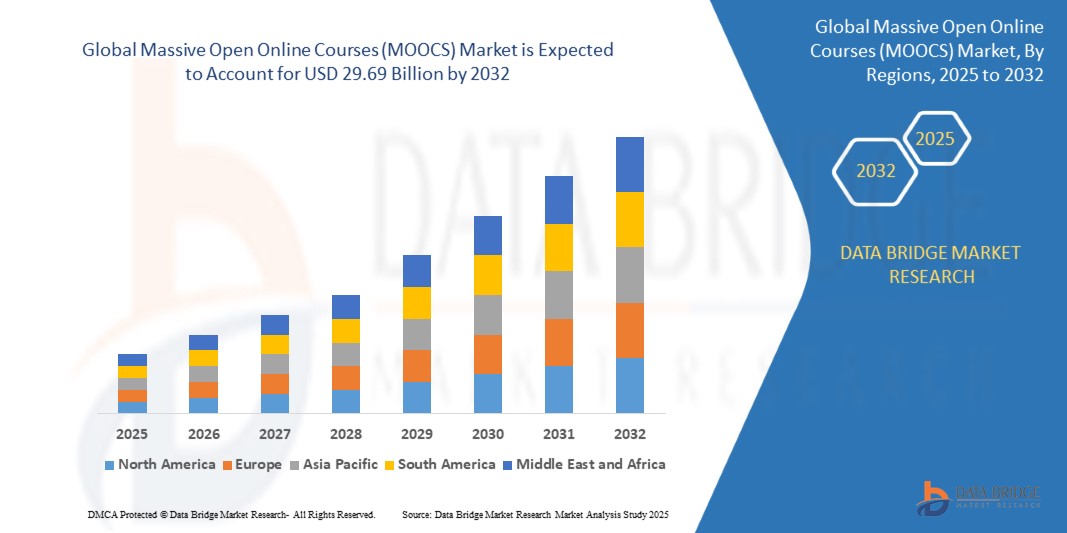
- The global massive open online courses (MOOCS) market size was valued atUSD 12.70 billion in 2024and is expected to reachUSD 29.69 billion by 2032, at aCAGR of 11.20%during the forecast period
- This growth is driven by growing corporate demand for continuous learning increases the demand for MOOCs
Massive Open Online Courses (MOOCS) Market Analysis
- Massive Open Online Courses (MOOCs) are transforming the education sector by offering accessible, affordable, and flexible learning opportunities to a global audience, breaking traditional barriers of time, cost, and geography
- The growing demand for MOOCs is fueled by the increasing need for upskilling, reskilling, and continuous learning in a rapidly evolving job market, alongside the expansion of digital infrastructure and widespread internet access
- North America is expected to dominate the MOOCs market with the largest market share of 34.62%, due to the strong presence of key providers such as Coursera, edX, and Udacity, supported by high adoption rates among universities and working professionals seeking career advancement
- Asia-Pacific is projected to be the fastest-growing region in the MOOCs market during the forecast period, driven by rising student populations, increasedsmartphonepenetration, and government-led digital learning initiatives in countries such as India, China, and Indonesia
- The XMOOC segment is expected to dominate the market with the largest market share of 61.27% due to its integration with formal degree programs is becoming increasingly common. Platforms such as Coursera and EDX provide credit-bearing courses, enabling learners to accumulate credentials that can be applied towards earning a full degree
Report Scope and Massive Open Online Courses (MOOCS) Market Segmentation
|
Attributes |
Massive Open Online Courses (MOOCS) Key Market Insights |
|
Segments Covered |
|
|
Countries Covered |
North America
Europe
Asia-Pacific
Middle East and Africa
South America
|
|
Key Market Players |
|
|
Market Opportunities |
|
|
Value Added Data Infosets |
In addition to the market insights such as market value, growth rate, market segments, geographical coverage, market players, and market scenario, the market report curated by the Data Bridge Market Research team includes in-depth expert analysis, import/export analysis, pricing analysis, production consumption analysis, and pestle analysis |
Massive Open Online Courses (MOOCS) Market Trends
“Integration of Microlearning and Modular Courses”
- A growing trend in the MOOCs market is the increasing adoption of microlearning formats, where learners consume content in short, focused segments that cater to limited attention spans and busy schedules
- MOOCs platforms are now offering modular courses that allow learners to build personalized learning paths by stacking credentials toward professional certifications or degrees
- The flexibility, affordability, and targeted approach of microlearning are attracting both individual learners and corporate clients seeking to upskill employees quickly
- For instance, in September 2024, Coursera launched “SkillSets,” a modular course offering tailored to job roles, allowing learners to gain job-relevant skills faster
- This trend is expected to reshapedigital educationby making learning more adaptive, efficient, and outcome-driven, enhancing MOOCs’ value across global education and enterprise sectors
Massive Open Online Courses (MOOCS) Market Dynamics
Driver
“Surge in Demand for Workforce Reskilling and Upskilling”
- The rapid evolution of job roles due to automation and digital transformation has created a strong demand for continuous learning and workforce reskilling.
- MOOCs offer scalable, accessible, and affordable solutions for individuals and organizations to keep pace with changing skill requirements.
- Governments and companies are actively partnering with MOOCs providers to offer training programs aligned with market demand
- For instance, in 2023, the Singapore government partnered with edX and LinkedIn Learning to subsidize MOOCs for digital skills development under its SkillsFuture initiative
- This rising demand is expected to continue driving the adoption of MOOCs as a key tool in global workforce development strategies
Opportunity
“Expansion of Multilingual and Regional Content”
- One major opportunity lies in offering localized and multilingual MOOCs that cater to non-English-speaking learners in emerging markets
- By expanding language options and regional content, platforms can unlock access to massive untapped learner populations across Asia, Africa, and Latin America
- MOOCs providers are increasingly partnering with regional universities and institutions to co-create culturally relevant and language-specific content
- For instance, in 2024, edX partnered with Universidad Nacional Autónoma de México (UNAM) to launch Spanish-language MOOCs tailored to Latin American learners
- This localization strategy is expected to fuel MOOCs adoption in diverse global markets, broadening reach and engagement
Restraint/Challenge
“Low Completion Rates and Learner Engagement”
- A persistent challenge in the MOOCs market is the low course completion rate, with many learners dropping out due to lack of motivation, poor course structure, or limited interaction
- Limited one-on-one engagement, absence of real-time feedback, and a lack of accountability mechanisms make it difficult for learners to stay committed
- These challenges are especially critical for long-term or certification-based courses that require sustained learner attention and discipline
- For instance, a 2023 MIT study found that average completion rates for MOOCs were below 10%, signaling the need for better engagement strategies
- If left unaddressed, this issue could hinder MOOCs' effectiveness and impact, prompting providers to invest in gamification, peer support, and mentor-led models
Massive Open Online Courses (MOOCS) Market Scope
The market is segmented on the basis of component, subjects, customer, objective, program, application, and end user.
|
Segmentation |
Sub-Segmentation |
|
By Component |
|
|
By Subjects |
|
|
By Customer |
|
|
By Objective |
|
|
By Program |
|
|
By Application |
|
|
By End User |
|
In 2025, the XMOOC is projected to dominate the market with a largest share in component segment
The XMOOC segment is expected to dominate the massive open online courses (MOOCS) market with the largest market share of 61.27% in 2025 due to its integration with formal degree programs is becoming increasingly common. Platforms such as Coursera and EDX provide credit-bearing courses, enabling learners to accumulate credentials that can be applied towards earning a full degree.
The degree and master programs MOOCs is expected to account for the largest share during the forecast period in program segment
In 2025, the degree and master programs MOOCs segment is expected to dominate the market with the largest market share of 57.01% because universities are increasingly adopting and expanding their hybrid online learning models to better meet students' needs. For instance, in February 2023, Pepperdine University partnered with EDX to launch the MicroMasters program, offering comprehensive knowledge and a flexible pathway toward earning a master's degree.
Massive Open Online Courses (MOOCS) Market Regional Analysis
“North America Holds the Largest Share in the Massive Open Online Courses (MOOCS) Market”
- North America is expected to dominate the MOOCs market, with the largest market share of 34.62%, driven by the presence of major online learning platforms, strong digital infrastructure, and a high demand for flexible, accessible education options.
- The U.S. stands as the key player in the region, supported by a robust educational ecosystem and a growing trend of lifelong learning among professionals.
- The region benefits from increasing adoption of online courses by both individuals and institutions, driven by the demand for upskilling, reskilling, and continued professional development
“Asia-Pacific is projected to register the Highest CAGR in the Massive Open Online Courses (MOOCS) Market”
- Asia-Pacific is expected to witness the fastest growth in the massive open online courses (MOOCs) market due to rising internet penetration, increasing smartphone usage, and a growing emphasis on digital education across countries such as India, China, Japan, and Australia
- Supportive government initiatives such as India's SWAYAM platform, China's Smart Education initiative, and strong public-private partnerships are driving widespread adoption of MOOCs in schools, universities, and corporate learning environments
- The expansion of edtech startups and localized course content in regional languages have made MOOCs more accessible to a broader learner base, especially in underserved and rural areas
- This exponential growth makes Asia-Pacific a key driver of the global MOOCs market, with ample opportunities for platform providers, content developers, and investors aiming to scale digital learning across diverse demographics
Massive Open Online Courses (MOOCS) Market Share
The market competitive landscape provides details by competitor. Details included are company overview, company financials, revenue generated, market potential, investment in research and development, new market initiatives, global presence, production sites and facilities, production capacities, company strengths and weaknesses, product launch, product width and breadth, application dominance. The above data points provided are only related to the companies' focus related to market.
The Major Market Leaders Operating in the Market Are:
- Coursera Inc. (U.S.)
- edX LLC(U.S.)
- Pluralsight LLC. (U.S.)
- Alison(Ireland)
- Udacity, Inc. (U.S.)
- Udemy, Inc.(U.S.)
- Miríadax (Spain)
- Jigsaw Academy Education Pvt. Ltd. (India)
- Simplilearn Solutions (U.S.)
- iversity Learning Solutions GmbH (Germany)
- INTELLIPAAT (India)
- FutureLearn (U.K.)
- LinkedIn (U.S.)
- NovoEd, Inc (U.S.)
- Open2Study (Australia)
- WizIQ (India)
- Skillshare, Inc (U.S.)
- XuetangX (China)
Latest Developments in Global Massive Open Online Courses (MOOCS) Market
- In July 2024, the Electronic Multimedia Research Centre (EMRC) department of Devi Ahilya, India, developed six new courses for MOOCs, making them accessible on the SWAYAM platform. This initiative aims to expand digital learning resources for students nationwide
- In June 2024, UNESCO and LG AI Research partnered to launch a global MOOC on the Ethics of Artificial Intelligence (AI), fostering ethical innovation and responsible AI adoption worldwide. This collaboration seeks to build a global community committed to ethical AI practices
- In June 2024, UNESCO and LG AI Research collaborated to introduce an AI ethics-focused MOOC, promoting responsible development and deployment of AI technologies. The course is designed to encourage ethical standards in AI innovation
- In May 2024, Pepperdine University’s edtech arm and 2U Inc. strengthened their partnership, announcing six new online degree programs in licensure-based fields, including education and speech-language pathology. This expansion enhances professional upskilling opportunities in critical sectors
- In March 2024, Accenture acquired Udacity to strengthen its foothold in AI education while unveiling a USD 1 billion investment in its new learning platform, LearnVantage. This move underscores Accenture’s commitment to advancing tech education globally
- In August 2023, the Andhra Pradesh (AP) government signed an MoU with edX to improve digital learning and skill development for students statewide. This partnership aims to bridge educational gaps and support workforce readiness
SKU-
Accédez en ligne au rapport sur le premier cloud mondial de veille économique

- Tableau de bord d'analyse de données interactif
- Tableau de bord d'analyse d'entreprise pour les opportunités à fort potentiel de croissance
- Accès d'analyste de recherche pour la personnalisation et les requêtes
- Analyse de la concurrence avec tableau de bord interactif
- Dernières actualités, mises à jour et analyse des tendances
- Exploitez la puissance de l'analyse comparative pour un suivi complet de la concurrence
Méthodologie de recherche
La collecte de données et l'analyse de l'année de base sont effectuées à l'aide de modules de collecte de données avec des échantillons de grande taille. L'étape consiste à obtenir des informations sur le marché ou des données connexes via diverses sources et stratégies. Elle comprend l'examen et la planification à l'avance de toutes les données acquises dans le passé. Elle englobe également l'examen des incohérences d'informations observées dans différentes sources d'informations. Les données de marché sont analysées et estimées à l'aide de modèles statistiques et cohérents de marché. De plus, l'analyse des parts de marché et l'analyse des tendances clés sont les principaux facteurs de succès du rapport de marché. Pour en savoir plus, veuillez demander un appel d'analyste ou déposer votre demande.
La méthodologie de recherche clé utilisée par l'équipe de recherche DBMR est la triangulation des données qui implique l'exploration de données, l'analyse de l'impact des variables de données sur le marché et la validation primaire (expert du secteur). Les modèles de données incluent la grille de positionnement des fournisseurs, l'analyse de la chronologie du marché, l'aperçu et le guide du marché, la grille de positionnement des entreprises, l'analyse des brevets, l'analyse des prix, l'analyse des parts de marché des entreprises, les normes de mesure, l'analyse globale par rapport à l'analyse régionale et des parts des fournisseurs. Pour en savoir plus sur la méthodologie de recherche, envoyez une demande pour parler à nos experts du secteur.
Personnalisation disponible
Data Bridge Market Research est un leader de la recherche formative avancée. Nous sommes fiers de fournir à nos clients existants et nouveaux des données et des analyses qui correspondent à leurs objectifs. Le rapport peut être personnalisé pour inclure une analyse des tendances des prix des marques cibles, une compréhension du marché pour d'autres pays (demandez la liste des pays), des données sur les résultats des essais cliniques, une revue de la littérature, une analyse du marché des produits remis à neuf et de la base de produits. L'analyse du marché des concurrents cibles peut être analysée à partir d'une analyse basée sur la technologie jusqu'à des stratégies de portefeuille de marché. Nous pouvons ajouter autant de concurrents que vous le souhaitez, dans le format et le style de données que vous recherchez. Notre équipe d'analystes peut également vous fournir des données sous forme de fichiers Excel bruts, de tableaux croisés dynamiques (Fact book) ou peut vous aider à créer des présentations à partir des ensembles de données disponibles dans le rapport.











