



Segmentation du marché mondial des biomatériaux issus de la fermentation de précision, par type de produit (protéines, enzymes, lipides, polysaccharides, peptides et facteurs de croissance, et autres biomolécules), hôte microbien (levures, bactéries, champignons et algues), technologie (ingénierie des souches, fermentation en amont, traitement en aval, formulation et conversion des matériaux, et fabrication à façon), application (médical et santé, agroalimentaire, cosmétique et soins personnels, matériaux industriels et de spécialité, et agriculture et alimentation animale) - Tendances et prévisions du secteur jusqu'en 2033
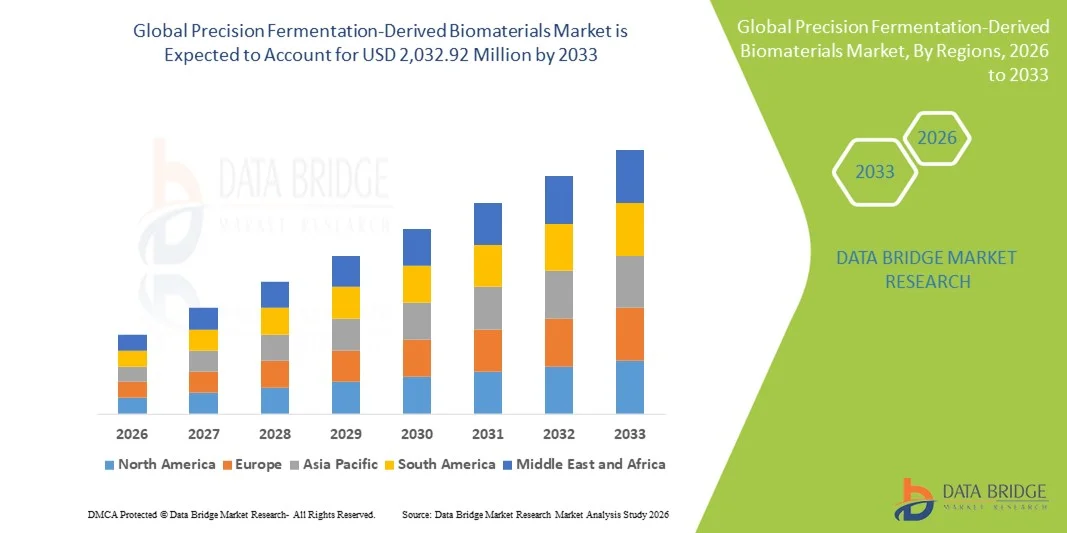
Taille du marché des biomatériaux issus de la fermentation de précision
- Le marché mondial des biomatériaux issus de la fermentation de précision était évalué à 803,68 millions de dollars américains en 2025 et devrait atteindre 2 032,92 millions de dollars américains d’ici 2033 , soit un TCAC de 12,30 % au cours de la période de prévision.
- La croissance du marché est principalement tirée par les progrès rapides de la biologie synthétique, de l'ingénierie des souches et des technologies de bioprocédés , qui permettent une production à grande échelle, rentable et durable de biomatériaux haute performance.
- De plus, la demande croissante de matériaux biosourcés, sans produits animaux et respectueux de l'environnement dans les secteurs de l'alimentation, de la santé, des cosmétiques et des applications industrielles positionne la fermentation de précision comme une approche de fabrication privilégiée, accélérant ainsi considérablement la croissance globale du marché.
Analyse du marché des biomatériaux issus de la fermentation de précision
- Les biomatériaux issus de la fermentation de précision, produits par des micro-organismes modifiés génétiquement pour créer des protéines, des polymères et d'autres biomolécules fonctionnelles, deviennent de plus en plus essentiels dans les secteurs de l'alimentation, de la santé, des cosmétiques et des applications industrielles en raison de leurs avantages en matière de durabilité, de qualité constante et de leur capacité à remplacer les matériaux d'origine animale ou pétrochimique.
- La demande croissante pour ces biomatériaux est principalement due aux progrès de la biologie synthétique et des technologies de fermentation, à l'importance accrue accordée aux méthodes de production durables et sans animaux, ainsi qu'au soutien croissant des autorités réglementaires et des consommateurs en faveur des matériaux biosourcés.
- L'Amérique du Nord a dominé le marché des biomatériaux issus de la fermentation de précision, avec la plus grande part de revenus (38,9 %) en 2025. Cette domination s'explique par une infrastructure de R&D solide, l'adoption précoce de la biologie synthétique, d'importants investissements en capital-risque et la présence d'entreprises de biotechnologie de premier plan et de jeunes pousses spécialisées dans la production à grande échelle de biomatériaux.
- La région Asie-Pacifique devrait connaître la croissance la plus rapide au cours de la période de prévision, avec le taux de croissance annuel composé (TCAC) le plus élevé, grâce au développement des capacités de production biotechnologique , au soutien croissant des gouvernements aux initiatives de bioéconomie et à la demande croissante de matériaux durables dans les secteurs de l'alimentation, de la santé et de l'industrie.
- Le segment des protéines a dominé le marché avec une part de 42,7 % en 2025, grâce à leur utilisation répandue dans les ingrédients alimentaires, les applications médicales et les formulations cosmétiques, ainsi qu'à leur capacité de production à grande échelle et leur viabilité commerciale éprouvées grâce à des procédés de fermentation de précision.
Portée du rapport et segmentation précise du marché des biomatériaux issus de la fermentation
|
Attributs |
Aperçu du marché des biomatériaux issus de la fermentation de précision |
|
Segments couverts |
|
|
Pays couverts |
Amérique du Nord
Europe
Asie-Pacifique
Moyen-Orient et Afrique
Amérique du Sud
|
|
Acteurs clés du marché |
|
|
Opportunités de marché |
|
|
Ensembles d'informations de données à valeur ajoutée |
Outre les informations sur les scénarios de marché tels que la valeur du marché, le taux de croissance, la segmentation, la couverture géographique et les principaux acteurs, les rapports de marché élaborés par Data Bridge Market Research incluent également une analyse approfondie par des experts, des données épidémiologiques sur les patients, une analyse des projets en développement, une analyse des prix et un aperçu du cadre réglementaire. |
Tendances du marché des biomatériaux issus de la fermentation de précision
Progrès en biologie synthétique et technologies de fermentation à grande échelle
- Une tendance importante et croissante sur le marché mondial des biomatériaux issus de la fermentation de précision est le développement rapide de la biologie synthétique, de l'ingénierie des souches et des plateformes de fermentation à grande échelle, qui permettent une production efficace de biomatériaux performants, de qualité constante et à impact environnemental réduit.
- Par exemple, des entreprises comme Ginkgo Bioworks et Perfect Day exploitent la programmation génétique avancée et la fermentation de précision pour optimiser les souches microbiennes afin d'obtenir un rendement, une pureté et une fonctionnalité supérieurs des protéines et des biomatériaux.
- Les innovations technologiques permettent la production de biomatériaux complexes tels que le collagène sans produits animaux, les protéines de soie et les polymères spéciaux qui étaient auparavant difficiles ou coûteux à fabriquer par les méthodes traditionnelles, élargissant ainsi leur viabilité commerciale.
- L'intégration des bioprocédés automatisés, de l'optimisation des souches par l'IA et des technologies de purification aval avancées améliore l'efficacité de la production et réduit les coûts dans les installations de fermentation à l'échelle industrielle.
- Cette attention croissante portée à la sophistication technologique et à l'optimisation des procédés redéfinit les normes industrielles, car les producteurs de biomatériaux recherchent des alternatives évolutives, rentables et durables aux matériaux d'origine pétrochimique et animale.
- Par conséquent, la demande de biomatériaux de précision issus de la fermentation est en hausse dans les secteurs de l'alimentation, de la santé, des cosmétiques et de l'industrie, les fabricants privilégiant l'innovation, la durabilité et la résilience à long terme de la chaîne d'approvisionnement.
Dynamique du marché des biomatériaux issus de la fermentation de précision
Conducteur
Demande croissante de biomatériaux durables et sans produits animaux
- L'importance croissante accordée à la durabilité, à l'approvisionnement éthique et à la réduction de l'impact environnemental à l'échelle mondiale est un facteur majeur qui alimente la demande de biomatériaux de précision issus de la fermentation dans de nombreux secteurs d'utilisation finale.
- Par exemple, les grandes marques alimentaires et cosmétiques adoptent de plus en plus les protéines et les polymères issus de la fermentation pour remplacer les ingrédients d'origine animale, favorisant ainsi un positionnement de produits « clean label », végétaliens et non testés sur les animaux ».
- La fermentation de précision permet des procédés de production contrôlés, évolutifs et économes en ressources, offrant des avantages significatifs par rapport aux procédés de fabrication de biomatériaux traditionnels basés sur l'agriculture ou la pétrochimie.
- De plus, le soutien croissant des autorités réglementaires et des consommateurs aux matériaux biosourcés, notamment en Europe et en Amérique du Nord, accélère l'adoption des biomatériaux issus de la fermentation dans les applications commerciales.
- La capacité à garantir une qualité constante, une traçabilité et une production tout au long de l'année renforce encore l'attrait des biomatériaux issus de la fermentation de précision auprès des fabricants à la recherche de chaînes d'approvisionnement fiables et durables.
- L'augmentation des investissements en capital-risque et des partenaires stratégiques corporatifs accélère l'innovation et l'expansion des capacités dans l'écosystème de la fermentation de précision.
- La demande croissante de biomatériaux haute performance dans les applications médicales et pharmaceutiques stimule davantage la croissance du marché.
Retenue/Défi
Coûts de production élevés et complexité des procédures d'approbation réglementaire
- Les coûts élevés de production et de mise à l'échelle associés aux infrastructures de fermentation avancées, à la purification en aval et au développement des souches demeurent un défi majeur limitant une pénétration plus large du marché.
- Par exemple, la production à l'échelle commerciale de biomatériaux de haute pureté nécessite souvent des investissements importants dans les bioréacteurs, les systèmes de purification et l'expertise spécialisée, ce qui augmente les coûts globaux.
- Les processus d'approbation réglementaire des nouveaux biomatériaux issus de la fermentation, notamment dans les domaines alimentaire et médical, peuvent être longs et complexes, retardant ainsi leur commercialisation.
- Les variations des cadres réglementaires d'une région à l'autre compliquent davantage l'expansion sur le marché mondial, car les entreprises doivent composer avec des exigences différentes en matière de sécurité, d'étiquetage et de conformité.
- Relever ces défis grâce à l'optimisation des processus, aux stratégies de réduction des coûts et à des cadres réglementaires plus clairs sera essentiel pour permettre une adoption plus large et une croissance durable du marché des biomatériaux issus de la fermentation de précision.
- La disponibilité limitée de personnel qualifié en bioprocédés peut freiner la mise à l'échelle rapide et l'efficacité opérationnelle.
- La dépendance à l'égard de matières premières spécialisées et d'intrants de fermentation peut exposer les producteurs à des perturbations de la chaîne d'approvisionnement.
Portée du marché des biomatériaux issus de la fermentation de précision
Le marché est segmenté en fonction du type de produit, de l'hôte microbien, de la technologie et de l'application.
- Par type de produit
Le marché des biomatériaux issus de la fermentation de précision est segmenté, selon le type de produit, en protéines, enzymes, lipides, polysaccharides, peptides et facteurs de croissance, et autres biomolécules. Le segment des protéines dominait le marché en 2025, représentant 42,7 % des revenus, grâce à son adoption généralisée dans les secteurs de l'alimentation, de la santé et des cosmétiques. Les protéines issues de la fermentation, telles que les protéines laitières sans produits animaux, le collagène et les protéines fonctionnelles, sont largement utilisées en raison de leur facilité de production à grande échelle, de leur qualité constante et de leur capacité à remplacer les ingrédients d'origine animale. La forte demande d'alternatives durables et végétaliennes dans les formulations alimentaires et les produits de soins personnels a encore renforcé la position dominante des protéines. De plus, les protéines bénéficient de procédés de fermentation relativement matures et d'un cadre réglementaire bien établi sur les principaux marchés. Leur polyvalence dans de nombreux secteurs d'utilisation finale contribue à maintenir leur position de leader en termes de revenus.
Le segment des peptides et facteurs de croissance devrait connaître la croissance la plus rapide au cours de la période de prévision, grâce à l'essor de leurs applications en médecine régénérative, en ingénierie tissulaire et en thérapies innovantes. La fermentation de précision permet une production rentable et à grande échelle de peptides complexes et de molécules bioactives difficiles à synthétiser chimiquement. L'augmentation des investissements dans la recherche biopharmaceutique et la médecine personnalisée accélère la demande en facteurs de croissance de haute pureté. Par ailleurs, la multiplication des activités de recherche clinique et l'utilisation croissante de ces produits dans la cicatrisation des plaies et les formulations cosmétiques favorisent une adoption rapide. Ce segment bénéficie également des progrès technologiques réalisés en matière d'ingénierie des souches et de purification en aval.
- Par hôte microbien
En fonction de l'hôte microbien, le marché est segmenté en levures, bactéries, champignons et algues. Le segment des levures dominait le marché en 2025, grâce à son utilisation répandue en fermentation de précision, due à sa stabilité génétique, son efficacité élevée d'expression protéique et son acceptation réglementaire. Des souches de levures telles que Saccharomyces cerevisiae sont largement utilisées pour la production de protéines, d'enzymes et de matériaux biosourcés à l'échelle industrielle. Leur compatibilité avec les infrastructures de fermentation à grande échelle et le faible risque de contamination renforcent encore leur position dominante sur le marché. De plus, les systèmes à base de levures sont parfaitement adaptés aux applications agroalimentaires et pharmaceutiques, où la sécurité et la constance sont essentielles. Ces avantages ont fait de la levure la plateforme microbienne de choix dans de nombreux secteurs.
Le segment des algues devrait connaître la croissance annuelle composée la plus rapide au cours de la période de prévision, portée par l'intérêt croissant pour la production durable de lipides et de biomolécules de spécialité. Les algues offrent une productivité élevée, un fort potentiel de capture du carbone et la capacité de produire des biomatériaux uniques tels que des lipides riches en oméga et des pigments. L'augmentation des investissements dans la biotechnologie des algues et les progrès des techniques de culture améliorent la rentabilité de ce segment. Par ailleurs, la demande croissante de matériaux durables dans les secteurs de l'alimentation, des nutraceutiques et des cosmétiques accélère la recherche sur la fermentation à base d'algues. La croissance de ce segment est également soutenue par son alignement sur les initiatives mondiales de décarbonation et de bioéconomie.
- Par la technologie
Sur la base de la technologie, le marché est segmenté en ingénierie des souches, fermentation en amont, traitement en aval, formulation et conversion de matériaux, et fabrication à façon. Le segment de la fermentation en amont détenait la plus grande part de marché en 2025, car il constitue l'étape de production centrale des flux de travail de fermentation de précision. Ce segment bénéficie du déploiement croissant de bioréacteurs à grande échelle et de systèmes de fermentation continue pour améliorer les rendements et réduire les coûts de production. Les investissements croissants dans les infrastructures de fermentation par les entreprises de biotechnologie et les CDMO renforcent encore sa position dominante. La fermentation en amont est essentielle pour garantir l'extensibilité et la reproductibilité, ce qui la rend indispensable à la viabilité commerciale. L'optimisation et l'automatisation continues des procédés améliorent également l'efficacité à ce stade.
Le segment de l'ingénierie des souches devrait connaître la croissance la plus rapide au cours de la période de prévision, porté par les progrès fulgurants de la biologie synthétique, de la conception génétique pilotée par l'IA et des outils basés sur la technologie CRISPR. L'amélioration des performances des souches influe directement sur le rendement, la rentabilité et la fonctionnalité des produits, ce qui confère à ce segment une importance stratégique. L'augmentation des dépenses en R&D des entreprises de biotechnologie accélère l'innovation dans la conception microbienne. Par ailleurs, la demande croissante de biomatériaux personnalisés aux propriétés améliorées incite les entreprises à investir massivement dans l'optimisation des souches. Face à une concurrence accrue, l'ingénierie des souches devient un facteur de différenciation clé pour les acteurs du marché.
- Sur demande
En fonction de l'application, le marché est segmenté en médical et santé, agroalimentaire, cosmétique et soins personnels, matériaux industriels et de spécialité, et agriculture et alimentation animale. Le segment agroalimentaire a dominé le marché en 2025, générant la plus grande part de revenus, grâce à une forte adoption des protéines, enzymes et ingrédients fonctionnels issus de la fermentation. La demande croissante des consommateurs pour des produits sans ingrédients d'origine animale, durables et à étiquetage clair accélère leur utilisation dans les alternatives aux produits laitiers et les aliments fonctionnels. La fermentation de précision garantit un approvisionnement et une qualité constants, palliant ainsi les limites de l'agriculture traditionnelle. Les approbations réglementaires sur les principaux marchés ont également favorisé la commercialisation dans ce segment. La forte consommation d'ingrédients alimentaires continue de soutenir la position dominante du marché en termes de revenus.
Le segment médical et de la santé devrait connaître la croissance la plus rapide au cours de la période de prévision, portée par l'utilisation croissante de biomatériaux issus de la fermentation en médecine régénérative, dans le traitement des plaies et les systèmes d'administration de médicaments. La forte demande de matériaux biocompatibles et sans produits animaux pour les applications médicales stimule leur adoption. La fermentation de précision offre une pureté et une homogénéité des lots supérieures, essentielles pour une utilisation clinique. L'augmentation des investissements dans la recherche en biotechnologie et la médecine personnalisée contribue également à cette croissance. Ce segment bénéficie par ailleurs de la hausse des dépenses de santé et des innovations dans les thérapies avancées.
Analyse régionale du marché des biomatériaux issus de la fermentation de précision
- L'Amérique du Nord a dominé le marché des biomatériaux issus de la fermentation de précision, avec la plus grande part de revenus (38,9 %) en 2025. Cette domination s'explique par une infrastructure de R&D solide, l'adoption précoce de la biologie synthétique, d'importants investissements en capital-risque et la présence d'entreprises de biotechnologie de premier plan et de jeunes pousses spécialisées dans la production à grande échelle de biomatériaux.
- Les acteurs industriels de la région accordent une grande importance aux biomatériaux durables, sans produits animaux et performants, soutenus par des écosystèmes de R&D robustes et la présence d'entreprises de biotechnologie et d'institutions de recherche de premier plan.
- Cette adoption généralisée est encore renforcée par d'importants financements en capital-risque, des cadres réglementaires favorables à l'innovation biosourcée et une demande croissante des secteurs de l'alimentation, de la santé et de l'industrie, positionnant l'Amérique du Nord comme une plaque tournante clé pour les biomatériaux issus de la fermentation de précision.
Aperçu du marché américain des biomatériaux issus de la fermentation de précision
Le marché américain des biomatériaux issus de la fermentation de précision a généré la plus grande part de revenus en Amérique du Nord en 2025, grâce à une forte adoption de la biologie synthétique, à des infrastructures de bioproduction avancées et à d'importants investissements dans l'innovation biotechnologique. Les entreprises américaines privilégient de plus en plus les biomatériaux durables et sans produits animaux pour les secteurs de l'alimentation, de la santé et de l'industrie. La présence de jeunes entreprises biotechnologiques de premier plan, d'instituts de recherche et d'organisations de fabrication à façon accélère la commercialisation. Par ailleurs, des financements en capital-risque solides et un cadre réglementaire favorable aux nouveaux produits biosourcés contribuent significativement à l'expansion du marché.
Aperçu du marché européen des biomatériaux issus de la fermentation de précision
Le marché européen des biomatériaux issus de la fermentation de précision devrait connaître une croissance annuelle composée (TCAC) importante tout au long de la période de prévision, principalement grâce à des réglementations strictes en matière de développement durable et à un soutien politique fort aux solutions biosourcées et à l'économie circulaire. La demande croissante de matériaux respectueux de l'environnement dans les secteurs de l'alimentation, des cosmétiques et des applications industrielles favorise leur adoption. Les fabricants européens intègrent de plus en plus la fermentation de précision afin de répondre aux objectifs de transparence des étiquettes et de réduction des émissions de carbone. La région enregistre une croissance notable dans les secteurs de l'alimentation, des soins personnels et des matériaux de spécialité, soutenue par des collaborations de recherche public-privé et des financements pour l'innovation.
Aperçu du marché britannique des biomatériaux issus de la fermentation de précision
Le marché britannique des biomatériaux issus de la fermentation de précision devrait connaître une croissance annuelle composée (TCAC) remarquable au cours de la période de prévision, grâce à un écosystème de biologie synthétique dynamique et aux initiatives gouvernementales en faveur de la bioéconomie. L'augmentation des investissements dans les protéines alternatives, les matériaux durables et l'innovation dans les sciences de la vie stimule la croissance du marché. L'importance croissante accordée à l'approvisionnement éthique et aux ingrédients sans produits d'origine animale favorise leur adoption dans les secteurs de l'alimentation et des cosmétiques. Par ailleurs, la solide base de recherche universitaire et l'écosystème dynamique des start-ups au Royaume-Uni devraient continuer à stimuler la croissance du marché.
Analyse du marché allemand des biomatériaux issus de la fermentation de précision
Le marché allemand des biomatériaux issus de la fermentation de précision devrait connaître une croissance annuelle composée (TCAC) importante au cours de la période de prévision, portée par l'accent mis par le pays sur la biotechnologie industrielle, le développement durable et la fabrication de pointe. La forte demande en biomatériaux performants et respectueux de l'environnement dans les secteurs industriel, automobile et de la santé favorise leur adoption. L'infrastructure développée de l'Allemagne et son expertise en ingénierie de précision contribuent au développement à grande échelle des technologies de fermentation. Par ailleurs, l'intégration croissante des matériaux biosourcés dans les chaînes de valeur industrielles s'inscrit dans les objectifs nationaux de développement durable et de lutte contre le changement climatique.
Aperçu du marché des biomatériaux issus de la fermentation de précision en Asie-Pacifique
Le marché des biomatériaux issus de la fermentation de précision en Asie-Pacifique devrait connaître la croissance annuelle composée la plus rapide entre 2026 et 2033, portée par une industrialisation rapide, l'expansion des capacités de production biotechnologique et la demande croissante de matériaux durables. Des pays comme la Chine, le Japon, l'Inde et la Corée du Sud investissent massivement dans la bioproduction et le développement de la bioéconomie. Les initiatives gouvernementales en faveur des protéines alternatives et des technologies vertes accélèrent leur adoption. Par ailleurs, le rôle de la région en tant que pôle de production mondial renforce la compétitivité des coûts et l'accessibilité au marché.
Aperçu du marché japonais des biomatériaux issus de la fermentation de précision
Le marché japonais des biomatériaux issus de la fermentation de précision connaît une forte croissance grâce à l'importance accordée par le pays aux biotechnologies avancées, à la fabrication de précision et à l'innovation. Les entreprises japonaises privilégient les biomatériaux fonctionnels de haute qualité destinés à l'alimentation, à la santé et à des applications spécifiques. L'intégration de ces biomatériaux dans les nutraceutiques, les dispositifs médicaux et les produits chimiques de spécialité contribue à cette croissance. Par ailleurs, le vieillissement de la population japonaise et la demande croissante de produits durables et axés sur la santé stimulent davantage l'adoption de ces biomatériaux sur le marché.
Aperçu du marché indien des biomatériaux issus de la fermentation de précision
Le marché indien des biomatériaux issus de la fermentation de précision a représenté une part importante des revenus de la région Asie-Pacifique en 2025, porté par une urbanisation rapide, le développement des capacités biotechnologiques et la demande croissante de biomatériaux durables et abordables. L'Inde s'impose comme un pôle majeur de la production par fermentation, grâce à une main-d'œuvre qualifiée et des avantages concurrentiels en termes de coûts. L'intérêt croissant pour les protéines alternatives, les ingrédients biosourcés et les biomatériaux destinés à la santé accélère la croissance du marché. Les initiatives gouvernementales en faveur de la biotechnologie, des start-ups et des infrastructures de bioproduction renforcent encore la position de l'Inde sur le marché.
Part de marché des biomatériaux issus de la fermentation de précision
L'industrie des biomatériaux issus de la fermentation de précision est principalement dominée par des entreprises bien établies, notamment :
- Perfect Day, Inc. (États-Unis)
- Remilk Ltd. (Israël)
- Imagindairy Ltd. (Israël)
- La société EVERY (États-Unis)
- TurtleTree (Singapour)
- Vivici (Pays-Bas)
- Change Foods, Inc. (États-Unis)
- De Novo Foodlabs (États-Unis)
- Eden Brew Pty Ltd. (Australie)
- Evonik Industries AG (Allemagne)
- Formo Bio GmbH (Allemagne)
- Fybraworks Foods, Inc. (États-Unis)
- Geltor, Inc. (États-Unis)
- Helaina Inc. (États-Unis)
- Usine de vaches zéro (Inde)
- MeliBio (États-Unis)
- Onego Bio Ltd. (Finlande)
- Motif FoodWorks, Inc. (États-Unis)
- Shiru, Inc. (États-Unis)
- Melt & Marble (Suède)
Quels sont les développements récents sur le marché mondial des biomatériaux issus de la fermentation de précision ?
- En juillet 2025, 21st.BIO a lancé un programme de fermentation de précision pour l'alpha-lactalbumine bovine (α-lac) en acquérant une licence pour une souche microbienne à haut rendement auprès de Novonesis. Ce programme permet une production à grande échelle et sans animaux de cette protéine de lait hautement fonctionnelle destinée à la nutrition infantile et aux aliments fonctionnels, répondant ainsi aux problématiques d'approvisionnement traditionnel limité et de coûts d'extraction élevés.
- En avril 2025, 21st.BIO a publié une avancée majeure en matière de sécurité de la fermentation de précision, avec la mise au point d'une souche d'Aspergillus oryzae totalement exempte de mycotoxines pour la production industrielle de protéines, établissant ainsi une nouvelle norme pour la production à grande échelle de nouvelles protéines sûres.
- En mai 2024, Provenance Bio a annoncé que son collagène hydroxylé de type I, produit par fermentation de précision, présentait une adhésion cellulaire fonctionnelle comparable à celle de la fibronectine, démontrant ainsi son potentiel pour remplacer les protéines d'origine animale dans les produits pharmaceutiques et les biomatériaux.
- En novembre 2022, New Culture, une entreprise de technologies alimentaires spécialisée dans la fermentation de précision, a levé des fonds de série A et s'est associée à CJ CheilJedang pour développer la production de fromages sans produits animaux qui fondent et s'étirent comme les produits laitiers, favorisant ainsi l'adoption commerciale des biomatériaux issus de la fermentation dans les applications alimentaires courantes.
- En février 2022, la société américaine Modern Kitchen a lancé le premier fromage à la crème sans produits animaux au monde, fabriqué grâce à une technologie de fermentation de précision, marquant ainsi l'une des premières entrées commerciales sur le marché des alternatives laitières issues de la fermentation.
SKU-
Accédez en ligne au rapport sur le premier cloud mondial de veille économique

- Tableau de bord d'analyse de données interactif
- Tableau de bord d'analyse d'entreprise pour les opportunités à fort potentiel de croissance
- Accès d'analyste de recherche pour la personnalisation et les requêtes
- Analyse de la concurrence avec tableau de bord interactif
- Dernières actualités, mises à jour et analyse des tendances
- Exploitez la puissance de l'analyse comparative pour un suivi complet de la concurrence
Méthodologie de recherche
La collecte de données et l'analyse de l'année de base sont effectuées à l'aide de modules de collecte de données avec des échantillons de grande taille. L'étape consiste à obtenir des informations sur le marché ou des données connexes via diverses sources et stratégies. Elle comprend l'examen et la planification à l'avance de toutes les données acquises dans le passé. Elle englobe également l'examen des incohérences d'informations observées dans différentes sources d'informations. Les données de marché sont analysées et estimées à l'aide de modèles statistiques et cohérents de marché. De plus, l'analyse des parts de marché et l'analyse des tendances clés sont les principaux facteurs de succès du rapport de marché. Pour en savoir plus, veuillez demander un appel d'analyste ou déposer votre demande.
La méthodologie de recherche clé utilisée par l'équipe de recherche DBMR est la triangulation des données qui implique l'exploration de données, l'analyse de l'impact des variables de données sur le marché et la validation primaire (expert du secteur). Les modèles de données incluent la grille de positionnement des fournisseurs, l'analyse de la chronologie du marché, l'aperçu et le guide du marché, la grille de positionnement des entreprises, l'analyse des brevets, l'analyse des prix, l'analyse des parts de marché des entreprises, les normes de mesure, l'analyse globale par rapport à l'analyse régionale et des parts des fournisseurs. Pour en savoir plus sur la méthodologie de recherche, envoyez une demande pour parler à nos experts du secteur.
Personnalisation disponible
Data Bridge Market Research est un leader de la recherche formative avancée. Nous sommes fiers de fournir à nos clients existants et nouveaux des données et des analyses qui correspondent à leurs objectifs. Le rapport peut être personnalisé pour inclure une analyse des tendances des prix des marques cibles, une compréhension du marché pour d'autres pays (demandez la liste des pays), des données sur les résultats des essais cliniques, une revue de la littérature, une analyse du marché des produits remis à neuf et de la base de produits. L'analyse du marché des concurrents cibles peut être analysée à partir d'une analyse basée sur la technologie jusqu'à des stratégies de portefeuille de marché. Nous pouvons ajouter autant de concurrents que vous le souhaitez, dans le format et le style de données que vous recherchez. Notre équipe d'analystes peut également vous fournir des données sous forme de fichiers Excel bruts, de tableaux croisés dynamiques (Fact book) ou peut vous aider à créer des présentations à partir des ensembles de données disponibles dans le rapport.











