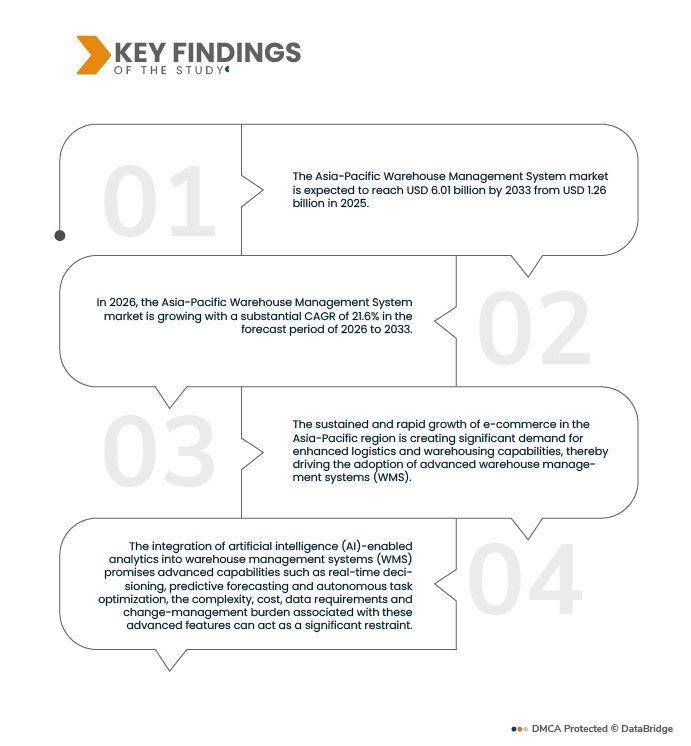
The sustained and rapid growth of e-commerce in the Asia-Pacific region is creating significant demand for enhanced logistics and warehousing capabilities, thereby driving the adoption of advanced warehouse management systems (WMS). As online retail volumes rise and consumer expectations for speed, flexibility and visibility increase, businesses across retail, third-party logistics and manufacturing sectors are compelled to upgrade their warehousing operations. This structural shift compels firms to implement robust WMS platforms that can orchestrate inbound goods, slotting, picking, packing, shipping and returns in real time enabling higher throughput, lower error rates, better inventory accuracy and improved customer service. Consequently, e-commerce expansion functions as a core driver for the WMS market in Asia-Pacific.
Access Full Report @ https://www.databridgemarketresearch.com/reports/asia-pacific-warehouse-management-system-market
The Asia-Pacific Warehouse Management System Market is expected to reach USD 6.01 billion by 2033 from USD 1.26 billion In 2026, growing with a substantial CAGR of 21.6% in the forecast period of 2026 to 2033.
Key Findings of the Study
AI-enabled analytics create advanced WMS capabilities
The integration of artificial intelligence (AI)-enabled analytics into warehouse management systems (WMS) promises advanced capabilities such as real-time decisioning, predictive forecasting and autonomous task optimization, the complexity, cost, data requirements and change-management burden associated with these advanced features can act as a significant restraint. In the Asia-Pacific region, many warehouses still operate with fragmented data, legacy systems and low analytics maturity, meaning that the move to AI-driven WMS requires substantial investment in data infrastructure, training, integration and governance. As a result, the promise of AI-enabled analytics may delay adoption of scalable WMS platforms because organizations may perceive too high a barrier to realizing the advanced features.
Report Scope and Market Segmentation
|
Report Metric
|
Details
|
|
Forecast Period
|
2026 to 2033
|
|
Base Year
|
2025
|
|
Historic Years
|
2024 (Customizable to 2018-2024)
|
|
Quantitative Units
|
Revenue in USD Billion
|
|
Segments Covered
|
By Type (Integrated and Standalone WMS), Component (Software, Services, and Hardware), System Type (Core WMS Execution System, Analytics & Optimization System, Labour Management System (LMS), Returns Management System, Warehouse Control System / Automation Control, Yard Management System, Billing Management System, Others), System Type (Analytics & Optimization, Labor Management System, Load And Route Optimization, Billing & Yard Management System, Built-In Returns Management, Others), Deployment Mode (Cloud, On-Premise, Hybrid), Enterprise Size (Large Enterprise, Small & Medium Enterprise), No. Of Warehouse (Multi-Warehouse and Single Warehouse), Tier Type (Intermediate Wms, Advanced Wms, Basic Wms), Function (Order Processing & Outbound Functions, Inbound & Storage Functions, Yard & Workforce Functions, Returns & Reverse Logistics Functions, Technology & Integration Functions, Others), Pricing (Subscription-Based, One-Time License, Freemium, Others), Vendor Type (Specialist WMS Suite Vendors, Supply Chain Management (SCM) Suite Vendors, Material Handling Equipment/Automation Vendors, Application Mega-Suite Vendors, Independent WMS Component Vendors), End User (E-Commerce, Third-Party Logistics (3PL), Retail, Food And Beverage, Automotive, Electronics & Electricals, Healthcare, Chemicals, Metals & Machinery, Others)
|
|
Countries Covered
|
China, India, Japan, South Korea, Taiwan, Thailand, Indonesia, Malaysia, Singapore, Philippines, Australia, New Zealand, Hong Kong, Rest of Asia-Pacific
|
|
Market Players Covered
|
ACCUTEK PACKAGING COMPANY, INC (U.S.), LOGISTEED Solutions Asia-Pacific Sdn. Bhd. (Malaysia), International Business Machines Corporation (IBM) (U.S.), Dematic (Germany), Oracle (U.S.), SAP SE (Germany), Körber AG (Germany), Dassault Systèmes (France), Blue Yonder Group, Inc. (U.S.), Reply (Italy), Infor (U.S.), Epicor Software Corporation (U.S.), Infolog Pte Ltd. Co. (Singapore), Tecsys (Canada), Manhattan Associates (U.S.), Vinculum Solutions Pvt. Ltd. (India), The PSI Group (Germany), Infocomm Software (Singapore), Unicommerce eSolutions Limited (India), AEB SE (Germany), Synergy Logistics Ltd. (U.K.), Zoho Corporation Pvt. Ltd. (India)
|
|
Data Points Covered in the Report
|
In addition to the insights on market scenarios such as market value, growth rate, segmentation, geographical coverage, and major players, the market reports curated by the Data Bridge Market Research also include in-depth expert analysis, network layouts of distributors and partners, and vendor share analysis
|
Segment Analysis
The Asia-Pacific warehouse management system is segmented into twelve segments based on type, component, system type, deployment mode, enterprise size, no. of warehouse, tier type, function, pricing, vendor type, and end user.
- On the basis of type, the market is segmented into integrated and standalone WMS.
In 2026, the Integrated segment is expected to dominate the market
On the basis of type, the market is segmented into Integrated and Standalone WMS. The integrated segment is further sub-segmented by type into Integrated In ERP System and Integrated In Supply Chain Management Software. In 2026, the Integrated segment is expected to dominate the market due to its.
- On the basis of component, the market is segmented into software, services, and hardware.
In 2026, the Software segment is expected to dominate the market
On the basis of Component, the market is segmented into Software, Services, and Hardware. Services segment is further sub-segmented by type into Professional Services and Managed Service. The Professional Services segment is further sub-segmented by type into System Integration, Consulting Services, and Support & Maintenance. The Managed Services segment is further sub-segmented by type into Advanced Automation Services, Predictive Analytics Services, Incident Tracking Services, Preferred Partner Integrations Services, EDI Support Services, Cross-Docking Services, Front Counter Tools Services, Others. The Hardware segment is further sub-segmented by type into Automated Storage And Retrieval Systems (ASRS), Conveyor Systems, Robotic Systems, Mobile Computers, Barcode Scanners, RFID Tags and Readers, IoT Sensors, Others. In 2026, the Software segment is expected to dominate the market.
- On the basis of system type, the market is segmented into core WMS execution system, analytics & optimization system, Labour Management System (LMS), returns management system, warehouse control system / automation control, yard management system, billing management system, others.
In 2026, the Core WMS Execution System segment is expected to dominate the market
On the basis of System Type, the market is segmented into Core WMS Execution System, Analytics & Optimization System, Labour Management System (LMS), Returns Management System, Warehouse Control System / Automation Control, Yard Management System, Billing Management System, Others. In 2026, the Core WMS Execution System segment is expected to dominate the market
- On the basis of system type, the market is segmented into analytics & optimization, labor management system, load and route optimization, billing & yard management system, built-in returns management, others.
In 2026, the Analytics & Optimization segment is expected to dominate the market
On the basis of System Type, the market is segmented into Analytics & Optimization, Labor Management System, Load And Route Optimization, Billing & Yard Management System, Built-In Returns Management, Others. The Analytics & Optimization segment is further sub-segmented by type into Slotting Optimization System, Order Release / Waveless Optimization System, Labor Forecasting & Workforce Optimization System, Route & Load Optimization System, Others. In 2026, the Analytics & Optimization segment is expected to dominate the market.
- On the basis of deployment mode, the market is segmented into cloud, on-premise, hybrid. cloud segment is further sub-segmented by type into public, private, and hybrid.
In 2026, the Cloud segment is expected to dominate the market
On the basis of Deployment Mode, the market is segmented into Cloud, On-Premise, Hybrid. Cloud segment is further sub-segmented by type into Public, Private, and Hybrid. In 2026, the Cloud segment is expected to dominate the market.
- On the basis of enterprise size, the market is segmented into large enterprise and small & medium enterprise.
In 2026, the Large Enterprise segment is expected to dominate the market
On the basis of Enterprise Size, the market is segmented into Large Enterprise and Small & Medium Enterprise. The Large Enterprise segment is further sub-segmented by Deployment Mode into Cloud, On-Premise, and Hybrid. The Cloud segment is further sub-segmented by type into Public, Private, and Hybrid. The Small & Medium Enterprise segment is further sub-segmented by Deployment Mode into Cloud, On-Premise, and Hybrid. The Cloud segment is further sub-segmented by type into Public, Private, and Hybrid. In 2026, the Large Enterprise segment is expected to dominate the market
- On the basis of no. of warehouse, the market is segmented into multi-warehouse and single warehouse.
In 2026, the Multi-Warehouse segment is expected to dominate the market
On the basis of No. Of Warehouse, the market is segmented into Multi-Warehouse and Single Warehouse. In 2026, the Multi-Warehouse segment is expected to dominate the market.
- On the basis of tier type, the market is segmented into intermediate WMS, advanced WMS, basic WMS.
In 2026, the Intermediate Wms segment is expected to dominate the market
On the basis of Tier Type, the market is segmented into Intermediate Wms, Advanced Wms, Basic Wms. In 2026, the Intermediate Wms segment is expected to dominate the market.
- On the basis of function, the market is segmented into order processing & outbound functions, inbound & storage functions, yard & workforce functions, returns & reverse logistics functions, technology & integration functions, others.
In 2026, the Order Processing & Outbound Functions segment is expected to dominate the market
On the basis of Function, the market is segmented into Order Processing & Outbound Functions, Inbound & Storage Functions, Yard & Workforce Functions, Returns & Reverse Logistics Functions, Technology & Integration Functions, Others. The Order Processing & Outbound Functions segment is further sub-segmented by type into Order Picking, Packing & Fulfilment, Shipping, Wave, Batch & Cluster Picking, Bulk, Pre-pack & Break-pack Processing, Others. The Inbound & Storage Functions segment is further sub-segmented by type into Inventory Management, Receiving & Inspection, Directed Put-away, Cycle & Physical Counting, Others. The Yard & Workforce Functions segment is further sub-segmented by type into Labor Execution & Workforce Tasks, Yard & Dock Operations, and Others. The Technology & Integration Functions segment is further sub-segmented by type into E-commerce & External System Integration, Warehouse Metrics & Operational Analytics, Mobile Device & Handheld Support, Others. In 2026, the Order Processing & Outbound Functions segment is expected to dominate the market.
- On the basis of pricing, the market is segmented into subscription-based, one-time license, freemium, others.
In 2026, the Subscription-Based segment is expected to dominate the market
On the basis of Pricing, the market is segmented into Subscription-Based, One-Time License, Freemium, Others. The Subscription-Based segment is further sub-segmented by type into Monthly and Annually. In 2026, the Subscription-Based segment is expected to dominate the market.
- On the basis of vendor type, the market is segmented into specialist WMS suite vendors, Supply Chain Management (SCM) suite vendors, material handling equipment/automation vendors, application mega-suite vendors, independent WMS component vendors.
In 2026, the Specialist Wms Suite Vendors segment is expected to dominate the market
On the basis of Vendor Type, the market is segmented into Specialist WMS Suite Vendors, Supply Chain Management (SCM) Suite Vendors, Material Handling Equipment/Automation Vendors, Application Mega-Suite Vendors, Independent WMS Component Vendors. In 2026, the Specialist Wms Suite Vendors segment is expected to dominate the market.
- On the basis of end user, the market is segmented into e-commerce, Third-Party Logistics (3PL), retail, food and beverage, automotive, electronics & electricals, healthcare, chemicals, metals & machinery, others..
In 2026, the E-Commerce segment is expected to dominate the market
On the basis of End User, the market is segmented into E-Commerce, Third-Party Logistics (3PL), Retail, Food And Beverage, Automotive, Electronics & Electricals, Healthcare, Chemicals, Metals & Machinery, Others. The E-Commerce segment is further sub-segmented by application into Order Fulfillment, Inventory Tracking, Pick & Pack, Shipping Coordination, Returns Management, Customer Notification, Others. The E-Commerce segment is further sub-segmented by type into Integrated and Standalone WMS. The Integrated is further sub-segmented by type into Integrated In ERP System and Integrated In Supply Chain Management Software. The Third-Party Logistics (3PL) segment is further sub-segmented by application into Warehouse Optimization, Inventory Visibility, Fleet Management, Load Planning, Billing & Invoicing, Carrier Management, Others. The Third-Party Logistics (3PL) segment is further sub-segmented by type into Integrated and Standalone WMS. The Integrated is further sub-segmented by type into Integrated In ERP System and Integrated In Supply Chain Management Software. The Third-Party Logistics (3PL) segment is further sub-segmented by application into Warehouse Optimization, Inventory Visibility, Fleet Management, Load Planning, Billing & Invoicing, Carrier Management, Others. The Retail segment is further sub-segmented by application into Order Processing, Inventory Management, Shelf Replenishment, Pick & Pack, Returns Handling, Shipping Coordination, Others. The Retail segment is further sub-segmented by type into Integrated In ERP System and Integrated In Supply Chain Management Software. The Integrated is further sub-segmented by type into Integrated In ERP System and Integrated In Supply Chain Management Software. The Food And Beverage segment is further sub-segmented by application into Cold Storage Management, Batch Management, Expiry Tracking, Quality Control, Order Processing, Delivery Scheduling, Others. The Food And Beverage segment is further sub-segmented by type into Integrated In ERP System and Integrated In Supply Chain Management Software. The Integrated is further sub-segmented by type into Integrated In ERP System and Integrated In Supply Chain Management Software. The Automotive segment is further sub-segmented by application into Spare Parts Inventory, Assembly Line Support, Just-In-Time Delivery, Order Tracking, Supplier Coordination, Vehicle Component Storage, Others. The Automotive segment is further sub-segmented by type into Integrated In ERP System and Integrated In Supply Chain Management Software. The Integrated is further sub-segmented by type into Integrated In ERP System and Integrated In Supply Chain Management Software. The Electronics & Electricals segment is further sub-segmented by application into Component Inventory, Order Fulfillment, Assembly Support, Shipping Scheduling, Supplier Coordination, Returns Management, Others. The Electronics & Electricals segment is further sub-segmented by type into Integrated In ERP System and Integrated In Supply Chain Management Software. The Integrated is further sub-segmented by type into Integrated In ERP System and Integrated In Supply Chain Management Software. The Healthcare segment is further sub-segmented by application into Pharmaceutical Storage, Batch Control, Cold Chain Monitoring, Order Fulfillment, Expiry Date Management, Medical Equipment Tracking, Others. The Healthcare segment is further sub-segmented by type into Integrated In ERP System and Integrated In Supply Chain Management Software. The Integrated is further sub-segmented by type into Integrated In ERP System and Integrated In Supply Chain Management Software. The Chemicals segment is further sub-segmented by application into Hazardous Material Storage, Compliance Management, Inventory Control, Batch Tracking, Safety Monitoring, Shipment Scheduling, Others. The Chemicals segment is further sub-segmented by type into Integrated In ERP System and Integrated In Supply Chain Management Software. The Integrated is further sub-segmented by type into Integrated In ERP System and Integrated In Supply Chain Management Software. The Metals & Machinery segment is further sub-segmented by application into Material Handling, Spare Parts Inventory, Heavy Equipment Storage, Order Tracking, Shipment Scheduling, Supplier Coordination, Others. The Metals & Machinery segment is further sub-segmented by type into Integrated In ERP System and Integrated In Supply Chain Management Software. The Integrated is further sub-segmented by type into Integrated In ERP System and Integrated In Supply Chain Management Software. The others segment is further sub-segmented by type into Integrated In ERP System and Integrated In Supply Chain Management Software. The Integrated is further sub-segmented by type into Integrated In ERP System and Integrated In Supply Chain Management Software. In 2026, the E-Commerce segment is expected to dominate the market.
Major Players
ACCUTEK PACKAGING COMPANY, INC (U.S.), LOGISTEED Solutions Asia-Pacific Sdn. Bhd. (Malaysia), International Business Machines Corporation (IBM) (U.S.), Dematic (Germany), Oracle (U.S.), SAP SE (Germany), Körber AG (Germany), Dassault Systèmes (France), Blue Yonder Group, Inc. (U.S.), Reply (Italy), Infor (U.S.), Epicor Software Corporation (U.S.), Infolog Pte Ltd. Co. (Singapore), Tecsys (Canada), Manhattan Associates (U.S.), Vinculum Solutions Pvt. Ltd. (India), The PSI Group (Germany), Infocomm Software (Singapore), Unicommerce eSolutions Limited (India), AEB SE (Germany), Synergy Logistics Ltd. (UK), Zoho Corporation Pvt. Ltd. (India)
Market Developments
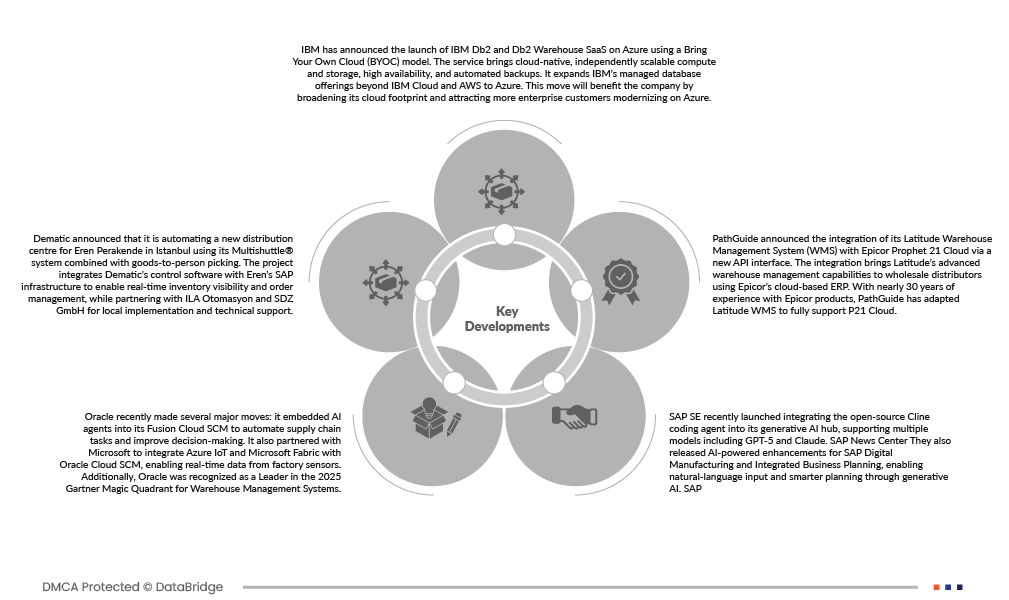
- In 2025 May, IBM has announced the launch of IBM Db2 and Db2 Warehouse SaaS on Azure using a Bring Your Own Cloud (BYOC) model. The service brings cloud-native, independently scalable compute and storage, high availability, and automated backups. It expands IBM’s managed database offerings beyond IBM Cloud and AWS to Azure. This move will benefit the company by broadening its cloud footprint and attracting more enterprise customers modernizing on Azure.
- In 2025 March, Dematic announced that it is automating a new distribution centre for Eren Perakende in Istanbul using its Multishuttle® system combined with goods-to-person picking. The project integrates Dematic’s control software with Eren’s SAP infrastructure to enable real-time inventory visibility and order management, while partnering with ILA Otomasyon and SDZ GmbH for local implementation and technical support.
- In 2025 October, Oracle recently made several major moves: it embedded AI agents into its Fusion Cloud SCM to automate supply chain tasks and improve decision-making. It also partnered with Microsoft to integrate Azure IoT and Microsoft Fabric with Oracle Cloud SCM, enabling real-time data from factory sensors. Additionally, Oracle was recognized as a Leader in the 2025 Gartner Magic Quadrant for Warehouse Management Systems.
- In 2025 September, SAP SE recently launched integrating the open-source Cline coding agent into its generative AI hub, supporting multiple models including GPT-5 and Claude. SAP News Center They also released AI-powered enhancements for SAP Digital Manufacturing and Integrated Business Planning, enabling natural-language input and smarter planning through generative AI. SAP
- In 2025 April, PathGuide announced the integration of its Latitude Warehouse Management System (WMS) with Epicor Prophet 21 Cloud via a new API interface. The integration brings Latitude’s advanced warehouse management capabilities to wholesale distributors using Epicor’s cloud-based ERP. With nearly 30 years of experience with Epicor products, PathGuide has adapted Latitude WMS to fully support P21 Cloud. This will benefit Epicor by enhancing the functionality of Prophet 21 Cloud, improving operational efficiency for customers, and increasing adoption of Epicor’s ERP solutions.
As per Data Bridge Market Research analysis:
For more detailed information about the Asia-Pacific warehouse management system Market report, click here – https://www.databridgemarketresearch.com/reports/asia-pacific-warehouse-management-system-market