Torque Vectoring was first started by Ricardo in 2006 SAE 2006-01-0818 in correlation with driveline technologies. The torque vectoring idea builds on the basic principles of a standard differential which provides safety for the vehicle and smooth transactions over curve. A torque vectoring differential performs basic differential tasks while also transmitting torque independently between wheels. Torque vectoring differentials were originally used in racing or performance cars, but in recent times it has shifted towards luxury vehicles. Moreover, Mitsubishi Motors were first to use these technologies in rally cars.
Access Full Report @ https://www.databridgemarketresearch.com/reports/global-torque-vectoring-market
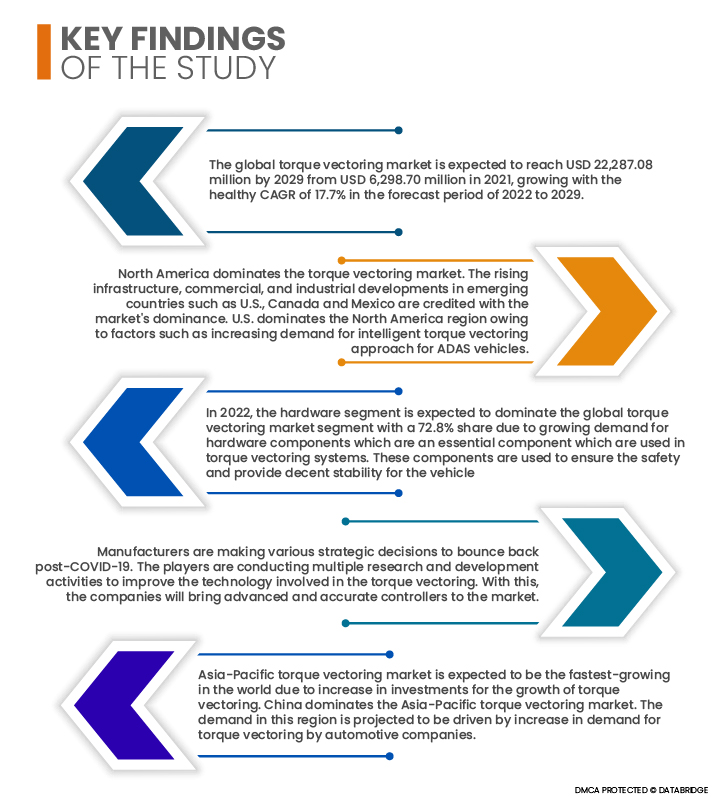
The global torque vectoring market is expected to reach USD 22,287.08 million by 2029 from USD 6,298.70 million in 2021, growing with the healthy CAGR of 17.7% in the forecast period of 2022 to 2029. The heaving adoption of torque vectoring system in off road vehicles, intelligent torque vectoring approach for ADAS vehicles and upsurge in demand for luxury and performance vehicles in the automotive industries are expected to boost the market growth. High cost associated with implementing torque vectoring/AWD/4WD systems is expected to restrain the global torque vectoring market.
Emergence of EV’s and its torque vectoring system across the world will drive the market's growth rate
Over a decade, industrialization and urbanization have played a significant role in the emergence and growth of the automotive industry. The growing global population and the majority of the population shifting towards urban areas for a better opportunity and better living standards plays a vital role in shaping the automotive industry sector. This growing tread of torque vectoring systems in urbanized areas boosts the market growth as all consumers are shifting towards advanced safety vehicles with advanced torque vectoring systems ensuring max safety and efficiency. Thereby rapid urbanization, population, the emergence of mobility as a service (MaaS) technologies, and change in consumer behavior pattern is forcing the major players to develop vehicles with advanced torque vectoring systems for the consumer to gain the market, leading to growth in global torque vectoring market across all regions of the globe.
Report Scope and Market Segmentation
Report Metric
|
Details
|
Forecast Period
|
2022 to 2029
|
Base Year
|
2021
|
Historic Years
|
2020 (Customizable to 2014 - 2019)
|
Quantitative Units
|
Revenue in USD Million, Volumes in Units, Pricing in USD
|
Segments Covered
|
By Component (Hardware and Services), Technology (Active Torque Vectoring System (ATVS) and Passive Torque Vectoring System (PTVS)), Clutch Actuation Type (Electric and Hydraulic), Driving Wheel Type (Rear-Wheel Drive (RWD), Front-Wheel Drive (FWD), and All-Wheel Drive/Four-Wheel Drive (AWD/4WD)), Vehicle Type (Passenger Cars, Commercial Vehicles, and Off Road Vehicle), Propulsion Type (Diesel/Petrol/CNG and Electric Vehicle)
|
Countries Covered
|
U.S., Canada and Mexico in North America, Germany, France, U.K., Netherlands, Switzerland, Belgium, Russia, Italy, Spain, Turkey, Rest of Europe in Europe, China, Japan, India, South Korea, Singapore, Malaysia, Australia, Thailand, Indonesia, Philippines, Rest of Asia-Pacific (APAC) in the Asia-Pacific (APAC), Saudi Arabia, U.A.E, South Africa, Egypt, Israel, Rest of Middle East and Africa (MEA) as a part of Middle East and Africa (MEA), Brazil, Argentina and Rest of South America as part of South America.
|
Market Players Covered
|
GKN (UK), American Axle (US), Dana (US), BorgWarner (US), Eaton (Ireland), ZF (Germany), JTEKT (Japan), Magna (Canada), Bosch (Germany), Univance (Germany), Schaeffler (Germany), Timken (US), Ricardo (UK), and Oerlikon Graziano (Italy) among others.
|
Data Points Covered in the Report
|
In addition to the market insights such as market value, growth rate, market segments, geographical coverage, market players, and market scenario, the market report curated by the Data Bridge Market Research team includes in-depth expert analysis, import/export analysis, pricing analysis, production consumption analysis, and pestle analysis.
|
Segment Analysis:
The global torque vectoring market is segmented into six notable segments based on the component, technology, clutch actuation type, driving wheel type, vehicle type, and propulsion type.
- On the basis of component, global torque vectoring market has been segmented into hardware, services. Hardware segment is further sub-segmented into drive control unit (DCU), motor controllers, can bus, sensors, motor, others. In 2022, the hardware segment is expected to dominate the global torque vectoring market segment with a 72.8% share due to growing demand for hardware components which are an essential component which are used in torque vectoring systems. These components are used to ensure the safety and provide decent stability for the vehicle
- On the basis of technology, global torque vectoring market has been segmented into active torque vectoring system (ATVS), passive torque vectoring system (PTVS). In 2022, active torque vectoring system (ATVS) segment is expected to dominate the global torque vectoring market 60.37% share due to the easy at which active torque vectoring applies brake to the inner wheels of your vehicle/car in order to provide optimum drive power to the outer wheel minimizing the drag. This technology is prominently used in recent times making it the dominant technology in the market.
- On the basis of clutch actuation type, global torque vectoring market has been segmented into electric, hydraulic. In 2022, the electric segment is expected to dominate the global torque vectoring market segment with a 59.81% share due to its efficiency in apply the clutch automatically which effectively eliminates any jolting or surges resulting in smooth clutch operation when pulling away, stopping, cornering and gear changing. This clutch actuation type is widely used in automobiles.
- On the basis of driving wheel type, global torque vectoring market has been segmented into rear-wheel drive (RWD), front-wheel drive (FWD), all-wheel drive/four-wheel drive (AWD/4WD). In 2022, the front-wheel drive (FWD) segment is expected to dominate the global torque vectoring market due to ease of use, globally majority of the cars used are front-wheel drive as they are comparatively cheap offers better mileage. Moreover, it offers better traction and has less auto parts and components
- On the basis of vehicle type, global torque vectoring market has been segmented into passenger cars, commercial vehicles, off road vehicle. Passenger cars is further sub segmented into by type and technology. By type is further sub segmented into SUV, sedan, hatchback, crossovers and others. By technology is further sub segmented into active torque vectoring system (ATVS), passive torque vectoring system (PTVS). Commercial vehicles are further sub segmented into by type and technology. By type is further sub segmented into light commercial vehicle and heavy commercial vehicle which is further segmented into bus, trucks. By technology is further sub segmented into active torque vectoring system (ATVS), passive torque vectoring system (PTVS). Off road vehicle is further sub segmented into by technology. By technology is further sub segmented into active torque vectoring system (ATVS), passive torque vectoring system (PTVS). In 2022, the passenger cars segment is expected to dominate the global torque vectoring market as passenger cars are widely used by consumer as it is considering as a premium mode of transportation. Growing concern among consumer for safety and advance features consumers are demanding for torque systems in their vehicle.
- On the basis of propulsion type, the global torque vectoring market has been segmented into diesel/petrol/CNG and electric vehicle. In 2022, the passenger cars segment is expected to dominate the global torque vectoring market segment with a 63.40% share due to the implementation of safety features and control systems in diesel/petrol/CNG propulsion type vehicles are affordable and cheap when compared with electric propulsion type. However, environmental concerns can deter the segment growth as diesel/petrol/CNG propulsion type vehicles have a high carbon footprint.
Major Players
Data Bridge Market Research에서는 토크 벡터링 시장의 주요 기업으로 다음 회사를 꼽았습니다. GKN(영국), American Axle(미국), Dana(미국), BorgWarner(미국), Eaton(아일랜드), ZF(독일), JTEKT(일본), Magna(캐나다), Bosch(독일), Univance(독일), Schaeffler(독일), Timken(미국), Ricardo(영국), Oerlikon Graziano(이탈리아).
시장 개발
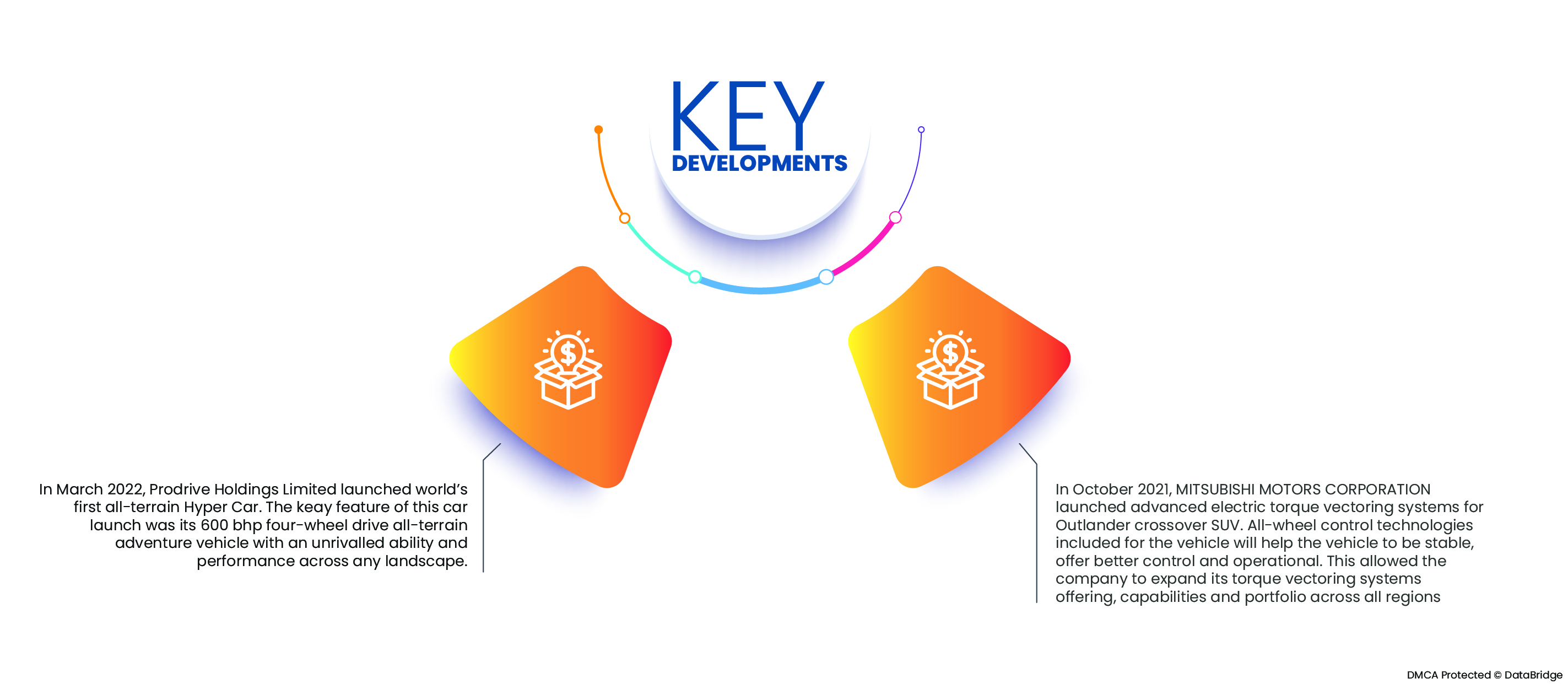
- 2022년 3월, Prodrive Holdings Limited는 세계 최초의 전지형 하이퍼카를 출시했습니다. 이 차량 출시의 핵심은 600마력의 사륜구동 전지형 어드벤처 차량으로, 어떤 지형에서도 탁월한 성능과 성능을 발휘한다는 점입니다. 이를 통해 회사는 고객에게 혁신적인 솔루션을 제공하며 시장을 확대했습니다.
- 2021년 10월, 미쓰비시 모터스는 아웃랜더 크로스오버 SUV를 위한 첨단 전기 토크 벡터링 시스템을 출시했습니다. 차량에 적용된 사륜구동 제어 기술은 차량의 안정성을 높이고, 향상된 제어력과 주행 성능을 제공합니다. 이를 통해 미쓰비시는 모든 지역에 걸쳐 토크 벡터링 시스템 제공, 기능 및 포트폴리오를 확장할 수 있었습니다.
지역 분석
지리적으로 h 토크 벡터링 시장 보고서에서 다루는 국가는 북미의 미국, 캐나다 및 멕시코, 유럽의 독일, 프랑스, 영국, 네덜란드, 스위스, 벨기에, 러시아, 이탈리아, 스페인, 터키, 유럽의 기타 유럽, 중국, 일본, 인도, 한국, 싱가포르, 말레이시아, 호주, 태국, 인도네시아, 필리핀, 아시아 태평양(APAC)의 기타 아시아 태평양(APAC), 사우디 아라비아, UAE, 남아프리카 공화국, 이집트, 이스라엘, 중동 및 아프리카(MEA)의 일부인 기타 중동 및 아프리카(MEA), 브라질, 아르헨티나, 남미의 일부인 기타 남미입니다.
Data Bridge Market Research 분석에 따르면:
북미는 2022년부터 2029년까지의 예측 기간 동안 토크 벡터링 시장 에서 지배적인 지역입니다.
북미는 토크 벡터링 시장을 장악하고 있습니다. 미국, 캐나다, 멕시코 등 신흥국의 인프라, 상업 및 산업 발전이 시장 지배력의 핵심 요인으로 꼽힙니다. 미국은 ADAS 차량용 지능형 토크 벡터링 기술에 대한 수요 증가 등의 요인으로 북미 지역에서 우위를 점하고 있습니다.
아시아 태평양 지역은 2022년부터 2029년까지 토크 벡터링 시장 에서 가장 빠르게 성장하는 지역으로 추정됩니다.
아시아 태평양 토크 벡터링 시장은 토크 벡터링 시장 성장을 위한 투자 증가로 인해 세계에서 가장 빠르게 성장할 것으로 예상됩니다. 중국은 아시아 태평양 토크 벡터링 시장을 장악하고 있으며, 자동차 회사의 토크 벡터링 수요 증가가 이 지역의 수요를 견인할 것으로 예상됩니다.
코로나 19 영향
바이러스로 인한 팬데믹의 발발로 인해 많은 소규모 산업이 문을 닫았고, 반면에 일부 산업은 일부 직원을 해고하기로 결정하여 대규모 실업이 발생했습니다. 토크 벡터링은 자동차 산업에도 사용됩니다. 팬데믹의 발발로 인해 이러한 제품에 대한 수요가 특히 의료 부문, 헬스케어, 제약, 식료품, 전자 상거래 및 기타 여러 부문에서 다소 감소했습니다. 그러나 예상치 못한 수요와 제한된 생산 용량 및 공급망 중단으로 인해 이러한 모든 산업에 어려움이 계속되고 있습니다. 제조업체는 COVID-19 이후 회복하기 위해 다양한 전략적 결정을 내리고 있습니다. 업체는 토크 벡터링과 관련된 기술을 개선하기 위해 여러 연구 개발 활동을 수행하고 있습니다. 이를 통해 회사는 시장에 고급 및 정밀 컨트롤러를 출시할 것입니다. 또한 정부 기관에서 대형 차량에 토크 벡터링을 사용함으로써 시장이 성장했습니다.
토크 벡터링 시장 보고서 에 대한 자세한 내용은 여기를 클릭하세요 - https://www.databridgemarketresearch.com/reports/global-torque-vectoring-market