



Asia-Pacific Herbal Medicine Market Segmentation, By Application (Pharmaceutical & Nutraceutical, Food & Beverages, Personal Care & Beauty Products), Source (Barks, Leaves, Roots, Others) Form (Powder, Liquid & Gel, Tablets & Capsules), Distribution Channel (Direct sales, Retail Sales) – Industry Trends and Forecast to 2032
Herbal Medicine Market Analysis
The Asia-Pacific (APAC) herbal medicine market is one of the fastest-growing segments in the global herbal medicine industry. The region's market growth is driven by a rich tradition of herbal medicine practices, increasing consumer preference for natural remedies, and government initiatives promoting the use of alternative medicines. Countries such as India and China have deep-rooted traditional medicine systems, such as Ayurveda and Traditional Chinese Medicine (TCM), which have been using herbal remedies for centuries. This cultural heritage and historical use of herbal medicine contribute to its popularity and acceptance in the region. As healthcare costs continue to rise, consumers in the region are increasingly turning to herbal remedies as a more affordable and accessible alternative to conventional medicine. The growing middle class in countries like India and China is driving increased disposable income, enabling consumers to spend more on healthcare, including herbal products. Many governments in the region are recognizing the potential of herbal medicine and are providing support in terms of research, development, and regulatory frameworks. In many countries, herbal medicines are regulated under less stringent guidelines than conventional drugs, making it easier to bring new herbal products to the market.
Herbal medicine Market Size
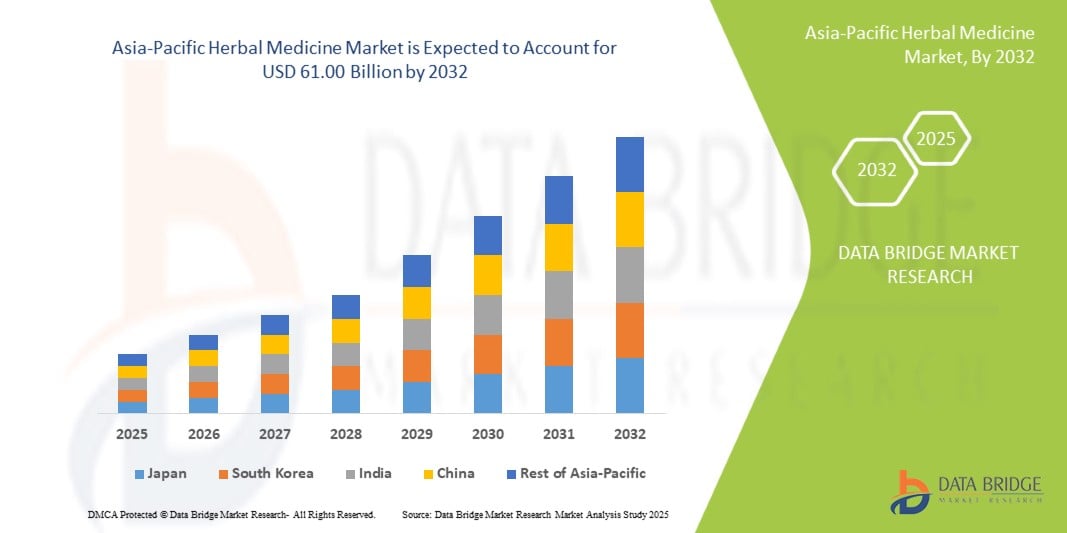
Asia-Pacific herbal medicine market size was valued at USD 24.11 billion in 2024 and is projected to reach USD 61.00 Billion by 2032, with a CAGR of 12.4% during the forecast period of 2025 to 2032. In addition to the insights on market scenarios such as market value, growth rate, segmentation, geographical coverage, and major players, the market reports curated by the Data Bridge Market Research also include depth expert analysis, patient epidemiology, pipeline analysis, pricing analysis, and regulatory framework.
Herbal Medicine Market Trends
“Integration of Herbal Medicine with Modern Healthcare Systems”
One prominent trend in the Asia-Pacific herbal medicine market is the increasing integration of herbal medicine into modern healthcare systems. Governments and healthcare institutions in countries such as China, Japan, and India are actively promoting the use of traditional herbal medicine alongside allopathic treatments. For instance, the AYUSH ministry advocates the use of Ayurvedic and herbal treatments, with dedicated hospitals and clinics offering these therapies.
Traditional Chinese Medicine (TCM) is formally integrated into the national healthcare system. Hospitals frequently offer TCM as part of treatment regimens for various chronic conditions. Kampo medicines, derived from Chinese herbal practices, are prescribed alongside conventional medicine and are covered under national health insurance. This integration ensures wider acceptance, increases patient trust, and fuels growth in the herbal medicine market.
Report Scope and Herbal Medicine Market Segmentation
|
Attributes |
Herbal Medicine Key Market Insights |
|
Segments Covered |
|
|
Countries Covered |
China, Japan, India, South Korea, Singapore, Malaysia, Australia, Thailand, Indonesia, Philippines, Rest of Asia-Pacific |
|
Key Market Players |
Cultivator Natural Products Pvt. Ltd. (India), 21ST Century HealthCare, Inc. (U.S.), Herbalife Nutrition (U.S.), ZeinPharma Germany GmbH (Germany), Blackmores Limited (Australia), Himalaya Global Holdings Ltd. (India), Nutraceutical Corporation (U.S.), Emami Limited (India), Nature's Answer, LLC. (U.S.), Patanjali Ayurved Limited (India), Changsheng Medical Technology (China), LKK Health Products Group Limited (China), Herbal Hills (India), Nordic Nutrients (Japan), Hamdard Laboratories (India), Dabur India Limited (India), AYUSH Ayurvedic Pte Ltd. (India), Sheng Chang Pharmaceutical Company (Taiwan) and Bionorica SE (Germany). |
|
Market Opportunities |
|
|
Value Added Data Infosets |
In addition to the insights on market scenarios such as market value, growth rate, segmentation, geographical coverage, and major players, the market reports curated by the Data Bridge Market Research also include depth expert analysis, patient epidemiology, pipeline analysis, pricing analysis, and regulatory framework. |
Herbal Medicine Market Definition
. Herbal medicine, a system of healing that utilizes plants or plant extracts, has been practiced for centuries across various cultures. It encompasses a wide range of practices, from traditional medicine systems like Ayurveda and Traditional Chinese Medicine to modern herbal medicine, which incorporates scientific research and standardized herbal preparations. Herbal medicines can be used in various forms, such as dried herbs, tinctures, capsules, and topical applications. They are employed to treat a variety of ailments, including common colds, digestive disorders, skin conditions, anxiety, and pain. While herbal medicine has a long history of use and is often considered safe and effective, it's crucial to use it responsibly and consult with a healthcare professional before starting any new herbal regimen, especially if you are taking other medications or have underlying health conditions.
Herbal medicine Market Dynamics
Drivers
- Cultural and Historical Roots in Traditional Medicine
The Asia-Pacific region has deep-rooted traditions in herbal medicine systems like Traditional Chinese Medicine (TCM), Ayurveda in India, and Kampo in Japan. These practices are widely accepted and form an integral part of healthcare systems in many countries, driving the demand for herbal medicines. In addition, governments in these regions also actively support and promote these practices, further boosting their adoption. For instance, in November 2023, the Indian Ministry of AYUSH and the World Health Organization (WHO) signed an agreement to advance traditional medicine practices like Ayurveda, Siddha, and Unani. This collaboration includes efforts to standardize herbal medicines, create an International Herbal Pharmacopoeia for South-East Asian herbs, and integrate evidence-based traditional medicine into mainstream health systems. Such initiatives not only boost the visibility of herbal medicine but also promote its adoption in Asia-Pacific.
- Rising Demand for Natural and Organic Products
Many synthetic drugs have been associated with adverse side effects, ranging from mild to severe. This has pushed people to seek gentler, more natural alternatives. Increasing awareness about the side effects of synthetic drugs has led consumers to seek natural, safe, and chemical-free remedies. This trend is amplified by the growing health and wellness movement, with a preference for organic and plant-based solutions driving significant growth in the herbal medicine market.
Opportunities
- Export Growth and Global Collaboration
Countries like India and China, with their vast biodiversity and strong traditions in herbal medicine, are experiencing significant export growth in the global herbal medicine market. Their ability to produce cost-effective, high-quality herbal products, combined with increasing consumer demand for natural remedies in developed markets, positions them as key exporters. Collaborations, such as the India-WHO agreement to develop a global herbal pharmacopoeia, aim to establish international standards for herbal medicine quality and efficacy. This enhances trust in their products and facilitates entry into regulated markets like Europe and North America. Furthermore, the Asia-Pacific region is becoming a hub for high-quality, standardized herbal products, driven by investments in research and development, biotechnology, and nanotechnology to enhance therapeutic efficacy. Regulatory alignment efforts through international frameworks like Codex Alimentarius also support the global acceptance of herbal products, fostering stronger trade links and positioning regional players for long-term growth in a competitive market.
- Expansion of E-Commerce Channels
The rapid growth of digital platforms in the Asia-Pacific region has enabled smaller herbal medicine manufacturers to reach a wider consumer base. Platforms like India’s Udaan are facilitating partnerships between international brands and local distributors, helping herbal products gain traction in rural and urban markets alike. This trend aligns with increased online health product purchases, particularly post-pandemic.
For instance, in January 2022, Blackmores Ltd., an australia-based natural health and dietary supplements company, partnered with India’s B2B e-commerce platform Udaan to distribute its multivitamin products. This collaboration allowed Blackmores’ herbal and dietary supplements to be distributed to independent pharmacies across India. By leveraging Udaan’s extensive e-commerce network, Blackmores tapped into a large and diverse market, showcasing the significant role digital platforms play in expanding the reach of herbal medicine products in the Asia-Pacific region.
Restraints/Challenges
- Lack of Standardization and Quality Control
A significant challenge in the Asia-Pacific herbal medicine market is the absence of uniform quality standards and regulations. Variations in the sourcing, processing, and composition of herbal medicines create inconsistencies, making it difficult to ensure safety and efficacy. This lack of standardization affects consumer trust and limits the export potential of herbal products.
Countries in this region, including those under ASEAN frameworks, face diverse standards and varying levels of harmonization for the approval, safety, and efficacy assessment of herbal medicines. These differences create hurdles for companies aiming to market their products across multiple countries.
For instance, while ASEAN has established guidelines for the harmonization of traditional medicines and health supplements, the implementation and regulatory requirements, such as clinical validation and ingredient safety documentation, differ significantly across member states. This lack of standardization can delay product approvals and limit market access.
- Regulatory Complexity Across Countries
The regulatory landscape for herbal medicines varies widely across the Asia-Pacific region. While countries like China and India have well-established systems for traditional medicine, others lack clear frameworks. This inconsistency complicates cross-border trade and hampers market growth. Additionally, many herbal medicines face delays in gaining regulatory approval due to limited clinical evidence, adding to the challenge. For instance, according to the American Council on Science and Health, the cost of medical devices are rarely mentioned. It represents about 5% of healthcare spending, or roughly USD 120 billion in 2017.
Herbal Medicine Market Scope
The market is segmented on the basis of application and form. The growth amongst these segments will help you analyze meagre growth segments in the industries and provide the users with a valuable market overview and market insights to help them make strategic decisions for identifying core market applications.
Application
- Pharmaceutical & Nutraceutical
- Food & Beverages
- Personal Care & Beauty Products
Source
- Barks
- Leaves
- Roots
- Others
Form
- Powder
- Liquid & Gel
- Tablets & Capsules
Distribution Channel
- Direct sales
- Retail Sales
- Online
- Offline
Herbal Medicine Market Regional Analysis
The market is analyzed and market size insights and trends are provided by country, application, form as referenced above.
The countries covered in the market are China, Japan, India, South Korea, Singapore, Malaysia, Australia, Thailand, Indonesia, Philippines, Rest of Asia-Pacific.
China is expected to dominate the market due to advancements in herbal medicine manufacturing technology and high healthcare expenditure, presence of key players. Additionally, the high adoption rate of herbal medicine is expected to further fuel the market's growth.
India is expected to be the fastest growing due to the region's rapidly increasing population. Government initiatives and investments aimed to increase adoption of herbal medicine, along with increasing awareness among people about the benefits of herbal medicine, surge in start-up activity in herbal medicine are contributing to the market's expansion.
The country section of the report also provides individual market impacting factors and changes in regulation in the market domestically that impacts the current and future trends of the market. Data points like down-stream and upstream value chain analysis, technical trends and porter's five forces analysis, case studies are some of the pointers used to forecast the market scenario for individual countries. Also, the presence and availability of global brands and their challenges faced due to large or scarce competition from local and domestic brands, impact of domestic tariffs and trade routes are considered while providing forecast analysis of the country data.
Herbal Medicine Market Share
The market competitive landscape provides details by competitor. Details included are company overview, company financials, revenue generated, market potential, investment in research and development, new market initiatives, global presence, production sites and facilities, production capacities, company strengths and weaknesses, product launch, product width and breadth, application dominance. The above data points provided are only related to the companies' focus related to market.
Herbal Medicine Market Leaders Operating in the Market Are:
- Cultivator Natural Products Pvt. Ltd. (India)
- 21ST Century HealthCare, Inc. (U.S.)
- Herbalife Nutrition (U.S.)
- ZeinPharma Germany GmbH (Germany)
- Blackmores Limited (Australia)
- Himalaya Global Holdings Ltd. (India)
- Nutraceutical Corporation (U.S.)
- Emami Limited (India)
- Nature's Answer, LLC. (U.S.)
- Patanjali Ayurved Limited (India)
- Changsheng Medical Technology (China)
- LKK Health Products Group Limited (China)
- Herbal Hills (India)
- Nordic Nutrients (Japan)
- Hamdard Laboratories (India)
- Dabur India Limited (India)
- AYUSH Ayurvedic Pte Ltd. (India)
- Sheng Chang Pharmaceutical Company (Taiwan)
- Bionorica SE (Germany)
Latest Developments in Herbal Medicine Market
- In February 2022, Indian traditional medicine manufacturer Hamdard expanded its product portfolio by introducing new offerings, including face washes, shampoos, and oral hygiene products. Hamdard, the iconic herbal medicine brand, is planning to foray into beauty products using medicinal oils. This expansion of products will drive the growth of market
- January 2022, Australia-based natural health and dietary supplements company Blackmores Ltd. partnered with B2B e-commerce platform Udaan to distribute its multivitamin products in India. This partnership allows independent pharmacies in India to access Blackmores' products via Udaan
- December 2021, Simply Herbal, a key player in the Indian healthcare supplement sector, unveiled a new product line under the brand name Divya Himalayan. The brand focuses on creating products made exclusively from organic ingredients
- March 2021, Indian beauty brand Lotus launched Lotus Botanicals, an e-commerce platform offering a wide range of haircare and skincare products that customers can order online. The rapid growth of digital platforms in the Asia-Pacific region has enabled smaller herbal medicine manufacturers to reach a wider consumer base and expanding the reach of herbal medicine products in the Asia-Pacific region
- In December 2022, Dabur, a one of India's leading consumer products makers announced the expansion of its Odonil portfolio with the launch of ‘Odonil Gel Pocket’, a unique Gel-based air freshener which gives superior and long-lasting fragrance. This launch is in line with the growing consumer preference for natural and herbal products in India and other Asian markets. This move highlights the increasing focus on herbal-based solutions for hair care and the potential for growth in the Asia-Pacific herbal medicine market
SKU-
세계 최초의 시장 정보 클라우드 보고서에 온라인으로 접속하세요

- 대화형 데이터 분석 대시보드
- 높은 성장 잠재력 기회를 위한 회사 분석 대시보드
- 사용자 정의 및 질의를 위한 리서치 분석가 액세스
- 대화형 대시보드를 통한 경쟁자 분석
- 최신 뉴스, 업데이트 및 추세 분석
- 포괄적인 경쟁자 추적을 위한 벤치마크 분석의 힘 활용
연구 방법론
데이터 수집 및 기준 연도 분석은 대규모 샘플 크기의 데이터 수집 모듈을 사용하여 수행됩니다. 이 단계에는 다양한 소스와 전략을 통해 시장 정보 또는 관련 데이터를 얻는 것이 포함됩니다. 여기에는 과거에 수집한 모든 데이터를 미리 검토하고 계획하는 것이 포함됩니다. 또한 다양한 정보 소스에서 발견되는 정보 불일치를 검토하는 것도 포함됩니다. 시장 데이터는 시장 통계 및 일관된 모델을 사용하여 분석하고 추정합니다. 또한 시장 점유율 분석 및 주요 추세 분석은 시장 보고서의 주요 성공 요인입니다. 자세한 내용은 분석가에게 전화를 요청하거나 문의 사항을 드롭하세요.
DBMR 연구팀에서 사용하는 주요 연구 방법론은 데이터 마이닝, 시장에 대한 데이터 변수의 영향 분석 및 주요(산업 전문가) 검증을 포함하는 데이터 삼각 측량입니다. 데이터 모델에는 공급업체 포지셔닝 그리드, 시장 타임라인 분석, 시장 개요 및 가이드, 회사 포지셔닝 그리드, 특허 분석, 가격 분석, 회사 시장 점유율 분석, 측정 기준, 글로벌 대 지역 및 공급업체 점유율 분석이 포함됩니다. 연구 방법론에 대해 자세히 알아보려면 문의를 통해 업계 전문가에게 문의하세요.
사용자 정의 가능
Data Bridge Market Research는 고급 형성 연구 분야의 선두 주자입니다. 저희는 기존 및 신규 고객에게 목표에 맞는 데이터와 분석을 제공하는 데 자부심을 느낍니다. 보고서는 추가 국가에 대한 시장 이해(국가 목록 요청), 임상 시험 결과 데이터, 문헌 검토, 재생 시장 및 제품 기반 분석을 포함하도록 사용자 정의할 수 있습니다. 기술 기반 분석에서 시장 포트폴리오 전략에 이르기까지 타겟 경쟁업체의 시장 분석을 분석할 수 있습니다. 귀하가 원하는 형식과 데이터 스타일로 필요한 만큼 많은 경쟁자를 추가할 수 있습니다. 저희 분석가 팀은 또한 원시 엑셀 파일 피벗 테이블(팩트북)로 데이터를 제공하거나 보고서에서 사용 가능한 데이터 세트에서 프레젠테이션을 만드는 데 도움을 줄 수 있습니다.











