



Global AI in Education Market Segmentation, By Component (Solutions and Services), Deployment Mode (On-premises and Cloud-based), Technology (Deep Learning and Machine Learning, Natural Language Processing (NLP), and Computer Vision), Application (Virtual Facilitators and Learning Environments, Intelligent Tutoring Systems (ITS), Content Delivery Systems, Fraud and Risk Management, Student-initiated Learning, and Others), End User (K-12 Education, Higher Education, Corporate Training and Learning, and Others) – Industry Trends and Forecast to 2032
AI in Education Market Analysis
The AI in education market is witnessing significant advancements, driven by cutting-edge methods such as adaptive learning systems, personalized learning paths, and intelligent tutoring. These systems use machine learning algorithms to tailor educational content to individual student needs, improving engagement and outcomes. Chatbots, powered by natural language processing, provide instant query resolution, enhancing administrative efficiency and learner support.
Augmented reality (AR) and virtual reality (VR), integrated with AI, offer immersive learning experiences, especially in complex subjects such as science and engineering. Predictive analytics is another breakthrough, enabling educators to identify at-risk students early and intervene effectively. Usage of AI in education spans K-12, higher education, and corporate training. Platforms such as Coursera and Khan Academy incorporate AI to personalize content delivery. Schools adopt AI tools for administrative tasks, freeing educators to focus on teaching.
The market is growing at a robust pace due to rising adoption of e-learning, demand for customized education, and government initiatives to modernize education systems. North America and Asia-Pacific are key regions driving growth.
AI in Education Market Size
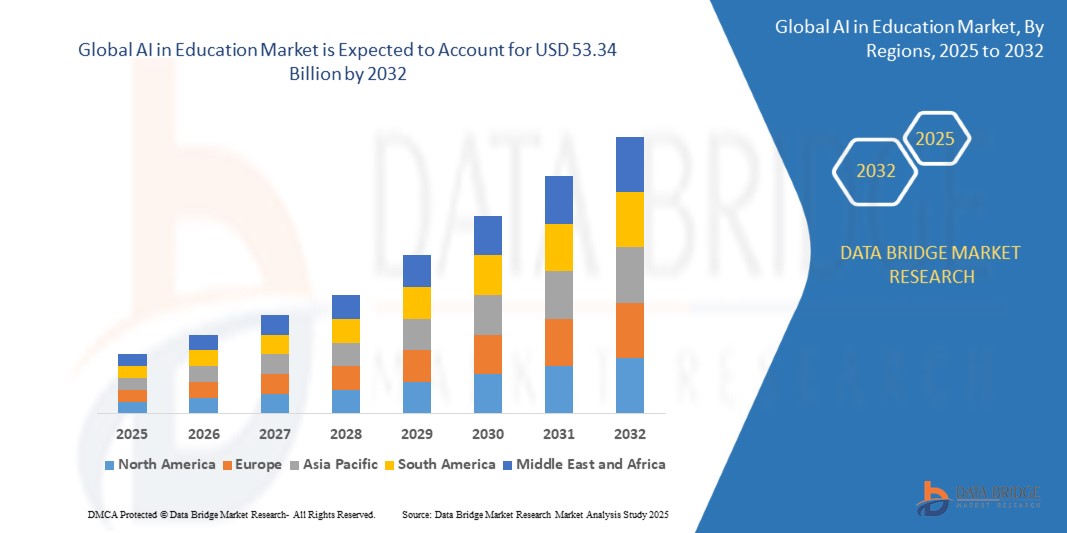
The global AI in education market size was valued at USD 5.32 billion in 2024 and is projected to reach USD 53.34 billion by 2032, with a CAGR of 33.51% during the forecast period of 2025 to 2032. In addition to the market insights such as market value, growth rate, market segments, geographical coverage, market players, and market scenario, the market report curated by the Data Bridge Market Research team includes in-depth expert analysis, import/export analysis, pricing analysis, production consumption analysis, and pestle analysis.
AI in Education Market Trends
“Growing Demand of Personalized Learning through AI-Driven Tools”
Personalized learning is a key trend shaping the AI in education market. AI-powered platforms such as adaptive learning systems use data analytics to assess individual student performance and tailor content accordingly. Platforms such as DreamBox Learning and Carnegie Learning analyze students' problem-solving patterns, identifying strengths and weaknesses to customize lessons. This approach ensures students learn at their own pace, improving engagement and academic outcomes. Furthermore, personalized learning reduces dropout rates by catering to diverse learning needs, particularly in large and diverse classrooms. For instance, Indian educational startup Unacademy expanded its offline centers, growing from 6,000 learners in 2022 to 32,000 learners in 2023. In addition, the company successfully reduced its cash burn by 60% over the past eight years, reflecting improved operational efficiency and growth in its learner base. The integration of AI-driven chatbots also enables on-demand tutoring and guidance, enhancing accessibility and creating a more supportive educational environment.
Report Scope and AI in Education Market Segmentation
|
Attributes |
AI in Education Key Market Insights |
|
Segments Covered |
|
|
Countries Covered |
U.S., Canada and Mexico in North America, Germany, France, U.K., Netherlands, Switzerland, Belgium, Russia, Italy, Spain, Turkey, Rest of Europe in Europe, China, Japan, India, South Korea, Singapore, Malaysia, Australia, Thailand, Indonesia, Philippines, Rest of Asia-Pacific (APAC) in the Asia-Pacific (APAC), Saudi Arabia, U.A.E, South Africa, Egypt, Israel, Rest of Middle East and Africa (MEA) as a part of Middle East and Africa (MEA), Brazil, Argentina and Rest of South America as part of South America |
|
Key Market Players |
ALEKS (U.S.), Riiid, Inc. (South Korea), Discovery Education (U.S.), Amazon Web Services, Inc. (U.S.), IBM Corporation (U.S.), Microsoft (U.S.), Cognizant (U.S.), Google LLC (U.S.), Pearson (U.K.), Carnegie Learning, Inc. (U.S.), Fishtree Inc. (U.S.), Anthology Inc. (U.S.), Jellynote (France), Alibaba Cloud (China), Adobe (U.S.), OpenAI (U.S.), Udacity, Inc. (U.S.), Duolingo, Inc. (U.K.), and Jenzabar Inc. (U.S.) |
|
Market Opportunities |
|
|
Value Added Data Infosets |
In addition to the market insights such as market value, growth rate, market segments, geographical coverage, market players, and market scenario, the market report curated by the Data Bridge Market Research team includes in-depth expert analysis, import/export analysis, pricing analysis, production consumption analysis, and pestle analysis. |
AI in Education Market Definition
Artificial Intelligence (AI) in education transforms teaching and learning by personalizing experiences, automating administrative tasks, and providing data-driven insights. AI-powered tools such as adaptive learning platforms cater to individual learning styles and paces, enhancing student engagement and outcomes. Virtual tutors and chatbots offer on-demand support, while AI analytics help educators identify areas where students need improvement. In addition, AI streamlines tasks such as grading and attendance management, allowing teachers to focus on instruction. Emerging technologies such as natural language processing enable better communication, making education more inclusive. Through integrating AI, education becomes more efficient, accessible, and tailored to meet diverse learner needs.
AI in Education Market Dynamics
Drivers
- AI-Based Educational Technology Enhances Learning Outcomes
AI-driven educational technology is significantly improving learning outcomes by personalizing the learning experience. These systems analyze student data to tailor instruction based on individual strengths, weaknesses, and interests. Through adapting the pace and content of education, AI ensures that each learner progresses effectively. Educators benefit from real-time insights into student performance and areas needing improvement, enabling more targeted teaching strategies. For instance, a Forbes Advisor survey in October 2023 revealed that 55% of U.S. educators observed improved educational outcomes due to AI. Among the 500 educators surveyed, 60% reported using AI tools in their classrooms, highlighting its growing adoption and effectiveness.
- AI-Powered Tools Supporting Educators in Education
In the AI in education market, natural language processing (NLP) technologies enable chatbots to provide 24/7 student support, answering doubts and delivering course materials. These chatbots assist educators by addressing availability challenges. AI also automates grading, plagiarism detection, and administrative tasks in tertiary education, freeing educators to focus on student engagement. For instance, in March 2024 launch of an AI-powered chatbot by Indian software firm Pinak Ai. Designed for Civil Services Examination aspirants, the chatbot, available on Android and iOS, delivers real-time information on topics and current affairs. This innovation highlights AI’s growing role in enhancing educator efficiency and student access to resources.
Opportunities
- Rising Investment in AI
Increasing investment in AI is driving the growth of the global AI in education market, with AI-based learning platforms playing a crucial role. These investments enable more advanced, personalized learning, aligning with the trend toward individualized education. AI-driven platforms are transforming how education is delivered, promoting lifelong learning and enhancing educational access. For instance, the U.K. has committed to supporting over 1,000 AI-focused PhD researchers by 2025, alongside initiatives such as Turing Fellowships for early-career AI researchers. Such efforts reflect a global commitment to cultivating a future AI workforce, creating significant opportunities in the education sector and accelerating market growth.
- Skill Development for Future Jobs
AI in education is revolutionizing skill development by aligning learning modules with evolving industry needs, ensuring students are ready for AI-driven job markets. It facilitates hands-on training in areas such as coding, data analysis, and machine learning through personalized programs. For instance, platforms such as Coursera and Udacity leverage AI to offer courses that adapt to learners’ progress, enhancing their proficiency in high-demand fields. Such advancements enable students to gain industry-relevant certifications and practical experience. By bridging the skills gap and preparing learners for future careers, AI benefits individuals and drives demand in the education market by addressing workforce readiness challenges.
Restraints/Challenges
- Lack of Adequate IT Infrastructure
The lack of adequate IT infrastructure in many emerging economies remains a significant barrier to the growth of AI in education. Despite high smartphone penetration and falling internet data costs, many regions still face low-quality internet connectivity and a shortage of compatible devices, particularly in underdeveloped areas. This limits the effectiveness and accessibility of AI-driven educational tools, preventing widespread adoption. Furthermore, the absence of skilled professionals in these regions exacerbates the problem, hindering the development, implementation, and maintenance of AI systems in educational settings. These infrastructure and talent gaps restrict the scalability and impact of AI in education, impeding its potential growth in these markets.
- High Implementation Costs
High implementation costs pose a significant barrier to the AI in education market. Developing and integrating AI technologies into educational institutions requires substantial upfront investment, including purchasing hardware, software, and specialized tools. In addition, the ongoing maintenance costs for updates, troubleshooting, and system management add to the financial burden. This creates a considerable challenge, particularly for schools with limited budgets or those in economically disadvantaged regions. As a result, many educational institutions may delay or forgo AI adoption due to the high financial commitment required, thus hindering the market's growth and limiting access to innovative educational solutions.
This market report provides details of new recent developments, trade regulations, import-export analysis, production analysis, value chain optimization, market share, impact of domestic and localized market players, analyses opportunities in terms of emerging revenue pockets, changes in market regulations, strategic market growth analysis, market size, category market growths, application niches and dominance, product approvals, product launches, geographic expansions, technological innovations in the market. To gain more info on the market contact Data Bridge Market Research for an Analyst Brief, our team will help you take an informed market decision to achieve market growth.
AI in Education Market Scope
The market is segmented on the basis of component, deployment mode, technology, application, and end user. The growth amongst these segments will help you analyze meagre growth segments in the industries and provide the users with a valuable market overview and market insights to help them make strategic decisions for identifying core market applications.
Component
- Solutions
- Services
Deployment Mode
- On-premises
- Cloud-based
Technology
- Deep Learning and Machine Learning
- Natural Language Processing (NLP)
- Computer Vision
Application
- Virtual Facilitators and Learning Environments
- Intelligent Tutoring Systems (ITS)
- Content Delivery Systems
- Fraud and Risk Management
- Student-initiated Learning
- Others
End User
- K-12 Education
- Higher Education
- Corporate Training and Learning
- Others
AI in Education Market Regional Analysis
The market is analyzed and market size insights and trends are provided by component, deployment mode, technology, application, and end user as referenced above.
The countries covered in the market report are U.S., Canada, Mexico in North America, Germany, Sweden, Poland, Denmark, Italy, U.K., France, Spain, Netherland, Belgium, Switzerland, Turkey, Russia, Rest of Europe in Europe, Japan, China, India, South Korea, New Zealand, Vietnam, Australia, Singapore, Malaysia, Thailand, Indonesia, Philippines, Rest of Asia-Pacific (APAC) in Asia-Pacific (APAC), Brazil, Argentina, Rest of South America as a part of South America, U.A.E, Saudi Arabia, Oman, Qatar, Kuwait, South Africa, Rest of Middle East and Africa (MEA) as a part of Middle East and Africa (MEA).
North America is expected to dominate the AI in education market, driven by its advanced technological infrastructure and significant investment in education technology. The presence of leading EdTech companies and AI solution providers in the U.S. fosters innovation, accelerating the adoption of AI tools across educational institutions, enhancing learning experiences.
Europe is expected to show significant market growth in the AI in education market, driven by the rising adoption of digital learning solutions and personalized education. Government initiatives such as the European Commission's Digital Education Action Plan are fostering AI integration in education. In addition, demand for intelligent tutoring systems and virtual learning environments is fueling investments in AI-driven tools.
The country section of the report also provides individual market impacting factors and changes in market regulation that impact the current and future trends of the market. Data points such as down-stream and upstream value chain analysis, technical trends and porter's five forces analysis, case studies are some of the pointers used to forecast the market scenario for individual countries. Also, the presence and availability of global brands and their challenges faced due to large or scarce competition from local and domestic brands, impact of domestic tariffs and trade routes are considered while providing forecast analysis of the country data.
AI in Education Market Share
The market competitive landscape provides details by competitor. Details included are company overview, company financials, revenue generated, market potential, investment in research and development, new market initiatives, global presence, production sites and facilities, production capacities, company strengths and weaknesses, product launch, product width and breadth, application dominance. The above data points provided are only related to the companies' focus related to market.
AI in Education Market Leaders Operating in the Market Are:
- ALEKS (U.S.)
- Riiid, Inc. (South Korea)
- Discovery Education (U.S.)
- Amazon Web Services, Inc. (U.S.)
- IBM Corporation (U.S.)
- Microsoft (U.S.)
- Cognizant (U.S.)
- Google LLC (U.S.)
- Pearson (U.K.)
- Carnegie Learning, Inc. (U.S.)
- Fishtree Inc. (U.S.)
- Anthology Inc. (U.S.)
- Jellynote (France)
- Alibaba Cloud (China)
- Adobe (U.S.)
- OpenAI (U.S.)
- Udacity, Inc. (U.S.)
- Duolingo, Inc. (U.K.)
- Jenzabar Inc. (U.S.)
Latest Developments in AI in Education Market
- In September 2024, PowerSchool, a leading provider of cloud-based software for K-12 education, introduced its new PowerBuddy AI products. These tools aim to strengthen the connectivity between school staff, teachers, counselors, students, families, and the broader community. In addition, PowerBuddy for College and Career and PowerBuddy for Custom AI assist students in exploring opportunities and taking actionable steps toward achieving success in college, careers, and life, promoting a more connected educational ecosystem
- In July 2024, Pearson launched new generative AI-powered tools via Pearson+ Channels to enhance the teaching and learning experience across various educational levels. These tools enable students to upload their syllabus and receive personalized learning experiences, along with an AI tutor embedded in videos to address concept-related questions. Furthermore, Pearson integrated these AI features into Connections Academy's high school curriculum, allowing teachers to design AI-based assessments for specific subjects
- In February 2024, CoRover P. Limited introduced an AI-powered education tablet designed to advance digital learning and inclusivity. The tablet features BharatGPT, a virtual assistant that supports inter-lingual translation and accommodates India’s diverse languages. This innovative solution aims to enhance the learning experience for students from various linguistic backgrounds and promote inclusivity for differently-abled individuals, offering a more accessible and effective approach to digital education across the country
- In July 2021, The Central Board of Secondary Education (CBSE) partnered with Intel Corporation to launch the AI Students Community learning platform (AISC). This initiative allows students from CBSE and non-CBSE institutions to benefit from AI-driven learning. The platform provides access to AI-certified specialists from Intel, fostering AI literacy among students and preparing them for future technological advancements in education and various industries
- In January 2020, Pearson acquired The Smart Sparrow Pty Ltd, an ed-tech startup, to enhance its adaptive learning capabilities. This acquisition aimed to strengthen Pearson's Global Learning Platform (GLP) by integrating Smart Sparrow’s innovative learning technologies. The partnership enables Pearson to offer more personalized and dynamic educational experiences, promoting the development of customized learning pathways for students across different educational levels
SKU-
세계 최초의 시장 정보 클라우드 보고서에 온라인으로 접속하세요

- 대화형 데이터 분석 대시보드
- 높은 성장 잠재력 기회를 위한 회사 분석 대시보드
- 사용자 정의 및 질의를 위한 리서치 분석가 액세스
- 대화형 대시보드를 통한 경쟁자 분석
- 최신 뉴스, 업데이트 및 추세 분석
- 포괄적인 경쟁자 추적을 위한 벤치마크 분석의 힘 활용
연구 방법론
데이터 수집 및 기준 연도 분석은 대규모 샘플 크기의 데이터 수집 모듈을 사용하여 수행됩니다. 이 단계에는 다양한 소스와 전략을 통해 시장 정보 또는 관련 데이터를 얻는 것이 포함됩니다. 여기에는 과거에 수집한 모든 데이터를 미리 검토하고 계획하는 것이 포함됩니다. 또한 다양한 정보 소스에서 발견되는 정보 불일치를 검토하는 것도 포함됩니다. 시장 데이터는 시장 통계 및 일관된 모델을 사용하여 분석하고 추정합니다. 또한 시장 점유율 분석 및 주요 추세 분석은 시장 보고서의 주요 성공 요인입니다. 자세한 내용은 분석가에게 전화를 요청하거나 문의 사항을 드롭하세요.
DBMR 연구팀에서 사용하는 주요 연구 방법론은 데이터 마이닝, 시장에 대한 데이터 변수의 영향 분석 및 주요(산업 전문가) 검증을 포함하는 데이터 삼각 측량입니다. 데이터 모델에는 공급업체 포지셔닝 그리드, 시장 타임라인 분석, 시장 개요 및 가이드, 회사 포지셔닝 그리드, 특허 분석, 가격 분석, 회사 시장 점유율 분석, 측정 기준, 글로벌 대 지역 및 공급업체 점유율 분석이 포함됩니다. 연구 방법론에 대해 자세히 알아보려면 문의를 통해 업계 전문가에게 문의하세요.
사용자 정의 가능
Data Bridge Market Research는 고급 형성 연구 분야의 선두 주자입니다. 저희는 기존 및 신규 고객에게 목표에 맞는 데이터와 분석을 제공하는 데 자부심을 느낍니다. 보고서는 추가 국가에 대한 시장 이해(국가 목록 요청), 임상 시험 결과 데이터, 문헌 검토, 재생 시장 및 제품 기반 분석을 포함하도록 사용자 정의할 수 있습니다. 기술 기반 분석에서 시장 포트폴리오 전략에 이르기까지 타겟 경쟁업체의 시장 분석을 분석할 수 있습니다. 귀하가 원하는 형식과 데이터 스타일로 필요한 만큼 많은 경쟁자를 추가할 수 있습니다. 저희 분석가 팀은 또한 원시 엑셀 파일 피벗 테이블(팩트북)로 데이터를 제공하거나 보고서에서 사용 가능한 데이터 세트에서 프레젠테이션을 만드는 데 도움을 줄 수 있습니다.











