What is the Solid Household Cleaning Concentrates Market Size and Growth Rate?
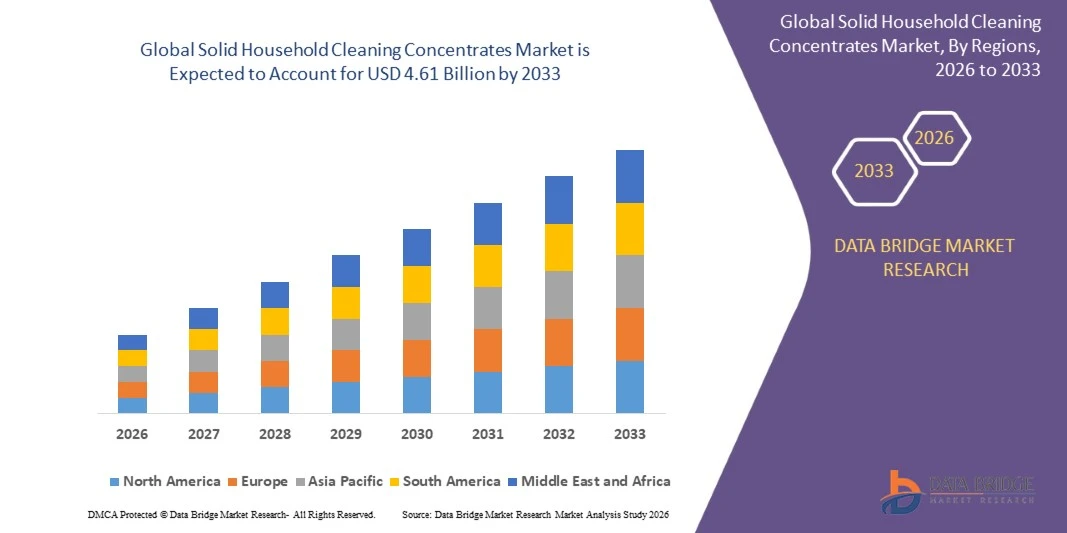
- As per Data Bridge Market Research analysis, the solid household cleaning concentrates market was valued at USD 2.20 billion in 2025 and is projected to reach USD 4.61 billion by 2033, growing at a CAGR of 9.70% from 2026 to 2033.
- The market is experiencing consistent growth driven by rising demand for plastic-free cleaning formats, lightweight and space-saving packaging, and pre-dosed products across laundry care, dishwashing, surface cleaning, and bathroom care in household and commercial settings.
- The increasing shift toward waterless formulations, reduced packaging emissions, and cold-water washing, combined with growing launches of tablets, sheets, and powder concentrates by established and emerging brands, is supporting market adoption. Solid concentrates are being applied across laundry detergent care, dishwashing, and household cleaning, offering consumers lower shipping weight, accurate dosing, and easier storage than bulky liquid bottles, along with concentrated formats that reduce plastic use.
Market Size & Forecast
- Global Market Value (2025): USD 2.20 Billion
- Expected Market Value (2033): USD 4.61 Billion
- Forecast CAGR (2026–2033): 9.70%
- Leading Region in 2025: North America
- Fastest Growing Region: Asia Pacific
What are the Major Takeaways of the Solid Household Cleaning Concentrates Market?
- North America dominated the solid household cleaning concentrates market with the largest revenue share of 37.42% in 2025, supported by the national rollout of fiber-based laundry tiles, strong online retail penetration, and rising preference for plastic-free household products.
- Asia-Pacific is expected to be the fastest-growing region at a CAGR of 12.15% from 2026 to 2033, fueled by rising washing machine ownership, expanding e-commerce, and strong demand for compact, lightweight cleaning products.
- The tablets segment led the market with a 44.86% share in 2025, driven by pre-measured dosing and wide use across dishwashing, laundry, and surface cleaning.
- Sheets and strips are the fastest-growing product type, projected to register a CAGR of 13.40%, reflecting the surge in demand for ultra-light, dissolvable laundry formats with minimal packaging.
- The laundry care segment dominated the application category with a 53.28% revenue share in 2025, led by large replacement demand for liquid detergents and pods in mature washing-machine markets.
- The surface and bathroom cleaning segment is the fastest-growing application category, with a CAGR of 12.10%, driven by refill-based sprays and foaming tablets.
- The online distribution channel is projected to register the fastest growth at a CAGR of 12.85%, supported by subscription refills and direct-to-consumer brands.
Report Scope and Solid Household Cleaning Concentrates Market Segmentation
|
Attributes |
Solid Household Cleaning Concentrates Key Market Insights |
|
Segments Covered |
|
|
Countries Covered |
North America
Europe
Asia-Pacific
Middle East and Africa
South America
|
|
Key Market Players |
|
|
Market Opportunities |
|
|
Value Added Data Infosets |
In addition to the insights on market scenarios such as market value, growth rate, segmentation, geographical coverage, and major players, the market reports curated by the Data Bridge Market Research also include in-depth expert analysis, pricing analysis, brand share analysis, consumer survey, demography analysis, supply chain analysis, value chain analysis, raw material/consumables overview, vendor selection criteria, PESTLE Analysis, Porter Analysis, and regulatory framework. |
What is the Key Trend in the Solid Household Cleaning Concentrates Market?
- Solid household cleaning concentrates are evolving from niche refill products into mainstream formats, with large consumer goods companies combining proprietary dissolvable materials, concentrated surfactants, and recyclable paper-based packaging to replace bottle-based liquid cleaners.
- For instance, in February 2026, according to Happi, Procter & Gamble launched Tide evo, a waterless laundry tile with six cleaning layers, at major U.S. retailers; the product is designed to clean in cold water and supports the brand’s goal of turning three out of four laundry loads in the U.S. and Canada to cold by 2030, highlighting large-brand entry into solid laundry formats.
- Dissolvable sheets and fiber-based tiles are enabling brands to remove water, fillers, and plastic bottles while keeping pre-measured dosing, which reduces shipping weight and storage space for consumers.
- Specialty and direct-to-consumer brands are widening the category by introducing paper-carton sheets, refill tablets, and subscription models that appeal to consumers seeking low-waste alternatives for everyday cleaning.
- For instance, in January 2026, according to Oman Observer, Clean Cult introduced its Fresh Linen Laundry Detergent Sheets in the U.S. in paper-based cartons, illustrating how emerging brands use plastic-free packaging and concentrated sheet formats to compete with established liquid and pod detergents.
- As consumers increasingly value convenience, sustainability, and accessibility, solid cleaning concentrates are expected to expand beyond laundry into dishwashing, bathroom, and multi-surface cleaning, supported by compact packaging and cold-water-ready formulations.
What are the Key Drivers of the Solid Household Cleaning Concentrates Market?
- Rising focus on reducing single-use plastic and packaging emissions is increasing interest in cleaning products that remove water and bottles while retaining the cleaning performance consumers expect from conventional liquids and powders.
- For instance, in May 2026, according to ACCESS Newswire, EverCleaner launched its Laundry Detergent Sheets as a compact alternative to bulky plastic bottles, noting that users can pack only the number of sheets needed without leaks, reflecting the shift in consumer behavior toward convenient and sustainable laundry solutions.
- Retailers and brands also benefit from lower shipping weight and smaller pack sizes, which reduce freight costs and storage requirements and support rapid growth of online and subscription-based sales of cleaning refills.
- For instance, in February 2026, according to Personal Care Insights, Procter & Gamble stated that Tide evo was developed over 10 years with 15 PhD-level chemists and engineers, removing water and fillers to create a 100.00% concentrated pre-dosed tile, demonstrating the research investment behind solid cleaning formats.
- With households seeking easier dosing and cold-water cleaning to reduce energy use, solid concentrates are expected to gain steady adoption across laundry, dishwashing, and surface-cleaning routines in mature and emerging markets.
What Factors Are Challenging the Growth of the Solid Household Cleaning Concentrates Market?
- Solid cleaning concentrates require specialized dissolvable films or fiber structures, concentrated surfactant systems, and moisture-resistant packaging, increasing formulation complexity compared with conventional liquids and powders.
- For instance, in February 2026, according to Fortune, a box of 42 Tide evo tiles was priced at USD 19.99 on Amazon compared with USD 12.97 for a pack of 42 Tide Pods, highlighting the price premium that can slow adoption among cost-sensitive households.
- These formulation and manufacturing requirements can increase production costs and create challenges related to dissolution speed in cold water, shelf life under humid conditions, dosing accuracy for heavily soiled loads, and consistent performance across different water hardness levels.
- Consumers accustomed to liquid detergents and sprays may also hesitate to switch formats, particularly where refill systems require reusable bottles, extra handling steps, or product education.
- For instance, in February 2026, according to Trellis, liquid laundry detergent is priced at about USD 0.20 per load and pods at USD 0.31 per load, while Tide evo costs almost double per load compared with the liquid version, highlighting the affordability gap that solid concentrates must close to reach mass-market households.
- The combination of higher unit prices, dissolution and storage concerns, and entrenched liquid and pod habits can constrain adoption among cost-sensitive users, particularly in emerging markets where sachets and bulk powders already satisfy basic cleaning needs.
How is the Solid Household Cleaning Concentrates Market Segmented?
The solid household cleaning concentrates market is segmented on the basis of product, application, end user, and distribution channel.
- By Product
On the basis of product, the solid household cleaning concentrates market is segmented into tablets, sheets and strips, and powder concentrates. The tablets segment dominated the market with 44.86% share in 2025, supported by pre-measured dosing and wide use across dishwashing, laundry, and surface-cleaning applications. Tablets allow users to avoid measuring, reduce spillage, and replace bulky bottles with compact refill packs. Their established presence in automatic dishwashing and refill-based spray systems strengthens repeat purchases. Improvements in dissolution speed, fragrance stability, and paper-based packaging are further supporting demand. Online retailers and subscription models also help brands deliver recurring refill volumes at lower shipping weight.
The sheets and strips segment is projected to register the fastest growth at a CAGR of 13.40% from 2026 to 2033, driven by increasing demand for ultra-light, dissolvable laundry formats with minimal packaging. Sheets can be stored flat, packed in paper cartons, and carried easily for travel or shared laundry facilities. Their applications include everyday laundry, delicate fabrics, and sensitive-skin formulations. Growing launches by established manufacturers and specialty brands are widening consumer awareness. Improvements in film strength, cold-water dissolution, and concentrated surfactant loading are enhancing performance, while online marketplaces are improving access across urban households.
- By Application
On the basis of application, the solid household cleaning concentrates market is segmented into laundry care, dishwashing, surface and bathroom cleaning, and others. The laundry care segment dominated the application category with 53.28% share in 2025, supported by the large installed base of washing machines and the scale of replacement demand for liquids and pods. Solid formats allow brands to remove water and plastic from the largest cleaning category in the household. Cold-water activation, pre-dosed units, and smaller shipping weight are strengthening their appeal. Retail launches by leading brands are also improving mainstream awareness and trial among consumers.
The surface and bathroom cleaning segment is projected to register the fastest growth at a CAGR of 12.10% from 2026 to 2033, driven by refill-based spray systems and foaming tablets that convert into ready-to-use cleaners when added to water. Reusable bottles and compact tablet packs reduce plastic waste and storage needs. Multi-surface, glass, toilet, and bathroom cleaners are being introduced in tablet formats with plant-derived ingredients. Subscription refills and online bundles are improving repeat purchase rates, while retailers are giving greater shelf visibility to low-waste cleaning ranges across household and small commercial use.
- By End User
On the basis of end user, the solid household cleaning concentrates market is segmented into household and commercial. The household segment dominated the end-user category with 79.14% share in 2025, supported by consumer interest in plastic-free products, convenient dosing, and compact storage. Households are the primary buyers of laundry sheets, dishwashing tablets, and refill-based cleaners sold through retail and online channels. Brand campaigns and expanding assortments are increasing awareness among younger and urban consumers. Cold-water washing and lower per-load packaging impact are further encouraging trial. Price promotions and multi-pack offers continue to support conversion from liquid and powder formats.
The commercial segment is projected to register the fastest growth at a CAGR of 11.30% from 2026 to 2033, driven by hospitality, travel, office, and institutional cleaning programs seeking lower storage requirements and simplified dosing. Pre-measured sheets and tablets can reduce product handling errors, spillage, and training needs for cleaning staff. Their lightweight packaging also lowers freight and warehousing costs for distributors. Growing sustainability targets among hotels, airlines, and facility-service providers are creating additional demand. Reliable dissolution, consistent performance, and compatibility with commercial equipment remain important considerations for deployment.
- By Distribution Channel
On the basis of distribution channel, the solid household cleaning concentrates market is segmented into online and offline. The offline segment dominated the distribution channel category with 56.72% share in 2025, supported by supermarkets, hypermarkets, and mass retailers that are adding solid laundry and cleaning formats to existing detergent aisles. In-store visibility helps consumers compare price per load and familiarize themselves with new formats. National rollouts by large brands are improving access to tiles, sheets, and tablets through established retail networks. Promotions, sampling, and shelf education further support adoption among mainstream households.
The online segment is projected to register the fastest growth at a CAGR of 12.85% from 2026 to 2033, driven by direct-to-consumer brands, marketplace listings, and subscription refills. Lightweight packs reduce shipping costs and make recurring delivery economically attractive. Online channels also allow brands to explain dissolving instructions, dosing, and sustainability benefits through reviews and detailed product pages. Bundles of starter kits and refills are helping brands acquire new customers. Rising smartphone use, digital payments, and quick-delivery services are further strengthening e-commerce sales of solid cleaning concentrates.
Which Region Holds the Largest Share of the Solid Household Cleaning Concentrates Market?
- North America dominated the solid household cleaning concentrates market with the largest revenue share of 37.42% in 2025, supported by the national rollout of fiber-based laundry tiles, strong online retail penetration, and rising preference for plastic-free household products.
- The region also benefits from high adoption of washing machines and automatic dishwashers, a large base of direct-to-consumer cleaning brands, and the presence of established detergent manufacturers investing in solid formats. Increasing consumer interest in cold-water washing, recyclable paper packaging, and subscription refills continues to strengthen North America’s position in the global market.
U.S. Solid Household Cleaning Concentrates Market Insight
The U.S. solid household cleaning concentrates market is witnessing strong growth due to the national rollout of fiber-based laundry tiles, expanding assortments of dissolvable detergent sheets, and rising consumer interest in plastic-free household products. Major retailers and online marketplaces are widening shelf and digital visibility for compact refill formats, while subscription models support repeat purchases. In addition, growing emphasis on cold-water washing, lower shipping weight, and recyclable paper-based packaging is accelerating adoption of solid concentrates across laundry, dishwashing, and surface-cleaning routines in American households.
Asia-Pacific Solid Household Cleaning Concentrates Market Insight
The Asia-Pacific solid household cleaning concentrates market is expected to witness rapid growth, driven by rising washing machine ownership, expanding e-commerce platforms, and increasing demand for compact, lightweight products across countries such as China, India, and Japan. Urban households with limited storage space are showing greater interest in dissolvable sheets and tablets, while local manufacturers are scaling production of low-cost concentrated formats. In addition, growing awareness of plastic waste and the region’s strong chemical and consumer goods manufacturing base are supporting expansion of solid cleaning concentrates.
Japan Solid Household Cleaning Concentrates Market Insight
The Japan solid household cleaning concentrates market is witnessing consistent growth due to compact living spaces, high environmental awareness, and strong consumer preference for convenient, pre-measured products. Households and commercial operators are increasingly adopting dissolvable and tablet-based cleaners that reduce storage needs and packaging waste. Moreover, strong demand for quality, safety, and fabric-friendly formulations, along with well-developed retail and online channels, is further contributing to market growth in Japan.
China Solid Household Cleaning Concentrates Market Insight
The China solid household cleaning concentrates market is growing rapidly, driven by large-scale detergent manufacturing, strong e-commerce infrastructure, and expanding urban demand for convenient laundry and dishwashing products. Domestic suppliers are offering concentrated sheets and tablets through online platforms at competitive price points, while rising environmental awareness is encouraging consumers to try low-plastic formats. In addition, growing export-oriented production of private-label sheets and tablets is positioning China as a key manufacturing and growth market across Asia-Pacific.
U.K. Solid Household Cleaning Concentrates Market Insight
The U.K. solid household cleaning concentrates market is experiencing steady growth, supported by consumer interest in plastic-free packaging, refill systems, and eco-labelled household products. Retailers and direct-to-consumer brands are expanding assortments of laundry sheets, cleaning tablets, and refillable systems, while subscription services improve convenience. Furthermore, compact housing, growing use of cold-water cycles, and strong sustainability commitments from retailers and brands are supporting wider adoption of solid cleaning concentrates in the U.K.
Germany Solid Household Cleaning Concentrates Market Insight
The Germany solid household cleaning concentrates market is expanding steadily due to the country’s strong consumer awareness of sustainability, established recycling culture, and presence of leading detergent manufacturers. Households are increasingly adopting concentrated tablets and dissolvable formats for laundry and dishwashing, while manufacturers invest in formulation and packaging innovation. Continuous advancements in dissolvable materials, together with Germany’s focus on product safety, regulatory compliance, and resource efficiency, are further driving market growth in the country.
Which are the Top Companies in Solid Household Cleaning Concentrates Market?
The solid household cleaning concentrates industry is primarily led by well-established companies, including:
- Procter & Gamble (U.S.)
- Church & Dwight Co., Inc. (U.S.)
- Unilever (Netherlands)
- Henkel AG & Co. KGaA (Germany)
- Reckitt Benckiser Group plc (U.K.)
- Colgate-Palmolive Company (U.S.)
- Kao Corporation (Japan)
- Lion Corporation (Japan)
- S. C. Johnson & Son, Inc. (U.S.)
- method products, pbc. (U.S.)
- Clean Cult (U.S.)
- Blueland (U.S.)
- Grove Collaborative (U.S.)
- Tru Earth (Canada)
- Earth Breeze (U.S.)
- Clean People (Canada)
- Dropps (U.S.)
- EverCleaner (U.S.)
- NIRMA (India)
- Amway (U.S.)
What are Latest Developments in Solid Household Cleaning Concentrates Market?
- In February 2026, Procter & Gamble began the national U.S. rollout of Tide evo, a fiber-based laundry tile with six cleaning layers that dissolves in cold water and is sold in recyclable, Forest Stewardship Council certified packaging. According to Happi and Trellis, the launch followed regional testing in Colorado for almost two years and marked the company’s first waterless solid format for its flagship laundry brand.
- In February 2026, Tide evo was introduced with a tactile symbol and a NaviLens code to help consumers with low or no vision identify the product as laundry detergent, according to Happi, extending solid-format innovation into accessibility-focused packaging design and supporting broader household reach for waterless laundry products.
- In January 2026, Clean Cult introduced Fresh Linen Laundry Detergent Sheets in the U.S., packaged in paper-based cartons, according to Oman Observer, expanding plastic-free sheet options for households and strengthening the presence of specialty brands in the solid laundry category alongside large manufacturers.
- In May 2026, EverCleaner launched its Laundry Detergent Sheets through its official website, positioning the compact sheets as a leak-free alternative to liquid and powder detergents for home and travel use, according to ACCESS Newswire, reflecting continued entry of new brands into solid laundry formats.
- In February 2026, according to Trellis, Procter & Gamble stated that it has invested USD 97.00 million in its Louisiana facility over the past two years, while declining to specify the share allocated to Tide evo, indicating continued manufacturing investment behind solid laundry formats.

- Interactive Data Analysis Dashboard
- Company Analysis Dashboard for high growth potential opportunities
- Research Analyst Access for customization & queries
- Competitor Analysis with Interactive dashboard
- Latest News, Updates & Trend analysis
- Harness the Power of Benchmark Analysis for Comprehensive Competitor Tracking
Data collection and base year analysis are done using data collection modules with large sample sizes. The stage includes obtaining market information or related data through various sources and strategies. It includes examining and planning all the data acquired from the past in advance. It likewise envelops the examination of information inconsistencies seen across different information sources. The market data is analysed and estimated using market statistical and coherent models. Also, market share analysis and key trend analysis are the major success factors in the market report. To know more, please request an analyst call or drop down your inquiry.
The key research methodology used by DBMR research team is data triangulation which involves data mining, analysis of the impact of data variables on the market and primary (industry expert) validation. Data models include Vendor Positioning Grid, Market Time Line Analysis, Market Overview and Guide, Company Positioning Grid, Patent Analysis, Pricing Analysis, Company Market Share Analysis, Standards of Measurement, Global versus Regional and Vendor Share Analysis. To know more about the research methodology, drop in an inquiry to speak to our industry experts.
Data Bridge Market Research is a leader in advanced formative research. We take pride in servicing our existing and new customers with data and analysis that match and suits their goal. The report can be customized to include price trend analysis of target brands understanding the market for additional countries (ask for the list of countries), clinical trial results data, literature review, refurbished market and product base analysis. Market analysis of target competitors can be analyzed from technology-based analysis to market portfolio strategies. We can add as many competitors that you require data about in the format and data style you are looking for. Our team of analysts can also provide you data in crude raw excel files pivot tables (Fact book) or can assist you in creating presentations from the data sets available in the report.