
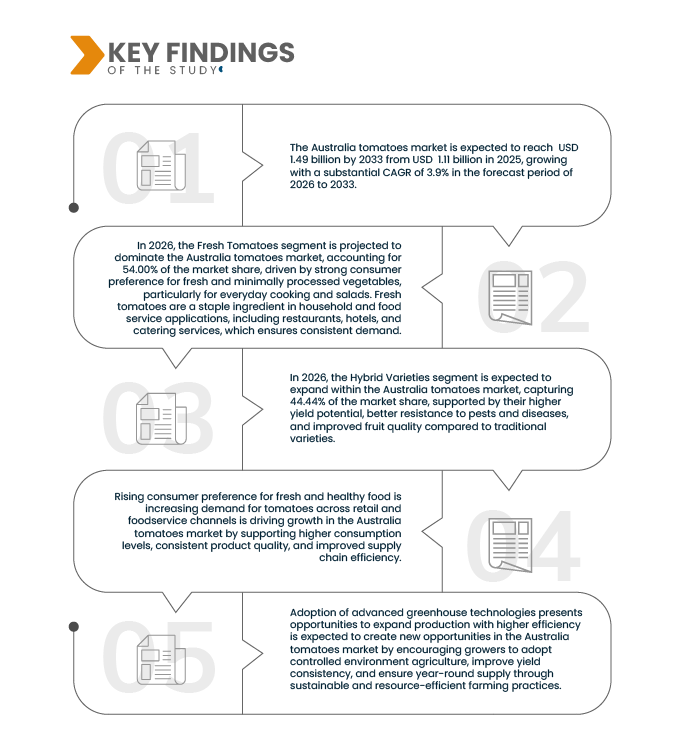
Rising consumer preference for fresh, healthy, and nutrient-rich food is significantly driving demand for tomatoes across Australia’s retail and foodservice sectors. Tomatoes are a staple ingredient in Australian households and are widely used across cuisines, including salads, ready-to-eat meals, sauces, and fast-food offerings. Their high nutritional value, including vitamins, antioxidants, and lycopene content, makes them a preferred choice among health-conscious consumers. This shift toward healthier eating habits, along with increasing awareness of clean-label and fresh produce consumption, is strongly supporting market growth.
Strong demand trends are particularly evident in major urban centers such as Sydney, Melbourne, and Brisbane, where consumers are increasingly purchasing fresh tomatoes through supermarkets, fresh produce stores, and online grocery platforms. The growing popularity of food delivery services and casual dining has also boosted tomato consumption in the foodservice industry, as tomatoes remain a key ingredient in pizzas, burgers, pasta, and other popular menu items. Overall, increasing demand for fresh and healthy food, combined with evolving consumer preferences and advancements in production and supply chain practices, is expected to remain a key growth driver for the Australia tomatoes market.
Access Full Report @ https://www.databridgemarketresearch.com/reports/australia-tomatoes-market
Data Bridge market research analyzes that Australia Tomatoes Market is expected to reach USD 1.49 billion by 2033 from USD 1.10 billion in 2025, growing with a substantial CAGR of 3.9% in the forecast period of 2026 to 2033.
Key Findings of the Study
Expansion of Domestic Supermarket Chains is Strengthening Organized Procurement and Distribution of Fresh Produce
The expansion of domestic supermarket chains is creating strong growth opportunities for the tomatoes market across Australia. Leading retailers such as Woolworths Group, Coles Group, and ALDI are strengthening organized procurement systems by sourcing directly from local growers and establishing long-term supply agreements. This shift is improving supply chain efficiency, ensuring consistent quality, and reducing dependency on fragmented wholesale markets. Supermarkets are also emphasizing standardized grading, attractive packaging, and traceability, which enhances consumer trust and supports premium pricing for high-quality tomato varieties.
At the same time, retailers are expanding their fresh produce offerings to include a wider range of tomato varieties such as cherry, grape, truss, and organic tomatoes, catering to evolving consumer preferences for convenience, freshness, and quality. Private label expansion and in-store branding strategies are further driving sales by offering competitively priced yet high-quality produce. The growing penetration of online grocery platforms and home delivery services is also strengthening distribution networks, making fresh tomatoes more accessible to urban consumers. Collaborations between retailers and Australian farmers are supporting investments in advanced farming techniques such as greenhouse cultivation and hydroponics, ensuring year-round supply and improved yield consistency.
Report Scope and Market Segmentation
|
Report Metric
|
Details
|
|
Forecast Period
|
2026 to 2033
|
|
Base Year
|
2025
|
|
Historic Years
|
2024 (Customizable to 2018-2023)
|
|
Quantitative Units
|
Revenue in USD billion
|
|
Segments Covered
|
By Product Type (Fresh Tomatoes, Processed Tomatoes, and Others), Variety (Hybrid Varieties, Round, Cherry, Vine-Ripened, Grape, Beefsteak (Heirloom), Heritage, Roma (Plum), and Others), End User (Household Consumption, Food Service Industry, Food Processing Industry, Exports, and Others), Form (Whole, Paste, Crushed, Diced, Pureed, Juice, Sun-Dried, Powdered, and Others), Distribution Channel (Retail Sales, Wholesale Distribution, Direct Sales, and Export Channels)
|
|
Countries Covered
|
|
|
Market Players Covered
|
|
|
Data Points Covered in the Report
|
In addition to the insights on market scenarios such as market value, growth rate, segmentation, geographical coverage, and major players, the market reports curated by the Data Bridge Market Research also include in-depth expert analysis, pricing analysis, brand share analysis, consumer survey, demography analysis, supply chain analysis, value chain analysis, raw material/consumables overview, vendor selection criteria, PESTLE Analysis, Porter Analysis, and regulatory framework.
|
Segment Analysis
The market is segmented into five notable segments on the basis of product type, variety, end user, form, and distribution channel.
- On the basis of product type, the Australia tomatoes market is segmented into fresh tomatoes, processed tomatoes, and others.
In 2026, the fresh tomatoes segment is expected to dominate the market
In 2026, the fresh tomatoes segment is expected to dominate the market with share of 54.00%, driven by strong consumer preference for fresh and minimally processed vegetables, particularly for everyday cooking and salads. Fresh tomatoes are a staple ingredient in household and food service applications, including restaurants, hotels, and catering services, which ensures consistent demand.
- On the basis of variety, the Australia Tomatoes Market is segmented into hybrid varieties, round, cherry, vine-ripened, grape, beefsteak (Heirloom), heritage, roma (Plum), and others.
In 2026, the hybrid varieties segment is expected to dominate the market
In 2026, hybrid varieties segment is expected to dominate the market with share of 44.44%, driven by their higher yield potential, better resistance to pests and diseases, and improved fruit quality compared to traditional varieties.
- On the basis of End User, the Australia Tomatoes Market is segmented into household consumption, food service industry, food processing industry, exports, and others.
In 2026, the household consumption segment is expected to dominate the market
In 2026, the household consumption segment is anticipated to dominate the market with share of 40.34% fueled by the widespread use of tomatoes in everyday home cooking across various cuisines. Tomatoes are a staple ingredient used in sauces, curries, soups, and salads, making them a regular purchase in household grocery baskets.
- On the basis of Form, the Australia Tomatoes Market is segmented into whole, paste, crushed, diced, pureed, juice, sun-dried, powdered, and others.
In 2026, the whole segment is expected to dominate the market
In 2026, the whole segment is anticipated to dominate the market with share of 41.25% driven by strong consumer preference for whole tomatoes due to their versatility and freshness. Whole tomatoes are widely used in household cooking as well as in food service applications for preparing sauces, soups, salads, and various culinary dishes.
- On the basis of Distribution Channel, the Australia Tomatoes Market is segmented into retail sales, wholesale distribution, direct sales, and export channels.
In 2026, the retail sales segment is expected to dominate the market
In 2026, the retail sales segment is anticipated to dominate the market with share of 51.05% driven by the widespread availability of tomatoes through supermarkets, hypermarkets, grocery stores, and local markets. Retail channels provide consumers with convenient access to a wide variety of fresh and processed tomato products, supporting consistent household demand.
Major Players
COSTA GROUP HOLDINGS LTD (Australia), FLAVORITE TOMATOES (Australia), Mars, Incorporated and its Affiliates (United States), Perfection Fresh Australia (Australia), Sundrop Farms (Australia), MON Natural Foods (Australia) an among others.

Latest Developments in Australia Tomatoes Market
- In October 2025, Costa Group teamed up with Coles and Opal to try out new recyclable cardboard packaging for its Perino tomatoes instead of traditional plastic. The trial is happening in Coles stores in Victoria and aims to reduce plastic use and support more environmentally friendly packaging. The recyclable cardboard packs are designed to still protect the tomatoes and keep them fresh while helping lower packaging waste. If the trial goes well, this new packaging could be used more widely in the future
- In September 2025, Costa's international berry team achieved a milestone by registering five new blueberry plant varieties in Laos, marking the first official plant variety registrations in the country. This was celebrated in a ceremony at the Lao Ministry of Industry and Commerce, highlighting the work of Costa's researchers and breeders. The registration helps protect these new varieties and encourages ongoing innovation in plant development. It also supports Costa's growing blueberry operations in the region.
- In November 2023, Simplot Australia Pty Ltd completed the acquisition of Agronico, a major seed potato production business in Tasmania. This move strengthens Simplot’s ability to produce early‑generation seed potatoes (minitubers) and gives the company full control over key stages of the potato supply chain in Australia. Agronico has supplied Simplot with seed and storage services for many years, and this acquisition will help ensure a steady supply and expanded expertise in potato seed production.
- In September 2023, Simplot celebrated major recognition at the Healthy Food Guide Magazine Awards, with 11 of its food products winning awards for nutrition and quality. These awards are judged by expert dietitians and highlight products that are both tasty and nutritious on supermarket shelves across Australia and New Zealand.
- In June 2025, Kagome Australia began supplying cold‑pressed tomato seed oil derived from by-products of its tomato processing operations to the cosmetics industry for use in moisturisers, facial scrubs, sunscreen, and other beauty products. The move turns previously unused tomato seed waste into a high‑value cosmetic ingredient, supporting sustainability goals and diversifying the company’s revenue streams. This initiative enhances Kagome’s commercial resilience amid industry challenges by creating new market opportunities in the cosmetic and personal care sectors.
For more detailed information about the Australia Tomatoes Market report, click here – https://www.databridgemarketresearch.com/reports/australia-tomatoes-market










