The global subSea cable market is witnessing robust growth, primarily driven by rising consumer expectations for enhanced comfort, premium aesthetics, and a superior in-cabin experience. The rapid expansion of cloud computing, artificial intelligence (AI), digital platforms, and cross-border digital services has significantly increased the demand for high-capacity international data transmission networks. As global internet traffic continues to rise, hyperscale cloud providers have increasingly invested in submarine cable infrastructure to improve network performance, reduce latency, strengthen resilience, and secure long-term bandwidth availability. Consequently, submarine cable systems have evolved into strategic digital infrastructure supporting global cloud ecosystems and enterprise connectivity. Growing investments by hyperscale companies have also transformed traditional cable ownership models, with private and joint ownership increasingly replacing telecom-led consortium deployments. These investments have accelerated the development of new international cable routes, advanced optical transmission technologies, and geographically diverse network corridors, thereby driving sustained growth across the global subsea cable market.
Access Full Report @ https://www.databridgemarketresearch.com/reports/global-subsea-cable-market
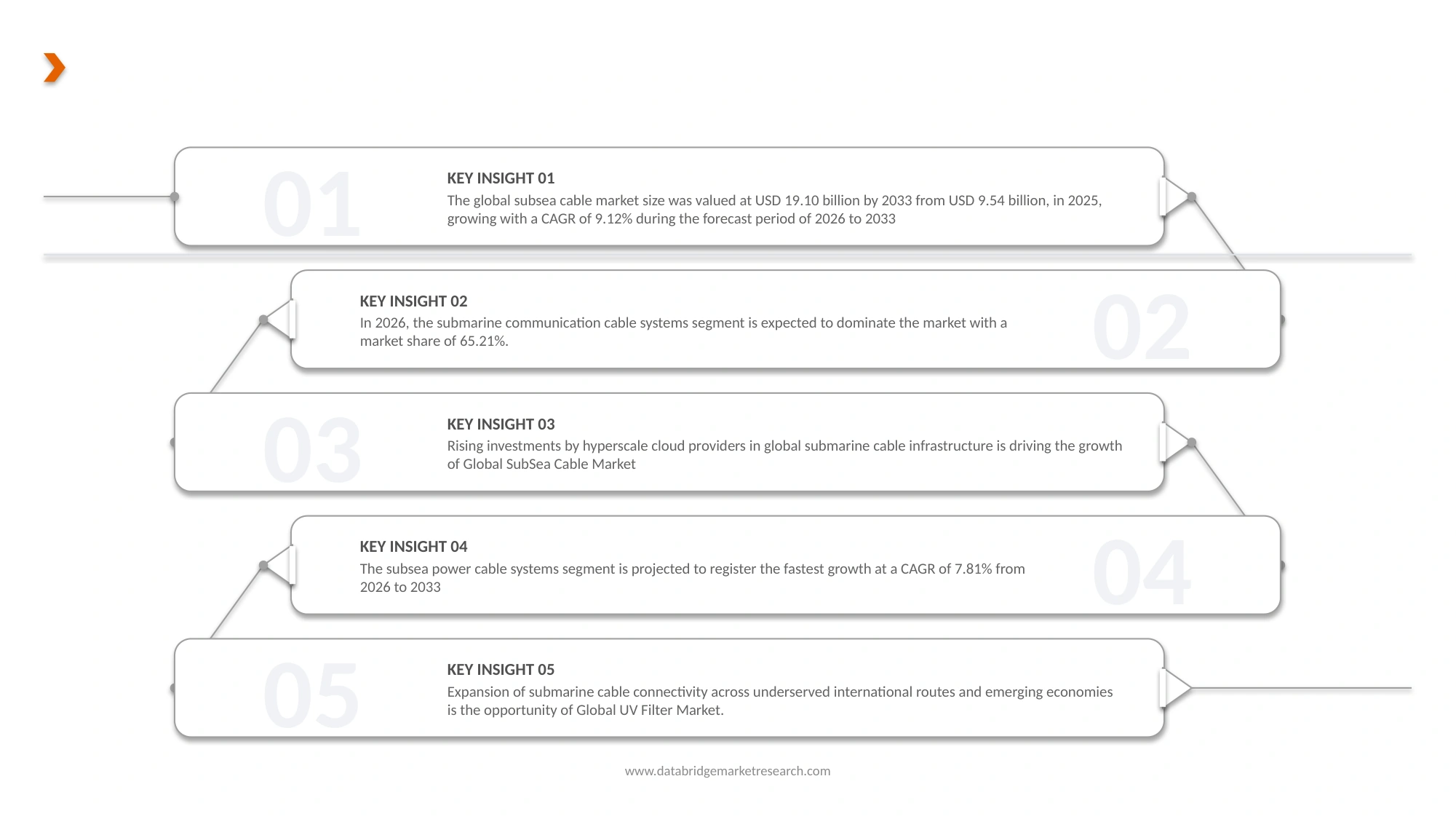
Data Bridge market research analyzes that the Global Subsea Cable Market size was valued at USD 19.10 billion by 2033 from USD 9.54 billion, in 2025, growing with a CAGR of 9.12% during the forecast period of 2026 to 2033.
Key Findings of the Study
Growing International Internet Traffic Requiring High-Capacity and Low-Latency Data Transmission
The continuous growth of international internet traffic is significantly increasing the demand for high-capacity and low-latency global communication infrastructure. Rising adoption of cloud computing, AI, video streaming, digital financial services, and enterprise applications has accelerated cross-border data exchange, making submarine cable systems the primary backbone of international connectivity. As bandwidth requirements continue to expand, investments in new cable routes and network upgrades are being prioritized to improve transmission capacity, reduce latency, and strengthen network resilience. Furthermore, the rapid expansion of hyperscale data centers and digital economies is driving the deployment of advanced submarine cable systems across both established and emerging regions. Telecom operators, cloud providers, and infrastructure companies are increasingly focusing on route diversification and higher-capacity optical technologies to support future internet traffic growth, reinforcing long-term expansion of the global subsea cable market.
Report Scope and Market Segmentation
|
Report Metric
|
Details
|
|
Forecast Period
|
2026 to 2033
|
|
Base Year
|
2025
|
|
Historic Years
|
2018-2024 (Customizable to 2013-2017)
|
|
Quantitative Units
|
Revenue in USD thousands
|
|
Segments Covered
|
By Cable System Type (Submarine Communication Cable Systems, and Subsea Power Cable Systems), Offering (Products and Services), Voltage (Extra High Voltage, HVDC Cable Systems, High Voltage, and Medium Voltage), Insulation Type (XLPE (Cross-Linked Polyethylene), Mass Impregnated (MI), Oil Impregnated Paper (OIP), Ethylene Propylene Rubber (EPR), and Polypropylene Insulation), Conductor Material (Copper and Aluminum), Armor Type (Double Armored, Single Armored, Rock Armored, Lightweight Armored, and Unarmored), Water Depth (Deepwater (1,500–3,000 M), Ultra-Deepwater (>3,000 M), Intermediate Water (500–1,500 M), and Shallow Water (<500 M)), Project Type (Telecommunication Projects, Offshore Wind Projects, Power Interconnector Projects, Offshore Oil & Gas Projects, and Defense & Government Projects), Project Lifecycle Stage (Cable Manufacturing, Installation & Commissioning, Operations & Maintenance, Engineering & Design, Route Survey & Marine Investigation, and Feasibility & FEED, Repair & Replacement), End User (Telecommunication Operators, Offshore Wind Developers, Transmission System Operators (TSOs), Cloud & Data Center Operators, Oil & Gas Operators, Utility Companies, and Government & Defense Organizations)
|
|
Countries Covered
|
U.S., Canada, Mexico, Germany, U.K., France, Italy, Spain, Netherlands, Switzerland, Sweden, Russia, Belgium, Turkey, Norway, Denmark, Finland, Rest of Europe, China, Japan, India, Australia, South Korea, Taiwan, Thailand, Indonesia, Malaysia, Singapore, Philippines, Hong Kong, New Zealand, Rest of Asia-Pacific, Brazil, Argentina, Colombia, Chile, Peru, Ecuador, Uruguay, Venezuela, Bolivia, Paraguay, Rest of South America, Saudi Arabia, South Africa, U.A.E, Israel, Egypt, Kuwait, Qatar, Oman, Bahrain, and Rest of Middle East & Africa
|
|
Market Players Covered
|
|
|
Data Points Covered in the Report
|
In addition to the insights on market scenarios such as market value, growth rate, segmentation, geographical coverage, and major players, the market reports curated by the Data Bridge Market Research also include in-depth expert analysis, geographically represented company-wise production and capacity, network layouts of distributors and partners, detailed and updated price trend analysis and deficit analysis of supply chain and demand.
|
Segment Analysis
The global subsea cable market is segmented on the basis of cable system type, offering, voltage, insulation type, conductor material, armor type, water depth, project type, project lifecycle stage, end user, and country.
- On the basis of cable system type, the market into submarine communication cable systems, and subsea power cable systems.
In 2026, the Submarine Communication Cable Systems segment is expected to dominate the market
In 2026, the submarine communication cable systems segment is expected to dominate the market with a market share of 65.21%, owing to region's extensive cross-border digital connectivity requirements, growing hyperscale data center investments, rising international internet traffic, and continuous deployment of high-capacity fiber-optic cable networks. Increasing cloud computing adoption, 5G backhaul expansion, and demand for low-latency communication between North America and other continents further strengthen investments in transnational submarine communication infrastructure across major coastal hubs.
- On the basis of Offering, market is segmented into Products, Services.
In 2026, the Products segment is expected to dominate the market
In 2026, the products segment is expected to dominate the market with a market share of 75.10%, because subsea cable projects require high-value cable systems, repeaters, joints, connectors, terminations, and associated hardware that account for the largest share of project expenditures. Increasing investments in communication and power transmission infrastructure, combined with technological advancements in cable materials and manufacturing, continue to drive substantial procurement of subsea cable products across North America's expanding offshore energy and digital connectivity sectors.
- On the basis of Voltage, the market is segmented into Extra High Voltage, HVDC Cable Systems, High Voltage, Medium Voltage.
In 2026, the Extra High Voltage segment is expected to dominate the market
In 2026, the extra high voltage segment is expected to dominate the market with a market share of 33.61%, because large-scale offshore wind farms and cross-border transmission projects require efficient long-distance electricity transfer with minimal transmission losses. Increasing deployment of high-capacity subsea transmission infrastructure, expanding renewable energy generation, and modernization of North America's interconnected power grid are driving demand for extra high voltage cable systems capable of delivering reliable and efficient bulk power transmission.
- On the basis of Insulation Type, the market is segmented into XLPE (Cross-Linked Polyethylene), Mass Impregnated (MI), Oil Impregnated Paper (OIP), Ethylene Propylene Rubber (EPR), Polypropylene Insulation.
In 2026, the XLPE (Cross-Linked Polyethylene) segment is expected to dominate the market
In 2026, the XLPE (cross-linked polyethylene) segment is expected to dominate the market with a market share of 47.64%, owing to its superior electrical performance, excellent thermal stability, low dielectric losses, and high mechanical strength. Its longer operational lifespan, ease of installation, environmental compatibility, and suitability for high-voltage offshore transmission applications have made XLPE the preferred insulation material for modern subsea communication and power cable projects across North Americaan offshore infrastructure developments.
- On the basis of Conductor Material, the market is segmented into Copper, Aluminum.
In 2026, the Copper segment is anticipated to dominate the market
In 2026, the copper segment is expected to dominate the market with a market share of 61.86%, due to its excellent electrical conductivity, high tensile strength, superior corrosion resistance, and proven reliability in demanding subsea environments. Copper conductors efficiently support high-capacity communication and power transmission while ensuring long operational life. Widespread adoption in offshore wind farms, telecommunications networks, and cross-border interconnection projects continues to reinforce its leading market position.
- On the basis of Armor Type, the market is segmented into Double Armored, Single Armored, Rock Armored, Lightweight Armored, Unarmored.
In 2026, the Double Armored segment is anticipated to dominate the market
In 2026, the double armored segment is expected to dominate the market with a market share of 31.88%, due to its superior mechanical protection against fishing activities, anchoring, seabed abrasion, and harsh marine conditions. These cables are widely deployed in shallow and high-risk offshore environments where durability is critical. Increasing investments in offshore wind farms, communication links, and power interconnectors requiring enhanced cable protection continue supporting the segment's leading market share.
- On the basis of Water Depth, the market is segmented into Deepwater (1,500–3,000 M), Ultra-Deepwater (>3,000 M), Intermediate Water (500–1,500 M), Shallow Water (<500 M).
In 2026, the Deepwater (1,500–3,000 M) segment is anticipated to dominate the market
In 2026, the deepwater (1,500–3,000 M) segment is expected to dominate the market with a market share of 34.23%, supported by the expanding transcontinental communication cable deployments, offshore energy developments, and interconnector projects traversing deep marine environments. Advances in cable laying technologies, improved installation vessels, and increasing investment in resilient offshore infrastructure enable efficient deployment at greater depths. Growing international data transmission requirements further reinforce demand for deepwater subsea cable installations across North America.
- On the basis of Project Type, the market is segmented into Telecommunication Projects, Offshore Wind Projects, Power Interconnector Projects, Offshore Oil & Gas Projects, Defense & Government Projects.
In 2026, the Telecommunication Projects segment is anticipated to dominate the market
In 2026, the telecommunication projects segment is expected to dominate the market with a market share of 41.48%, driven by surging internet traffic, expansion of cloud services, increasing hyperscale data center connectivity, and continuous deployment of international fiber-optic networks. Rising bandwidth requirements, digital transformation initiatives, and growing dependence on secure, low-latency communication infrastructure encourage substantial investments in new submarine cable projects linking North America with major global markets and regional economies.
- On the basis of Project Lifecycle Stage, the market is segmented into Cable Manufacturing, Installation & Commissioning, Operations & Maintenance, Engineering & Design, Route Survey & Marine Investigation, Feasibility & FEED, Repair & Replacement.
In 2026, the Cable Manufacturing segment is anticipated to dominate the market
In 2026, the cable manufacturing segment is expected to dominate the market with a market share of 25.03%, due to production of high-performance subsea cables represents one of the largest cost components within offshore infrastructure projects. Growing investments in communication and power cable deployment, increasing demand for technologically advanced cable designs, and expanding manufacturing capacities across North America continue supporting significant revenue generation from cable production activities throughout the regional subsea cable value chain.
- On the basis of End User, the market is segmented into Telecommunication Operators, Offshore Wind Developers, Transmission System Operators (TSOs), Cloud & Data Center Operators, Oil & Gas Operators, Utility Companies, Government & Defense Organizations.
In 2026, the Telecommunication Operators segment is anticipated to dominate the market
In 2026, the telecommunication operators segment is expected to dominate the market with a market share of 34.82%, supported by continuous investments in international fiber-optic connectivity, growing mobile and broadband traffic, expansion of cloud computing services, and increasing deployment of high-capacity submarine communication networks. Rising digitalization, demand for secure global communications, and growing data consumption across businesses and consumers continue driving significant subsea cable investments by telecommunications providers throughout North America.
Major Players
Prysmian Group (Italy), Nexans S.A. (U.S.), NKT A/S (Denmark), Sumitomo Electric Industries, Ltd. (Japan), LS Cable & System Ltd. (South Korea)
Market Developments
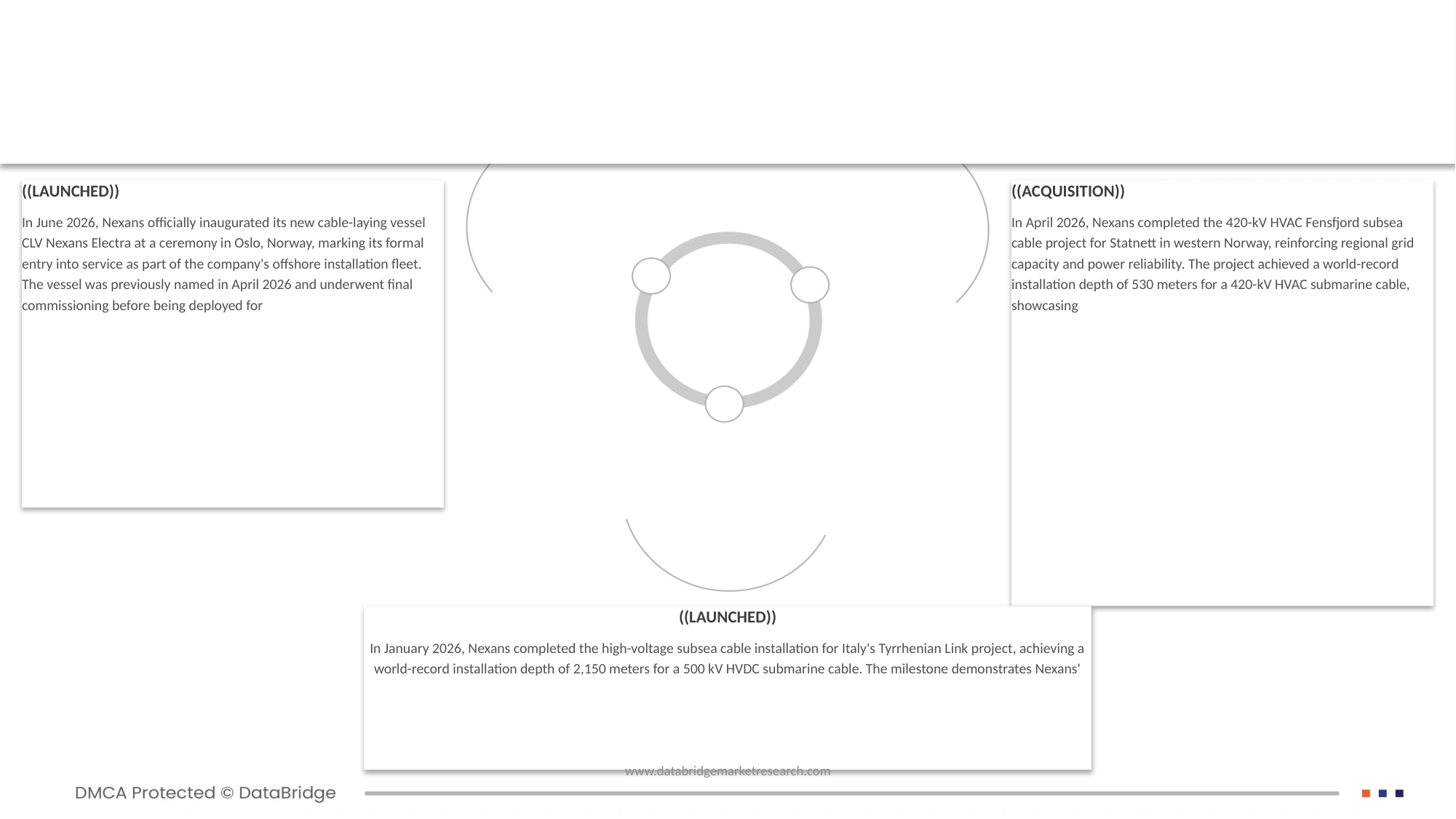
- In June 2026, Nexans officially inaugurated its new cable-laying vessel CLV Nexans Electra at a ceremony in Oslo, Norway, marking its formal entry into service as part of the company’s offshore installation fleet. The vessel was previously named in April 2026 and underwent final commissioning before being deployed for upcoming offshore wind and interconnector projects. The Electra is a next-generation cable-laying vessel designed to support high-voltage subsea cable installation. Strengthens Nexans’ offshore installation capabilities.
- In January 2026, Nexans completed the high-voltage subsea cable installation for Italy's Tyrrhenian Link project, achieving a world-record installation depth of 2,150 meters for a 500 kV HVDC submarine cable. The milestone demonstrates Nexans' advanced engineering, manufacturing, and offshore installation capabilities while strengthening Italy's electricity transmission network with a 1,000 MW interconnection.
- In April 2026, Nexans completed the 420-kV HVAC Fensfjord subsea cable project for Statnett in western Norway, reinforcing regional grid capacity and power reliability. The project achieved a world-record installation depth of 530 meters for a 420-kV HVAC submarine cable, showcasing Nexans' advanced engineering, deepwater installation expertise, and capability to deliver complex high-voltage transmission infrastructure.
- In July 2025, SubCom and Telecom Egypt announced the successful completion of the SEA-ME-WE-6 subsea cable system's two landings in Egypt at Port Said and Ras Ghareb, along with the trans-Egypt terrestrial crossing routes. The 21,700-km cable system, linking Singapore to U.S. through 17 landing points, reached a key construction milestone that advances connectivity between Africa, Asia, and North America and moves the project closer to commercial operation. This will help the company by strengthening SubCom's execution track record in global subsea cable projects, enhancing its reputation, and creating opportunities for future international network infrastructure contracts.
- In March 2025, Liberty Networks, Gold Data, and Sparkle announced that SubCom was awarded the design, manufacturing, and installation contract for the MANTA subsea cable system, with the contract entering into force. The approximately 5,400 km system will connect the United States, Mexico, Central America, and Latin America through high-capacity, low-latency routes linking key data hubs including Mexico City, Querétaro, Bogotá, and Panama City. This will help the company by expanding SubCom’s global subsea cable project portfolio, strengthening its position as a leading connectivity infrastructure provider, and creating new opportunities in the growing international data transmission market.
As per Data Bridge Market Research analysis:
For more detailed information about the Global subsea cable market report, click here – https://www.databridgemarketresearch.com/reports/global-subsea-cable-market