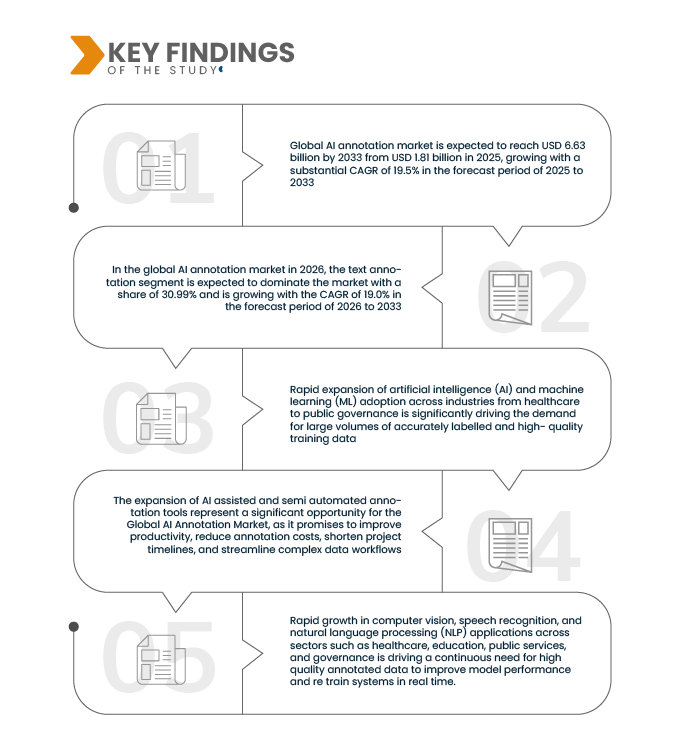
Rapid expansion of artificial intelligence (AI) and machine learning (ML) adoption across industries from healthcare to public governance is significantly driving the demand for large volumes of accurately labelled and high quality training data. As these technologies become integral to decision making systems, predictive analytics, personalised services, and automation workflows, organisations and governments alike are investing heavily in data infrastructure, open datasets initiatives, and capacity building programmes. This trend necessitates extensive annotation efforts and curated data repositories to train sophisticated AI models that can understand complex patterns in text, images, videos, and sensor data. Initiatives from government bodies highlight a strategic shift toward data centric AI ecosystems where labelled training data serves as a foundational input for machine learning scalability and responsible AI deployment, fuelling growth in the global AI Annotation Market.
Few examples are In January 2026, Reuters reported that the U.K. government announced a Meta backed AI team to develop open source AI tools for public services, emphasising machine learning and data processing capabilities to manage complex infrastructure systems. In February 2026, Press Information Bureau described initiatives such as Centres of Excellence and AI Competency Frameworks for government officials to build skills and infrastructure around AI adoption and data driven governance. The above developments across major economies demonstrate a sustained global shift toward building and leveraging vast, publicly accessible, and high quality datasets to support artificial intelligence and machine learning initiatives. Governments are explicitly investing in structured data platforms, interoperability frameworks, and large scale data repositories to facilitate machine learning training, foster innovation, and enable cross sectoral AI deployment. This collective emphasis on data accessibility, integration, and annotation underpins the escalating demand for accurately labelled training data, thereby reinforcing strong growth momentum for the global AI Annotation Market.
Access Full Report @ https://www.databridgemarketresearch.com/reports/global-ai-annotation-market
Data Bridge market research analyzes that Global AI Annotation Market is expected to reach USD 6.63 billion by 2033 from USD 1.80 billion in 2025, growing with a substantial CAGR of 19.5% in the forecast period of 2025 to 2033.
Key Findings of the Study
Expansion of AI-Assisted and Semi-Automated Annotation Tools to Improve Productivity, Reduce Costs, and Shorten Project Timelines
The expansion of AI assisted and semi-automated annotation tools represent a significant opportunity for the Global AI Annotation Market, as it promises to improve productivity, reduce annotation costs, shorten project timelines, and streamline complex data workflows. Traditional manual annotation is labour intensive and time consuming, especially at scale; however, emerging technologies that integrate machine learning, active learning, and AI driven pre annotation can automatically suggest labels, flag uncertain cases for human review, and drastically decrease repetitive human effort while maintaining quality and consistency. Governments and official bodies around the world are driving digital transformation agendas that include the adoption of AI tools in administrative, analytical, and data intensive tasks a trend that will encourage broader uptake of AI supported annotation solutions across public and private sectors. As public administrations and national programs deploy intelligent automation capabilities to handle large volumes of unstructured data and streamline decision making, the need for tools that accelerate and augment annotation workflows will become increasingly critical in supporting AI model training and deployment efficiently.
Few examples are, In June 2025, Financial Times reported that a UK government study found civil servants using AI tools saved an average of 26 minutes per day in administrative tasks such as drafting documents and summarising information, demonstrating how assisted tools can boost productivity within public sector workflows., In February 2026, TechObserver.in reported that the Indian government has rolled out a range of AI tools, digital IDs, and satellite data platforms to improve productivity and data driven decision making in agriculture and governance, showcasing official adoption of AI powered systems to handle large datasets. The above examples from government initiatives and official publications demonstrate a clear and growing move toward the use of AI assisted and semi-automated tools to improve productivity, reduce manual effort, and accelerate data processing workflows. As public administrations and national programs embrace intelligent automation for handling large and complex datasets, this will support broader adoption of AI supported annotation technologies, creating strong market opportunities for solutions that enhance efficiency and scalability in data annotation.
Report Scope and Market Segmentation
|
Report Metric
|
Details
|
|
Forecast Period
|
2026 to 2033
|
|
Base Year
|
2025
|
|
Historic Years
|
2024 (Customizable to 2018-2023)
|
|
Quantitative Units
|
Revenue in USD billion
|
|
Segments Covered
|
By Data Type (Text Annotation, Image Annotation, Video Annotation, Audio Annotation, Sensor & 3d Data Annotation, Document Annotation), By Deployment Mode (Cloud-based Annotation Platforms, On-premises Annotation Tools, Hybrid Deployment, Mobile Annotation Interfaces), By Offering (Annotation Tools & Software, Managed Annotation Services), By End User Industry IT & Telecom, Automotive & Transportation, Healthcare & Life Sciences, Retail & Ecommerce, Financial Services, Media & Entertainment, Manufacturing & Industrial IoT, Agriculture & Remote Sensing, Government & Defense, Education & Research), By Annotation Complexity (Basic Annotation, Intermediate Annotation, Advanced Annotation), By Annotation Approach (Manual Annotation, Semi-automated Annotation, Fully Automated Annotation), By Customer Type (Large Enterprises, Medium Enterprises, Small & Startup Organizations)
|
|
Countries Covered
|
|
|
Market Players Covered
|
|
|
Data Points Covered in the Report
|
In addition to the market insights such as market value, growth rate, market segments, geographical coverage, market players, and market scenario, the market report curated by the Data Bridge Market Research team includes in-depth expert analysis, import/export analysis, pricing analysis, production consumption analysis, and pestle analysis.
|
Segment Analysis
The Global AI Annotation Market is segmented into seven notable segments which are based on data type, deployment mode, offering, end user industry, annotation complexity, annotation approach, and customer type.
- On the basis of data type, global AI Annotation market is segmented into Text Annotation, Image Annotation, Video Annotation, Audio Annotation, Sensor & 3d Data Annotation, Document Annotation.
In 2026, the Text Annotation segment is expected to dominate the market
In 2026, the Text Annotation segment is expected to dominate the Global AI Annotation market share of 30.99% due to rapid expansion of natural language processing (NLP), large language models (LLMs), and generative AI applications. Strong demand for labelled text data across chatbots, virtual assistants, content moderation, and enterprise knowledge systems continues to reinforce segment leadership.
- On the basis of Deployment Mode, the global AI Annotation market is segmented into Cloud-based Annotation Platforms, On-premises Annotation Tools, Hybrid Deployment, and Mobile Annotation Interfaces.
In 2026, the Cloud-Based Annotation Platforms segment is expected to dominate the market
In 2026, Cloud-Based Annotation Platforms segment is expected to dominate the Global AI Annotation market share of 61.00% due to enterprise preference for scalable, collaborative, and cost-efficient annotation environments. Widespread adoption of cloud-native AI pipelines, distributed workforces, and real-time dataset management continues to support strong growth.
- On the basis of Offering, the global AI Annotation market is segmented into Annotation Tools & Software, and Managed Annotation Services.
In 2026, the Managed Annotation Services segment is expected to dominate the market
In 2026, the Managed Annotation Services segment is anticipated to dominate the Global AI Annotation market share of 58.68% due to rising enterprise reliance on outsourced, end-to-end data labeling to ensure quality, scalability, and faster AI model deployment.
- On the basis of End User Industry, the global AI Annotation market is segmented into IT & Telecom, Automotive & Transportation, Healthcare & Life Sciences, Retail & Ecommerce, Financial Services, Media & Entertainment, Manufacturing & Industrial IoT, Agriculture & Remote Sensing, Government & Defense, and Education & Research.
In 2026, the IT & Telecom segment is expected to dominate the market
In 2026, the IT & Telecom segment is anticipated to dominate the Global AI Annotation market share of 30.15% due to large-scale AI adoption in network optimization, conversational AI, fraud detection, and digital platform operations.
- On the basis of Annotation Complexity, the global AI Annotation market is segmented into Basic Annotation, Intermediate Annotation, and Advanced Annotation.
In 2026, the Basic Annotation segment is expected to dominate the market
In 2026, the Basic Annotation segment is anticipated to dominate the Global AI Annotation market share of 50.46% due to high-volume demand for foundational labeling tasks such as image tagging, bounding boxes, and text classification.
- On the basis of Annotation Approach, the global AI Annotation market is segmented into Manual Annotation, Semi-automated Annotation, and Fully Automated Annotation.
In 2026, the Manual segment is expected to dominate the market
In 2026, the Manual segment is anticipated to dominate the Global AI Annotation market share of 53.60% due to the continued need for human judgment, domain expertise, and high-accuracy ground truth generation for complex AI use cases.
- On the basis of Customer Type, the global AI Annotation market is segmented into Large Enterprises, Medium Enterprises, and Small & Startup Organizations.
In 2026, the Large Enterprises segment is expected to dominate the market
In 2026, the Large Enterprises segment is anticipated to dominate the Global AI Annotation market share of 60.92% due to substantial AI budgets, large-scale data requirements, and mature MLOps infrastructures enabling enterprise-wide AI deployment.
Major Players
Scale AI, Inc.(U.S.), CloudFactory Limited (Nepal), iMerit (U.S.), Samasource Impact Sourcing, Inc. (U.S.), Appen Limited (Australia) among others.
Latest Developments in Global AI Annotation Market
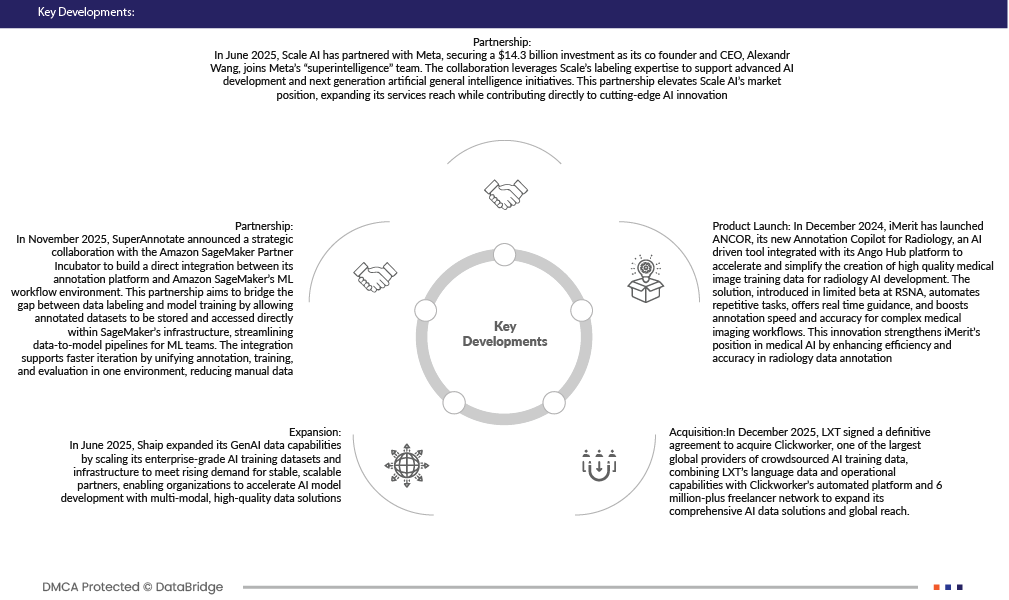
- In June 2025, Scale AI has partnered with Meta, securing a $14.3 billion investment as its co-founder and CEO, Alexandr Wang, joins Meta’s “superintelligence” team. The collaboration leverages Scale’s labeling expertise to support advanced AI development and next generation artificial general intelligence initiatives. This partnership elevates Scale AI’s market position, expanding its services reach while contributing directly to cutting-edge AI innovation.
- In December 2024, iMerit has launched ANCOR, its new Annotation Copilot for Radiology, an AI driven tool integrated with its Ango Hub platform to accelerate and simplify the creation of high quality medical image training data for radiology AI development. The solution, introduced in limited beta at RSNA, automates repetitive tasks, offers real time guidance, and boosts annotation speed and accuracy for complex medical imaging workflows. This innovation strengthens iMerit’s position in medical AI by enhancing efficiency and accuracy in radiology data annotation.
- In February 2023, Appen has launched three new products to help enterprises build trustworthy generative AI applications, including tools for reinforcement learning with human feedback, document intelligence, and automated NLP labeling to support data quality and annotation at scale. These solutions are designed to address bias, improve insight extraction from unstructured documents, and speed up language data annotation. This product expansion enhances Appen’s competitive edge by empowering clients to develop more accurate, ethical, and scalable generative AI systems.
- In July 2025, Anolytics announced the expansion of its enterprise-focused data classification solutions, strengthening its capabilities across the annotation workflows. The initiative emphasizes scalable, compliance-ready data labeling infrastructure designed to support large-scale AI model development and deployment. This expansion enhances the company’s positioning in the AI training data market by reinforcing its core annotation offerings and enabling broader adoption across enterprise clients.
- In October 2025, Clarifai has entered a strategic partnership with Crimson Phoenix to enhance advanced AI/ML and unstructured data labeling capabilities for defense and intelligence communities, aiming to accelerate mission critical analytics and AI readiness. The collaboration will leverage Clarifai’s full stack AI platform and Crimson Phoenix’s data expertise to improve labeling of complex imagery and sensor data to support critical operations. This alliance strengthens Clarifai’s position in defense AI applications and expands its government and enterprise opportunities.
For more detailed information about the Global AI Annotation Market report, click here – https://www.databridgemarketresearch.com/reports/global-ai-annotation-market