
Der globale Markt für Buttersäure für Tierfutter verzeichnet im Prognosezeitraum ein deutliches Wachstum. Buttersäure für Tierfutter wird aufgrund der erhöhten Proteinfreisetzung als Natriumbutyrat-Injektion bei Kälbern eingesetzt. Diese Säuren und die Zugabe von Butyratglyceriden erhöhen das Körpergewicht von Masthähnchen. Die neu entwickelte Buttersäure der dritten Generation in Form von Glyceriden gewinnt aufgrund der steigenden Nachfrage nach Buttersäure für Tierfutter auf dem globalen Markt für Buttersäure für Tierfutter zunehmend an Bedeutung.
Vollständigen Bericht abrufen unter https://www.databridgemarketresearch.com/reports/global-butyric-acid-for-animal-feed-market
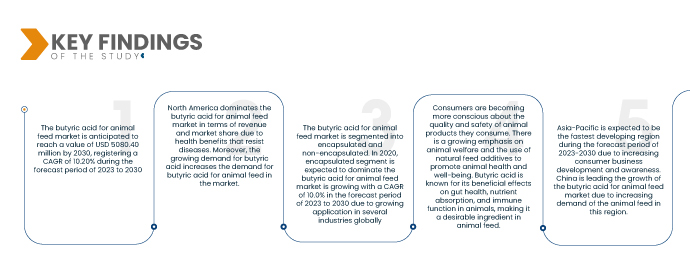
Data Bridge Market Research analysiert, dass der Markt für Buttersäure für Tierfutter im Jahr 2022 einen Wert von 2.335,85 Millionen USD hatte und bis 2030 voraussichtlich 5.080,40 Millionen USD erreichen wird, was einer durchschnittlichen jährlichen Wachstumsrate (CAGR) von 10,20 % im Prognosezeitraum von 2023 bis 2030 entspricht. Die Weltbevölkerung wächst und damit auch die Nachfrage nach tierischem Eiweiß wie Fleisch, Milch und Eiern. Dies führt zu einem Anstieg der Viehproduktion, was wiederum die Nachfrage nach Futtermittelzusätzen wie Buttersäure zur Verbesserung der Tiergesundheit und -produktivität ankurbelt.
Wichtigste Ergebnisse der Studie
Forschungs- und Entwicklungsaktivitäten dürften das Marktwachstum ankurbeln
Forschungs- und Entwicklungsaktivitäten im Bereich Tierernährung und -gesundheit haben zu einem besseren Verständnis der Vorteile von Buttersäure in Tierfutter geführt. Laufende Studien und Versuche belegen weiterhin die positiven Auswirkungen von Buttersäure auf Darmgesundheit, Immunität und Leistungsfähigkeit verschiedener Tierarten. Diese wachsende Zahl wissenschaftlicher Erkenntnisse unterstützt die Verwendung von Buttersäure in Tierfutterformulierungen und treibt das Marktwachstum voran.
Berichtsumfang und Marktsegmentierung
Berichtsmetrik
|
Details
|
Prognosezeitraum
|
2023 bis 2030
|
Basisjahr
|
2022
|
Historische Jahre
|
2021 (Anpassbar auf 2015–2020)
|
Quantitative Einheiten
|
Umsatz in Millionen USD, Mengen in Einheiten, Preise in USD
|
Abgedeckte Segmente
|
Produkttyp (Natriumbutyrat, Calciumbutyrat, Magnesiumbutyrat und Kaliumbutyrat), Tier (Wiederkäuer, Schweine, Geflügel, Aquakultur, Haustiere, Pferde, Vögel und andere), Typ (verkapselt und nicht verkapselt), Quelle (synthetisch und natürlich), Lebenszyklus (Zuchtfutter, Mastfutter, Starterfutter, Brutfutter und andere
|
Abgedeckte Länder
|
USA, Kanada, Mexiko in Nordamerika, Deutschland, Schweden, Polen, Dänemark, Italien, Großbritannien, Frankreich, Spanien, Niederlande, Belgien, Schweiz, Türkei, Russland, Restliches Europa in Europa, Japan, China, Indien, Südkorea, Neuseeland, Vietnam, Australien, Singapur, Malaysia, Thailand, Indonesien, Philippinen, Restlicher Asien-Pazifik-Raum (APAC) in Asien-Pazifik (APAC), Brasilien, Argentinien, Restliches Südamerika als Teil von Südamerika, VAE, Saudi-Arabien, Oman, Katar, Kuwait, Südafrika, Restlicher Naher Osten und Afrika (MEA) als Teil von Naher Osten und Afrika (MEA)
|
Abgedeckte Marktteilnehmer
|
Eastman Chemical Company (USA), Thermo Fisher Scientific (USA), DSM (Niederlande), Merck KGaA (Deutschland), DAYANG CHEM (HANGZHOU) CO., LTD. (China), Great Plains Processing (USA), Perstorp (Schweden), Hefei TNJ Chemical Industry Co., Ltd. (China), Kemin Industries, Inc. (USA), Weifang Qiyi Chemical Co., Ltd. (China), OQ Chemicals GmbH (Deutschland), Finoric LLC (USA), Palital Feed Additives BV (Niederlande), Trouw Nutrition (Indien), Bioscreen technologies srl (Italien), Yufeng International Co., Ltd. (China)
|
Im Bericht behandelte Datenpunkte
|
Zusätzlich zu den Einblicken in Marktszenarien wie Marktwert, Wachstumsrate, Segmentierung, geografische Abdeckung und wichtige Akteure enthalten die von Data Bridge Market Research kuratierten Marktberichte auch ausführliche Expertenanalysen, geografisch dargestellte Produktion und Kapazität nach Unternehmen, Netzwerklayouts von Distributoren und Partnern, detaillierte und aktuelle Preistrendanalysen und Defizitanalysen der Lieferkette und Nachfrage.
|
Segmentanalyse:
Der globale Markt für Buttersäure für Tierfutter ist in fünf wichtige Segmente unterteilt, die auf Produkttyp, Tier, Art, Quelle und Lebenszyklus basieren.
- Der Markt ist nach Produkttyp in Calciumbutyrat, Natriumbutyrat, Kaliumbutyrat und Magnesiumbutyrat segmentiert. Es wird erwartet, dass das Calciumbutyrat-Segment den Markt für Buttersäure für Tierfutter mit einer durchschnittlichen jährlichen Wachstumsrate (CAGR) von 10,3 % im Prognosezeitraum 2023–2030 dominieren wird.
Im Jahr 2023 wird erwartet, dass das Segment Calciumbutyrat des Produkttypsegments den Markt für Buttersäure für Tierfutter dominieren wird
Im Jahr 2023 wird das Calciumbutyrat-Segment den Markt für Buttersäure für Tierfutter dominieren, da seine darmstärkenden Eigenschaften seine Anwendungsmöglichkeiten erweitert haben. Es wird erwartet, dass das Calciumbutyrat-Segment im Prognosezeitraum 2023–2030 die höchste jährliche Wachstumsrate (CAGR) von 10,3 % erreichen wird.
- Der Markt für Buttersäure für Tierfutter ist nach Tierarten segmentiert: Wiederkäuer, Schweine, Geflügel, Aquakultur, Haustiere, Pferde, Vögel und weitere. Aufgrund der Enzymsekretion wird das Geflügelsegment voraussichtlich den Markt für Buttersäure für Tierfutter mit einer durchschnittlichen jährlichen Wachstumsrate (CAGR) von 10,3 % im Prognosezeitraum 2023 bis 2030 dominieren. Zudem sind die Energiequellen im Vergleich zu anderen Geflügelfutterprodukten günstiger.
- Der Markt für Buttersäure für Tierfutter wird nach Typ in gekapselte und unverkapselte Produkte unterteilt. Es wird erwartet, dass das Segment der gekapselten Produkte im Jahr 2023 den Markt für Buttersäure für Tierfutter mit einer durchschnittlichen jährlichen Wachstumsrate (CAGR) von 10,0 % im Prognosezeitraum von 2023 bis 2023 dominieren wird.
Im Jahr 2023 wird erwartet, dass das gekapselte Segment des Typsegments das Typsegment der Buttersäure für den Tierfuttermarkt dominieren wird
Im Jahr 2023 wird das verkapselte Segment dieses Marktes den Markt für Buttersäure für Tierfutter dominieren, da es in verschiedenen Branchen weltweit zunehmend Anwendung findet. Es wird erwartet, dass das verkapselte Segment im Prognosezeitraum 2023–2030 die höchste jährliche Wachstumsrate (CAGR) von 10,0 % erreichen wird.
- Der Markt für Buttersäure für Tierfutter wird nach Herkunft in natürliche und synthetische Produkte unterteilt. Das natürliche Segment wird voraussichtlich den Markt für Buttersäure für Tierfutter dominieren und wächst im Prognosezeitraum von 2023 bis 2030 mit einer durchschnittlichen jährlichen Wachstumsrate (CAGR) von 10,0 %. Dies ist auf die einfachen Verarbeitungsverfahren zurückzuführen, die die Nachfrage nach Buttersäure für Tierfutter steigern, und auf die zunehmende Verwendung bei der Herstellung von Butyratestern.
- Der Markt für Buttersäure für Tierfutter wird anhand des Lebenszyklus in Mastfutter, Mastfutter, Starterfutter, Brutfutter und weitere Produkte unterteilt. Das Mastfuttersegment wird voraussichtlich den Markt für Buttersäure für Tierfutter dominieren und wächst im Prognosezeitraum von 2023 bis 2030 mit einer durchschnittlichen jährlichen Wachstumsrate (CAGR) von 10,3 % aufgrund des steigenden Verbrauchs bei Tieren ab einem bestimmten Alter. Darüber hinaus gibt es im Vergleich zu anderen Futtermitteln günstigere Futtermittel.
Hauptakteure
Data Bridge Market Research erkennt die folgenden Unternehmen als die wichtigsten Akteure auf dem Markt für Buttersäure für Tierfutter an: Eastman Chemical Company (USA), Thermo Fisher Scientific (USA), DSM (Niederlande), Merck KGaA (Deutschland), DAYANG CHEM (HANGZHOU) CO., LTD. (China), Great Plains Processing (USA), Perstorp (Schweden), Hefei TNJ Chemical Industry Co., Ltd. (China), Kemin Industries, Inc. (USA), Weifang Qiyi Chemical Co., Ltd. (China), OQ Chemicals GmbH (Deutschland), Finoric LLC (USA), Palital Feed Additives BV (Niederlande), Trouw Nutrition (Indien), Bioscreen technologies srl (Italien) und Yufeng International Co., Ltd. (China).
Marktentwicklung
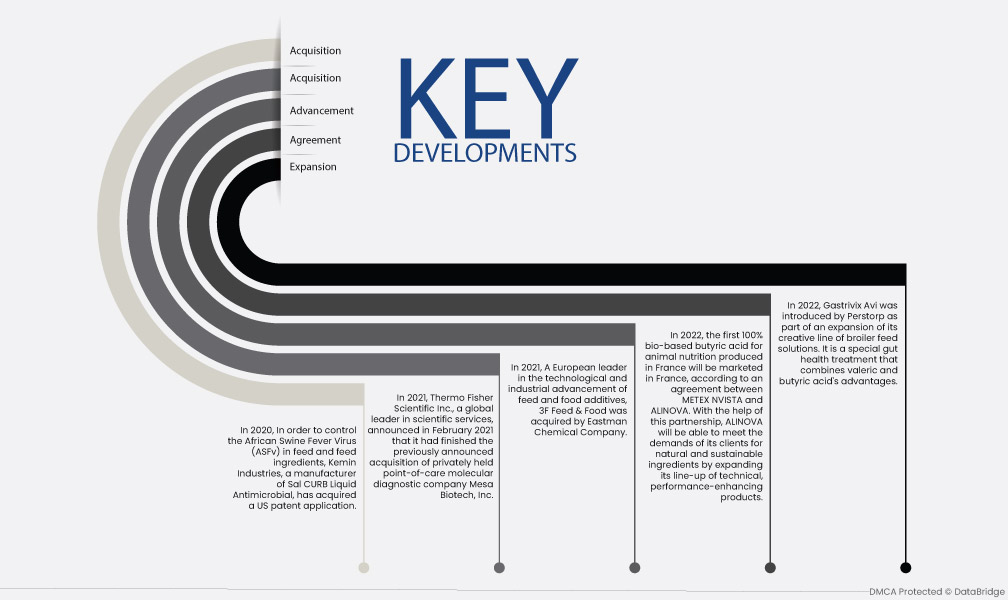
- Im Jahr 2022 führte Perstorp Gastrivix Avi als Teil einer Erweiterung seiner kreativen Produktlinie für Broilerfutterlösungen ein. Es handelt sich um eine spezielle Behandlung für die Darmgesundheit, die die Vorteile von Baldrian- und Buttersäure kombiniert.
- Im Jahr 2022 wird gemäß einer Vereinbarung zwischen METEX NVISTA und ALINOVA die erste in Frankreich produzierte, 100 % biobasierte Buttersäure für Tierfutter auf den Markt kommen. Dank dieser Partnerschaft kann ALINOVA die Nachfrage seiner Kunden nach natürlichen und nachhaltigen Inhaltsstoffen erfüllen und sein Angebot an technischen, leistungssteigernden Produkten erweitern.
- Im Jahr 2021 wurde 3F Feed & Food, ein europäischer Marktführer im Bereich der technologischen und industriellen Weiterentwicklung von Futter- und Lebensmittelzusatzstoffen, von der Eastman Chemical Company übernommen.
- Im Jahr 2021 gab Thermo Fisher Scientific Inc., ein weltweit führendes Unternehmen im Bereich wissenschaftlicher Dienstleistungen, im Februar 2021 bekannt, dass es die zuvor angekündigte Übernahme des in Privatbesitz befindlichen Point-of-Care-Molekulardiagnostikunternehmens Mesa Biotech, Inc. abgeschlossen habe.
- Im Oktober 2020 wird die Erber Group für 980 Millionen Euro vollständig von Royal DSM übernommen. Royal DSM ist ein internationales, wissenschaftsorientiertes Unternehmen mit Schwerpunkt auf Ernährung, Gesundheit und nachhaltigem Leben. DSM hat Biomin und Romer Labs von der Erber Group übernommen. Romer Labs bietet Lösungen für die Prüfung der Lebensmittel- und Futtermittelsicherheit an, während Biomin, ein Spezialunternehmen der Erber Group für Tierernährung und -gesundheit, sich auf Mykotoxin-Risikomanagement und Leistungsmanagement für die Darmgesundheit konzentriert. Beide Unternehmen erweitern das Portfolio von DSM um höherwertige Speziallösungen.
- Um das Afrikanische Schweinepestvirus (ASFv) in Futtermitteln und Futtermittelzutaten unter Kontrolle zu bringen, hat Kemin Industries, ein Hersteller des flüssigen antimikrobiellen Mittels Sal CURB, im Jahr 2020 eine US-Patentanmeldung erworben.
- Im Juni 2020 wurde die Eastman Chemical Company aufgrund ihrer Recycling-Innovation mit dem Preis „Projekt des Jahres“ ausgezeichnet. Die Auszeichnung trägt dazu bei, den Umsatz des Unternehmens zu steigern und den Kundenstamm zu erweitern.
Regionale Analyse
Geografisch betrachtet sind die im Marktbericht über Buttersäure für Tierfutter abgedeckten Länder die USA, Kanada, Mexiko in Nordamerika, Deutschland, Schweden, Polen, Dänemark, Italien, Großbritannien, Frankreich, Spanien, die Niederlande, Belgien, die Schweiz, die Türkei, Russland, das übrige Europa in Europa, Japan, China, Indien, Südkorea, Neuseeland, Vietnam, Australien, Singapur, Malaysia, Thailand, Indonesien, die Philippinen, der übrige asiatisch-pazifische Raum (APAC) in Asien-Pazifik (APAC), Brasilien, Argentinien, der übrige Südamerika als Teil von Südamerika, die Vereinigten Arabischen Emirate, Saudi-Arabien, Oman, Katar, Kuwait, Südafrika, der übrige Nahe Osten und Afrika (MEA) als Teil von Naher Osten und Afrika (MEA).
Laut Marktforschungsanalyse von Data Bridge:
Nordamerika ist die dominierende Region im Buttersäuremarkt für Tierfutter im Prognosezeitraum 2023-2030
Nordamerika dominiert den Markt für Buttersäure für Tierfutter in Bezug auf Umsatz und Marktanteil aufgrund der gesundheitlichen Vorteile und der Widerstandsfähigkeit gegen Krankheiten. Dies ist auf die gesundheitlichen Vorteile von Buttersäure zurückzuführen, zu denen auch die Krankheitsresistenz bei Tieren gehört. Darüber hinaus trägt die steigende Nachfrage nach Buttersäure selbst zur steigenden Nachfrage nach Buttersäure für Tierfutter bei. Diese Faktoren tragen zur starken Präsenz Nordamerikas auf dem Markt bei.
Der asiatisch-pazifische Raum wird im Prognosezeitraum 2023–2030 voraussichtlich die am schnellsten wachsende Region für Buttersäure im Tierfuttermarkt sein.
Der asiatisch-pazifische Raum dürfte im Prognosezeitraum 2023–2030 aufgrund der zunehmenden Geschäftsentwicklung und des steigenden Verbraucherbewusstseins die am schnellsten wachsende Region sein. Dies ist vor allem auf die steigende Geschäftsentwicklung und das steigende Verbraucherbewusstsein in der Region zurückzuführen. Insbesondere China ist aufgrund der steigenden Nachfrage nach Tierfutter führend im Wachstum des Marktes für Buttersäure für Tierfutter. Dieser Trend deutet auf positive Marktaussichten in der Region hin.
Für detailliertere Informationen zum Marktbericht über Buttersäure für Tierfutter klicken Sie hier – https://www.databridgemarketresearch.com/reports/global-butyric-acid-for-animal-feed-market










