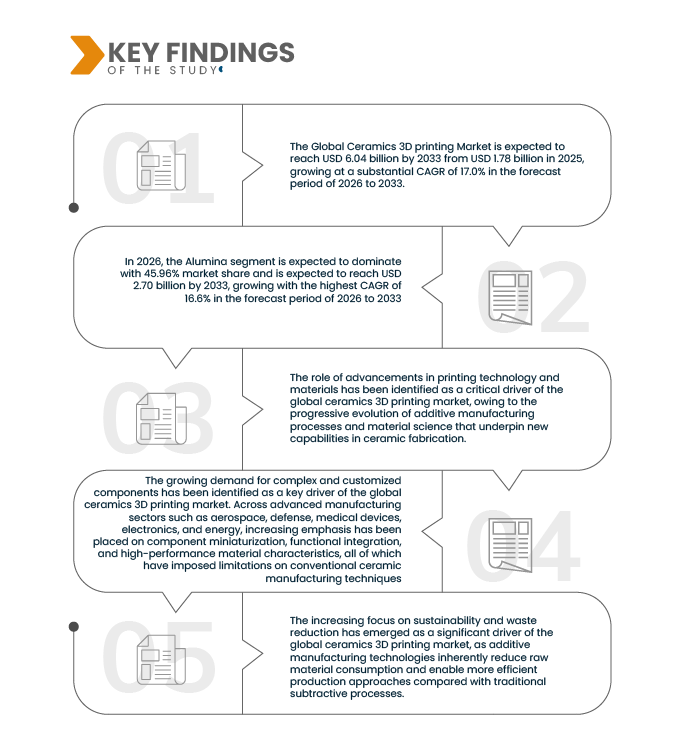
The role of advancements in printing technology and materials has been identified as a critical driver of the global ceramics 3D printing market, owing to the progressive evolution of additive manufacturing processes and material science that underpin new capabilities in ceramic fabrication. Continuous innovation in printing mechanisms, process controls, feedstock development, and post-processing methods has been reported across official research programmes and national initiatives, enabling the production of higher quality, more complex, and performance-oriented ceramic components.
These developments in technology and materials are expected to support industrial applications requiring enhanced precision, structural integrity, and reliability, thereby stimulating market uptake of ceramics-based additive manufacturing solutions.
Access Full Report @ https://www.databridgemarketresearch.com/reports/global-ceramics-3d-printing-market
Data Bridge market research analyzes that the Global Ceramics 3D Printing Market is expected to reach USD 6.04 billion by 2033 from USD 1.78 billion in 2025, growing at a substantial CAGR of 17.0% in the forecast period of 2026 to 2033.
Key Findings of the Study
Strong Demand for Complex and Customized Components.
The growing demand for complex and customized components has been identified as a key driver of the global ceramics 3D printing market. Across advanced manufacturing sectors such as aerospace, defence, medical devices, electronics, and energy, increasing emphasis has been placed on component miniaturization, functional integration, and high-performance material characteristics, all of which have imposed limitations on conventional ceramic manufacturing techniques. Through ceramics 3D printing, intricate geometries, internal channels, lattice structures, and application-specific designs have been enabled with high dimensional accuracy and reduced material waste. As a result, ceramics additive manufacturing has been positioned not merely as a prototyping tool but as a strategic production technology supporting low-volume, high-complexity, and application-driven components. This structural shift toward customization and performance-oriented design has been observed to be reshaping procurement and production strategies, thereby strengthening the market pull for ceramics 3D printing solutions as an enabler of next-generation engineered components.
Report Scope and Market Segmentation
|
Report Metric
|
Details
|
|
Forecast Period
|
2026 to 2033
|
|
Base Year
|
2025
|
|
Historic Years
|
2024 (Customizable to 2018-2023)
|
|
Quantitative Units
|
Revenue in USD billion
|
|
Segments Covered
|
By Material Type (Alumina, Zirconia, Hydroxyapatite (HA) & Bio-ceramics, Silicon Nitride and Others), By Technology (Stereolithography (SLA), Binder Jetting, Material Jetting, Selective Laser Sintering and Others), By Application (Non-Medical, Medical and Others)
|
|
Countries Covered
|
North America
Europe
Asia-Pacific
Middle East and Africa
South America
|
|
Market Players Covered
|
Sinto America, Inc (U.S.), Lithoz (U.S.), BMF Boston Micro Fabrication (U.S.), Admatec BV (Netherlands), Jinan Chenkun Intelligent Technology Co., Ltd. (China), Durbeen Designworks Pvt Ltd (India), Guangzhou Jinguanqiao Industry Co., Ltd. (China), Shenzhen 3KU Technology And Science Co., Ltd. (China), Raylas (China), ZRapid Tech (China), WASP S.R.L. (Italy), Shenzhen Adventure Technology Co., Ltd. (China), Ten Dimensions Technology (China), XJet Ltd. (Israel)
|
|
Data Points Covered in the Report
|
In addition to the insights on market scenarios such as market value, growth rate, segmentation, geographical coverage, and major players, the market reports curated by the Data Bridge Market Research also include import export analysis, production capacity overview, production consumption analysis, price trend analysis, climate change scenario, supply chain analysis, value chain analysis, raw material/consumables overview, vendor selection criteria, PESTLE Analysis, Porter Analysis, and regulatory framework..
|
Segment Analysis
The global ceramics 3D printing market is segmented into three notable segments which are based on material type, technology, application.
- On the basis of material type, the global ceramics 3D printing market is segmented into alumina, zirconia, hydroxyapatite (HA) & bioceramics, silicon nitride, others.
In 2026, the Alumina segment is expected to dominate the market
On the basis of material type, global ceramics 3D printing market is segmented into alumina, zirconia, hydroxyapatite (HA) & bioceramics, silicon nitride, others. In 2026, the alumina segment is expected to dominate with 45.96% market share and is expected to reach USD 2.70 billion by 2033, growing with the highest CAGR of 16.6% in the forecast period of 2026 to 2033, due to its optimal balance of performance, cost-effectiveness, and manufacturability. Alumina offers high hardness, thermal stability, electrical insulation, and chemical resistance at a significantly lower cost than other advanced ceramics, making it the preferred material across electronics, industrial machinery, automotive, medical, and aerospace applications.
In 2026, the Stereolithography (SLA) segment is expected to dominate the market
- On the basis of technology, the global ceramics 3D printing market is segmented into stereolithography (SLA), binder jetting, material jetting, selective laser sintering, others. In 2026, the stereolithography (SLA) segment is expected to dominate with 40.69% market share and is expected to reach USD 2.35 billion by 2033, growing with the highest CAGR of 16.3% in the forecast period of 2026 to 2033, due to its superior precision, excellent surface finish, and strong material compatibility, especially with advanced ceramic and photopolymer-based formulations. SLA enables the production of high-density, complex, and fine-feature components with minimal post-processing, making it highly preferred in electronics, medical, aerospace, and industrial applications.
In 2026, the Non-Medical segment is expected to dominate the market
- On the basis of application, the global ceramics 3D printing market is segmented into non-medical, medical, others. In 2026, the non-medical segment is expected to dominate with 66.34% market share and is expected to reach USD 3.96 billion by 2033, growing with the highest CAGR of 16.9% in the forecast period of 2026 to 2033, due to its broad and rapidly expanding industrial adoption. Strong demand from electronics, automotive, aerospace, industrial machinery, and energy sectors for high-performance, heat-resistant, and wear-resistant components is accelerating uptake. Unlike medical applications, non-medical uses face lower regulatory barriers, faster qualification cycles, and higher production volumes, enabling quicker commercialization and scalability.
Major Players
Sinto America, Inc (U.S.), Lithoz (U.S.), BMF Boston Micro Fabrication (U.S.), Admatec BV (Netherlands), Jinan Chenkun Intelligent Technology Co., Ltd. (China), Durbeen Designworks Pvt Ltd (India), Guangzhou Jinguanqiao Industry Co., Ltd. (China), Shenzhen 3KU Technology And Science Co., Ltd. (China), Raylas (China), ZRapid Tech (China), WASP S.R.L. (Italy), Shenzhen Adventure Technology Co., Ltd. (China), Ten Dimensions Technology (China), XJet Ltd. (Israel)
Market Developments
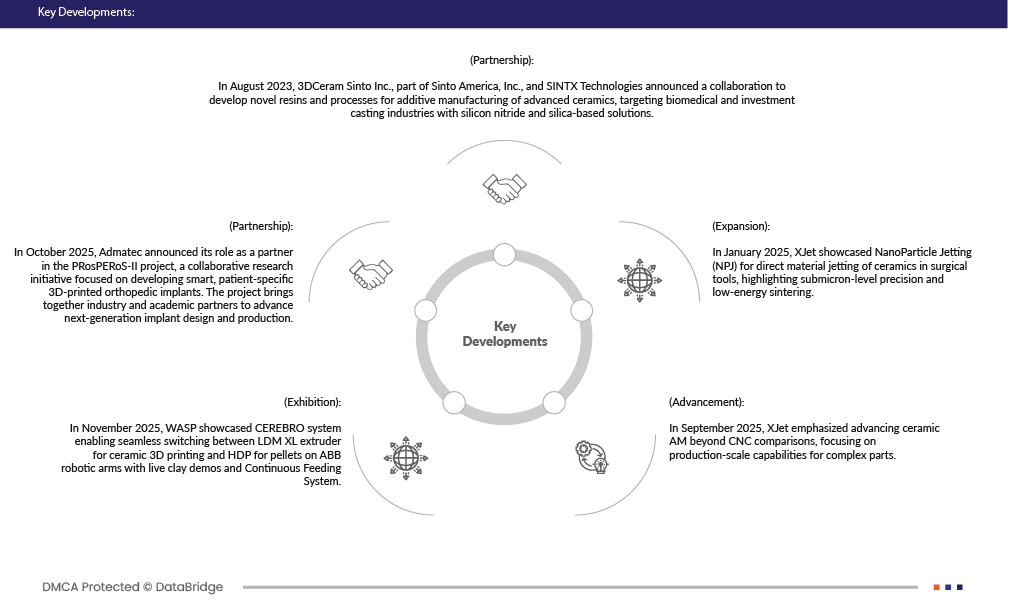
- In 2023 August, 3DCeram Sinto Inc., part of Sinto America, Inc., and SINTX Technologies announced a collaboration to develop novel resins and processes for additive manufacturing of advanced ceramics, targeting biomedical and investment casting industries with silicon nitride and silica-based solutions.
- In 2025 October, Admatec announced its role as a partner in the PRosPERoS-II project, a collaborative research initiative focused on developing smart, patient-specific 3D-printed orthopedic implants. The project brings together industry and academic partners to advance next-generation implant design and production.
- In 2025 November, WASP showcased CEREBRO system enabling seamless switching between LDM XL extruder for ceramic 3D printing and HDP for pellets on ABB robotic arms with live clay demos and Continuous Feeding System.
- In 2025 September, XJet emphasized advancing ceramic AM beyond CNC comparisons, focusing on production-scale capabilities for complex parts.
- In 2025 January, XJet showcased NanoParticle Jetting (NPJ) for direct material jetting of ceramics in surgical tools, highlighting submicron-level precision and low-energy sintering.
As per Data Bridge Market Research analysis:
Geographically, the countries covered in the global ceramics 3D printing market report are North America, Europe, Asia-Pacific, Middle East and Africa, South America. The North America is further segmented into U.S., Canada, and Mexico. Europe is further segmented into Germany, U.K., France, Italy, Spain, Russia, Turkey, Netherlands, Norway, Finland, Denmark, Sweden, Poland, Switzerland, Belgium, and rest of Europe. The Asia-Pacific is further segmented into China, Japan, India, South Korea, Australia, Indonesia, Thailand, Malaysia, Singapore, Philippines, New Zealand, and rest of Asia-Pacific. The South America is further segmented into Brazil, Argentina, and rest of South America. The Middle East and Africa is further segmented into Saudi Arabia, U.A.E., South Africa, Egypt, Israel, Rest of Middle East and Africa.
China is the dominating country in global ceramics 3D printing market
China is the dominant country in the global ceramics 3D printing market, supported by its strong manufacturing base, large-scale electronics and industrial ceramics production, cost-efficient supply chain, and growing adoption of additive manufacturing in aerospace, automotive, and consumer electronics.
India is expected to be the fastest growing country in global ceramics 3D printing market
India is expected to be the fastest-growing country in the global ceramics 3D printing market due to rapid industrialization, increasing investments in advanced manufacturing, rising adoption of 3D printing in electronics and healthcare, and government initiatives promoting domestic manufacturing and high-tech materials.
For more detailed information about the global ceramics 3D printing Market report, click here – https://www.databridgemarketresearch.com/reports/global-ceramics-3d-printing-market