
Rising consumer demand for clean-label, natural, and recognizable food ingredients is a primary driver of the global plant-based colorants market. Across developed and emerging economies, consumers are increasingly scrutinizing ingredient lists and actively avoiding artificial additives, particularly synthetic food colors perceived as chemically derived or health-concerning. Plant-based colorants align closely with consumer expectations around transparency, simplicity, and natural sourcing.
Food and beverage brands are responding by reformulating products to replace artificial dyes with colors derived from beetroot, turmeric, spirulina, paprika, annatto, and fruit concentrates. This shift is particularly visible in categories such as beverages, confectionery, dairy alternatives, and children’s food products, where visual appeal and perceived safety strongly influence purchase decisions.
Access Full Report @ https://www.databridgemarketresearch.com/reports/global-plant-based-colorants-market
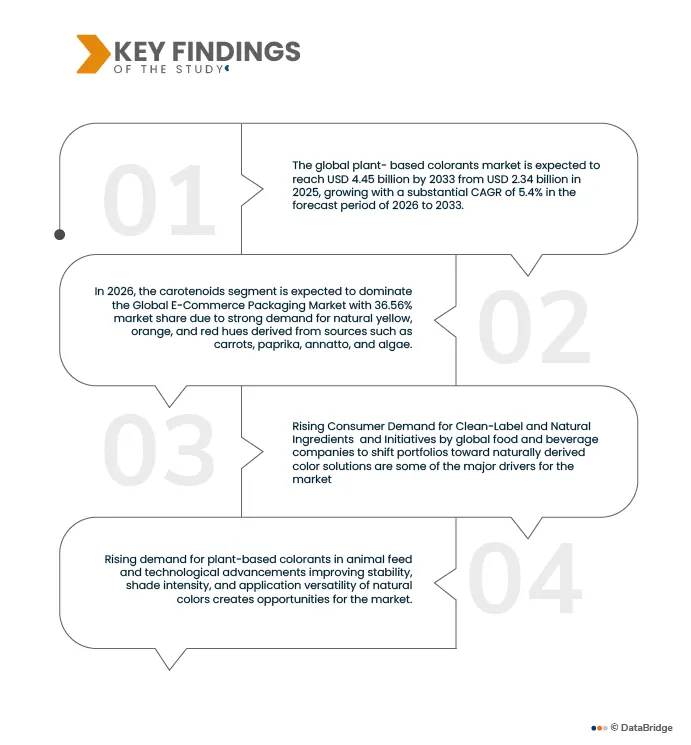
Data Bridge Market Research analyzes that the Global Plant-Based Colorants Market is expected to reach USD 2.34 billion by 2033 from USD 4.45 billion in 2025, growing at a substantial CAGR of 8.4% in the forecast period of 2026 to 2033.
Key Findings of the Study
Increasing Regulatory Scrutiny On Synthetic Food Colorants
Increasing regulatory scrutiny and tightening restrictions on synthetic food colorants across major global regions are significantly accelerating the shift toward plant-based alternatives. Food safety authorities in Europe, North America, and parts of Asia are strengthening risk assessment frameworks, revisiting approvals, and imposing stricter labeling and usage requirements for artificial colors-especially those associated with potential behavioral, allergenic, or long-term health concerns. High-profile regulatory actions, warning labels, and periodic re-evaluations have increased uncertainty around the continued use of synthetic colorants, raising compliance complexity for food manufacturers operating across multiple jurisdictions.
In response, food and beverage companies are proactively reformulating products using naturally derived, plant-based color systems to mitigate regulatory risk and maintain formulation consistency across markets. Natural colorants offer greater alignment with evolving safety standards while supporting cleaner labels and future-proof product portfolios, acting as a key growth driver for the plant-based colorants market.
Report Scope and Market Segmentation
|
Report Metric
|
Details
|
|
Forecast Period
|
2026 to 2033
|
|
Base Year
|
2025
|
|
Historic Year
|
2024 (Customizable 2018-2024)
|
|
Quantitative Units
|
Revenue in USD Billion
|
|
Segments Covered
|
By Product Type (Carotenoids, Anthocyanins, Chlorophylls, Betalains, Curcumin, Paprika Extract, Spirulina Extract, Gardenia Yellow, Saffron Extract, Annatto, and Others); Type (Pigments, Dyes, Masterbatches, Color Concentrates, and Others); Color (Red, Yellow, Orange, Green, Blue, Brown, Black, Purple, Pink, White/Off-White, Gray/Silver, Gold, Beige, and Others); Form (Powder, Liquid/Paste and Granules/Pellets); Solubility (Water-Soluble, Oil-Soluble, and Solvent-Soluble); End Use (Food & Beverage, Cosmetics & Personal Care, Textile Industry, Paints & Coatings, Packaging, Pharmaceutical, Plastics & Rubber, Printing, and Others); Distribution Channel (Direct and Indirect)
|
|
Countries Covered
|
U.S., Canada, Mexico, Germany, France, U.K., Italy, Russia, Spain, Switzerland, Netherlands, Turkey, Belgium, Norway, Sweden, Finland, Denmark, Rest of Europe, China, India, Japan, South Korea, Taiwan, Thailand, Indonesia, Malaysia, Singapore, Philippines, Australia, New Zealand, Hong Kong, Rest of Asia-Pacific, Brazil, Argentina, Peru, Colombia, Chile, Bolivia, Ecuador, Venezuela, Paraguay, Uruguay, Rest of South America, Saudi Arabia, U.A.E., South Africa, Egypt, Qatar, Kuwait, Oman, Israel, Bahrain, and Rest of Middle East and Africa
|
|
Market Players Covered
|
|
|
Data Points Covered in the Report
|
In addition to the market insights such as market value, growth rate, market segments, geographical coverage, market players, and market scenario, the market report curated by the Data Bridge Market Research team includes in-depth expert analysis, import/export analysis, pricing analysis, production consumption analysis, and pestle analysis.
|
Segment Analysis
The global plant-based colorants market is segmented into seven segments based on product type, type, color, form, solubility, end use, and distribution channel.
- On the basis of product type, the market is segmented into carotenoids, anthocyanins, chlorophylls, betalains, curcumin, paprika extract, spirulina extract, gardenia yellow, saffron extract, annatto, and others
In 2026, the Carotenoids segment is expected to dominate the global plant-based colorants market
In 2026, the Carotenoids segment is expected to dominate the market with a market share of 36.51% due to its cost-effectiveness, high bandwidth capability over short distances, and increasing deployment in offshore oil & gas operations, subsea construction, marine research, and underwater inspection tasks where real-time control and high-quality video transmission are critical.
- On the basis of type, the market is segmented into pigments, dyes, masterbatches, color concentrates, and others
In 2026, Pigments segment is expected to dominate the global plant-based colorants market
In 2026, Pigments segment is expected to dominate the market with a market share of 44.73% rapid advancements in marine sensing technologies, increasing need for high-resolution seabed mapping, growth in naval ISR missions, and rising use of multi-mission sonar and camera systems for oceanographic, environmental, and commercial underwater operations.
- On the basis of color, the market is segmented into red, yellow, orange, green, blue, brown, black, purple, pink, white/off-white, gray/silver, gold, beige, and others. In 2026, Red is expected to dominate the market with a market share of 23.68%
- On the basis of form, the market is segmented into powder, liquid/paste, and granules/pellets. Liquid/Paste is further sub segmented into water-based and oil-based. In 2026, Powder is expected to dominate the market with a market share of 55.13%
- On the basis of solubility, the market is segmented into water-soluble, oil-soluble, and solvent-soluble. In 2026, water-soluble is expected to dominate the market with a market share of 60.19%
- On the basis of end use, the market is segmented into food & beverage, cosmetics & personal care, textile industry, paints & coatings, packaging, pharmaceutical, plastics & rubber, printing, and others. In 2026, Food & Beverage is expected to dominate the market with a market share of 39.29%
- On the basis of distribution channel, the market is segmented into direct and indirect. In 2026, Direct is expected to dominate the market with a market share of 63.19%
Major Players
Data Bridge Market Research analyzes Allied Biotech Corporation (Taiwan), Archer Daniels Midland Company (U.S.), BASF SE (Germany), BIOCON COLORS (Netherlands), Chenguang Biotech Group Co., Ltd (China) as the major market players of the global plant-based colorants market.
Market Developments
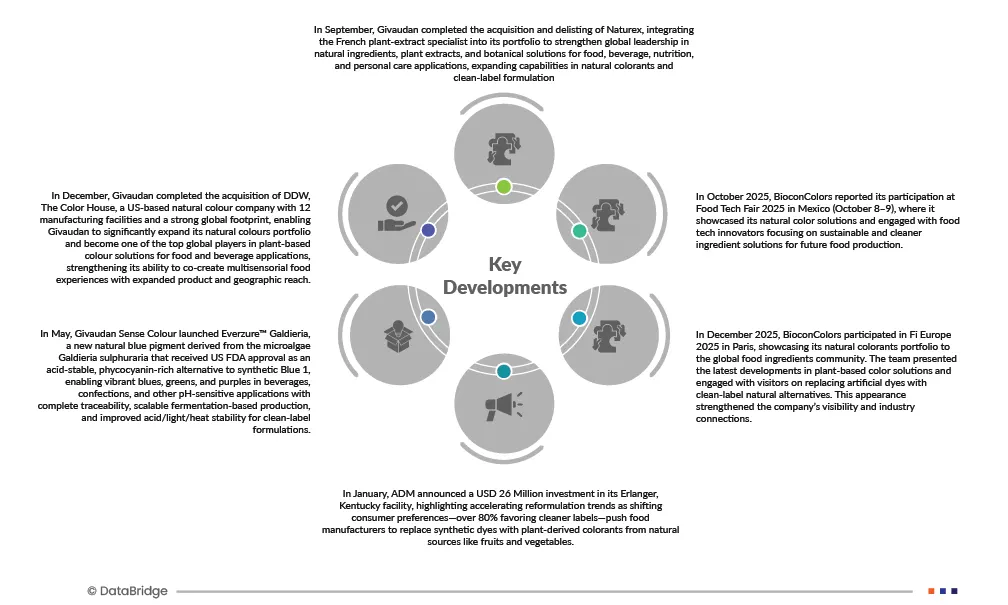
- In December 2023, Oterra partnered with Ecoflora Cares after FDA approval of Jagua blue—a stable, plant-based natural blue pigment from Colombian jagua fruit (Genipa americana)—enabling vibrant blues, greens, and purples for beverages, confectionery, cereals, and snacks with pH/light/heat stability.
- In May 2025, Givaudan Sense Colour launched Everzure™ Galdieria, a new natural blue pigment derived from the microalgae Galdieria sulphuraria that received US FDA approval as an acid-stable, phycocyanin-rich alternative to synthetic Blue 1, enabling vibrant blues, greens, and purples in beverages, confections, and other pH-sensitive applications with complete traceability, scalable fermentation-based production, and improved acid/light/heat stability for clean-label formulations.
- In February 2024, Sensient highlighted accelerating plant-based food innovation, noting that shifting consumer preferences are pushing food manufacturers to reformulate products using plant-derived ingredients, reinforcing demand for clean-label solutions across flavours, textures, and supporting components such as natural colours.
- In January 2026, ADM announced a USD 26 Million investment in its Erlanger, Kentucky facility, highlighting accelerating reformulation trends as shifting consumer preferences—over 80% favoring cleaner labels—push food manufacturers to replace synthetic dyes with plant-derived colorants from natural sources like fruits and vegetables
Regional Analysis
Geographically, the countries covered in the global plant-based colorants market report are the U.S., Canada, Mexico, Germany, France, U.K., Italy, Russia, Spain, Switzerland, Netherlands, Turkey, Belgium, Norway, Sweden, Finland, Denmark, Rest of Europe, China, India, Japan, South Korea, Taiwan, Thailand, Indonesia, Malaysia, Singapore, Philippines, Australia, New Zealand, Hong Kong, Rest of Asia-Pacific, Brazil, Argentina, Peru, Colombia, Chile, Bolivia, Ecuador, Venezuela, Paraguay, Uruguay, Rest of South America, Saudi Arabia, U.A.E., South Africa, Egypt, Qatar, Kuwait, Oman, Israel, Bahrain, and Rest of Middle East and Africa.
As per Data Bridge Market Research analysis:
North America is expected to be the dominant the global plant-based colorants market
North America is expected to dominate the global plant-based colorants market with a strong presence of established natural ingredient manufacturers, high adoption of clean-label products, and strict regulations limiting synthetic additives. Food & beverage, cosmetics, and nutraceutical brands widely incorporate plant-based colorants to meet consumer demand for safe, natural, and sustainable ingredients.
Asia-Pacific is expected to be the fastest-growing region the global plant-based colorants market driven by expanding processed food industries, rising disposable incomes, and increasing awareness of natural and herbal products. Rapid urbanization, growth in packaged foods, and strong demand for naturally derived ingredients in traditional foods, beverages, and personal care products are accelerating market expansion.
For more detailed information about the global plant-based colorants market report, click here – https://www.databridgemarketresearch.com/reports/global-plant-based-colorants-market










