Growing consumer awareness regarding product safety, ingredient transparency, and formulation quality is significantly increasing the demand for effective preservative and antimicrobial systems in personal care products. Consumers increasingly expect skincare, haircare, cosmetics, and hygiene products to remain microbiologically stable throughout their intended shelf life without compromising skin compatibility or product performance. At the same time, the popularity of water-based formulations, multifunctional cosmetics, and clean-label beauty products has made preservation technologies more critical, as these formulations are more susceptible to microbial contamination during manufacturing and consumer use. Manufacturers are therefore investing in advanced preservative blends, naturally derived antimicrobial ingredients, and multifunctional preservation systems that can deliver broad-spectrum microbial protection while meeting evolving regulatory requirements and consumer preferences for milder, more sustainable ingredients. This shift is encouraging ingredient suppliers to develop innovative preservation technologies that balance efficacy, safety, formulation flexibility, and environmental responsibility across a wide range of personal care applications.
Access Full Report @ https://www.databridgemarketresearch.com/reports/global-preservatives-and-antimicrobial-ingredients-within-the-personal-care-market
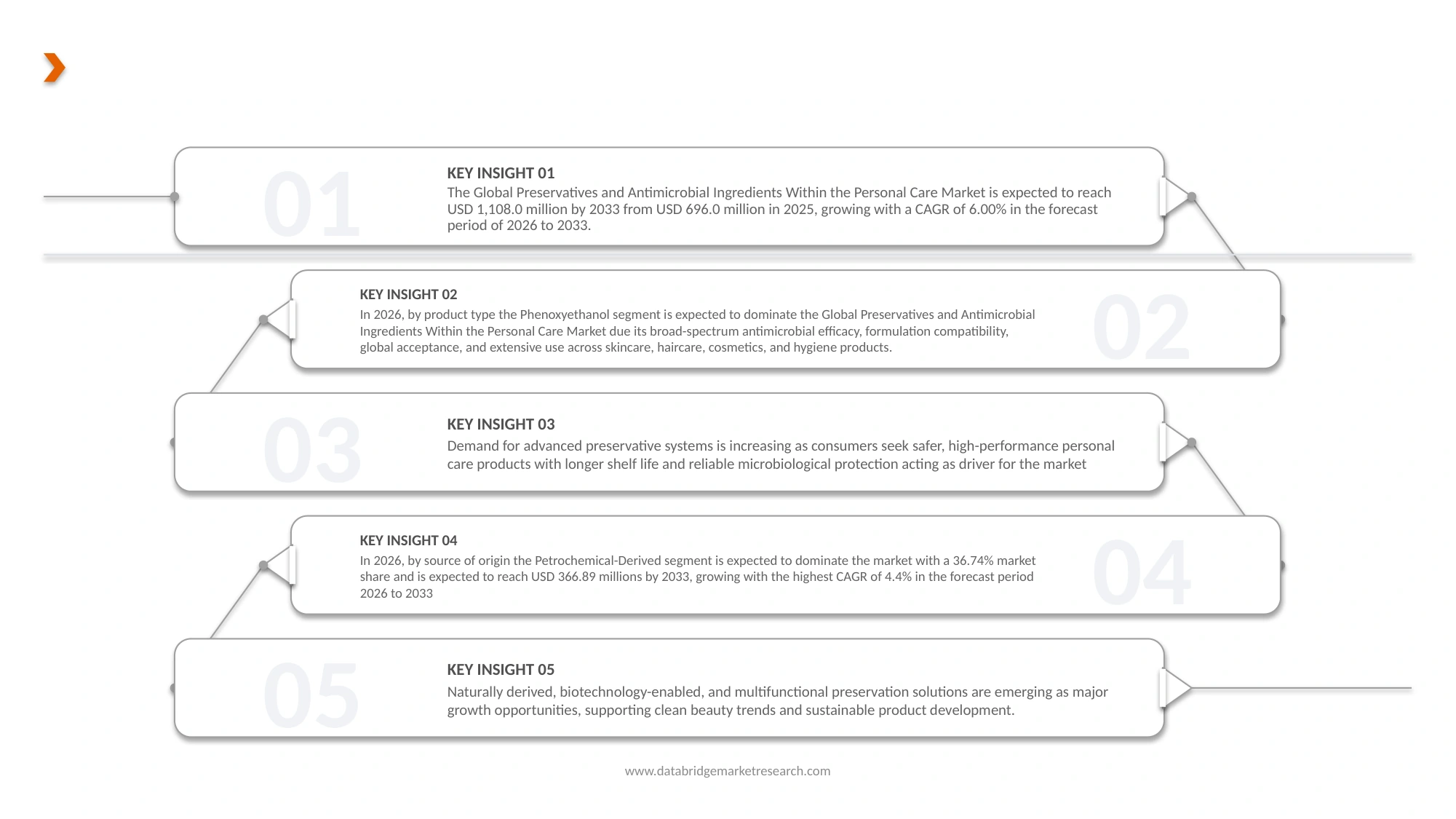
Data Bridge market research analyzes that The Global Preservatives and Antimicrobial Ingredients Within the Personal Care Market is expected to reach USD 1,108.0 million by 2033 from USD 696.0 million in 2025, growing with a CAGR of 6.00% in the forecast period of 2026 to 2033.
Key Findings of the Study
Continued Expansion and Premiumization of the Global Personal Care and Beauty Industry
The continued expansion and premiumization of the global personal care and beauty industry is driving greater adoption of high-quality preservative and antimicrobial ingredients across product categories. Consumers are increasingly shifting toward premium skincare, cosmetics, haircare, and personal hygiene products that incorporate sophisticated active ingredients, botanical extracts, fermented ingredients, and multifunctional formulations. These premium products require highly effective preservation systems to maintain microbiological stability, product efficacy, and sensory attributes throughout their shelf life. At the same time, beauty brands are expanding their premium portfolios into new geographic markets and investing in science-backed formulations that comply with stringent safety and quality standards. This combination of product innovation, geographic expansion, and rising consumer expectations is increasing the need for advanced preservative technologies that deliver broad-spectrum protection without compromising formulation aesthetics or brand positioning.
Report Scope and Market Segmentation
|
Report Metric
|
Details
|
|
Forecast Period
|
2026 to 2033
|
|
Base Year
|
2025
|
|
Historic Years
|
2018-2024 (Customizable to 2013-2017)
|
|
Quantitative Units
|
Revenue in USD Thousand
|
|
Segments Covered
|
By Product Type (Parabens And Their Salts, Isothiazolinones, Formaldehyde-Releasing Preservatives, Phenoxyethanol, Aromatic Alcohols, Organic Acids And Their Salts, Halogenated Carbamates And Related Preservatives, Phenolic Preservatives, Biguanides And Amidines, Quaternary Ammonium Preservatives, Diols And Multifunctional Preservation Boosters, Fatty Acids And Glyceryl Ester-Based Boosters, Amino Acid-Derived Antimicrobials, Ferment-Derived Antimicrobial Ingredients, Botanical And Essential Oil-Based Antimicrobials, Inorganic And Mineral-Based Antimicrobials, Others), By Source Of Origin (Petrochemical-Derived, Plant-Derived, Fermentation-Derived, Mineral / Inorganic-Derived, Mixed-Origin Formulated Systems, Other Sources), By Product Form (Liquid, Powder, Granule / Flake, Paste / Semi-Solid, Other Forms), By Solubility Profile (Water-Soluble, Oil-Soluble, Water-Dispersible, Oil-Dispersible, Dual-Phase / Amphiphilic, Other Solubility Profiles), By Primary Formulation Compatibility (Aqueous Solutions And Gels, Emulsion-Based Formulations, Surfactant-Based Cleansing Formulations, Hydroalcoholic Formulations, Anhydrous And Low-Water-Activity Formulations, Impregnated Substrate Formulation, Powder-Based Formulations, Other Specialized Formulations), By Application (Facial Skin Care, Body And Hand Care, Sun Care, Hair And Scalp Care, Bath, Shower And Intimate Hygiene), By Function (Primary Preservatives, Preservative Boosters, Multifunctional Antimicrobial Ingredients, Chelating Preservation Enhancers, Formulated Preservative Systems), By System Type (Single-Active Preservative Systems, Multi-Active Preservative Blends, Preservative-And-Booster Combinations, Organic Acid-Based Blends, Multifunctional Preservation Systems, Botanical And Ferment-Based Systems, Other Preservative Systems)
|
|
Countries Covered
|
U.S., Canada, Mexico, Germany, U.K., France, Italy, Spain, Russia, Switzerland, Netherlands, Turkey, Belgium, Denmark, Sweden, Norway, Finland, Rest of Europe, China, India, Australia, Japan, Indonesia, South Korea, Thailand, Philippines, Malaysia, New Zealand, Taiwan, Singapore, Hong Kong, Rest of Asia-Pacific, Brazil, Argentina, Colombia, Chile, Peru, Ecuador, Paraguay, Uruguay, Bolivia, Venezuela, Rest of South America, South Africa, Saudi Arabia, Egypt, United Arab Emirates, Israel, Qatar, Kuwait, Oman, Bahrain, Rest of Middle East & Africa
|
|
Market Players Covered
|
|
|
Data Points Covered in the Report
|
In addition to the insights on market scenarios such as market value, growth rate, segmentation, geographical coverage, and major players, the market reports curated by the Data Bridge Market Research also include in-depth expert analysis, patient epidemiology, pipeline analysis, pricing analysis, and regulatory framework.
|
Segment Analysis
The Global Preservatives and Antimicrobial Ingredients Within the Personal Care market is segmented on the basis of Product type, Source of Origin, Product form, solubility form, Primary Formulation Compatibility, Application, Function, and System type.
- On the basis of Product type, the Global Preservatives and Antimicrobial Ingredients Within the Personal Care Market is segmented into Parabens And Their Salts, Isothiazolinones, Formaldehyde-Releasing Preservatives, Phenoxyethanol, Aromatic Alcohols, Organic Acids And Their Salts, Halogenated Carbamates And Related Preservatives, Phenolic Preservatives, Biguanides And Amidines, Quaternary Ammonium Preservatives, Diols And Multifunctional Preservation Boosters, Fatty Acids And Glyceryl Ester-Based Boosters, Amino Acid-Derived Antimicrobials, Ferment-Derived Antimicrobial Ingredients, Botanical And Essential Oil-Based Antimicrobials, Inorganic And Mineral-Based Antimicrobials, Others.
In 2026, the Phenoxyethanol segment is expected to dominate the market
In 2026, the Phenoxyethanol segment is expected to dominate the market with a 14.36% market share, due to its broad-spectrum antimicrobial efficacy, compatibility with diverse cosmetic formulations, relatively low odor, and effectiveness at low concentrations. Its widespread use across skin care, hair care, cleansing, and personal hygiene products, combined with established regulatory acceptance and formulation familiarity, supports its leading position.
- On the basis of Source of Origin, the Global Preservatives and Antimicrobial Ingredients Within the Personal Care Market is segmented into Petrochemical-Derived, Plant-Derived, Fermentation-Derived, Mineral / Inorganic-Derived, Mixed-Origin Formulated Systems, Other Sources
In 2026, the Petrochemical-Derived segment is expected to dominate the market
In 2026, the Petrochemical-Derived segment is expected to dominate the market with a 36.74% market share, due to its established manufacturing infrastructure, consistent quality, cost-effectiveness, and reliable supply availability. Petrochemical-derived preservatives offer proven antimicrobial performance across a broad range of formulations and remain widely adopted by manufacturers seeking effective preservation, formulation stability, and scalable production for mass-market personal care products.
- On the basis of Product Form, the Global Preservatives and Antimicrobial Ingredients Within the Personal Care Market is segmented into Liquid, Powder, Granule / Flake, Paste / Semi-Solid, Other Forms.
In 2026, the liquid segment is expected to dominate the market
In 2026, the Liquid segment is expected to dominate the market with a 44.06% market share, due to its ease of handling, rapid incorporation, and uniform distribution within cosmetic formulations. Liquid preservatives are particularly suitable for creams, lotions, shampoos, conditioners, and cleansing products, enabling convenient dosing and processing while supporting efficient manufacturing and consistent preservation performance across diverse personal care applications.
- On the basis of Solubility Profile, the Global Preservatives and Antimicrobial Ingredients Within the Personal Care Market is segmented into Water-Soluble, Oil-Soluble, Water-Dispersible, Oil-Dispersible, Dual-Phase / Amphiphilic, Other Solubility Profiles.
In 2026, the water-soluble segment is expected to dominate the market
In 2026, the Water-Soluble segment is expected to dominate the market with a 34.54% market share, due to the widespread use of water-based personal care formulations, including creams, lotions, shampoos, facial cleansers, and gels. Water-soluble preservatives can be readily incorporated into aqueous phases, providing efficient distribution and antimicrobial protection while simplifying formulation processes and supporting consistent preservation across finished products.
- On the basis of Primary Formulation Compatibility, the Global Preservatives and Antimicrobial Ingredients Within the Personal Care Market is segmented into Aqueous Solutions and Gels, Emulsion-Based Formulations, Oil-in-Water Emulsions, Water-in-Oil Emulsions, Surfactant-Based Cleansing Formulations, Hydroalcoholic Formulations, Anhydrous and Low-Water-Activity Formulations, Impregnated Substrate Formulations, Wipes, Pads, Sheet Masks, Other Impregnated Substrates, Powder-Based Formulations, and Other Specialized Formulations.
In 2026, the emulsion-based formulations segment is anticipated to dominate the market
In 2026, the Emulsion-Based Formulations segment is expected to dominate the market with a 17.85% market share, due to the extensive use of emulsions in modern personal care products, particularly creams, lotions, moisturizers, and sunscreens. These formulations require effective microbial protection because of their water-containing nature, driving demand for preservatives compatible with emulsified systems and capable of maintaining product stability.
- On the basis of Application, the Global Preservatives and Antimicrobial Ingredients Within the Personal Care Market is segmented into facial skin care, body and hand care, sun care, hair and scalp care, and bath, shower and intimate hygiene.
In 2026, the facial skin care segment is anticipated to dominate the market
In 2026, the Facial Skin Care segment is expected to dominate the market with a 29.51% market share, due to increasing consumer focus on skincare, growing demand for moisturizers, cleansers, serums, and anti-aging products, and the frequent use of water-based formulations. The expanding global facial skincare market increases demand for effective antimicrobial protection to maintain product safety, stability, and shelf life.
- On the basis of Function, the Global Preservatives and Antimicrobial Ingredients Within the Personal Care Market is segmented into Primary Preservatives, Preservative Boosters, Multifunctional Antimicrobial Ingredients, Chelating Preservation Enhancers, Formulated Preservative Systems.
In 2026, the primary preservatives segment is anticipated to dominate the market
In 2026, the Primary Preservatives segment is expected to dominate the market with a 39.37% market share, due to their essential role in preventing microbial growth and maintaining the safety, quality, and shelf life of personal care products. Their widespread application across creams, lotions, shampoos, cleansers, and other formulations, along with established efficacy and regulatory acceptance, supports continued market dominance.
- On the basis of System Type, the Global Preservatives and Antimicrobial Ingredients Within the Personal Care Market is segmented into Single-Active Preservative Systems, Multi-Active Preservative Blends, Preservative-And-Booster Combinations, Organic Acid-Based Blends, Multifunctional Preservation Systems, Botanical and Ferment-Based Systems, Other Preservative Systems.
In 2026, the single-active preservative segment is anticipated to dominate the market
In 2026, the Single-Active Preservative Systems segment is expected to dominate the market with a 21.94% market share, due to their straightforward formulation, predictable antimicrobial performance, ease of dosing, and established use across personal care products. Manufacturers can efficiently incorporate individual active preservatives into formulations while maintaining control over concentration and compatibility, supporting widespread adoption across diverse cosmetic applications.
Major Players
Symrise AG (Germany), Active Micro Technologies, LLC (AMT) (U.S.), Givaudan SA (Switzerland), Ashland Inc. (U.S.), BASF SE (Germany), and Corbion N.V. (Netherlands).
Market Developments
- In September 2024, Symrise launched SymSave Next-gen, a multifunctional preservation booster designed for microbiome-friendly cosmetic formulations. The innovation supports effective product protection while aligning with growing consumer demand for gentle, skin-compatible and microbiome-conscious personal care products. The launch strengthened Symrise’s Micro Protection portfolio and expanded its solutions for modern preservation systems.
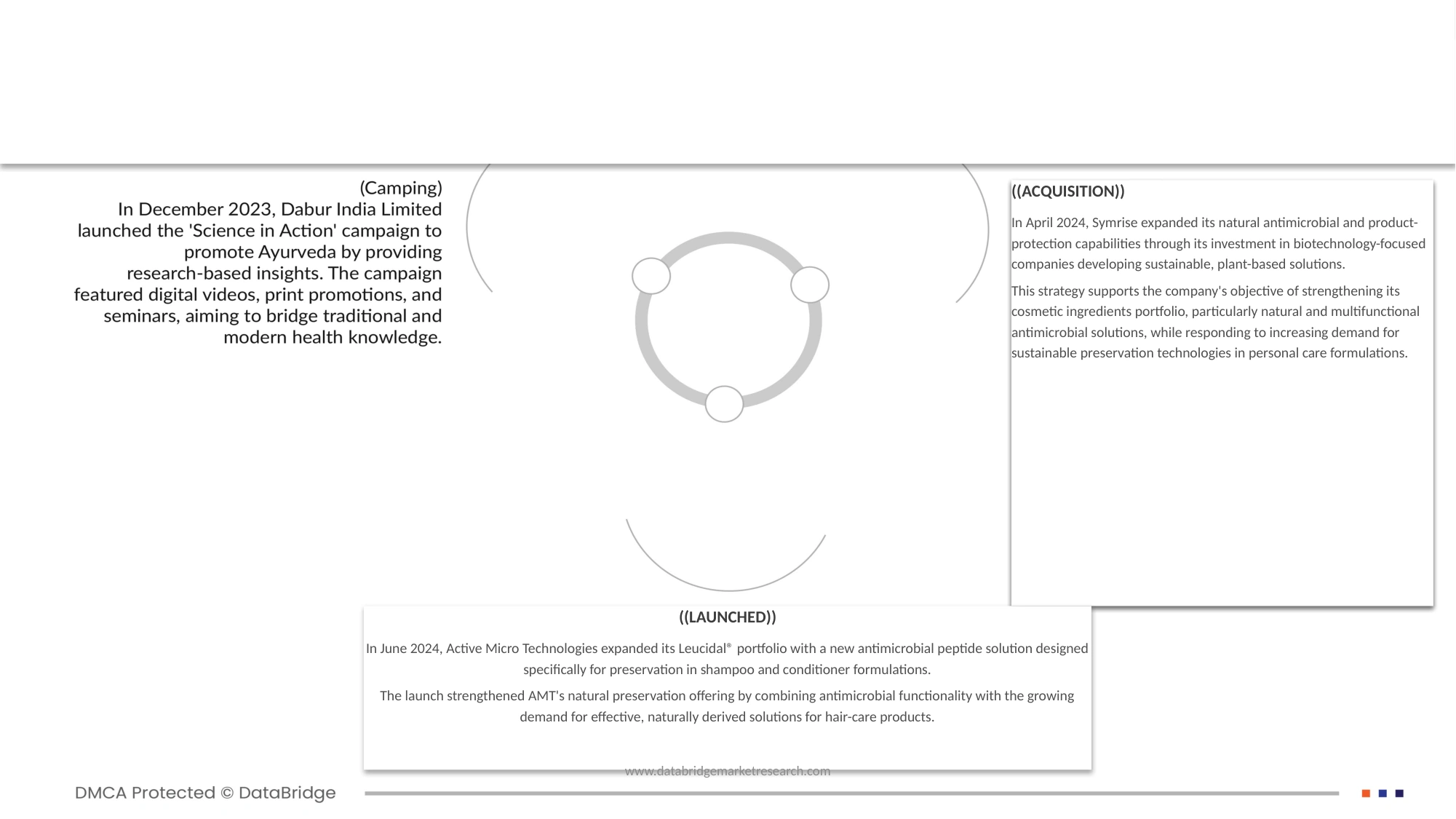
- In April 2024, Symrise expanded its natural antimicrobial and product-protection capabilities through its investment in biotechnology-focused companies developing sustainable, plant-based solutions. This strategy supports the company’s objective of strengthening its cosmetic ingredients portfolio, particularly natural and multifunctional antimicrobial solutions, while responding to increasing demand for sustainable preservation technologies in personal care formulations.
- In June 2024, Active Micro Technologies expanded its Leucidal® portfolio with a new antimicrobial peptide solution designed specifically for preservation in shampoo and conditioner formulations. The launch strengthened AMT’s natural preservation offering by combining antimicrobial functionality with the growing demand for effective, naturally derived solutions for hair-care products.
- In November 2023, Active Micro Technologies strengthened its international distribution network by entering long-term distribution agreements covering Brazil and South Korea. The partnerships supported broader regional access to AMT’s natural antimicrobial and preservation technologies, including its Leucidal® portfolio, while expanding the company’s presence in important personal care and cosmetic ingredient markets.
- In June 2024: Givaudan strengthened its presence in Brazil’s beauty and cosmetic ingredients market through the acquisition of Vika Cosmetics Ingredients. The transaction expanded Givaudan’s local capabilities and portfolio of specialty ingredients, supporting its strategy to broaden its Fragrance & Beauty offering and strengthen customer access across the Latin American personal care market.
As per Data Bridge Market Research analysis:
Geographically, the countries covered in the Global Preservatives and Antimicrobial Ingredients Within the Personal Care market report are U.S., Canada, Mexico, Germany, U.K., France, Italy, Spain, Russia, Switzerland, Netherlands, Turkey, Belgium, Denmark, Sweden, Norway, Finland, Rest of Europe, China, India, Australia, Japan, Indonesia, South Korea, Thailand, Philippines, Malaysia, New Zealand, Taiwan, Singapore, Hong Kong, Rest of Asia-Pacific, Brazil, Argentina, Colombia, Chile, Peru, Ecuador, Paraguay, Uruguay, Bolivia, Venezuela, Rest of South America, South Africa, Saudi Arabia, Egypt, United Arab Emirates, Israel, Qatar, Kuwait, Oman, Bahrain, Rest of Middle East & Africa.
U.S. Preservatives and Antimicrobial Ingredients Within the Personal Care Insight
The U.S. is a major market for preservatives and antimicrobial ingredients within personal care, supported by its large and diverse cosmetics, skincare, haircare, and hygiene industries. Demand is driven by premium skincare, clean beauty, multifunctional formulations, and growing consumer attention to ingredient safety and transparency. Manufacturers increasingly use preservative blends, boosters, and alternative antimicrobial systems to balance efficacy with evolving consumer preferences. The country’s established ingredient suppliers and formulation capabilities further strengthen market development.
Germany is the dominating country in Preservatives and Antimicrobial Ingredients Within the Personal Care market
Germany represents a significant European market for personal care preservatives and antimicrobial ingredients, supported by its strong cosmetics manufacturing base, advanced formulation capabilities, and well-established natural cosmetics industry. Demand is influenced by stringent safety expectations and increasing preference for effective, sustainable, and naturally derived preservation systems. Regulatory requirements under the European Union framework also encourage manufacturers to carefully evaluate preservative safety, concentration limits, and formulation compatibility, supporting innovation in multifunctional and alternative preservation technologies..
India Preservatives and Antimicrobial Ingredients Within the Personal Care Market Insight
India is an increasingly important market for personal care preservatives and antimicrobial ingredients, driven by expanding cosmetics consumption, rising middle-class spending, e-commerce penetration, and increasing awareness of product safety and quality. Demand is also supported by the growth of domestic beauty brands and premium personal care products. Manufacturers are increasingly exploring natural, multifunctional, and eco-friendly preservation systems while maintaining affordability and formulation stability.
For more detailed information about the global preservatives and antimicrobial ingredients within the personal care market report, click here – https://www.databridgemarketresearch.com/reports/global-preservatives-and-antimicrobial-ingredients-within-the-personal-care-market