The global defense sector is experiencing a rapid acceleration in the procurement and operational integration of unmanned aerial vehicles (UAVs), driven by evolving and increasingly complex intelligence, surveillance, reconnaissance (ISR), and force-protection requirements. Armed forces worldwide are prioritizing UAVs as key assets for a range of missions, from persistent ISR and border surveillance to electronic intelligence (ELINT) and precision strike operations. As military strategies evolve to meet new threats, there is a growing demand for UAV platforms capable of extended flight durations, autonomous mission execution, and secure communication links to enable real-time data transfer. To address these needs, defense ministries are laying out structured UAV acquisition pathways that include clear roadmaps for platform development, testing, and fielding. This structured approach ensures that UAVs, once trialed and refined, transition smoothly into permanent operational use, with an emphasis on enhancing mission readiness and strategic effectiveness.
Access Full Report @ https://www.databridgemarketresearch.com/reports/global-unmanned-aerial-vehicle-market
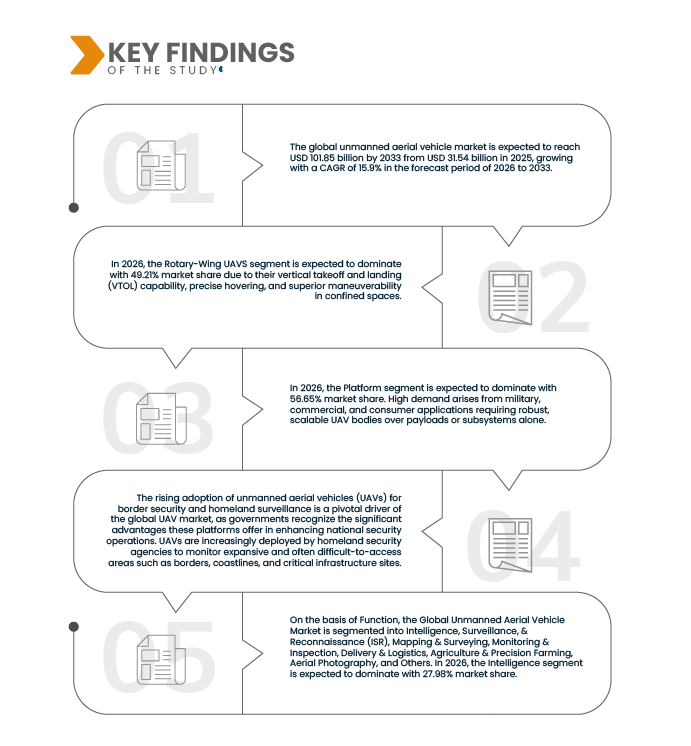
Data Bridge Market Research analyses that the Global Unmanned Aerial Vehicle Market is expected to reach USD 101.85 thousand by 2033 from USD 31.54 billion in 2025, growing with a CAGR of 15.9% in the forecast period of 2026 to 2033.
Key Findings of the Study
Rising Adoption of UAVS For Border Security And Homeland Surveillance
The rising adoption of unmanned aerial vehicles (UAVs) for border security and homeland surveillance is a pivotal driver of the global UAV market, as governments recognize the significant advantages these platforms offer in enhancing national security operations. UAVs are increasingly deployed by homeland security agencies to monitor expansive and often difficult-to-access areas such as borders, coastlines, and critical infrastructure sites. These regions typically present challenges for traditional patrol methods, such as manned aerial surveillance or ground-based monitoring, due to vast distances, remote locations, and rugged terrains. UAVs, with their ability to fly over large areas for extended periods, provide a persistent, real-time aerial view of high-priority zones, enabling quicker detection of potential threats like illegal border crossings, trafficking, or sabotage of infrastructure. This persistent surveillance capability makes UAVs invaluable for law enforcement and defense agencies tasked with safeguarding borders, coastlines, and other vulnerable sites.
Moreover, the integration of UAVs into comprehensive national security architectures has been accelerating, with governments embedding these platforms into broader surveillance systems that also incorporate ground sensors, satellite imagery, and command-and-control networks. This layered approach strengthens situational awareness and enhances response times to emerging threats. UAVs are no longer viewed as supplementary tools but as critical assets that augment and complement other surveillance technologies, offering real-time intelligence, flexibility, and operational efficiency. Their ability to operate autonomously, with minimal human intervention, also reduces the risks and costs associated with traditional surveillance methods. As the global demand for enhanced border security and homeland defense rises, UAVs are rapidly becoming a cornerstone of national security operations, driving investment in both military and commercial UAV markets worldwide.
Report Scope and Market Segmentation
|
Report Metric
|
Details
|
|
Forecast Period
|
2026 to 2033
|
|
Base Year
|
2025
|
|
Historic Years
|
2018-2024 (Customizable from 2013-2017)
|
|
Quantitative Units
|
Revenue in USD Thousand
|
|
Segments Covered
|
Product Type (Rotary-Wing UAVS, Fixed-Wing UAVS, Hybrid UAVS, Others), by System Component (Platform, Software & Cybersecurity, Data Link, Launch & Recovery Systems), by Function (Intelligence, Surveillance, & Reconnaissance (ISR), Mapping & Surveying, Monitoring & Inspection, Delivery & Logistics, Agriculture & Precision Farming, Aerial Photography, Others), by Mobility Type (Rotary-Wing, Fixed-Wing, Hybrid VTOL, Single-Rotor Helicopter UAVs. Nano / Micro Drones, Others), by End User (Defense & Security, Commercial, Recreational, Civil, Others), by User Type (Military, Commercial Operators, Government & Law Enforcement, Consumer / Enthusiast) by Distribution Channel (Indirect, Direct).
|
|
Countries Covered
|
U.S., Canada, Mexico, Germany, U.K., France, Italy, Spain, Russia, Turkey, Netherlands, Norway, Finland, Denmark, Sweden, Poland, Switzerland, Belgium, Rest of Europe, China, Japan, India, South Korea, Australia, Indonesia, Thailand, Malaysia, Singapore, Philippines, Rest of Asia-Pacific, Brazil, Argentina, rest of South America. U.A.E., Saudi Arabia, South Africa, Egypt, Israel, and rest of Middle East and Africa
|
|
Market Players Covered
|
DJI (China), Northrop Grumman Corporation (U.S.), Lockheed Martin Corporation (U.S.), General Atomics Aeronautical Systems (U.S.), BAE Systems (U.K.), Thales Group (France), Leonardo S.P.A. (Italy), Teledyne Flir LLC (U.S.), Insitu (A Boeing Company) (U.S.), Autel Robotics (China), Ehang Holdings (China), Parrot SA (France).
|
|
Data Points Covered in the Report
|
In addition to the market insights such as market value, growth rate, market segments, geographical coverage, market players, and market scenario, the market report curated by the Data Bridge Market Research team includes in-depth expert analysis, import/export analysis, pricing analysis, production consumption analysis, and PESTLE analysis.
|
Segment Analysis
The global Unmanned Aerial Vehicle market is segmented into seven notable segments, which are based on Product Type, Component, Function, Mobility Type, End User, User Type, distribution channel.
- On the basis of product type, Global Unmanned Aerial Vehicle Market is segmented into Rotary-Wing UAVS, Fixed-Wing UAVS, Hybrid UAVS, Others.
In 2026, the Rotary-Wing UAVS segment is expected to dominate the global Unmanned Aerial Vehicle market
In 2026, the Rotary-Wing UAVS segment is expected to dominate with 49.21% market share due to their vertical takeoff and landing (VTOL) capability, precise hovering, and superior maneuverability in confined spaces.
- On the System Component, the Global Unmanned Aerial Vehicle Market is segmented into Platform, Software & Cybersecurity, Data Link, Launch & Recovery Systems.
In 2026, the Platform segment is expected to dominate the global Unmanned Aerial Vehicle market
In 2026, the Platform segment is expected to dominate with 56.65% market share. High demand arises from military, commercial, and consumer applications requiring robust, scalable UAV bodies over payloads or subsystems alone.
- On the basis of Function, the Global Unmanned Aerial Vehicle Market is segmented into Intelligence, Surveillance, & Reconnaissance (ISR), Mapping & Surveying, Monitoring & Inspection, Delivery & Logistics, Agriculture & Precision Farming, Aerial Photography, and Others. In 2026, the Intelligence segment is expected to dominate with 27.98% market share.
- On the basis of Mobility Type, the Global Unmanned Aerial Vehicle Market is segmented into Rotary-Wing, Fixed-Wing, Hybrid VTOL, Single-Rotor Helicopter UAVs. Nano / Micro Drones, Others. In 2026, the Rotary-Wing segment is expected to dominate with a 44.74% market share.
- On the basis of End User, the Global Unmanned Aerial Vehicle Market is segmented into Defense & Security, Commercial, Recreational, Civil, Others. In 2026, the Defense & Security segment is expected to dominate with 56.78% market share.
- On the basis of User Type, the Global Unmanned Aerial Vehicle Market is segmented into Military, Commercial Operators, Government & Law Enforcement, Consumer / Enthusiast. In 2026, the Military segment is expected to dominate with 44.24% market share
- On the basis of Distribution Channel, the Global Unmanned Aerial Vehicle Market is segmented into Indirect, Direct. In 2026, the Indirect segment is expected to dominate with 57.10% market share
Major Players
Data Bridge Market Research analyzes Some of the major market players operating in the market are DJI (China), Northrop Grumman Corporation (U.S.), Lockheed Martin Corporation (U.S.), General Atomics Aeronautical Systems (U.S.), and BAE Systems (U.K.).
Market Developments
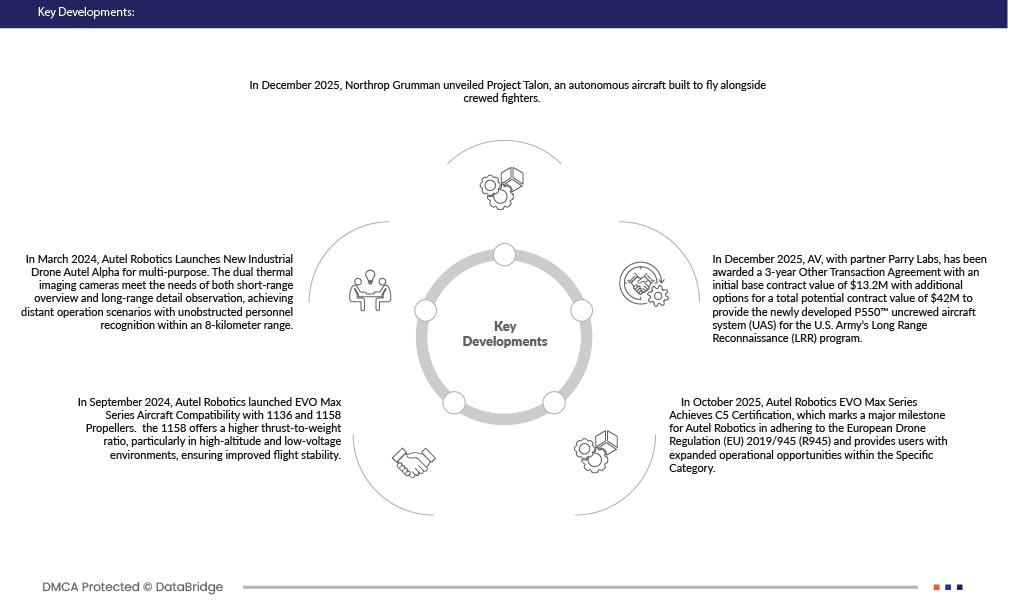
- In December 2025, Northrop Grumman unveiled Project Talon, an autonomous aircraft built to fly alongside crewed fighters. As the latest addition to the company’s elite autonomous portfolio, Project Talon represents a paradigm shift in air dominance as an adaptive, collaborative teammate for combat missions.
- In March 2024, Autel Robotics Launches New Industrial Drone Autel Alpha for multi-purpose. The dual thermal imaging cameras meet the needs of both short-range overview and long-range detail observation, achieving distant operation scenarios with unobstructed personnel recognition within an 8-kilometer range.
- In September 2024, Autel Robotics launched EVO Max Series Aircraft Compatibility with 1136 and 1158 Propellers. the 1158 offers a higher thrust-to-weight ratio, particularly in high-altitude and low-voltage environments, ensuring improved flight stability.
- In October 2025, Autel Robotics EVO Max Series Achieves C5 Certification, which marks a major milestone for Autel Robotics in adhering to the European Drone Regulation (EU) 2019/945 (R945) and provides users with expanded operational opportunities within the Specific Category.
- In December 2025, AV, with partner Parry Labs, has been awarded a 3-year Other Transaction Agreement with an initial base contract value of $13.2M with additional options for a total potential contract value of $42M to provide the newly developed P550™ uncrewed aircraft system (UAS) for the U.S. Army’s Long Range Reconnaissance (LRR) program.
Regional Analysis
Geographically, the country covered in the Global Unmanned Aerial Vehicle market report is U.S., Canada, Mexico, Germany, U.K., France, Italy, Spain, Russia, Turkey, Netherlands, Norway, Finland, Denmark, Sweden, Poland, Switzerland, Belgium, Rest of Europe, China, Japan, India, South Korea, Australia, Indonesia, Thailand, Malaysia, Singapore, Philippines, Rest of Asia-Pacific, Brazil, Argentina, rest of South America. U.A.E., Saudi.
As per Data Bridge Market Research analysis:
North America is the dominant region in the global Unmanned Aerial Vehicle market
North America leads the global Unmanned Aerial Vehicle market due to substantial defense investments, particularly in the U.S., which boasts the world's largest military budget supporting advanced UAV development by firms like Boeing, Lockheed Martin, and Northrop Grumman.
North America is estimated to be the fastest-growing region in the global Unmanned Aerial Vehicle market
North America is expected to be the fastest-growing region in the global Unmanned Aerial Vehicle market from 2026 to 2053, driven by surging government funding for advanced defense technologies and national security.
For more detailed information about the Global Unmanned Aerial Vehicle market click here – https://www.databridgemarketresearch.com/reports/global-unmanned-aerial-vehicle-market