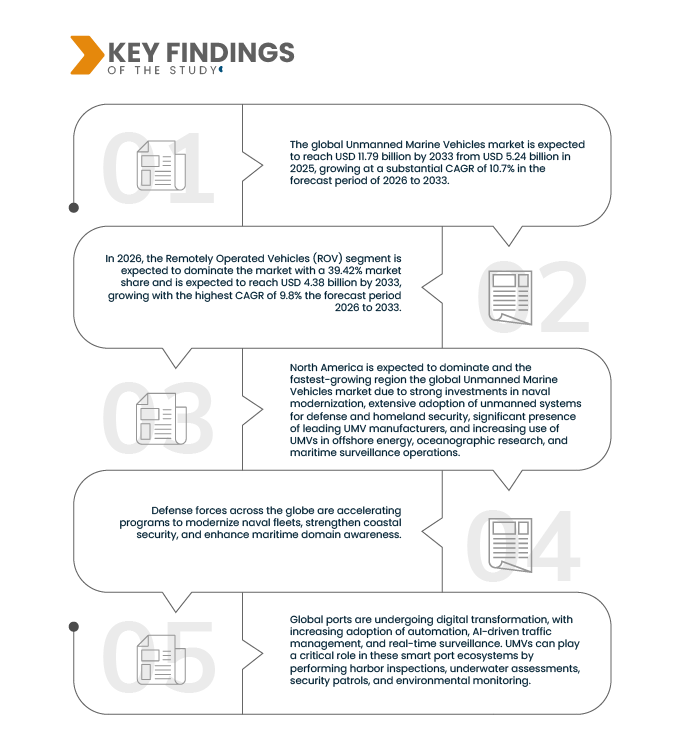
Defense forces across the globe are accelerating programs to modernize naval fleets, strengthen coastal security, and enhance maritime domain awareness. unmanned marine vehicles (UMVs), including Unmanned Surface Vehicles (USVs) and Autonomous Underwater Vehicles (AUVs), are now central to these modernization plans due to their ability to conduct long-endurance missions without risking human life. They support a wide range of tactical and strategic applications, such as intelligence gathering, mine detection, anti-submarine warfare, and persistent surveillance of territorial waters. Rising geopolitical tensions and increasing maritime boundary disputes have further intensified the need for systems that offer real-time situational awareness and rapid threat detection.
Access Full Report @ https://www.databridgemarketresearch.com/reports/global-unmanned-marine-vehicles-market
Data Bridge Market Research analyzes that the Global Unmanned Marine Vehicles Market is expected to reach USD 11.79 billion by 2033 from USD 5.24 billion in 2025, growing at a substantial CAGR of 10.7% in the forecast period of 2026 to 2033.
Key Findings of the Study
Integration With Smart Ports And Digital Maritime Ecosystems
Global ports are undergoing digital transformation, with increasing adoption of automation, AI-driven traffic management, and real-time surveillance. UMVs can play a critical role in these smart port ecosystems by performing harbor inspections, underwater assessments, security patrols, and environmental monitoring. Their ability to operate autonomously enhances port efficiency and reduces manual workload.
As ports continue to implement digital command-and-control centers, UMVs can be seamlessly integrated into centralized monitoring networks. This transformation supports safer port operations, reduces vessel downtime, and improves overall maritime logistics. With rising global investments in smart port infrastructure, the demand for UMV-based solutions is set to accelerate, acting as a key growth driver for the unmanned marine vehicles market.
Report Scope and Market Segmentation
|
Report Metric
|
Details
|
|
Forecast Period
|
2026 to 2033
|
|
Base Year
|
2025
|
|
Historic Year
|
2024 (Customizable 2018-2024)
|
|
Quantitative Units
|
Revenue in USD Billion
|
|
Segments Covered
|
By Vehicle Type (Autonomous Underwater Vehicles (AUV), Remotely Operated Vehicles (ROV), Surface Unmanned Marine Vehicles (USV), Autonomous Surface Vehicles (ASV), Hybrid Systems, Others), By System Component (Sensors & Payloads, Control Systems, Launch & Recovery Systems, Others), By Propulsion (Diesel engine systems, Electric drive systems, Battery module, Fuel cell systems), By Application (Defense & Security, Oil & Gas Exploration, Oceanographic Survey, Search & Rescue, Underwater, Inspection & Maintenance, Scientific Research, Commercial Shipping, Others), By End User (Navy, Coast Guard, Research institutes, Oil & gas industry, Environmental agencies, Maritime security organizations, Port authorities, Salvage & rescue operations, Others), By Distribution Channel Direct sales, Distributors, Online platforms, System integrators), By Operation (Autonomous, Remote controlled)
|
|
Countries Covered
|
US., Canada, Mexico, Germany, UNITED KINGDOM, France, Italy, Spain, Russia, Turkey, Netherlands, Norway, Finland, Denmark, Sweden, Poland, Switzerland, Belgium, Rest of Europe, China, Japan, India, South Korea, Australia, Indonesia, Thailand, Malaysia, Singapore, Philippines, Rest of Asia-Pacific, Argentina, Bolivia, Brazil, Chile, Colombia, Ecuador, Paraguay, Peru, Uruguay, Venezuela Rest of South America, U.A.E., Saudi Arabia, South Africa, Egypt, Israel, Kuwait, Oman, Qatar, Bahrain and rest of Middle East and Africa
|
|
Market Players Covered
|
|
|
Data Points Covered in the Report
|
In addition to the market insights such as market value, growth rate, market segments, geographical coverage, market players, and market scenario, the market report curated by the Data Bridge Market Research team includes in-depth expert analysis, import/export analysis, pricing analysis, production consumption analysis, and pestle analysis.
|
Segment Analysis
Global unmanned marine vehicles market is segmented into seven notable segments based on the vehicle type, system component, propulsion, application, end user, distribution channel and operation.
- On the basis of Vehicle type, the global unmanned marine vehicles Market is segmented into autonomous underwater vehicles (AUV), remotely operated vehicles (ROV), surface unmanned marine vehicles (USV), autonomous surface vehicles (ASV), hybrid systems and others
In 2026, the Remotely Operated Vehicles (ROV) segment is expected to dominate the global unmanned marine vehicles market
In 2026, the Remotely Operated Vehicles (ROV) segment is expected to dominate the market with a market share of 39.42% due to its cost-effectiveness, high bandwidth capability over short distances, and increasing deployment in offshore oil & gas operations, subsea construction, marine research, and underwater inspection tasks where real-time control and high-quality video transmission are critical.
- On the basis of System component, the global unmanned marine vehicles Market is segmented into sensors & payloads, control systems, launch & recovery systems and others
In 2026, Sensors & Payloads segment is expected to dominate the global unmanned marine vehicles market
In 2026, Sensors & Payloads segment is expected to dominate the market with a market share of 37.03% rapid advancements in marine sensing technologies, increasing need for high-resolution seabed mapping, growth in naval ISR missions, and rising use of multi-mission sonar and camera systems for oceanographic, environmental, and commercial underwater operations.
- On the basis of System component, the North America Unmanned Marine Vehicles Market is segmented into sensors & payloads, control systems, launch & recovery systems and others. In 2026 Sensors & Payloads is expected to dominate the North America Unmanned Marine Vehicles Market with The Market Share of 37.03%
- On the basis of Propulsion, the global unmanned marine vehicles Market is segmented into diesel engine systems, electric drive systems, battery modules and fuel cell systems. In 2026, Diesel engine systems segment is expected to dominate the market with a market share of 37.85%
- On the basis of Application, the global unmanned marine vehicles Market is segmented into defense & security, oil & gas exploration, oceanographic survey, search & rescue, underwater inspection & maintenance, scientific research, commercial shipping and others. In 2026, Defense & Security segment is expected to dominate the market with a market share of 46.72%
- On the basis of End user, the global unmanned marine vehicles Market is segmented into navy, coast guard, research institutes, oil & gas industry, environmental agencies, maritime security organizations, port authorities, salvage & rescue operations and others. In 2026, Navy segment is expected to dominate the market with a market share of 44.40%
- On the basis of Distribution channel, the global unmanned marine vehicles Market is segmented into direct sales, Distributors, online platforms and system integrators. In 2026, Direct sales is expected to dominate the market with a market share of 50.31%
- On the basis of operation, the global unmanned marine vehicles Market is segmented into autonomous and remote controlled. In 2026, Remote Controlled is expected to dominate the market with a market share of 58.85%
Major Players
Data Bridge Market Research analyzes L3Harris Technologies, Inc. (U.S.), Kongsberg Discovery (Norway), Oceaneering International, Inc. (U.S.), Subsea 7 (Luxembourg), BAE Systems (U.K.) as the major market players of the global unmanned marine vehicles market.
Market Developments
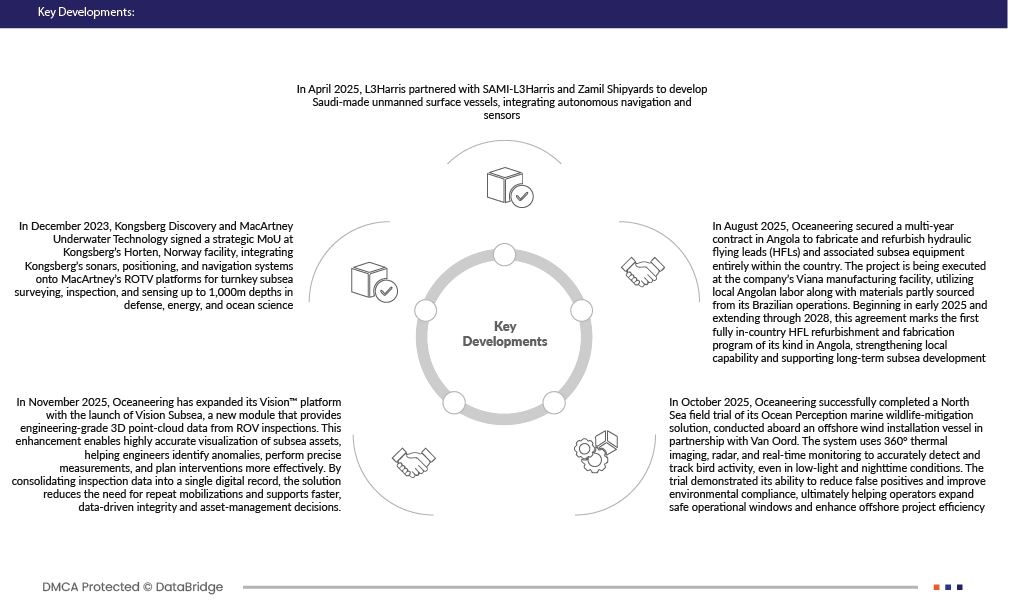
- In April 2025, L3Harris partnered with SAMI-L3Harris and Zamil Shipyards to develop Saudi-made unmanned surface vessels, integrating autonomous navigation and sensors
- In December 2023, Kongsberg Discovery and MacArtney Underwater Technology signed a strategic MoU at Kongsberg’s Horten, Norway facility, integrating Kongsberg’s sonars, positioning, and navigation systems onto MacArtney’s ROTV platforms for turnkey subsea surveying, inspection, and sensing up to 1,000m depths in defense, energy, and ocean science
- In November 2025, Oceaneering has expanded its Vision™ platform with the launch of Vision Subsea, a new module that provides engineering-grade 3D point-cloud data from ROV inspections. This enhancement enables highly accurate visualization of subsea assets, helping engineers identify anomalies, perform precise measurements, and plan interventions more effectively. By consolidating inspection data into a single digital record, the solution reduces the need for repeat mobilizations and supports faster, data-driven integrity and asset-management decisions.
- In October 2025, Oceaneering successfully completed a North Sea field trial of its Ocean Perception marine wildlife-mitigation solution, conducted aboard an offshore wind installation vessel in partnership with Van Oord. The system uses 360° thermal imaging, radar, and real-time monitoring to accurately detect and track bird activity, even in low-light and nighttime conditions. The trial demonstrated its ability to reduce false positives and improve environmental compliance, ultimately helping operators expand safe operational windows and enhance offshore project efficiency
- In August 2025, Oceaneering secured a multi-year contract in Angola to fabricate and refurbish hydraulic flying leads (HFLs) and associated subsea equipment entirely within the country. The project is being executed at the company’s Viana manufacturing facility, utilizing local Angolan labor along with materials partly sourced from its Brazilian operations. Beginning in early 2025 and extending through 2028, this agreement marks the first fully in-country HFL refurbishment and fabrication program of its kind in Angola, strengthening local capability and supporting long-term subsea development
Regional Analysis
Geographically, the countries covered in the global unmanned marine vehicles market report are the U.S.., Canada, Mexico, Germany, U.K., France, Italy, Spain, Russia, Turkey, Netherlands, Norway, Finland, Denmark, Sweden, Poland, Switzerland, Belgium, rest of Europe, China, Japan, India, South Korea, Australia, Indonesia, Thailand, Malaysia, Singapore, Philippines, rest of Asia-Pacific, Argentina, Bolivia, Brazil, Chile, Colombia, Ecuador, Paraguay, Peru, Uruguay, Venezuela, rest of South America, U.A.E., Saudi Arabia, South Africa, Egypt, Israel, Kuwait, Oman, Qatar, Bahrain, and rest of Middle East and Africa.
As per Data Bridge Market Research analysis:
North America is expected to be the dominant and the fastest-growing region in the global unmanned marine vehicles market
North America is expected to dominate and the fastest-growing region the global unmanned marine vehicles market due to strong investments in naval modernization, extensive adoption of unmanned systems for defense and homeland security, significant presence of leading UMV manufacturers, and increasing use of UMVs in offshore energy, oceanographic research, and maritime surveillance operations.
Asia-Pacific is expected to be the fastest-growing region the global unmanned marine vehicles market due to Growing domestic capabilities in robotics, AI, and autonomous systems allow Asia-Pacific countries to develop and deploy UMVs cost-effectively.
For more detailed information about the global unmanned marine vehicles market report, click here – https://www.databridgemarketresearch.com/reports/global-unmanned-marine-vehicles-market