
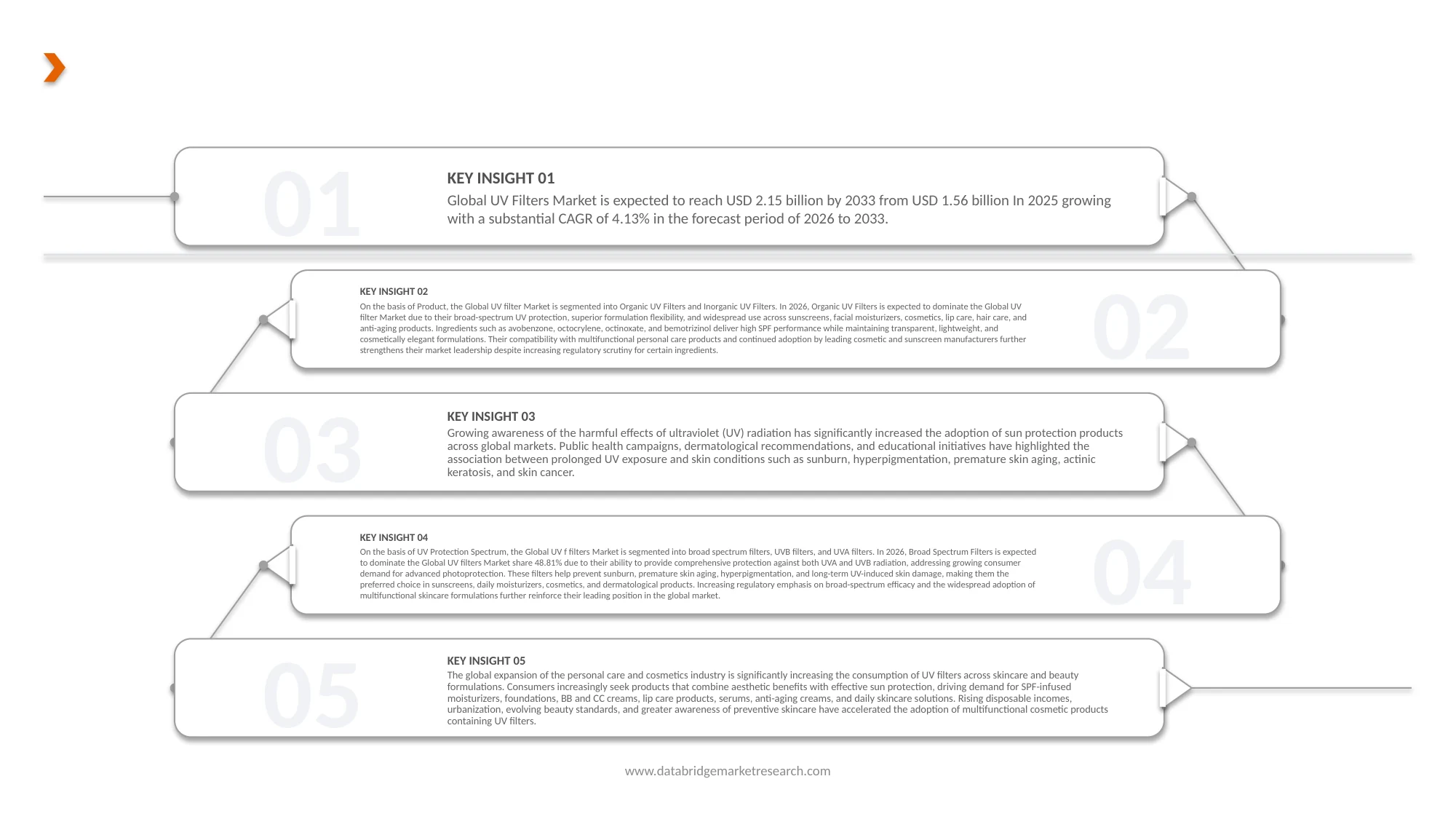
Growing awareness of the harmful effects of ultraviolet (UV) radiation has significantly increased the adoption of sun protection products across global markets. Public health campaigns, dermatological recommendations, and educational initiatives have highlighted the association between prolonged UV exposure and skin conditions such as sunburn, hyperpigmentation, premature skin aging, actinic keratosis, and skin cancer. Consumers increasingly recognize sunscreen as an essential component of daily skincare rather than a seasonal product, leading to higher demand for formulations offering broad-spectrum UVA and UVB protection. Rising interest in preventive skincare, coupled with expanding use of SPF-infused cosmetics, moisturizers, and dermatological products, has further accelerated the consumption of advanced UV filters in personal care formulations. This growing awareness of skin protection and skin health acts as a major driver for the global UV filters market by consistently increasing demand for high-performance UV filters ingredients across sunscreen and skincare products.
Access Full Report @ https://www.databridgemarketresearch.com/reports/global-uv-filter-market
The UV Filters Market is expected to reach USD 2.15 billion by 2033 from USD 1.56 billion In 2025 growing with a substantial CAGR of 4.13% in the forecast period of 2026 to 2033.
Key Findings of the Study
Growing Demand for Personal Care and Cosmetic Products
The global expansion of the personal care and cosmetics industry is significantly increasing the consumption of UV filters across skincare and beauty formulations. Consumers increasingly seek products that combine aesthetic benefits with effective sun protection, driving demand for SPF-infused moisturizers, foundations, BB and CC creams, lip care products, serums, anti-aging creams, and daily skincare solutions. Rising disposable incomes, urbanization, evolving beauty standards, and greater awareness of preventive skincare have accelerated the adoption of multifunctional cosmetic products containing UV filters. Premium beauty brands and dermatological skincare manufacturers continue incorporating advanced organic and inorganic UV filters to enhance product efficacy, photostability, and broad-spectrum protection. The growing demand for personal care and cosmetic products acts as a major driver for the global UV filters market by increasing the incorporation of UV filters ingredients across a wide range of skincare, cosmetic, and sun care formulations.
Report Scope and Market Segmentation
|
Report Metric
|
Details
|
|
Forecast Period
|
2026 to 2033
|
|
Base Year
|
2025
|
|
Historic Years
|
2018-2024 (Customizable to 2013-2017)
|
|
Quantitative Units
|
Revenue in USD Million
|
|
Segments Covered
|
By Product (Organic UV filters, Inorganic UV filters), By Source (Synthetic UV filters, Mineral UV filters, Bio-Based UV filters, Others), By Form (Liquid, Powder, Dispersion / Slurry, Paste, Others), By UV Protection Spectrum (Broad Spectrum Filters, UVB Filters, UVA Filters), By Functionality (UV Absorbers, UV Reflectors / Scattering Agents, Spf Boosters, Photostabilizers, Others), By Chemical Class (Metal Oxides, Cinnamates, Triazines, Salicylates, Dibenzoylmethanes, Benzophenones, Benzimidazoles, Camphor Derivatives, Anthranilates), By Solubility (Oil-Soluble, Dispersible, Water-Soluble, Encapsulated / Controlled Release, Others) By Sunscreen Application (Daily Wear Sunscreens, Facial Sunscreens, Body Sunscreens, Sports & Outdoor Sunscreens, Sensitive Skin / Dermatological Sunscreens, Water-Resistant Sunscreens, Baby & Children's Sunscreens) By Distribution Channel (Direct B2B Sales, Ingredient Distributors, Specialty Chemical Suppliers, Others)
|
|
Countries Covered
|
U.S., Canada and Mexico in North America, Germany, U.K., France, Spain, Belgium, Russia, Netherlands, Italy, Turkey, Switzerland, Sweden, Denmark, Norway, Finland, and Rest of Europe in Europe, India, China, Japan, Australia, South Korea, Singapore, Thailand, Indonesia, Taiwan, Hong Kong, Malaysia, New Zealand, Philippines, and Rest of Asia-Pacific (APAC) in the Asia-Pacific (APAC), U.A.E, Saudi Arabia, South Africa, Egypt, Qatar, Kuwait, Bahrain, Oman, Israel, and Rest of Middle East and Africa as a part of Middle East and Africa (MEA), Brazil, Argentina and rest of South America as part of South America.
|
|
Market Players Covered
|
|
|
Data Points Covered in the Report
|
In addition to the insights on market scenarios such as market value, growth rate, segmentation, geographical coverage, and major players, the market reports curated by the Data Bridge Market Research also include import export analysis, production capacity overview, production consumption analysis, price trend analysis, climate change scenario, supply chain analysis, value chain analysis, raw material/consumables overview, vendor selection criteria, PESTLE Analysis, Porter Analysis, and regulatory framework.
|
Segment Analysis
Global UV filters Market is categorized into nine notable segments which are based on product, source, form, UV protection spectrum, functionality, chemical class, solubility, sunscreen application, and distribution channel.
- On the basis of Product, the Global UV filters Market is segmented into organic UV filters and inorganic UV filters.
In 2026, Organic UV filters segment is expected to dominate the market
In 2026, Organic UV filters is expected to dominate the Global UV filters Market share 67.65% due to their broad-spectrum UV protection, superior formulation flexibility, and widespread use across sunscreens, facial moisturizers, cosmetics, lip care, hair care, and anti-aging products. Ingredients such as avobenzone, octocrylene, octinoxate, and bemotrizinol deliver high SPF performance while maintaining transparent, lightweight, and cosmetically elegant formulations. Their compatibility with multifunctional personal care products and continued adoption by leading cosmetic and sunscreen manufacturers further strengthens their market leadership despite increasing regulatory scrutiny for certain ingredients.
- On the basis of Source, the Global UV filters Market is segmented into synthetic UV filters, mineral UV filters, bio-based UV filters, and others.
In 2026, synthetic UV filters segment is expected to dominate the market
In 2026, synthetic UV filters is expected to dominate the Global UV filters Market share 69.69% due to their extensive use in sunscreens, cosmetics, skincare, hair care, and pharmaceutical formulations. These filters provide broad-spectrum UV protection, high SPF efficiency, excellent photostability, and compatibility with a wide range of formulations while delivering transparent, lightweight, and aesthetically appealing products. Their established regulatory approvals across major markets, large-scale commercial production, and cost-effective manufacturing further support their widespread adoption, reinforcing their leading position in the global market.
- On the basis of form, the Global UV filters Market is segmented into liquid, powder, dispersion / slurry, paste, and others.
In 2026, liquid segment is expected to dominate the market
In 2026, liquid is expected to dominate the Global UV filters Market share 46.44% due to its excellent compatibility with sunscreen, skincare, cosmetic, hair care, and pharmaceutical formulations. Liquid UV filters offer easy incorporation into emulsions and lotions, ensure uniform dispersion, and enable the development of lightweight, transparent, and high-performance products with superior sensory appeal. Their suitability for large-scale manufacturing, formulation flexibility, and widespread use in premium and mass-market personal care products further strengthen their dominant position in the global UV filters Market.
- On the basis of UV Protection Spectrum, the Global UV filters Market is segmented into broad spectrum filters, UVB filters, and UVA filters.
In 2026, broad spectrum filters segment is expected to dominate the market
In 2026, Broad Spectrum Filters is expected to dominate the Global UV filters Market share 48.81% due to their ability to provide comprehensive protection against both UVA and UVB radiation, addressing growing consumer demand for advanced photoprotection. These filters help prevent sunburn, premature skin aging, hyperpigmentation, and long-term UV-induced skin damage, making them the preferred choice in sunscreens, daily moisturizers, cosmetics, and dermatological products. Increasing regulatory emphasis on broad-spectrum efficacy and the widespread adoption of multifunctional skincare formulations further reinforce their leading position in the global market.
- On the basis of Functionality, the Global UV filters Market is segmented into UV absorbers, UV reflectors / scattering agents, SPF boosters, photostabilizers, others.
In 2026, UV Absorbers segment is expected to dominate the market
In 2026, UV absorbers are expected to dominate the Global UV filters Market share 61.36% owing to their superior ability to absorb both UVA and UVB radiation while providing broad-spectrum protection, high SPF performance, and excellent formulation compatibility. Their widespread adoption in sunscreens, skincare, and cosmetic products, supported by continuous innovations in photostable organic UV filters, further strengthens their market leadership.
- On the basis of chemical class, Global UV filters Market is segmented into metal oxides, cinnamates, triazines, salicylates, dibenzoylmethanes, benzophenones, benzimidazoles, camphor derivatives, and anthranilates.
In 2026, metal oxides segment is expected to dominate the market
In 2026, Metal Oxides is expected to dominate the Global UV filters Market share 26.85% due to the increasing preference for mineral-based UV filters, particularly titanium dioxide and zinc oxide, which provide effective broad-spectrum UVA and UVB protection with excellent photostability. Their widespread adoption in sensitive skin, baby care, reef-friendly, and dermatologist-recommended formulations has accelerated alongside growing consumer demand for safer and environmentally responsible ingredients. Expanding regulatory acceptance, compatibility with clean-label skincare products, and rising demand for mineral sunscreens further strengthen the leadership of the Metal Oxides segment in the global market
- On the basis of solubility, Global UV filters Market is segmented into oil-soluble, dispersible, water-soluble, encapsulated / controlled release, and others.
In 2026, oil-soluble segment is expected to dominate the market
In 2026, oil-soluble is expected to dominate the Global UV filters Market share 56.52% due to its widespread use in sunscreen, skincare, cosmetic, and personal care formulations. Most organic UV filters are oil-soluble, enabling high SPF performance, excellent photostability, and efficient incorporation into emulsions, creams, lotions, and water-resistant products. Oil-soluble filters also enhance formulation stability, improve sensory attributes, and provide uniform UV protection without compromising product aesthetics. Their extensive adoption by cosmetic and sunscreen manufacturers continues to reinforce the segment's leading position in the global UV filters Market.
- On the basis of sunscreen application, the market is segmented into daily wear sunscreens, facial sunscreens, body sunscreens, sports & outdoor sunscreens, sensitive skin / dermatological sunscreens, water-resistant sunscreens, and baby & children's sunscreens.
In 2026, daily wear sunscreens segment is expected to dominate the market
In 2026, daily wear sunscreens is expected to dominate the Global UV filters Market share 27.80% due to increasing consumer awareness of the harmful effects of year-round UV exposure and the growing adoption of daily photoprotection as part of regular skincare routines. The rising popularity of moisturizers, BB/CC creams, foundations, and other multifunctional products with SPF has significantly increased demand for UV filters in everyday formulations. Recommendations from dermatologists for daily sunscreen use, coupled with growing urbanization and prolonged outdoor exposure, further strengthen the dominance of the Daily Wear Sunscreens segment in the global market
- On the basis of distribution channel, the Global UV filters Market is segmented into direct b2b sales, ingredient distributors, specialty chemical suppliers, and others.
In 2026, direct b2b sales segment is expected to dominate the market
In 2026, direct b2b sales is expected to dominate the Global UV filters Market share 47.10% due to the high-volume procurement requirements of sunscreen, cosmetics, personal care, pharmaceutical, and industrial coating manufacturers. Direct sourcing enables manufacturers to secure consistent product quality, customized formulations, long-term supply agreements, technical support, and competitive pricing while ensuring regulatory compliance and supply chain reliability. Strong strategic partnerships between UV filters producers and end-use manufacturers, along with bulk purchasing practices, further reinforce the dominance of the Direct B2B Sales segment in the global market.
Major Players
Symrise (Germany), BASF (Germany), Advanced ZincTek (Australia), Berg, Chemspec Chemicals Private Limited (India), Croda (U.K.), dsm-firmenich (Switzerland), EverZinc (Belgium), Galaxy Surfactants (India), Jay Finechem (India), Ketul Chem Pvt. Ltd. (India), Kobo Products, Inc. (U.S.), SUSONITY Commercial GmbH (Germany), SAKAI CHEMICAL INDUSTRY CO., LTD. (Japan), Salicylates & Chemicals Pvt. Ltd. (India), Sarex (India), Sunjin Beauty Science (South Korea), Tagra Biotechnologies (Israel), and TAYCA Co., Ltd. (Japan)
 Market Developments
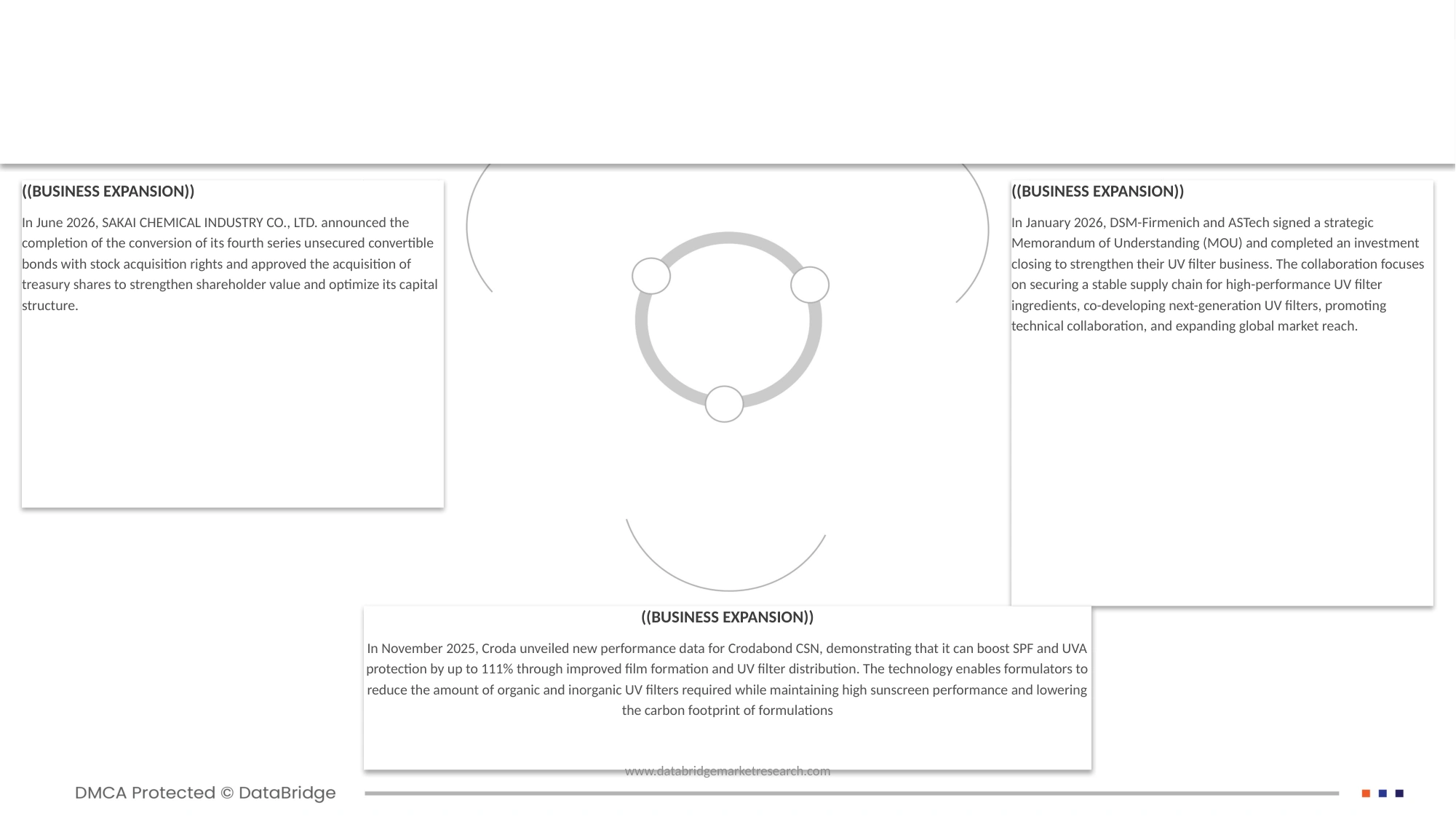
- In June 2026, SAKAI CHEMICAL INDUSTRY CO., LTD. announced the completion of the conversion of its fourth series unsecured convertible bonds with stock acquisition rights and approved the acquisition of treasury shares to strengthen shareholder value and optimize its capital structure.
- In January 2026, DSM-Firmenich and ASTech signed a strategic Memorandum of Understanding (MOU) and completed an investment closing to strengthen their UV filters business. The collaboration focuses on securing a stable supply chain for high-performance UV filters ingredients, co-developing next-generation UV filterss, promoting technical collaboration, and expanding global market reach.
- In November 2025, Croda unveiled new performance data for Crodabond CSN, demonstrating that it can boost SPF and UVA protection by up to 111% through improved film formation and UV filters distribution. The technology enables formulators to reduce the amount of organic and inorganic UV filterss required while maintaining high sunscreen performance and lowering the carbon footprint of formulations
- In April 2026, BASF introduced Uvinul T 150 X EcoBalanced, its first biomass balance (BMB) UV filters, at in-cosmetics Global 2026. The product offers the same high-performance UVB protection as conventional Uvinul T 150 while significantly reducing the product carbon footprint through the use of renewable feedstocks.
- In June 2025, Symrise launched Neo Heliopan 310 (Diethylhexyl Butamido Triazone), a highly photostable organic crystalline UVB filter with excellent solubility and compatibility. The ingredient enables high-SPF formulations, offers photoaging prevention, and is suitable for water-resistant sunscreens, anti-aging creams, serums, lotions, and water-free formulations. It is approved for use in the EU, China, ASEAN, and Mercosur at concentrations up to 10%.
As per Data Bridge Market Research analysis:
For more detailed information about the UV filters market report, click here – https://www.databridgemarketresearch.com/reports/global-uv-filter-market










