The dry eye syndrome market offers diverse solutions, including tear stimulators, artificial tears, and secretagogues, addressing varied patient needs. These products aim to alleviate symptoms through different mechanisms. Dosage types encompass liquids, semi-solids, and others, providing options for personalized treatment. This dynamic market reflects a commitment to enhancing patient comfort and addressing the multifaceted nature of dry eye syndrome, offering a range of innovative products tailored to individual preferences and conditions.
Access Full Report at https://databridgemarketresearch.com/reports/global-dry-eye-syndrome-market
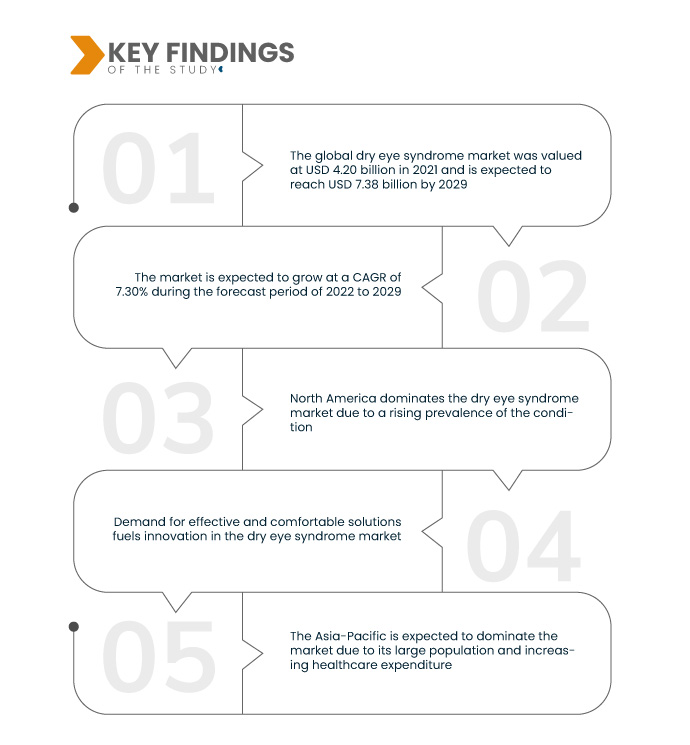
Data Bridge Market Research analyses that the Global Dry Eye Syndrome Market was valued at USD 4.20 billion in 2021 and is expected to reach USD 7.38 billion by 2029, registering a CAGR of 7.30% during the forecast period of 2022 to 2029. The surge in healthcare expenditure significantly propels the dry eye syndrome market, fostering the development and widespread adoption of advanced treatments. This financial investment supports research, innovation, and the implementation of cutting-edge solutions, ultimately improving patient care and outcomes for individuals with dry eye conditions.
Key Findings of the Study
Aging population is expected to drive the market's growth rate
The expanding aging population is a pivotal driver in the dry eye syndrome market, correlating with an elevated risk of dry eye conditions. As individuals age, physiological changes, and an increased prevalence of age-related factors contribute to dry eye symptoms. This demographic trend underscores the pressing need for effective treatments and drives the market's focus on developing innovative solutions to address the unique challenges posed by dry eye conditions in the elderly, enhancing overall patient care.
Report Scope and Market Segmentation
Report Metric
|
Details
|
Forecast Period
|
2022 to 2029
|
Base Year
|
2021
|
Historic Years
|
2020 (Customizable to 2014-2019)
|
Quantitative Units
|
Revenue in USD Billion, Volumes in Units, Pricing in USD
|
Segments Covered
|
Product Type (Tear stimulators, Artificial Tears, Secretagogue, Others), Dosage Type (Liquid, Semi-solid, Others), Drug Class (Lubricating Agent, Cholinergics, Anti-Inflammatory, Anti-Infectives, Anti-Allergics, Others), Dose (Unit dose, Multi-dose), Medication Type (Prescription (Rx) Drugs, Over The Counter (OTC) Drugs), Container Type (Unit-Dose Vials, Bottles, Tubes), Packaging Type (Plastic, Aluminium, Glass), Type (Brands, Generics), Distribution Channel (Hospital Pharmacy, Retail Pharmacy, Online Pharmacy), End-Users (Hospitals, Homecare, Specialty Clinics, Others)
|
Countries Covered
|
U.S., Canada and Mexico in North America, Germany, France, U.K., Netherlands, Switzerland, Belgium, Russia, Italy, Spain, Turkey, Rest of Europe in Europe, China, Japan, India, South Korea, Singapore, Malaysia, Australia, Thailand, Indonesia, Philippines, Rest of Asia-Pacific (APAC) in the Asia-Pacific (APAC), Saudi Arabia, U.A.E, South Africa, Egypt, Israel, Rest of Middle East and Africa (MEA) as a part of Middle East and Africa (MEA), Brazil, Argentina and Rest of South America as part of South America.
|
Market Players Covered
|
Eli Lilly and Company (U.S.), AstraZeneca (U.K.), Novartis AG (Switzerland), Johnson & Johnson Private Limited (U.S.), Teva Pharmaceutical Industries Ltd.(Jerusalem), Merck & Co., Inc. (U.S.), Allergan (Ireland), Bausch Health Companies Inc. (Canada), Abbott (U.S.), F. Hoffmann-La Roche Ltd. (Switzerland), Pfizer Inc. (U.S.), GlaxoSmithKline plc (U.K.), Sanofi (France), Merck KGaA (Germany), Otsuka America Pharmaceutical, Inc. (U.S.), Akorn Operating Company LLC (U.S.), Allostera Pharma Inc. (Canada), I-Med Pharma Inc. (Canada), Santen Pharmaceuticals Co. Ltd., (Japan), AFT Pharmaceuticals (New Zealand), Novaliq GmbH (Germany)
|
Data Points Covered in the Report
|
In addition to the insights on market scenarios such as market value, growth rate, segmentation, geographical coverage, and major players, the market reports curated by the Data Bridge Market Research also include depth expert analysis, patient epidemiology, pipeline analysis, pricing analysis, and regulatory framework.
|
Segment Analysis:
The global dry eye syndrome market is segmented on the basis of product type, dosage type, drug class, dose, medication type, container type, packaging type, type, end-users, and distribution channel.
- On the basis of product type, the global dry eye syndrome market is segmented into tear stimulators, artificial tears, secretagogue, and others
- On the basis of dosage type, the global dry eye syndrome market is segmented into liquid, semi solid, and others
- On the basis of drug class, the global dry eye syndrome market is segmented into anti-inflammatory, lubricating agents, anti-infectives, anti-allergics, cholinergics, and others
- On the basis of dose, the global dry eye syndrome market is segmented into multi dose and unit dose
- On the basis of medication type, the global dry eye syndrome market is segmented into prescription (RX) drugs, and over the counter (OTC) drug
- On the basis of container type, the global dry eye syndrome market is segmented into unit dose vials, bottles, and tubes
- On the basis of packaging type, the global dry eye syndrome market is segmented into plastic, glass, and aluminium
- On the basis of type, the global dry eye syndrome market is segmented into generics and brands
- On the basis of end-users, the global dry eye syndrome market is segmented into hospitals, specialty clinics, homecare, and others
- Com base no canal de distribuição, o mercado global da síndrome do olho seco também foi segmentado em farmácias hospitalares, farmácias de retalho, farmácias online e outras.
Principais jogadores
A Data Bridge Market Research reconhece as seguintes empresas como participantes no mercado global da síndrome do olho seco: Eli Lilly and Company (EUA), AstraZeneca (Reino Unido), Novartis AG (Suíça), Johnson & Johnson Private Limited (EUA), Teva Pharmaceutical Industries Ltd. (Jerusalém), Merck & Co., Inc. (EUA).
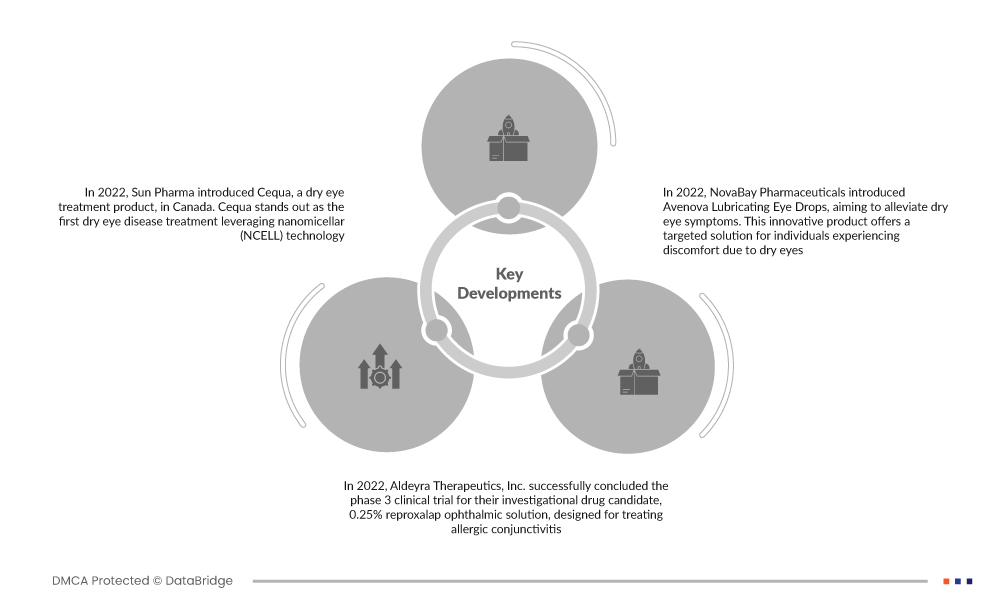
Desenvolvimentos de mercado
- Em 2022, a Sun Pharma lançou o Cequa, um produto para o tratamento do olho seco, no Canadá. Cequa destaca-se como o primeiro tratamento para a doença do olho seco que utiliza a tecnologia nanomicelar (NCELL). Esta abordagem inovadora aumenta a biodisponibilidade e a estabilidade físico-química da ciclosporina, aumentando a sua penetração nos tecidos oculares. O lançamento representa um avanço significativo no tratamento das condições do olho seco, oferecendo uma opção de tratamento eficaz com eficácia terapêutica melhorada e precisão de administração ocular.
- Em 2022, a Aldeyra Therapeutics, Inc. concluiu com sucesso o ensaio clínico de fase 3 para o seu candidato a medicamento experimental, a solução oftálmica de reproxalap a 0,25%, concebida para tratar a conjuntivite alérgica. A empresa apresentou os dados clínicos do estudo na Reunião Anual da Academia Americana de Optometria de 2022, assinalando um marco significativo no avanço de potenciais opções de tratamento para a conjuntivite alérgica através de uma avaliação clínica rigorosa e da apresentação de resultados de investigação convincentes.
- Em 2022, a NovaBay Pharmaceuticals lançou o colírio lubrificante Avenova, com o objetivo de aliviar os sintomas do olho seco. Este produto inovador oferece uma solução direcionada para indivíduos que sofrem de desconforto devido aos olhos secos. Os colírios lubrificantes Avenova contribuem para o crescente cenário de tratamentos para o olho seco, oferecendo aos pacientes uma opção fiável para aumentar a humidade dos olhos e aliviar os sintomas associados a esta condição ocular prevalente.
Análise Regional
Geograficamente, os países abrangidos pelo relatório do mercado global da síndrome do olho seco são os EUA, Canadá e México na América do Norte, Alemanha, França, Reino Unido, Holanda, Suíça, Bélgica, Rússia, Itália, Espanha, Turquia, Resto da Europa na Europa, China, Japão, Índia, Coreia do Sul, Singapura, Malásia, Austrália, Tailândia, Indonésia, Filipinas, Resto da Ásia-Pacífico (APAC) na Ásia-Pacífico (APAC), Arábia Saudita, Emirados Árabes Unidos, África do Sul, Egito, Israel, Resto do Médio Oriente e África (MEA) como parte do Médio Oriente e África (MEA), Brasil, Argentina e Resto da América do Sul como parte da América do Sul.
De acordo com a análise de pesquisa de mercado da Data Bridge:
A América do Norte é a região dominante no mercado global da síndrome do olho seco durante o período previsto de 2022-2029
A América do Norte domina o mercado da síndrome do olho seco devido à crescente prevalência da doença. O domínio da região é sublinhado pelo crescente foco dos principais players do setor em tecnologias inovadoras. Este esforço concentrado em busca de novas soluções contribui para uma maior taxa de crescimento no mercado, refletindo o empenho da região em enfrentar os desafios impostos pela síndrome do olho seco através de intervenções terapêuticas e tecnológicas avançadas.
Prevê-se que a região Ásia-Pacífico domine o mercado global da síndrome do olho seco no período previsto de 2022 a 2029
Espera-se que a região Ásia-Pacífico domine o mercado devido à sua grande população e ao aumento dos gastos com a saúde. Com uma base demográfica substancial, o aumento dos investimentos em cuidados de saúde contribui para a expansão dos serviços e tecnologias médicas. Esta convergência de factores posiciona a Ásia-Pacífico como um dos principais impulsionadores do crescimento no período previsto, enfatizando o cenário de saúde em evolução da região e o seu impacto na dinâmica do mercado.
Para obter informações mais detalhadas sobre o relatório do mercado global da síndrome do olho seco, clique aqui – https://www.databridgemarketresearch.com/reports/global-dry-eye-syndrome-market