The global internet of things (IoT) node and gateway market represent a dynamic landscape of interconnected devices and communication hubs facilitating seamless data exchange. IoT nodes serve as endpoints, collecting and transmitting data from sensors and devices, while gateways act as intermediaries that aggregate, process, and relay this information to the cloud or other connected systems. This market encompasses a wide array of industries, including healthcare, manufacturing, smart cities, and agriculture, driving the proliferation of IoT applications.
Access Full Report at https://www.databridgemarketresearch.com/reports/global-iot-node-gateway-market
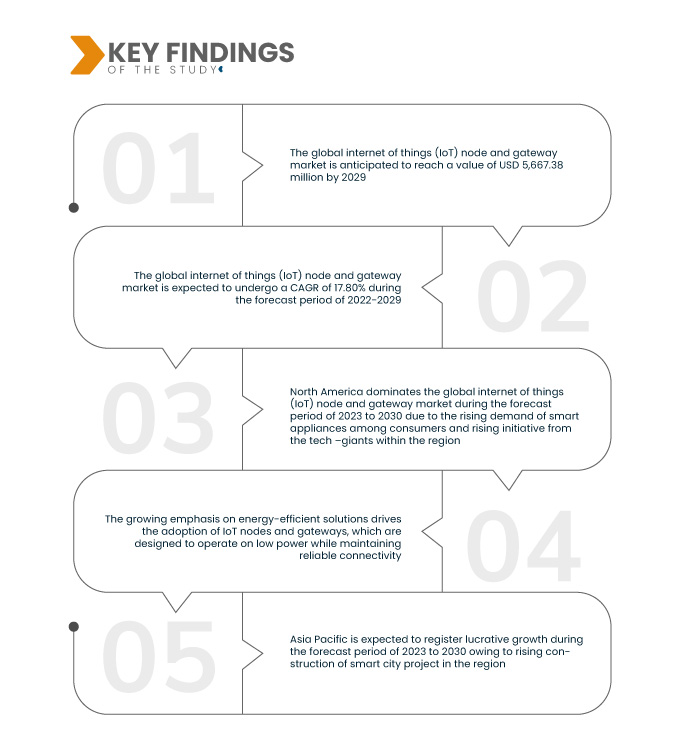
Data Bridge Market Research analyses that the Global Internet of Things (IoT) Node and Gateway Market which was USD 1,259.86 million in 2021 and is expected to reach USD 5,667.38 million by 2029, registering a CAGR of 17.80% during the forecast period of 2022-2029. IoT nodes and gateways are essential for connecting devices, sensors, and systems in industrial automation and smart manufacturing. They enable data-driven decision-making, predictive maintenance, and process optimization, aligning with the industry 4.0 paradigm and fostering digital transformation in the manufacturing sector.
Key Findings of the Study
Development of 5G technology is expected to drive the market's growth rate
The imminent rollout of 5G technology herald’s significant advancements for the IoT market. With a substantial increase in internet users, 5G promises enhanced worker safety and the ability to control a greater number of devices remotely. Its high-speed and low-latency capabilities open doors for revolutionary applications, such as enabling remote surgeries and fostering a new era of connectivity where real-time interactions and control become increasingly accessible and efficient.
Report Scope and Market Segmentation
Report Metric
|
Details
|
Forecast Period
|
2022 to 2029
|
Base Year
|
2021
|
Historic Years
|
2020 (Customizable to 2014-2019)
|
Quantitative Units
|
Revenue in USD Million, Volumes in Units, Pricing in USD
|
Segments Covered
|
Component (Sensors, Processors, Connectivity IC, Memory Devices, and Logic Devices), Connectivity (Ethernet, Wi-Fi, Bluetooth, ZigBee, Z-Wave and Others), Application (Wearable Devices, Consumer Electronics, Healthcare, Automotive and Transportation, Industrial, Building Automation, Retail, Aerospace and Defense, Banking, Financial Services and Insurance (BFSI), Oil and Gas, Agriculture and Others)
|
Countries Covered
|
U.S., Canada and Mexico in North America, Germany, France, U.K., Netherlands, Switzerland, Belgium, Russia, Italy, Spain, Turkey, Rest of Europe in Europe, China, Japan, India, South Korea, Singapore, Malaysia, Australia, Thailand, Indonesia, Philippines, Rest of Asia-Pacific (APAC) in the Asia-Pacific (APAC), Saudi Arabia, U.A.E, South Africa, Egypt, Israel, Rest of Middle East and Africa (MEA) as a part of Middle East and Africa (MEA), Brazil, Argentina and Rest of South America as part of South America
|
Market Players Covered
|
Dell (U.S.), EUROTECH (India), NXP Semiconductors (Netherlands), Cisco (U.S.), Advantech Co., Ltd. (Taiwan), AAEON (Taiwan), ADLINK Technology Inc. (Taiwan), ARM LIMITED (U.K.), Cradlepoint, Inc (U.S.), Embitel (India), Helium Systems Inc. (U.S.), Hewlett Packard Enterprise Development LP (India), Huawei Technologies Co., Ltd (China), Intel Corporation (U.S.), Lantronix, Inc (U.S.), Microchip Technology Inc (U.S.), Mitsubishi Electric Corporation (Japan), NEXCOM International Co., Ltd (Taiwan), Samsara Networks (U.S.), Inc., STMicroelectronics (Switzerland), Texas Instruments Incorporated (U.S.), TE Connectivity (Switzerland), and VOLANSYS Technologies (India), among others
|
Data Points Covered in the Report
|
In addition to the insights on market scenarios such as market value, growth rate, segmentation, geographical coverage, and major players, the market reports curated by the Data Bridge Market Research also include in-depth expert analysis, geographically represented company-wise production and capacity, network layouts of distributors and partners, detailed and updated price trend analysis and deficit analysis of supply chain and demand.
|
Segment Analysis:
The global internet of things (IoT) node and gateway market is segmented on the basis of component, connectivity and application.
- On the basis of component, the global internet of things (IoT) node and gateway market is segmented into sensors, processors, connectivity IC, logic devices, and memory devices
- On the basis of connectivity, the global internet of things (IoT) node and gateway market is segmented into ethernet, Wi-Fi, bluetooth, zigbee, z-wave, and others
- On the basis of application, the global internet of things (IoT) node and gateway market is segmented into wearable devices, consumer electronics, healthcare, automotive and transportation, industrial, building automation, retail, aerospace and defense, banking, financial services and insurance (BFSI), oil and gas, agriculture and others
Major Players-
Data Bridge Market Research recognizes the following companies as the major global internet of things (IoT) node and gateway market players in the global internet of things (IoT) node and gateway market are Dell (U.S.), EUROTECH (India), NXP Semiconductors (Netherlands), Cisco (U.S.), Advantech Co., Ltd. (Taiwan), AAEON (Taiwan), ADLINK Technology Inc. (Taiwan), ARM LIMITED (U.K.), Cradlepoint, Inc (U.S.), Embitel (India)
Desenvolvimentos de mercado
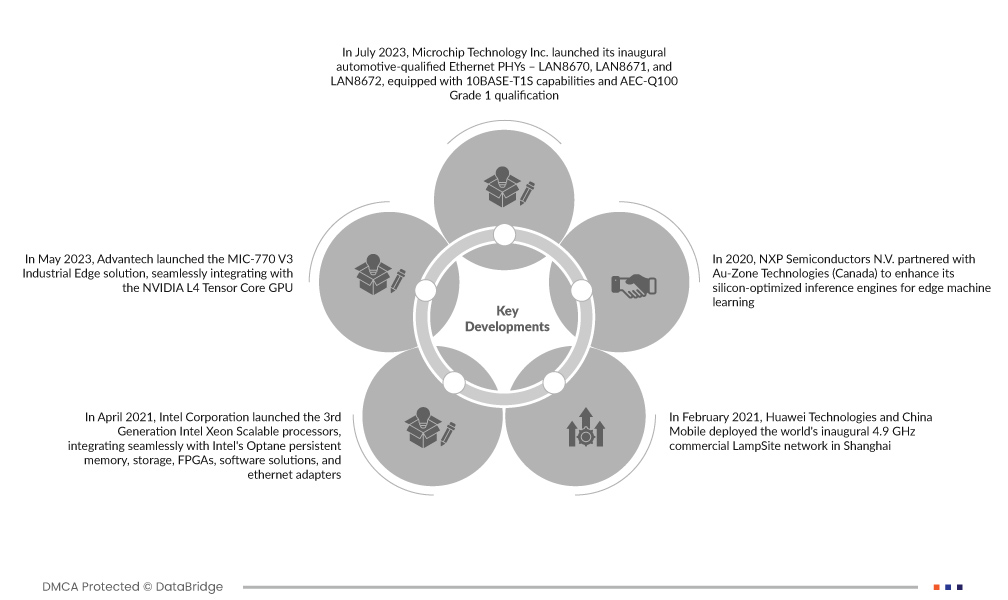
- Em 2023, a Microchip Technology Inc. lançou os seus primeiros Ethernet PHY qualificados para o setor automóvel – LAN8670, LAN8671 e LAN8672, equipados com capacidades 10BASE-T1S e qualificação AEC-Q100 Grau 1. Em conformidade com as normas de segurança funcional ISO 26262, estes PHY permitem a integração de dispositivos de baixa velocidade numa rede Ethernet padronizada em aplicações automóveis
- Em 2023, a Advantech lançou a solução Industrial Edge MIC-770 V3, integrando-se perfeitamente com o GPU NVIDIA L4 Tensor Core. Com uns modestos 7.424 núcleos CUDA e 24 GB de memória GPU GDDR6, esta solução de eficiência energética, que consome apenas 72 W, facilita diversas aplicações de AIoT, incluindo aprendizagem profunda, inferência de ponta e automação em vários setores.
- Em 2021, a Intel Corporation lançou os processadores escaláveis Intel Xeon de 3ª geração, integrando-se perfeitamente com a memória persistente Optane da Intel, armazenamento, FPGAs, soluções de software e adaptadores Ethernet. Este portfólio abrangente melhora o desempenho, as capacidades de memória e a versatilidade, capacitando as empresas com soluções avançadas para uma gama diversificada de aplicações de computação.
- Em 2021, a Huawei Technologies e a China Mobile implementaram a rede comercial inaugural LampSite de 4,9 GHz do mundo em Xangai. Esta implementação marcou a primeira instância de redes internas digitais com uma largura de banda agregada de 200 MHz nas bandas de 2,6 e 4,9 GHz, juntamente com a tecnologia Massive MIMO distribuída.
- Em 2020, a NXP Semiconductors NV estabeleceu uma parceria com a Au-Zone Technologies (Canadá) para melhorar os seus mecanismos de inferência otimizados para o silício para a aprendizagem automática de ponta. Esta parceria teve como objetivo aumentar o ambiente de desenvolvimento de software de aprendizagem automática elQ da NXP, reforçando as suas capacidades no fornecimento de soluções avançadas para aplicações de inteligência artificial de ponta.
Análise Regional
Geograficamente, os países abrangidos pelo relatório do mercado global de nós e gateways da Internet das Coisas (IoT) são os EUA, Canadá e México na América do Norte, Alemanha, França, Reino Unido, Holanda, Suíça, Bélgica, Rússia, Itália, Espanha, Turquia, Resto da Europa na Europa, China, Japão, Índia, Coreia do Sul, Singapura, Malásia, Austrália, Tailândia, Indonésia, Filipinas, Resto da Ásia-Pacífico (APAC) na Ásia-Pacífico (APAC), Arábia Saudita, Emirados Árabes Unidos, África do Sul, Egito, Israel, Resto do Médio Oriente e África (MEA) como parte do Médio Oriente e África (MEA), Brasil, Argentina e Resto da América do Sul como parte da América do Sul
De acordo com a análise de pesquisa de mercado da Data Bridge:
A América do Norte é a região dominante no mercado global de nós e gateways da Internet das Coisas (IoT) durante o período previsto de 2022-2029
A América do Norte domina o mercado global de nós e gateways de internet das coisas (IoT), impulsionada pela crescente procura de dispositivos inteligentes entre os consumidores e pelas iniciativas proativas dos gigantes tecnológicos da região. O aumento da adoção de dispositivos habilitados para IoT, aliado a iniciativas estratégicas, posiciona a América do Norte como um ator-chave na formação da trajetória do mercado de nós e gateways IoT, refletindo a liderança da região no avanço de tecnologias conectadas e soluções inteligentes.
Estima-se que a Ásia-Pacífico seja a região de crescimento mais rápido no mercado global de nós e gateways da Internet das Coisas (IoT) durante o período previsto de 2022 a 2029.
Espera-se que a Ásia-Pacífico domine o mercado global de nós e gateways de internet das coisas (IoT) durante o período previsto de 2022 a 2029. Este domínio é impulsionado pelo crescimento substancial da região, atribuído ao aumento dos projetos de cidades inteligentes. A crescente construção de cidades inteligentes na Ásia-Pacífico impulsiona a procura por nós e gateways IoT, estabelecendo a região como um ator chave na formação do cenário interligado e impulsionando a adoção da IoT em diversos setores.
Para obter informações mais detalhadas sobre o relatório do mercado global de nós e gateways da Internet das Coisas (IoT), clique aqui – https://www.databridgemarketresearch.com/reports/global-iot-node-gateway-market