
PET-CT scanning services refer to diagnostic imaging solutions that combine Positron Emission Tomography (PET) and Computed Tomography (CT) technologies into a single integrated system. This hybrid imaging technique captures metabolic activity through PET and anatomical details through CT, allowing clinicians to detect, stage, and monitor diseases with high precision. The service includes scan procedures, radiotracer administration, image interpretation, and reporting performed in hospitals, diagnostic centers, and specialized imaging facilities. The market for PET-CT scanning services encompasses all clinical applications, infrastructure support, and service-based models that provide access to these advanced imaging systems. It is driven by rising cancer prevalence, increasing adoption of precision diagnostics, expanding use in cardiology and neurology, and growing demand for early disease detection. Service providers include public and private imaging centers offering PET-CT scans either directly to patients or through referrals from healthcare institutions.
Access Full Report @ https://www.databridgemarketresearch.com/reports/global-pet-ct-scanning-services-market
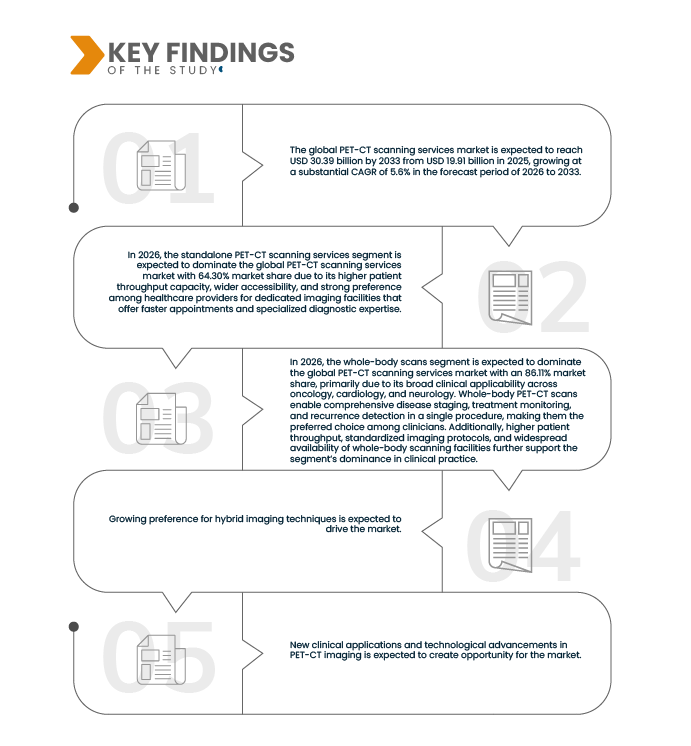
Data Bridge Market Research analyzes that the Global PET-CT Scanning Services Market is expected to reach USD 30.39 billion by 2033 from USD 19.91 billion in 2025, growing at a substantial CAGR of 5.6% in the forecast period of 2026 to 2033.
Key Findings of the Study
Increasing Incidence of Cancer and Neurological Disorders
Increasing incidence of cancer and neurological disorders has become a foundational force propelling growth in the global PET-CT scanning services market. As the prevalence of cancers and neurodegenerative or neurological conditions rises worldwide, demand for high-precision diagnostic imaging such as PET-CT has intensified. PET-CT offers critical advantages in early detection, accurate staging, treatment planning and monitoring for oncology and certain neurological indications — making it a preferred diagnostic modality where disease burden increases. Consequently, the escalation in cancer and neurological disorders globally has translated into higher utilization rates of PET-CT services and is driving geographic expansion of diagnostic infrastructure. The global escalation in cancer and neurological disease prevalence is being firmly established as a permanent structural growth engine for PET-CT scanning services. The continuous rise in new cancer diagnoses, coupled with the expanding population living with chronic neurological disorders, is creating a sustained and non-cyclical need for high-precision molecular imaging. As treatment protocols become increasingly personalized and therapy monitoring becomes mandatory across oncology and neurology, reliance on PET-CT for disease staging, prognosis evaluation, and therapeutic monitoring is being intensively strengthened. Furthermore, increasing survival rates are extending the diagnostic monitoring lifecycle per patient, thereby multiplying lifetime imaging demand. This dynamic is ensuring that PET-CT scanning services remain deeply anchored to global epidemiological trends, positioning this driver as a long-term foundational pillar for market expansion across both developed and emerging healthcare systems.
Report Scope and Market Segmentation
|
Report Metric
|
Details
|
|
Forecast Period
|
2026 to 2033
|
|
Base Year
|
2025
|
|
Historic Year
|
2018-2024 (Customizable 2013-17)
|
|
Quantitative Units
|
Revenue in USD Billion
|
|
Segments Covered
|
Service Type (Standalone PET-CT scanning services, Onsite PET-CT scanning services, and Mobile PET-CT scanning services), Scan Type (Whole Body Scans, Partial Body Scans), Tracer Type (FDG (Fluorodeoxyglucose), Non-FDG Tracers, New/Emerging Tracers), Application (Oncology, Neurology, Cardiology, Infectious Diseases, Inflammatory Diseases, Others (Orthopedic, Pediatrics)), End User (Hospitals, Diagnostic Imaging Centers, Specialty Clinics, Research Institutes, Others), Distribution Channel (Direct and Indirect)
|
|
Countries Covered
|
U.S., Canada, Mexico, China, Japan, India, South Korea, Australia, Thailand, Singapore, Indonesia, Malaysia, Philippines, Rest of Asia-Pacific, Egypt, Saudi Arabia, UAE, South Africa, Israel, Rest of MEA, Germany, Italy, France, U.K., Spain, Netherlands, Belgium, Switzerland, Russia, Turkey, Rest of Europe, Brazil, Argentina, and Rest of South America
|
|
Market Players Covered
|
C-HCA, Inc. (U.S.), Siemens Healthineers AG (Germany), RadNet, Inc. (U.S.), GenesisCare (Australia), I-MED Radiology Network (Australia), Medica Group Ltd (U.K.), Capitol Imaging (U.S.), Shared Medical Services, Inc. (U.S.), Circle Health Group Ltd (U.K.), Fortis Healthcare (India), Alliance Medical Limited (United Kingdom), InHealth Group (U.K.), Dignity Health (U.S.), Apollo Hospitals Enterprises Ltd. (India), NM Medical (India), Nueclear (U.S.), Cobalt Health (U.S.), DMS Health (U.S.), Cardiac Imaging, Inc. (U.S.), and Alliance-HNI Health Care Services (U.S.) and, among others
|
|
Data Points Covered in the Report
|
In addition to the insights on market scenarios such as market value, growth rate, segmentation, geographical coverage, and major players, the market reports curated by the Data Bridge Market Research also include depth expert analysis, patient epidemiology, pipeline analysis, pricing analysis, and regulatory framework.
|
Segment Analysis
Global PET-CT scanning services market is categorized into six notable segments which are based on service type, scan type, tracer type, application, end users, and distribution channel.
- On the basis of service type, global PET-CT scanning services market is segmented into standalone PET-CT scanning services, onsite PET-CT scanning services, and Mobile PET-CT scanning services
In 2026, the standalone PET-CT scanning services segment is expected to dominate the market
In 2026, the standalone PET-CT scanning services segment is expected to dominate with 64.30% due to its higher patient throughput capacity, wider accessibility, and strong preference among healthcare providers for dedicated imaging facilities that offer faster appointments and specialized diagnostic expertise. Standalone centers typically operate with extended hours, advanced equipment, and efficient workflow models, enabling them to deliver quicker turnaround times and cost-effective services compared to hospital-based units.
- On the basis of scan type, the global PET-CT scanning services market is segmented into whole body scans and partial body scans
In 2026, the whole body scans segment is expected to dominate the market
In 2026, the whole body scans segment is expected to dominate with 86.11% market share due to its critical role in comprehensive disease detection, staging, and treatment monitoring across oncology, cardiology, and neurology. Whole body PET-CT scans provide a complete assessment of metabolic activity and anatomical structures, enabling clinicians to identify metastatic spread, evaluate multi-organ involvement, and make more informed therapeutic decisions. The rising global cancer burden, increasing adoption of precision medicine, and growing preference for full-body imaging in routine follow-ups further strengthen the demand.
- On the basis of tracer type, the global PET-CT scanning services market is segmented into FDG (fluorodeoxyglucose), non-FDG tracers, new/emerging tracers. In 2026, the FDG (fluorodeoxyglucose) segment is expected to dominate the market with 77.97% market share
- On the basis of application, the global PET-CT scanning services market is segmented into oncology, neurology, cardiology, infectious diseases, inflammatory diseases, others (orthopedic, pediatrics). In 2026, oncology segment is expected to dominate the market with 64.74% market share.
- On the basis of end user, the global PET-CT scanning services market is segmented into hospitals, diagnostic, imaging centers, specialty clinics, research institutes, others. In 2026, hospitals segment is expected to dominate with 55.62% market share
- On the basis of distribution channel, the global PET-CT scanning services market is segmented into direct, indirect. In 2026, the direct segment is expected to dominate the with 76.62% market share
Major Players
Data Bridge Market Research analyzes C-HCA, Inc. (U.S.), Siemens Healthineers AG (Germany), RadNet, Inc. (U.S.), GenesisCare (Australia), I-MED Radiology Network (Australia), Medica Group Ltd (U.K.), Capitol Imaging (U.S.), Shared Medical Services, Inc. (U.S.), as the major market players of the market.
Market Development
- In October 2025, RadNet’s DeepHealth division signed a letter of intent with GE Healthcare to jointly accelerate innovation and adoption of AI-powered imaging across multiple modalities. The agreement aims to expand access to advanced imaging technologies, support remote scanning workflows, and integrate AI tools to enhance diagnostic accuracy and reporting efficiency.
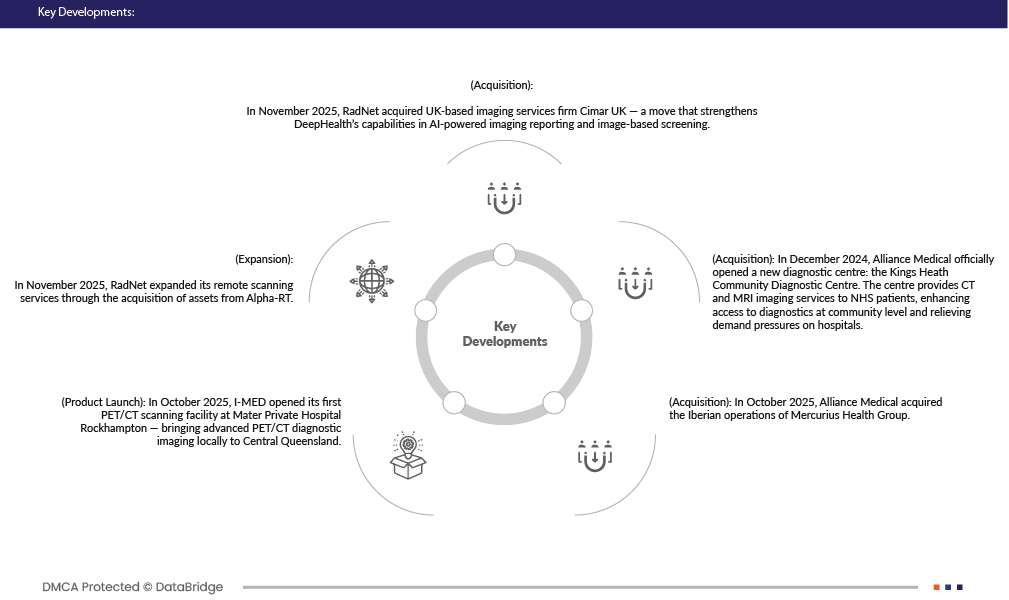
- In November 2025, RadNet acquired UK-based imaging services firm Cimar UK — a move that strengthens DeepHealth’s capabilities in AI-powered imaging reporting and image-based screening. The acquisition is expected to boost RadNet’s footprint in Europe and accelerate its ambition to deliver remote diagnostics and AI-enhanced imaging services globally.
- In August 2020, I‑MED Radiology Network announced that it would acquire Alfred Medical Imaging — a well‑established imaging provider offering a full range of diagnostic services including MRI and PET/CT. This move significantly expanded I MED’s presence in New South Wales, adding six clinics in Sydney’s Inner West, one at Mater Hospital in North Sydney, along with existing contracts to provide radiologist reporting services to public health authorities.
- In October 2025, Alliance Medical acquired the Iberian operations of Mercurius Health Group. The deal added six PET-CT centres, a radiopharmacy, two radiotherapy centres and a radiotherapy consultancy business across Spain and Portugal — expanding Alliance Medical’s footprint and introducing radiotherapy services to its nuclear-medicine offerings.
- In April 2025, ACC introduced ColFit, a comprehensive colorectal-cancer screening programme designed to improve early detection. ColFit uses non-invasive Faecal Immunochemical Testing (FIT) for average-risk adults and stratified risk protocols (including colonoscopy) for higher-risk individuals, aiming to increase survival rates and reduce treatment costs by catching cancer earlier.
Regional Analysis
Geographically, the country covered in the global PET-CT scanning services market report is U.S., Canada, Mexico, China, Japan, India, South Korea, Australia, Thailand, Singapore, Indonesia, Malaysia, Philippines, Rest of Asia-Pacific, Egypt, Saudi Arabia, UAE, South Africa, Israel, Rest of MEA, Germany, Italy, France, U.K., Spain, Netherlands, Belgium, Switzerland, Russia, Turkey, Rest of Europe, Brazil, Argentina, and Rest of South America.
As per Data Bridge Market Research analysis:
North America is the dominant region in the global PET-CT scanning services market
North America leads the global PET-CT scanning services market is experiencing significant growth driven by increasing healthcare expenditures and the rising prevalence of chronic diseases such as cancer and neurological disorders. Advanced imaging technologies and growing adoption of hybrid imaging systems are further fueling market expansion.
Asia-Pacific is estimated to be the fastest-growing region in the global PET-CT scanning services market
Asia-Pacific is expected to be the fastest-growing region in the global PET-CT scanning services market from 2026 to 2033 due to rapidly rising healthcare investments across emerging economies such as China, India, and Southeast Asian countries. Expanding hospital networks, increasing installation of advanced diagnostic imaging systems, growing prevalence of cancer and chronic diseases, and improving access to nuclear medicine facilities are driving demand. Additionally, supportive government initiatives, medical tourism growth, and increasing awareness of early disease detection and personalized medicine further accelerate PET-CT adoption across the region.
For more detailed information about the global PET-CT scanning services Market report, click here – https://www.databridgemarketresearch.com/reports/global-pet-ct-scanning-services-market










