


Global Flexible Foam Packaging Market, By Type (Polyurethane, Polyethylene, and Polypropylene), Application (Construction, Consumer Goods, Furniture, Transportation, and Others) – Industry Trends and Forecast to 2029
Market Analysis and Size
Flexible Foam packaging Market is expected to grow in forecast period in packaging industry due to rapid expansion. Accordingly to the market, the flexible and distinctive features, along with an increase in end-user applications, are expected to be main reason for influencing the growth of the flexible foam Market in forecast period. The increase in the use of thermal insulation in the building and construction and the good outlook in the furniture and bedding businesses boost the flexible foam Market’s growth.
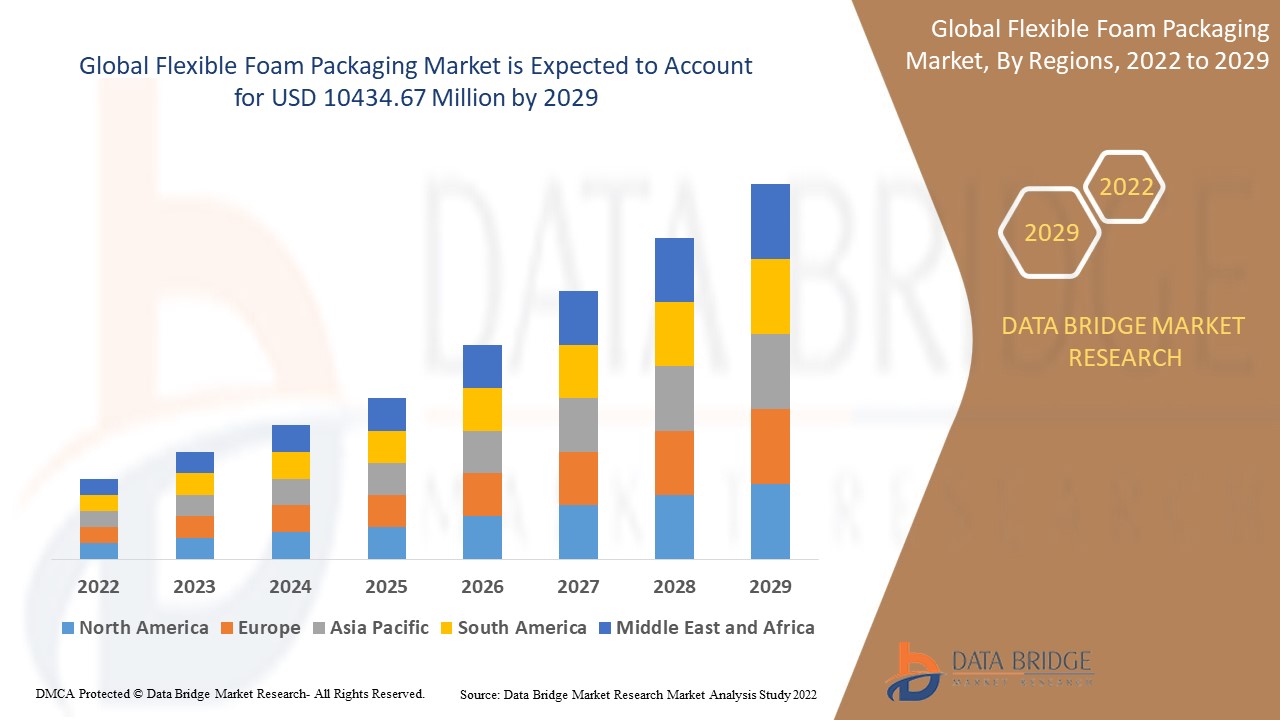
Data Bridge Market Research analyses that the flexible foam packaging market was valued at USD 6851.00 million in 2021 and is expected to reach USD 10434.67 million by 2029, registering a CAGR of 5.4% during the forecast period of 2022 to 2029. The market report curated by the Data Bridge Market Research team includes in-depth expert analysis, import/export analysis, pricing analysis, production consumption analysis, patent analysis and technological advancements.
Market Definition
Flexible foam is a processed polymer or plastic which has made up of hydrocarbons and other organic compounds linked by urethane linkages. These type of foam is used in many type of applications, including upholstery, automobiles, furniture, and more. Flexible foam uses are nearly limitless, ranging from small items like kitchen sponges and medical dressings to large filters and sound proofing systems to keep the environment quiet. The flexible foam also delivers environmental benefits.
Report Scope and Market Segmentation
|
Report Metric |
Details |
|
Forecast Period |
2022 to 2029 |
|
Base Year |
2021 |
|
Historic Years |
2020 (Customizable to 2014 - 2019) |
|
Quantitative Units |
Revenue in USD million, Volumes in Units, Pricing in USD |
|
Segments Covered |
Type (Polyurethane, Polyethylene, and Polypropylene), Application (Construction, Consumer Goods, Furniture, Transportation, and Others) |
|
Countries Covered |
U.S., Canada, Mexico, Brazil, Argentina, Rest of South America, Germany, France, Italy, U.K., Belgium, Spain, Russia, Turkey, Netherlands, Switzerland, Rest of Europe, Japan, China, India, South Korea, Australia and New Zealand, Singapore, Malaysia, Thailand, Indonesia, Philippines, Rest of Asia-Pacific, United Arab Emirate, Saudi Arabia, Egypt, Israel, South Africa, Rest of Middle East and Africa |
|
Market Players Covered |
BASF SE (Germany), Bayer Material Science (U.S.), Dow (U.S.), Huntsman International LLC (U.S.), Rogers Corporation (U.S.), Ube corporation (Japan), Recticel (Belgium), Zotefoams Plc (U.K.), The Woodbridge (Canada), Sekisui Alveo (Switzerland), Indoac corporation (japan), Covestro AG (Germany) |
|
Market Opportunities |
|
Flexible Foam Packaging Market Dynamics
This section deals with understanding the market drivers, advantages, opportunities, restraints and challenges. All of this is discussed in detail as below:
Drivers
- Increasing demand for end-use industry
Flexible foam offers various features such as resilience, durability, relative clarity and others. these are other factors that have expected to increase the adoption of flexible foam and drive the market's growth over the forecast period. Furthermore, the increasing demand for flexible foam in furniture is another factor expected to rise the need for flexible foam packaging to drive market growth in the near future.
- Rapidly growing e-commerce industry across the globe
The growing e-commerce industry is driving foam packaging demand from past years as it used for packaging of electronics and other products. This high growth in the e-commerce market will probably increase the foam packaging demand over the forecast period.
- Rising demand in the automotive industry
The global market for flexible foam is growing in demand due to the manufacturing of automobiles in the automotive industry. Flexible foams are used to increase vehicles' comfort, protection, and energy efficiency. It is broadly deployed in armrests, headrests, and seats of cars to improve the driving and seating experience.
- Versatility and unique physical properties
Flexible foam is durable, lightweight, water-resistant, abrasion-resistant and versatile among others, due to which it is widely deployed in many applications in industries. Flexible foam is extensively used for cushioning applications in mattresses and furniture. Due to the unique properties of flexible foam, it is used by many end-use industries, which increase the market growth of flexible foam packaging.
Opportunities
- Development of bio-based and carbon dioxide based polyols
Due to sustainability of flexible foams, organic or bio-based polyols contents promising substitutes for petrochemical polyols. Mixture of petroleum polyol and commercial soy polyols with many hydroxyl numbers and functions was effectively produced for flexible foams. The replacements of flexible polyurethane foams with organic foams may be reduce noise pollution and vibration and increase the comfort of aircrafts and automobiles in the upcoming years.
- Emergence of zero energy buildings
According to the International Energy Conservation Code, the US zero energy ready home program has set standards. In national program initiatives, building codes have a standard to be qualified by creating energy-efficient buildings with proficiency between 40% and 50% compared to other houses.
Restraints/ Challenges
Flexible foam is expensive due to the high cost of polyurethane foam because the fluctuating raw material cost, which act as a main restraint for the market. Changes in the demand and supply of these raw materials could significantly impact the flexible foam industry packaging. Moreover, supply disruption has rocked the flexible foams market which in turn has increased the cost of flexible foam packaging, these are the major market restrains that will obstruct the market's growth rate.
This flexible foam packaging market report provides details of new recent developments, trade regulations, import-export analysis, production analysis, value chain optimization, market share, impact of domestic and localized market players, analyses opportunities in terms of emerging revenue pockets, changes in market regulations, strategic market growth analysis, market size, category market growths, application niches and dominance, product approvals, product launches, geographic expansions, technological innovations in the market. To gain more info on the flexible foam packaging market contact Data Bridge Market Research for an Analyst Brief, our team will help you take an informed market decision to achieve market growth.
COVID-19 Impact on Flexible Foam Packaging Market
COVID-19 had a negative influence on the flexible foam sector since demand for building, furniture, and automobiles decreased dramatically. The building industry was hampered by the lockdown laws because many constructions were suspended, resulting in less demand for furnishings in workplaces and homes. On other hand COVID-19 crisis created an excellent opportunity to the packaging industry due to the raise awareness about safe packaged products. This will be driven by several factors such as growth in safe consumer goods, domestic demand and others.
Recent Development
- In January 2022, Recticel has final agreements with Swiss-listed Conzzeta AG (SIX:CON) to buy 100% of Foam Partner in cash for an enterprise value of CHF 270 million, with CHF 20 million of the purchase cost due in January 2022. This is associated to a normal normalized EBITDA multiple of 8.6x for 2019A-2020F. The transaction is subject to typical pre-closing conditions, for example, antitrust approval.
Global Flexible Foam Packaging Market Scope
The flexible foam packaging market is segmented on the basis of type and application. The growth amongst these segments will help you analyze meagre growth segments in the industries and provide the users with a valuable market overview and market insights to help them make strategic decisions for identifying core market applications.
Type
- Polyurethane
- Polyethylene
- Polypropylene
Application
- Construction
- Consumer Goods
- Furniture
- Transportation
- Other
Flexible Foam Packaging Market Regional Analysis/Insights
The flexible foam packaging market is analyzed and market size insights and trends are provided by country, Type and application as referenced above.
The countries covered in the flexible foam packaging market report are U.S., Canada, Mexico, Brazil, Argentina, Rest of South America, Germany, France, Italy, U.K., Belgium, Spain, Russia, Turkey, Netherlands, Switzerland, Rest of Europe, Japan, China, India, South Korea, Australia and New Zealand, Singapore, Malaysia, Thailand, Indonesia, Philippines, Rest of Asia-Pacific, United Arab Emirate, Saudi Arabia, Egypt, Israel, South Africa, Rest of Middle East and Africa.
Asia-Pacific dominates the flexible foam packaging market in terms of Increasing the penetration of green building technology into the construction sector would rapid growth, along with fuel regional in the automotive industry during the forecast period. The Asia-Pacific region dominates the flexible foam packaging market, with China leading the way to increase thermal insulation in the construction industry flexible foam packaging. China is leading the Asia-Pacific market.
During the projected period, North America is expected to be the fastest developing region due to the rising demand of thermal insulation in construction industry flexible foam packaging in automative sector in this region.
The country section of the report also provides individual market impacting factors and changes in market regulation that impact the current and future trends of the market. Data points like down-stream and upstream value chain analysis, technical trends and porter's five forces analysis, case studies are some of the pointers used to forecast the market scenario for individual countries. Also, the presence and availability of global brands and their challenges faced due to large or scarce competition from local and domestic brands, impact of domestic tariffs and trade routes are considered while providing forecast analysis of the country data.
Competitive Landscape and Flexible Foam Packaging Market Share Analysis
The flexible foam packaging market competitive landscape provides details by competitor. Details included are company overview, company financials, revenue generated, market potential, investment in research and development, new market initiatives, global presence, production sites and facilities, production capacities, company strengths and weaknesses, product launch, product width and breadth, application dominance. The above data points provided are only related to the companies' focus related to flexible foam packaging market.
Some of the major players operating in the flexible foam packaging market are:
- BASF SE (Germany)
- Bayer Material Science (U.S.)
- Dow (U.S.)
- Huntsman International LLC (U.S.)
- Rogers Corporation (U.S.)
- Ube Corporation (Japan)
- Recticel (Belgium)
- Zotefoams Plc (U.K.)
- The Woodbridge (Canada)
- Sekisui Alveo (Switzerland)
- Indoac Corporation (Japan)
- covestro AG (Germany)
SKU-
Obtenha acesso online ao relatório sobre a primeira nuvem de inteligência de mercado do mundo

- Painel interativo de análise de dados
- Painel de análise da empresa para oportunidades de elevado potencial de crescimento
- Acesso de analista de pesquisa para personalização e customização. consultas
- Análise da concorrência com painel interativo
- Últimas notícias, atualizações e atualizações Análise de tendências
- Aproveite o poder da análise de benchmark para um rastreio abrangente da concorrência
Metodologia de Investigação
A recolha de dados e a análise do ano base são feitas através de módulos de recolha de dados com amostras grandes. A etapa inclui a obtenção de informações de mercado ou dados relacionados através de diversas fontes e estratégias. Inclui examinar e planear antecipadamente todos os dados adquiridos no passado. Da mesma forma, envolve o exame de inconsistências de informação observadas em diferentes fontes de informação. Os dados de mercado são analisados e estimados utilizando modelos estatísticos e coerentes de mercado. Além disso, a análise da quota de mercado e a análise das principais tendências são os principais fatores de sucesso no relatório de mercado. Para saber mais, solicite uma chamada de analista ou abra a sua consulta.
A principal metodologia de investigação utilizada pela equipa de investigação do DBMR é a triangulação de dados que envolve a mineração de dados, a análise do impacto das variáveis de dados no mercado e a validação primária (especialista do setor). Os modelos de dados incluem grelha de posicionamento de fornecedores, análise da linha de tempo do mercado, visão geral e guia de mercado, grelha de posicionamento da empresa, análise de patentes, análise de preços, análise da quota de mercado da empresa, normas de medição, análise global versus regional e de participação dos fornecedores. Para saber mais sobre a metodologia de investigação, faça uma consulta para falar com os nossos especialistas do setor.
Personalização disponível
A Data Bridge Market Research é líder em investigação formativa avançada. Orgulhamo-nos de servir os nossos clientes novos e existentes com dados e análises que correspondem e atendem aos seus objetivos. O relatório pode ser personalizado para incluir análise de tendências de preços de marcas-alvo, compreensão do mercado para países adicionais (solicite a lista de países), dados de resultados de ensaios clínicos, revisão de literatura, mercado remodelado e análise de base de produtos . A análise de mercado dos concorrentes-alvo pode ser analisada desde análises baseadas em tecnologia até estratégias de carteira de mercado. Podemos adicionar quantos concorrentes necessitar de dados no formato e estilo de dados que procura. A nossa equipa de analistas também pode fornecer dados em tabelas dinâmicas de ficheiros Excel em bruto (livro de factos) ou pode ajudá-lo a criar apresentações a partir dos conjuntos de dados disponíveis no relatório.











