


Middle East and Africa Wearable Electronic Devices Market, By Type (Head-Mounted Displays, Smartwatches, Ear-Worn Devices (Hearables), Sports Watches, Smart Garments, and Wristbands), Application (Sports and Fitness, Healthcare, Security and Proximity, Automotive, Electronics, Automation, Industrial, and Others) – Industry Trends and Forecast to 2030.
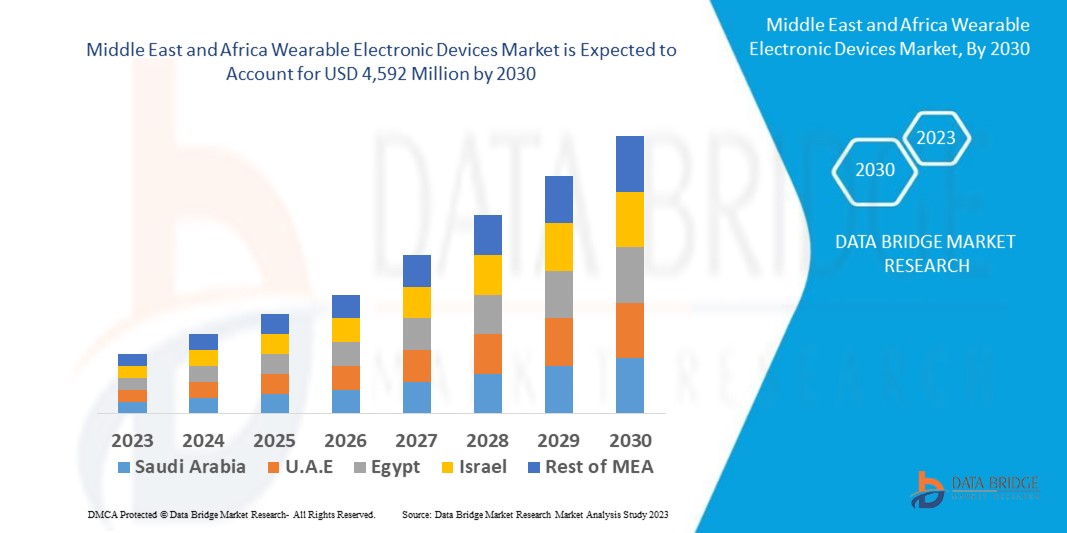
Middle East and Africa Wearable Electronic Devices Market Analysis and Size
Rising awareness about health and fitness, the high adoption of digitalization, and changing lifestyles are the major drivers propelling the market in the forecast period.
Data Bridge Market Research analyses that the Middle East and Africa wearable electronic devices market, which was USD 1467,12 million in 2022, is expected to reach USD 4,592 million by 2030 and is likely to undergo a CAGR of 18.4% during the forecast period. "Positive Displacement" dominates the type segment of the Middle East and Africa wearable electronic devices market due to their sports and fitness segment is expected to dominate the market due to continuously increasing adoption of wearable electronic devices for sports and fitness to enhanced sports, fitness, and well-being by monitoring physiological conditions of wearers. In addition to the insights on market scenarios such as market value, growth rate, segmentation, geographical coverage, and major players, the market reports curated by the Data Bridge Market Research also include in-depth expert analysis, geographically represented company-wise production and capacity, network layouts of distributors and partners, detailed and updated price trend analysis and deficit analysis of supply chain and demand.
Middle East and Africa Wearable Electronic Devices Market Scope and Segmentation
|
Report Metric |
Details |
|
Forecast Period |
2023 to 2030 |
|
Base Year |
2022 |
|
Historic Years |
2021 (Customisable 2015-2020) |
|
Quantitative Units |
Revenue in USD Million, Volumes in Units, Pricing in USD |
|
Segments Covered |
By Type (Head-Mounted Displays, Smartwatches, Ear-Worn Devices (Hearables), Sports Watches, Smart Garments, and Wristbands), Application (Sports and Fitness, Healthcare, Security and Proximity, Automotive, Electronics, Automation, Industrial, and Others |
|
Countries Covered |
Saudi Arabia, U.A.E., Israel, South Africa, Egypt, Kuwait, Qatar, and Rest of Middle East and Africa |
|
Market Players Covered |
Apple Inc. (U.S), PUMA SE (U.K), Seiko Epson Corporation (U.S)., Fitbit, Inc. (U.S)., LG Electronics(South Korea), SAMSUNG (South Korea), Garmin Ltd. (U.S)., Huawei Technologies Co., Ltd. (China), Polar Electro(U.S)., HTC Corporation and UMIDIGI (U.S)., Sonly Middle East & Africa (Sony Corporation) (Japan), Lenovo Group Limited (China), Amazfit (Huami Corporation) (U.S)., LG Electronics Inc. (South Korea), Fossil Group Inc (U.S). |
|
Market Opportunities |
|
Market Definition
Wearable electronic devices are portable devices that can be worn on the body, typically designed to provide various functionalities such as tracking health and fitness data, displaying notifications, monitoring vital signs, and connecting to other devices or the internet.
They include smartwatches, fitness trackers, smart clothing, virtual reality headsets, smart glasses, and healthcare devices such as heart rate monitors or sleep trackers. These devices often incorporate sensors, wireless connectivity, and advanced technologies to gather data and provide users personalized information and experiences. The Middle East and Africa wearable electronic devices market involve manufacturers, retailers, and consumers of these devices in countries across the region. It encompasses the production and distribution channels, including manufacturing facilities, supply chains, retail stores, and online platforms, through which wearable devices are made available to consumers.
Middle East and Africa Wearable Electronic Devices Market Dynamics
Drivers
- Increasing Health and Fitness Awareness
There is a growing awareness among individuals in the MEA region regarding health and fitness. Wearable devices, such as fitness trackers and smartwatches, provide real-time monitoring of various health parameters, such as heart rate, sleep patterns, and physical activity, empowering individuals to take control of their health and well-being.
- Technological Advancements
Technological Advancements: Advancements in wearable technology, such as improved sensors, longer battery life, and enhanced connectivity options, have made wearable devices more appealing and useful. The introduction of innovative features and functionalities, such as GPS tracking, waterproofing, and advanced health monitoring capabilities, has further accelerated the adoption of wearable devices in the MEA market.
- Growing Smartphone Penetration:
The MEA region has experienced a rapid increase in smartphone penetration over the years. Wearable devices often integrate with smartphones to provide seamless connectivity and synchronization of data. The widespread use of smartphones has acted as a catalyst for the adoption of wearable electronic devices, as they complement and enhance the functionalities of smartphones.
Opportunity
- Demand for Healthcare and Fitness Applications
The region has a growing focus on healthcare and wellness. Wearable devices that offer healthcare monitoring, remote patient monitoring, and fitness tracking capabilities have a wide range of applications and are in demand. Companies that develop innovative solutions tailored to the market's specific needs can capitalize on this opportunity.
Restraint/Challenge
- Price Sensitivity
Price sensitivity remains a significant restraint in this region. While disposable incomes are rising, a large portion of the population still has limited purchasing power. Affordability of wearable devices, especially premium models, can be a barrier to adoption for many potential customers. Companies need to carefully consider pricing strategies and offer affordable options to cater to a broader consumer base.
Recent Developments
- In 2022 - With the assistance of Intertec Group, which serves as the country of Qatar's authorized distributor for Amzfit smart watches, Amazfit, a global brand of wearable technology owned by Zepp Health, has introduced the fourth generation of its GTR and GTS series in Qatar. The new watches have advanced sporting capabilities, huge HD AMOLED displays, and the industry's first circularly polarised GPS antenna technology, all housed in fashionable designs.
- In 2022 - Xiaomi introduced the Smart Band 7 Pro in the UAE. Through its larger viewing area and auto-brightness feature, the Xiaomi Smart Band 7 Pro improves every discriminating user's watching experience in a lot more practical and enjoyable way without sacrificing its beautiful details. It has a high-resolution 1.64" rectangular AMOLED screen. Xiaomi Smart Band 7 Pro features over 110 sports modes that may satisfy any user's tracking requirements, from sleep monitoring to sports tracking.
Middle East and Africa Wearable Electronic Devices Market Scope
The Middle East and Africa wearable electronic devices market is segmented on the basis of type and application. The growth amongst these segments will help you analyse meagre growth segments in the industries and provide the users with a valuable market overview and market insights to help them make strategic decisions for identifying core market applications.
Type
- Smartwatches
- Ear-Worn Devices (Hearables)
- Head-Mounted Displays
- Sports Watches
- Wristbands
- Smart Garments
Application
- Sports and Fitness
- Healthcare
- Security and Proximity
- Electronics
- Industrial
- Automation
- Automotive
- Others
Middle East and Africa Wearable Electronic Devices Market Regional Analysis/Insights
The Middle East and Africa wearable electronic devices market is analysed and market size insights and trends are provided by country, type and application, as referenced above.
The countries covered in the Middle East and Africa wearable electronic devices market report are the Saudi Arabia, U.A.E., Israel, South Africa, Egypt, Kuwait, Qatar, and rest of Middle East and Africa.
The Saudi Arabia dominates the wearable electronic devices market due to its strong technological expertise and innovation capabilities. The country has a robust research and development infrastructure and is home to several renowned universities and research institutes specializing in imaging technologies. This ecosystem fosters the development of cutting-edge flowmeter solutions and facilitates collaborations between academia and industry.
The country section of the report also provides individual market-impacting factors and changes in regulation in the market domestically that impact the current and future trends of the market. Data points like downstream and upstream value chain analysis, technical trends, and porter's five forces analysis, case studies are some of the pointers used to forecast the market scenario for individual countries. Also, the presence and availability of Middle East and Africa brands and the challenges faced due to large or scarce competition from local and domestic brands, the impact of domestic tariffs, and trade routes are considered while providing forecast analysis of the country data.
Semiconductor Infrastructure Growth Installed base and New Technology Penetration
The Middle East and Africa wearable electronic devices market also provides you with a detailed market analysis for every country's growth in wearable electronic devices for capital equipment, installed base of different kinds of products for market, the impact of technology using life line curves, and changes in semiconductor regulatory scenarios and their impact on the Flowmeters market. The data is available for the historic period 2015-2020.
Competitive Landscape and Middle East and Africa Wearable Electronic Devices Market Share Analysis
The wearable electronic devices market competitive landscape provides details by competitor. Details included are company overview, company financials, revenue generated, market potential, investment in research and development, new market initiatives, Middle East and Africa presence, production sites and facilities, production capacities, company strengths and weaknesses, product launch, product width and breadth, and application dominance. The above data points provided are only related to the companies' focus related to the market.
Some of the major players operating in the Middle East and Africa wearable electronic devices market are:
- Apple Inc. (U.S)
- PUMA SE (U.K)
- Seiko Epson Corporation (U.S.)
- Fitbit, Inc. (U.S.)
- LG Electronics (South Korea),
- SAMSUNG (South Korea)
- Garmin Ltd. (U.S.)
- Huawei Technologies Co., Ltd. (China)
- Polar Electro(U.S.)
- HTC Corporation and UMIDIGI (U.S.)
- Sonly Middle East & Africa (Sony Corporation) (Japan)
- Lenovo Group Limited (China)
- Amazfit (Huami Corporation) (U.S.)
- LG Electronics Inc. (South Korea)
- Fossil Group Inc (U.S).
SKU-
Obtenha acesso online ao relatório sobre a primeira nuvem de inteligência de mercado do mundo

- Painel interativo de análise de dados
- Painel de análise da empresa para oportunidades de elevado potencial de crescimento
- Acesso de analista de pesquisa para personalização e customização. consultas
- Análise da concorrência com painel interativo
- Últimas notícias, atualizações e atualizações Análise de tendências
- Aproveite o poder da análise de benchmark para um rastreio abrangente da concorrência
Metodologia de Investigação
A recolha de dados e a análise do ano base são feitas através de módulos de recolha de dados com amostras grandes. A etapa inclui a obtenção de informações de mercado ou dados relacionados através de diversas fontes e estratégias. Inclui examinar e planear antecipadamente todos os dados adquiridos no passado. Da mesma forma, envolve o exame de inconsistências de informação observadas em diferentes fontes de informação. Os dados de mercado são analisados e estimados utilizando modelos estatísticos e coerentes de mercado. Além disso, a análise da quota de mercado e a análise das principais tendências são os principais fatores de sucesso no relatório de mercado. Para saber mais, solicite uma chamada de analista ou abra a sua consulta.
A principal metodologia de investigação utilizada pela equipa de investigação do DBMR é a triangulação de dados que envolve a mineração de dados, a análise do impacto das variáveis de dados no mercado e a validação primária (especialista do setor). Os modelos de dados incluem grelha de posicionamento de fornecedores, análise da linha de tempo do mercado, visão geral e guia de mercado, grelha de posicionamento da empresa, análise de patentes, análise de preços, análise da quota de mercado da empresa, normas de medição, análise global versus regional e de participação dos fornecedores. Para saber mais sobre a metodologia de investigação, faça uma consulta para falar com os nossos especialistas do setor.
Personalização disponível
A Data Bridge Market Research é líder em investigação formativa avançada. Orgulhamo-nos de servir os nossos clientes novos e existentes com dados e análises que correspondem e atendem aos seus objetivos. O relatório pode ser personalizado para incluir análise de tendências de preços de marcas-alvo, compreensão do mercado para países adicionais (solicite a lista de países), dados de resultados de ensaios clínicos, revisão de literatura, mercado remodelado e análise de base de produtos . A análise de mercado dos concorrentes-alvo pode ser analisada desde análises baseadas em tecnologia até estratégias de carteira de mercado. Podemos adicionar quantos concorrentes necessitar de dados no formato e estilo de dados que procura. A nossa equipa de analistas também pode fornecer dados em tabelas dinâmicas de ficheiros Excel em bruto (livro de factos) ou pode ajudá-lo a criar apresentações a partir dos conjuntos de dados disponíveis no relatório.











