


Asia-Pacific Breast Lesion Localization Methods Market Size
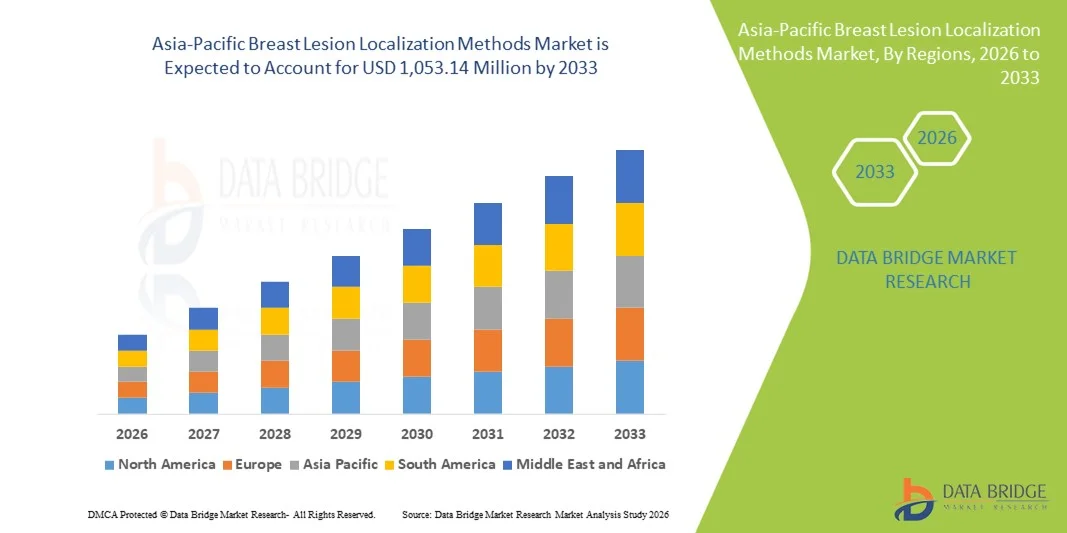
- The Asia-Pacific breast lesion localization methods market size was valued at USD 528.54 million in 2025 and is expected to reach USD 1,053.14 million by 2033, at a CAGR of 9.0% during the forecast period
- The market growth is largely fueled by the rising incidence of breast cancer across Asia-Pacific countries, coupled with expanding adoption of advanced diagnostic imaging and minimally invasive breast surgery techniques in hospitals and specialized cancer centers. Increasing investments in healthcare infrastructure and screening programs are also accelerating demand for accurate lesion localization technologies in the region
- Furthermore, growing awareness regarding early breast cancer detection, expanding mammography screening initiatives, and technological advancements such as magnetic seed and radar-based localization systems are strengthening the adoption of breast lesion localization methods. These factors are supporting improved surgical precision and workflow efficiency, thereby significantly boosting the growth of the Asia-Pacific breast lesion localization methods market
Asia-Pacific Breast Lesion Localization Methods Market Analysis
- Breast lesion localization methods, used to accurately identify and mark non-palpable breast abnormalities prior to surgery, are becoming increasingly essential in modern breast cancer management across hospitals and diagnostic centers due to their ability to improve surgical precision, reduce re-excision rates, and support minimally invasive breast procedures
- The escalating demand for breast lesion localization methods is primarily fueled by the rising incidence of breast cancer, growing adoption of advanced diagnostic imaging such as mammography and ultrasound, and an increasing focus on early cancer detection through national screening initiatives and hospital-based diagnostic programs
- China dominated the Asia-Pacific breast lesion localization methods market with the largest revenue share of 34.8% in 2025, supported by its large patient population, expanding oncology care infrastructure, and increasing adoption of advanced breast imaging and surgical guidance technologies in major hospitals and cancer treatment centers
- India is expected to be the fastest growing country in the Asia-Pacific breast lesion localization methods market during the forecast period, driven by rising breast cancer awareness, increasing screening campaigns, improving healthcare infrastructure, and expanding availability of minimally invasive breast surgery procedures in urban hospitals
- Wire Localization segment dominated the breast lesion localization methods market with a market share of 46.1% in 2025, driven by its long-standing clinical acceptance, widespread availability across healthcare facilities, and cost-effectiveness compared with newer technologies such as magnetic seed or radar-based localization systems
Report Scope and Asia-Pacific Breast Lesion Localization Methods Market Segmentation
|
Attributes |
Asia-Pacific Breast Lesion Localization Methods Key Market Insights |
|
Segments Covered |
|
|
Countries Covered |
Asia-Pacific
|
|
Key Market Players |
|
|
Market Opportunities |
|
|
Value Added Data Infosets |
In addition to the insights on market scenarios such as market value, growth rate, segmentation, geographical coverage, and major players, the market reports curated by the Data Bridge Market Research also include in-depth expert analysis, patient epidemiology, pipeline analysis, pricing analysis, and regulatory framework |
Asia-Pacific Breast Lesion Localization Methods Market Trends
Adoption of Non-Wire and Advanced Localization Technologies in Breast Surgery
- A significant and accelerating trend in the Asia-Pacific breast lesion localization methods market is the increasing adoption of non-wire localization technologies such as magnetic seed, radar-based, and radiofrequency identification systems. These technologies are significantly improving surgical workflow efficiency and patient comfort in breast cancer procedures
- For instance, the Magseed localization system by Endomag allows surgeons to mark non-palpable breast lesions using a tiny magnetic seed detected during surgery, eliminating the need for traditional wire placement on the day of surgery. Similarly, SAVI SCOUT by Merit Medical Systems utilizes radar technology to guide surgeons to the lesion with high accuracy
- The integration of advanced localization technologies enables improved surgical planning and enhanced precision in tumor removal procedures. For instance, some systems allow flexible scheduling of localization before surgery and reduce patient anxiety associated with same-day wire placement while improving workflow coordination between radiologists and surgeons. Furthermore, these advanced solutions help reduce operating room delays and enhance patient experience during breast-conserving surgeries
- The seamless integration of advanced breast imaging modalities such as mammography, ultrasound, and MRI with localization technologies facilitates accurate lesion identification and surgical guidance. Through coordinated imaging and localization workflows, clinicians can precisely target suspicious breast lesions while minimizing damage to surrounding healthy tissue
- This trend towards more precise, patient-friendly, and minimally invasive localization systems is fundamentally reshaping breast cancer surgical practices across hospitals in the Asia-Pacific region. Consequently, companies such as Endomag are developing next-generation magnetic localization systems designed to improve surgical accuracy and streamline clinical workflows in breast cancer care
- The demand for advanced breast lesion localization solutions is growing rapidly across hospitals and specialized oncology centers as healthcare providers increasingly prioritize surgical precision, patient comfort, and improved clinical outcomes in breast cancer treatment
- Growing investments in advanced diagnostic imaging infrastructure across emerging economies such as India, China, and Southeast Asian countries are also supporting the wider implementation of modern breast lesion localization technologies in clinical practice
Asia-Pacific Breast Lesion Localization Methods Market Dynamics
Driver
Rising Breast Cancer Incidence and Expanding Screening Programs
- The increasing prevalence of breast cancer across Asia-Pacific countries, coupled with expanding national breast cancer screening programs, is a significant driver for the growing demand for breast lesion localization methods
- For instance, in March 2024, Fujifilm Holdings Corporation expanded its breast imaging and diagnostic solutions portfolio in Asia, strengthening early breast cancer detection and supporting hospitals with advanced imaging technologies used alongside lesion localization procedures. Such strategies by key companies are expected to drive the breast lesion localization methods industry growth in the forecast period
- As healthcare systems strengthen early cancer detection initiatives and diagnostic infrastructure, hospitals are increasingly performing image-guided biopsies and breast-conserving surgeries that require accurate localization of non-palpable lesions before surgical removal
- Furthermore, the growing awareness about early breast cancer detection and the expansion of hospital diagnostic imaging capabilities are making lesion localization procedures an essential component of modern breast cancer treatment pathways
- The increasing adoption of breast-conserving surgery, improved accessibility to mammography and ultrasound imaging, and the expansion of oncology centers are key factors propelling the adoption of breast lesion localization technologies across hospitals in Asia-Pacific. The growing investment in cancer care infrastructure and technological advancements in imaging-guided surgery further contribute to market growth
- Rising government initiatives focused on improving women’s health and cancer screening programs are also encouraging hospitals and diagnostic centers to adopt more advanced breast imaging and localization technologies for accurate diagnosis and treatment planning
- Increasing collaborations between medical device companies and healthcare institutions are helping accelerate the introduction of innovative breast lesion localization systems across Asia-Pacific healthcare facilities
Restraint/Challenge
High Procedure Costs and Limited Access to Advanced Localization Technologies
- Concerns surrounding the high cost of advanced breast lesion localization technologies and limited access to specialized surgical infrastructure pose a significant challenge to broader market penetration in several Asia-Pacific countries
- For instance, the adoption of newer non-wire localization technologies such as magnetic seed and radar-based systems often requires specialized detection equipment and training, increasing the initial investment required for hospitals and diagnostic centers
- Addressing these cost-related challenges and infrastructure limitations is crucial for expanding the availability of advanced localization methods across healthcare systems. Companies such as Merit Medical Systems and Endomag are focusing on developing user-friendly and efficient localization technologies to support broader clinical adoption. In addition, disparities in healthcare resources between urban and rural regions can limit access to advanced breast cancer diagnostic and surgical technologies
- While breast cancer screening programs are expanding across the region, the availability of advanced localization technologies remains limited in some developing healthcare systems, particularly in smaller hospitals or regional medical centers
- Overcoming these challenges through increased healthcare investments, improved physician training, and wider adoption of cost-effective localization technologies will be vital for ensuring equitable access to advanced breast cancer surgical care and supporting long-term market growth
- Limited reimbursement policies for advanced breast cancer surgical technologies in several Asia-Pacific healthcare systems can also restrict the adoption of newer localization techniques within hospitals
- In addition, the shortage of trained radiologists and breast surgeons in some developing countries may hinder the effective implementation of advanced lesion localization procedures in clinical practice
Asia-Pacific Breast Lesion Localization Methods Market Scope
The market is segmented on the basis of type, usage, technique, and end user.
- By Type
On the basis of type, the Asia-Pacific breast lesion localization methods market is segmented into wire localization, radioisotope localization, electromagnetic localization, magnetic localization, and others. The wire localization segment dominated the market with the largest revenue share of 46.1% in 2025, primarily due to its long-standing clinical use and widespread availability in hospitals and diagnostic centers across the region. Wire-guided localization has been the traditional and most widely practiced method for identifying non-palpable breast lesions prior to surgery. The technique is relatively cost-effective and compatible with common imaging systems such as mammography and ultrasound, making it accessible for healthcare facilities across both developed and developing countries in Asia-Pacific. Surgeons and radiologists are highly familiar with the procedure, which contributes to its continued adoption. In addition, the large number of breast-conserving surgeries performed in hospitals further strengthens the demand for wire localization methods.
The magnetic localization segment is expected to witness the fastest growth during the forecast period, driven by increasing adoption of advanced and patient-friendly localization technologies. Magnetic localization systems enable clinicians to place a magnetic seed at the tumor site days before surgery, allowing greater scheduling flexibility and reducing patient discomfort associated with same-day wire placement. Hospitals in technologically advanced healthcare markets such as Japan, Australia, and South Korea are increasingly adopting these systems to improve surgical precision and workflow efficiency. Magnetic localization also reduces the risk of wire displacement and improves the overall patient experience. As healthcare providers focus more on minimally invasive procedures and improved surgical outcomes, the demand for magnetic localization technologies is expected to increase significantly.
- By Usage
On the basis of usage, the Asia-Pacific breast lesion localization methods market is segmented into tumor identification and sentinel lymph node identification. The tumor identification segment dominated the market with the largest revenue share in 2025, as localization technologies are primarily used to identify and guide the removal of non-palpable breast tumors during surgery. The increasing incidence of breast cancer across Asia-Pacific countries has significantly increased the need for precise tumor localization methods. Early detection programs and routine mammography screenings are identifying more small and non-palpable breast lesions that require accurate localization before surgical removal. Localization technologies help surgeons accurately target tumor tissue, thereby reducing the chances of incomplete excision and minimizing the need for repeat surgeries. The growing adoption of breast-conserving surgeries is also contributing to the strong demand for tumor identification applications.
The sentinel lymph node identification segment is expected to witness the fastest growth during the forecast period, driven by the increasing adoption of minimally invasive cancer staging procedures. Sentinel lymph node identification helps clinicians determine whether breast cancer has spread to nearby lymph nodes. Localization methods combined with advanced imaging technologies assist surgeons in accurately identifying sentinel lymph nodes during surgery. This approach reduces unnecessary lymph node removal and lowers the risk of complications such as lymphedema. Increasing awareness of precision oncology and advancements in surgical techniques are encouraging healthcare providers to adopt more advanced lymph node identification procedures. As breast cancer treatment protocols continue to evolve, the demand for accurate sentinel lymph node identification methods is expected to rise.
- By Technique
On the basis of technique, the Asia-Pacific breast lesion localization methods market is segmented into fine-needle aspiration biopsy, core needle biopsy, image guided biopsy, and surgical biopsy. The image guided biopsy segment dominated the market with the largest revenue share in 2025, due to its high diagnostic accuracy and ability to precisely locate suspicious breast lesions. Image-guided biopsy procedures use advanced imaging modalities such as ultrasound, mammography, or MRI to guide the biopsy needle to the abnormal tissue. This approach allows clinicians to collect accurate tissue samples while minimizing damage to surrounding healthy tissue. The increasing adoption of digital imaging technologies in hospitals and diagnostic centers across Asia-Pacific has significantly improved the efficiency of image-guided biopsy procedures. In addition, the growing emphasis on early breast cancer detection is supporting the demand for reliable and minimally invasive biopsy techniques.
The core needle biopsy segment is expected to witness the fastest growth during the forecast period, driven by its ability to obtain larger and more reliable tissue samples compared to fine-needle aspiration. Core needle biopsy provides more comprehensive histological information, which helps clinicians accurately diagnose breast abnormalities and determine appropriate treatment strategies. The technique is widely used in the evaluation of suspicious breast lesions detected through imaging screenings. In addition, the increasing adoption of outpatient biopsy procedures and advancements in biopsy device technologies are encouraging healthcare providers to use core needle biopsy more frequently. As healthcare systems in Asia-Pacific expand their cancer diagnostic capabilities, the adoption of core needle biopsy is expected to grow rapidly.
- By End User
On the basis of end user, the Asia-Pacific breast lesion localization methods market is segmented into hospitals, oncology clinics, diagnostic centers, and ambulatory surgical centers. The hospitals segment dominated the market with the largest revenue share in 2025, as hospitals serve as the primary facilities for breast cancer diagnosis and surgical treatment. Most localization procedures are performed in hospitals due to the availability of advanced imaging technologies, specialized surgical infrastructure, and multidisciplinary oncology teams. Hospitals also manage a large volume of breast cancer patients and provide comprehensive care that includes screening, diagnosis, surgery, and post-treatment monitoring. Furthermore, increasing government investments in hospital infrastructure and oncology services across Asia-Pacific countries are strengthening the dominance of this segment.
The diagnostic centers segment is expected to witness the fastest growth during the forecast period, driven by the increasing demand for specialized breast imaging and early cancer detection services. Diagnostic centers are expanding their capabilities by incorporating advanced technologies such as digital mammography, ultrasound, and MRI systems. These facilities play a crucial role in identifying suspicious breast lesions and conducting image-guided biopsy procedures before patients are referred for surgical treatment. The growing awareness regarding early breast cancer screening and the rising number of standalone diagnostic imaging centers in urban areas are contributing to the growth of this segment. In addition, shorter waiting times and convenient outpatient services offered by diagnostic centers are attracting more patients for breast screening and diagnostic procedures.
Asia-Pacific Breast Lesion Localization Methods Market Regional Analysis
- China dominated the Asia-Pacific breast lesion localization methods market with the largest revenue share of 34.8% in 2025, supported by its large patient population, expanding oncology care infrastructure, and increasing adoption of advanced breast imaging and surgical guidance technologies in major hospitals and cancer treatment centers
- Healthcare providers in China highly emphasize early breast cancer detection and minimally invasive surgical treatments, which has increased the demand for accurate lesion localization techniques used alongside mammography, ultrasound, and MRI imaging technologies
- This strong market position is further supported by government initiatives promoting cancer screening programs, rapid expansion of tertiary hospitals, and increasing investments in advanced medical technologies, establishing breast lesion localization methods as essential tools for precise tumor identification and breast-conserving surgeries across China’s healthcare system
The China Breast Lesion Localization Methods Market Insight
The China breast lesion localization methods market captured the largest revenue share in 2025 within Asia-Pacific, fueled by the country’s large patient population and the rapidly increasing incidence of breast cancer. Hospitals and cancer treatment centers are increasingly adopting advanced imaging technologies and minimally invasive surgical procedures to improve diagnostic accuracy and treatment outcomes. The growing expansion of tertiary hospitals, along with significant government investments in healthcare infrastructure, further propels the market. Moreover, national breast cancer screening initiatives and the adoption of advanced localization technologies are significantly contributing to the market's expansion.
Japan Breast Lesion Localization Methods Market Insight
The Japan breast lesion localization methods market is anticipated to grow at a noteworthy CAGR during the forecast period, driven by the country’s advanced healthcare system and strong focus on early cancer detection. Japan has a well-established network of diagnostic imaging facilities and oncology centers that support the adoption of advanced breast imaging and localization technologies. In addition, the increasing use of breast-conserving surgeries and minimally invasive procedures is encouraging healthcare providers to utilize accurate lesion localization techniques. The integration of advanced imaging modalities such as MRI and digital mammography with localization technologies is further stimulating market growth.
India Breast Lesion Localization Methods Market Insight
The India breast lesion localization methods market is expected to expand at a considerable CAGR during the forecast period, fueled by the increasing awareness of breast cancer screening and the expansion of healthcare infrastructure. The rising number of diagnostic imaging centers and oncology hospitals is supporting the adoption of breast lesion localization procedures. India’s growing focus on early cancer detection programs and improved access to diagnostic imaging technologies is promoting the demand for accurate tumor localization methods. Furthermore, increasing government initiatives aimed at strengthening cancer care services and expanding screening programs are contributing significantly to market growth across the country.
South Korea Breast Lesion Localization Methods Market Insight
The South Korea breast lesion localization methods market is anticipated to grow at a significant CAGR during the forecast period, supported by the country’s advanced healthcare infrastructure and strong adoption of medical technologies. South Korea has a well-developed network of hospitals and diagnostic imaging centers that actively implement advanced breast cancer diagnostic and surgical procedures. Increasing participation in national breast cancer screening programs and the rising awareness of early detection are further encouraging the adoption of lesion localization methods. In addition, the integration of advanced imaging technologies such as digital mammography and ultrasound with minimally invasive surgical procedures is contributing to the expansion of the market in South Korea.
Asia-Pacific Breast Lesion Localization Methods Market Share
The Asia-Pacific Breast Lesion Localization Methods industry is primarily led by well-established companies, including:
- Hologic, Inc. (U.S.)
- Merit Medical Systems, Inc. (U.S.)
- BD (U.S.)
- Cook (U.S.)
- Argon Medical Devices, Inc. (U.S.)
- SOMATEX Medical Technologies GmbH (Germany)
- IsoAid, LLC (U.S.)
- Ranfac Corp. (U.S.)
- Stryker Corporation (U.S.)
- BPB Medica S.r.l. (Italy)
- STERLAB S.r.l. (Italy)
- Biomedical Srl (Italy)
- MDL Srl (Italy)
- Vigeo Srl (Italy)
- Medax S.r.l. (Italy)
- Sirius Medical Systems B.V. (Netherlands)
- IZI Medical Products, LLC (U.S.)
- Intramedical Imaging, LLC (U.S.)
- Laurane Medical LLC (U.S.)
- Tsunami Medical Srl (Italy)
What are the Recent Developments in Asia-Pacific Breast Lesion Localization Methods Market?
- In October 2025, Merit Medical Systems announced that its SCOUT® Radar Localization technology had been used in more than 750,000 patient procedures worldwide. The wireless localization system enables surgeons to accurately identify and remove non-palpable breast lesions by implanting a small reflector that can be detected with a handheld probe during surgery. The technology helps physicians localize abnormal breast tissue within ±1 mm accuracy, improving surgical precision and reducing the need for repeat procedures
- In June 2025, the SAVI SCOUT® wireless breast lesion localization system was evaluated in a clinical audit published by the British Journal of Surgery, demonstrating successful implementation in breast-conserving surgeries and improved surgical workflow efficiency. The study reviewed dozens of procedures using the radar-guided reflector technology, showing high accuracy in locating non-palpable breast lesions and achieving a 100% successful excision rate in the evaluated cases
- In February 2024, Merit Medical Systems received FDA clearance for the SCOUT® MD Surgical Guidance System designed to enhance tumor localization during breast cancer surgery. The system supports the implantation of multiple radar reflectors, allowing surgeons to precisely identify the location and margins of breast tumors during breast-conserving procedures
- In December 2023, research presented at the San Antonio Breast Cancer Symposium reported strong clinician preference for the Magseed® magnetic localization system for breast tumor surgery. The study surveyed breast surgeons and radiologists and found that the adoption of magnetic seed localization increased significantly compared with traditional wire-guided localization methods
- In December 2022, Merit Medical Systems announced the launch of the Scout Bx delivery system, a wireless radar-guided breast lesion localization solution designed to support stereotactic and MRI-guided breast biopsies. The technology enables clinicians to place a small reflector marker within a breast lesion prior to surgery, which can later be detected using a handheld probe during tumor removal. The wire-free design allows localization days or weeks before surgery, improving workflow coordination between radiology and surgical teams

- Interactive Data Analysis Dashboard
- Company Analysis Dashboard for high growth potential opportunities
- Research Analyst Access for customization & queries
- Competitor Analysis with Interactive dashboard
- Latest News, Updates & Trend analysis
- Harness the Power of Benchmark Analysis for Comprehensive Competitor Tracking
Data collection and base year analysis are done using data collection modules with large sample sizes. The stage includes obtaining market information or related data through various sources and strategies. It includes examining and planning all the data acquired from the past in advance. It likewise envelops the examination of information inconsistencies seen across different information sources. The market data is analysed and estimated using market statistical and coherent models. Also, market share analysis and key trend analysis are the major success factors in the market report. To know more, please request an analyst call or drop down your inquiry.
The key research methodology used by DBMR research team is data triangulation which involves data mining, analysis of the impact of data variables on the market and primary (industry expert) validation. Data models include Vendor Positioning Grid, Market Time Line Analysis, Market Overview and Guide, Company Positioning Grid, Patent Analysis, Pricing Analysis, Company Market Share Analysis, Standards of Measurement, Global versus Regional and Vendor Share Analysis. To know more about the research methodology, drop in an inquiry to speak to our industry experts.
Data Bridge Market Research is a leader in advanced formative research. We take pride in servicing our existing and new customers with data and analysis that match and suits their goal. The report can be customized to include price trend analysis of target brands understanding the market for additional countries (ask for the list of countries), clinical trial results data, literature review, refurbished market and product base analysis. Market analysis of target competitors can be analyzed from technology-based analysis to market portfolio strategies. We can add as many competitors that you require data about in the format and data style you are looking for. Our team of analysts can also provide you data in crude raw excel files pivot tables (Fact book) or can assist you in creating presentations from the data sets available in the report.













