


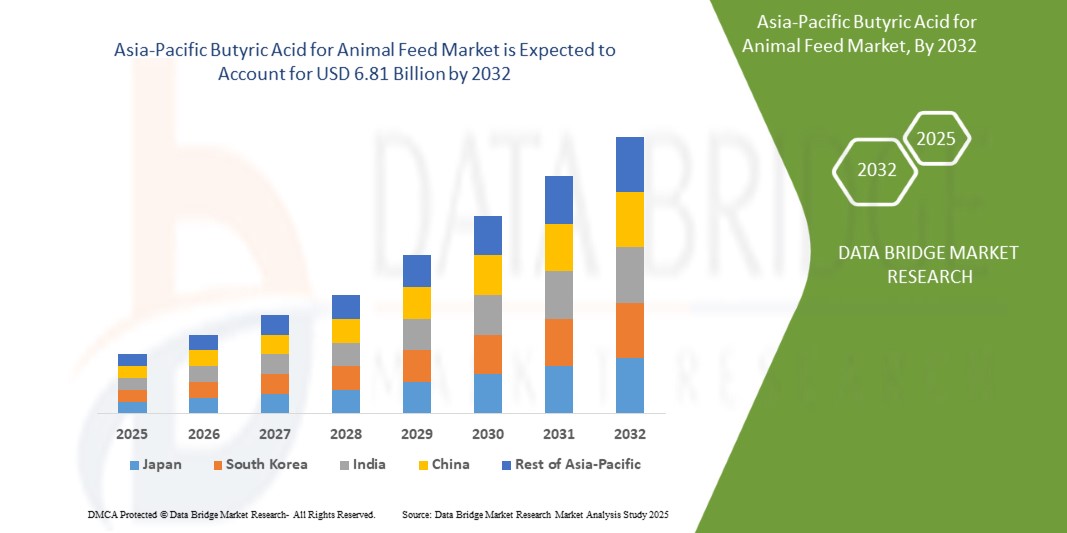
Asia-Pacific Butyric Acid for Animal Feed Market Size
- The Asia-Pacific butyric acid for animal feed market size was valued at USD 2.89 billion in 2024 and is expected to reach USD 6.81 billion by 2032, at a CAGR of 11.30% during the forecast period
- The market growth is largely fuelled by the rising demand for high-quality animal protein, increasing awareness regarding gut health and digestion in livestock, and the shift toward antibiotic-free feed additives across the region
- Expanding poultry and swine farming operations, particularly in countries such as China, India, and Indonesia, are further accelerating the adoption of butyric acid in feed formulations due to its proven benefits in enhancing growth performance and improving feed conversion ratios
Asia-Pacific Butyric Acid for Animal Feed Market Analysis
- Rapid urbanization and growing disposable incomes are driving meat consumption in the Asia-Pacific region, prompting livestock producers to invest in functional feed ingredients such as butyric acid that support animal health and production efficiency
- The market is also supported by strong government initiatives promoting safe and sustainable animal farming, which encourages the use of alternatives to antibiotic growth promoters
- China is expected to dominate the Asia-Pacific butyric acid for animal feed market, driven by its large-scale livestock and poultry production, increasing demand for high-performance feed additives, and growing efforts to reduce antibiotic usage in animal nutrition
- Japan is expected to witness the highest compound annual growth rate (CAGR) in the Asia-Pacific butyric acid for animal feed market due to rising awareness of gut health in animal rearing, increasing demand for premium meat products, and a strong shift toward antibiotic-free and functional feed solutions
- The sodium butyrate segment held the largest market revenue share in 2024, primarily due to its high bioavailability, cost-effectiveness, and wide application across poultry and swine feed. It is favored for its role in enhancing gut integrity, reducing inflammation, and improving nutrient absorption, especially in young animals. Feed manufacturers across China, India, and Thailand have increasingly adopted sodium butyrate due to its strong scientific validation and compatibility with existing feed formulations
Report Scope and Asia-Pacific Butyric Acid for Animal Feed Market Segmentation
|
Attributes |
Asia-Pacific Butyric Acid for Animal Feed Key Market Insights |
|
Segments Covered |
|
|
Countries Covered |
Asia-Pacific
|
|
Key Market Players |
|
|
Market Opportunities |
• Growing Demand for Sustainable and Bio-Based Feed Additives • Expansion of Livestock Farming in Emerging Asia-Pacific Economies |
|
Value Added Data Infosets |
In addition to the insights on market scenarios such as market value, growth rate, segmentation, geographical coverage, and major players, the market reports curated by the Data Bridge Market Research also include in-depth expert analysis, pricing analysis, brand share analysis, consumer survey, demography analysis, supply chain analysis, value chain analysis, raw material/consumables overview, vendor selection criteria, PESTLE Analysis, Porter Analysis, and regulatory framework. |
Asia-Pacific Butyric Acid for Animal Feed Market Trends
“Rising Shift Toward Antibiotic-Free Feed Additives to Promote Livestock Health”
- Butyric acid helps reduce pathogenic bacterial load in the gut, minimizing the need for antibiotics in poultry and swine farming
- Regulatory agencies in countries such as China and India have introduced restrictions on the use of AGPs, boosting demand for butyric acid-based feed solutions
- Leading feed manufacturers in Thailand and Vietnam are reformulating their products with protected butyrate forms to align with global food safety standards
- The shift supports broader regional goals focused on sustainable livestock farming and export competitiveness
- For instance, in China, large-scale poultry producers have adopted butyric acid to comply with national antibiotic-free meat certifications; similarly, Indian dairy cooperatives are using it to improve calf health and reduce early-life digestive issues
Asia-Pacific Butyric Acid for Animal Feed Market Dynamics
Driver
“Increased Demand for High-Performance Feed Additives to Boost Livestock Efficiency”
- Butyric acid is increasingly used in livestock feed as a natural alternative to antibiotic growth promoters (AGPs), especially in poultry and swine, due to its ability to enhance gut health and immunity
- Governments across Asia-Pacific, such as in China and India, are implementing stricter regulations that restrict the use of antibiotics in animal feed, promoting the use of organic acids such as butyric acid
- Feed manufacturers in countries such as Thailand and Vietnam are incorporating protected forms of butyric acid to ensure efficient delivery in the lower gut, improving feed efficacy and animal growth
- The trend aligns with regional strategies for sustainable farming, reduced antimicrobial resistance (AMR), and improved meat export standards
- For instance, major poultry producers in China have adopted butyric acid-based formulations to qualify for national “antibiotic-free” meat certifications and expand their global export footprint
Restraint/Challenge
“High Cost and Limited Awareness Among Small-Scale Farmers”
- The higher cost of protected or encapsulated butyric acid formulations limits its adoption, especially among small and medium-scale livestock producers across Asia-Pacific
- Limited technical awareness about the correct usage and benefits of butyric acid hinders its acceptance in rural and low-income farming regions
- Distribution challenges and underdeveloped feed supply chains make it difficult for butyric acid products to reach remote farming areas in countries such as Bangladesh and Myanmar
- Smaller farms often prioritize affordability over functionality, relying on traditional feed additives or antibiotic-based solutions due to cost and familiarity
- For instance, in India’s eastern states, many smallholder poultry farmers continue to use older-generation acidifiers instead of butyric acid due to price concerns and lack of advisory support from feed companies
Asia-Pacific Butyric Acid for Animal Feed Market Scope
The market is segmented on the basis of product type, animal, type, source, and lifecycle.
• By Product Type
On the basis of product type, the Asia-Pacific butyric acid for animal feed market is segmented into sodium butyrate, calcium butyrate, magnesium butyrate, and potassium butyrate. The sodium butyrate segment held the largest market revenue share in 2024, primarily due to its high bioavailability, cost-effectiveness, and wide application across poultry and swine feed. It is favored for its role in enhancing gut integrity, reducing inflammation, and improving nutrient absorption, especially in young animals. Feed manufacturers across China, India, and Thailand have increasingly adopted sodium butyrate due to its strong scientific validation and compatibility with existing feed formulations.
The calcium butyrate segment is expected to witness a fastest growth rate from 2025 to 2032, driven by its stability during feed processing and targeted release in the gastrointestinal tract. Its growing use in high-performance poultry diets, particularly in broilers, is supported by its ability to improve feed conversion ratios and promote intestinal health under commercial farming conditions.
• By Animal
On the basis of animal, the market is segmented into ruminants, swine, poultry, aquaculture, pets, equine, birds, and others. The poultry segment accounted for the largest revenue share in 2024, owing to the high demand for butyric acid in broiler and layer feed to promote growth, support gut development, and improve immunity. The prevalence of large-scale poultry farms in China and Southeast Asia has created a strong market base for butyrate-enriched feed.
The aquaculture segment is expected to witness a fastest growth rate from 2025 to 2032, driven by increasing investments in fish farming and shrimp production. Butyric acid is gaining popularity in aquafeed due to its role in enhancing nutrient absorption, reducing pathogen load, and improving intestinal morphology in fish and crustaceans, especially in markets such as Vietnam and Indonesia.
• By Type
On the basis of type, the market is segmented into encapsulated and non-encapsulated. The encapsulated segment dominated the market in 2024, driven by its ability to deliver butyric acid efficiently to the lower gut without degradation in the upper gastrointestinal tract. Encapsulation helps in masking odor and improving feed palatability, making it ideal for use in poultry and swine nutrition.
The non-encapsulated segment is expected to witness a fastest growth rate from 2025 to 2032, due to its cost advantage and use in specific formulations where stability is less of a concern, particularly in pet food and certain ruminant applications.
• By Source
On the basis of source, the Asia-Pacific market is segmented into synthetic and natural. The synthetic segment led the market in 2024, backed by consistent supply, ease of formulation, and affordability. It is widely adopted in commercial feed applications across high-volume livestock operations in China, India, and Bangladesh.
The natural segment is expected to witness a fastest growth rate from 2025 to 2032, supported by rising consumer demand for organic and clean-label meat, eggs, and dairy products. Producers are increasingly turning to natural butyric acid sources to align with food safety and antibiotic-free production standards.
• By Lifecycle
On the basis of lifecycle, the market is segmented into grower feed, finisher feed, starter feed, brooder feed, and others. The starter feed segment dominated the market in 2024, as early-life feeding strategies increasingly incorporate butyric acid to promote digestive maturity and improve survival rates in young poultry and piglets.
The grower feed segment is expected to witness a fastest growth rate from 2025 to 2032, as farms across Southeast Asia and South Korea focus on optimizing weight gain and feed efficiency during mid-growth stages, where gut health plays a critical role in production outcomes.
Asia-Pacific Butyric Acid for Animal Feed Market Regional Analysis
- China is expected to dominate the Asia-Pacific butyric acid for animal feed market, driven by its large-scale livestock and poultry production, increasing demand for high-performance feed additives, and growing efforts to reduce antibiotic usage in animal nutrition
- The country’s expanding aquaculture industry and strong government support for feed innovation further contribute to its leadership position in the regional market
Japan Butyric Acid for Animal Feed Market Insight
Japan is expected to witness a fastest growth rate from 2025 to 2032, due to rising awareness of gut health in animal rearing, increasing demand for premium meat products, and a strong shift toward antibiotic-free and functional feed solutions. Japan’s focus on sustainability and precision nutrition in livestock farming also supports the growing adoption of butyric acid-based additives.
Asia-Pacific Butyric Acid for Animal Feed Market Share
The Asia-Pacific Butyric Acid for Animal Feed industry is primarily led by well-established companies, including:
- Perstorp (Sweden)
- OQ Chemicals GmbH (Germany)
- Eastman Chemical Company (U.S.)
- Arvesta (Belgium)
- Tokyo Chemical Industry Co., Ltd. (Japan)
- Merck KGaA (Germany)
- Kemin Industries, Inc. (U.S.)
- Hefei TNJ Chemical Industry Co., Ltd. (China)
- Kunshan Odowell Co., Ltd. (China),
- Yufeng International Group Co., Ltd. (China)
- Central Drug House (India)
- Spectrum Chemical (U.S.)
- DSM (Netherlands)
- Finoric LLC (U.S.)
- DAYANG CHEM (HANGZHOU) CO., LTD. (China)
- Trouw Nutrition (Netherlands)
- Thermo Fisher Scientific Inc (U.S.)
Latest Developments in Asia-Pacific Butyric Acid for Animal Feed Market
- In March 2022, ALINOVA entered into a strategic partnership with METEX NØØVISTA to market 100% bio-based butyric acid in France. This collaboration aims to expand ALINOVA’s animal nutrition portfolio with sustainable, natural ingredients. The initiative supports the growing demand for eco-friendly feed additives and reinforces the shift toward green alternatives in livestock farming, enhancing the company’s position in the European market
- In April 2021, Eastman Chemical Company completed the acquisition of 3F Feed and Food, a leading European supplier of animal and human food additives. This acquisition is intended to strengthen Eastman’s capabilities in the animal nutrition sector by leveraging 3F’s technical expertise and customer network. It is expected to accelerate Eastman’s global expansion within the Additives & Functional Products division, boosting its competitive edge and innovation in feed solutions

- Interactive Data Analysis Dashboard
- Company Analysis Dashboard for high growth potential opportunities
- Research Analyst Access for customization & queries
- Competitor Analysis with Interactive dashboard
- Latest News, Updates & Trend analysis
- Harness the Power of Benchmark Analysis for Comprehensive Competitor Tracking
Asia Pacific Butyric Acid For Animal Feed Market, Supply Chain Analysis and Ecosystem Framework
To support market growth and help clients navigate the impact of geopolitical shifts, DBMR has integrated in-depth supply chain analysis into its Asia Pacific Butyric Acid For Animal Feed Market research reports. This addition empowers clients to respond effectively to global changes affecting their industries. The supply chain analysis section includes detailed insights such as Asia Pacific Butyric Acid For Animal Feed Market consumption and production by country, price trend analysis, the impact of tariffs and geopolitical developments, and import and export trends by country and HSN code. It also highlights major suppliers with data on production capacity and company profiles, as well as key importers and exporters. In addition to research, DBMR offers specialized supply chain consulting services backed by over a decade of experience, providing solutions like supplier discovery, supplier risk assessment, price trend analysis, impact evaluation of inflation and trade route changes, and comprehensive market trend analysis.
Data collection and base year analysis are done using data collection modules with large sample sizes. The stage includes obtaining market information or related data through various sources and strategies. It includes examining and planning all the data acquired from the past in advance. It likewise envelops the examination of information inconsistencies seen across different information sources. The market data is analysed and estimated using market statistical and coherent models. Also, market share analysis and key trend analysis are the major success factors in the market report. To know more, please request an analyst call or drop down your inquiry.
The key research methodology used by DBMR research team is data triangulation which involves data mining, analysis of the impact of data variables on the market and primary (industry expert) validation. Data models include Vendor Positioning Grid, Market Time Line Analysis, Market Overview and Guide, Company Positioning Grid, Patent Analysis, Pricing Analysis, Company Market Share Analysis, Standards of Measurement, Global versus Regional and Vendor Share Analysis. To know more about the research methodology, drop in an inquiry to speak to our industry experts.
Data Bridge Market Research is a leader in advanced formative research. We take pride in servicing our existing and new customers with data and analysis that match and suits their goal. The report can be customized to include price trend analysis of target brands understanding the market for additional countries (ask for the list of countries), clinical trial results data, literature review, refurbished market and product base analysis. Market analysis of target competitors can be analyzed from technology-based analysis to market portfolio strategies. We can add as many competitors that you require data about in the format and data style you are looking for. Our team of analysts can also provide you data in crude raw excel files pivot tables (Fact book) or can assist you in creating presentations from the data sets available in the report.













