


Asia-Pacific Disposable Peripheral Capillary Oxygen Saturation (SpO2) Sensor Market Size
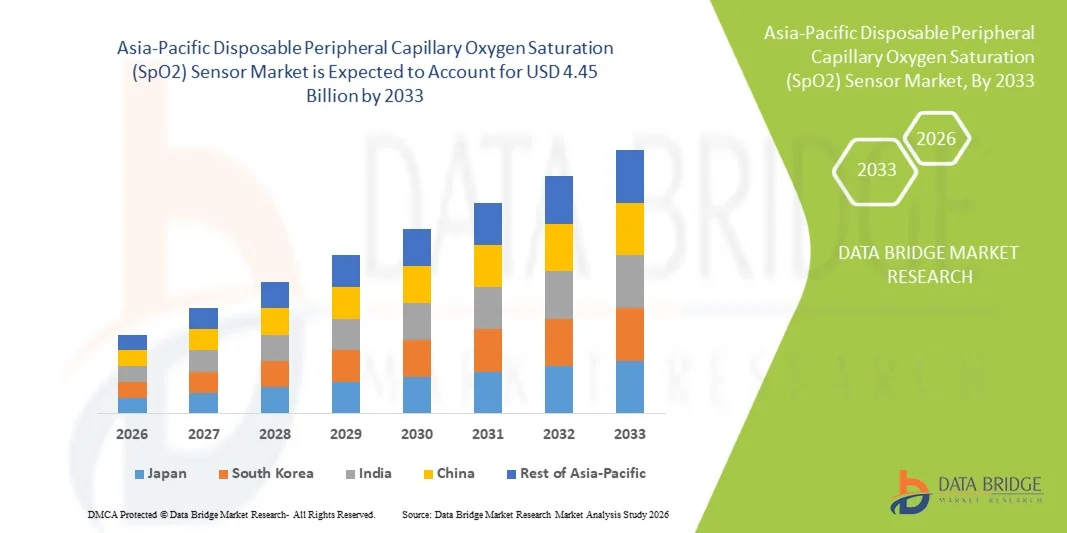
- The Asia-Pacific disposable peripheral capillary oxygen saturation (SpO2) sensor market size was valued at USD 1.56 billion in 2025 and is expected to reach USD 4.45 billion by 2033, at a CAGR of 14.0% during the forecast period
- The market growth is primarily driven by the increasing prevalence of respiratory disorders, rising surgical procedures, and the expanding demand for continuous patient monitoring across hospitals and homecare settings, leading to greater adoption of disposable SpO2 sensors
- Furthermore, growing awareness regarding infection control, coupled with the rising preference for single-use medical devices and advancements in sensor accuracy and compatibility with monitoring systems, is positioning disposable SpO2 sensors as an essential component in modern patient care. These combined factors are significantly accelerating market growth across the Asia-Pacific region
Asia-Pacific Disposable Peripheral Capillary Oxygen Saturation (SpO2) Sensor Market Analysis
- Asia-Pacific disposable peripheral capillary oxygen saturation (SpO2) sensor, designed for single-use patient monitoring of blood oxygen levels, is becoming an increasingly essential component in modern healthcare settings across hospitals, ambulatory surgical centers, and homecare environments due to its ability to minimize cross-contamination risks while ensuring accurate and hygienic monitoring
- The escalating demand for disposable peripheral capillary oxygen saturation (SpO2) sensor is primarily driven by the rising prevalence of respiratory disorders, increasing number of surgical and critical care procedures, and a growing emphasis on infection prevention practices, along with the expanding adoption of continuous and remote patient monitoring systems
- China dominated the Asia-Pacific disposable peripheral capillary oxygen saturation (SpO2) sensor market with the largest revenue share of 35.2% in 2025, characterized by a large patient pool, rapidly improving healthcare infrastructure, and rising healthcare expenditure, with strong demand for patient monitoring devices across hospitals and intensive care units supported by government healthcare reforms
- India is expected to be the fastest growing country in the Asia-Pacific disposable peripheral capillary oxygen saturation (SpO2) sensor market during the forecast period due to increasing healthcare investments, expanding hospital networks, and rising awareness regarding infection control and patient safety, particularly in urban and semi-urban healthcare facilities
- Adult segment dominated the Asia-Pacific disposable peripheral capillary oxygen saturation (SpO2) sensor market with a market share of 43.2% in 2025, driven by higher hospitalization rates, increased burden of chronic respiratory diseases, and widespread use of SpO2 sensors in critical and emergency care settings
Report Scope and Asia-Pacific Disposable Peripheral Capillary Oxygen Saturation (SpO2) Sensor Market Segmentation
|
Attributes |
Asia-Pacific Disposable Peripheral Capillary Oxygen Saturation (SpO2) Sensor Key Market Insights |
|
Segments Covered |
|
|
Countries Covered |
Asia-Pacific
|
|
Key Market Players |
|
|
Market Opportunities |
|
|
Value Added Data Infosets |
In addition to the insights on market scenarios such as market value, growth rate, segmentation, geographical coverage, and major players, the market reports curated by the Data Bridge Market Research also include in-depth expert analysis, patient epidemiology, pipeline analysis, pricing analysis, and regulatory framework |
Asia-Pacific Disposable Peripheral Capillary Oxygen Saturation (SpO2) Sensor Market Trends
“Advancement in Accuracy and Connectivity”
- A significant and accelerating trend in the Asia-Pacific disposable peripheral capillary oxygen saturation (SpO2) sensor market is the integration of high-accuracy optical sensors with wireless connectivity, enabling seamless data transfer to patient monitoring systems and mobile devices
- For instance, the Masimo Rad-G™ disposable SpO2 sensor allows real-time wireless monitoring of oxygen saturation and pulse rate, providing clinicians with immediate patient insights at the bedside or remotely
- Connectivity integration enables features such as continuous patient monitoring, trend analysis, and early warning alerts for hypoxemia, allowing healthcare providers to make timely interventions. For instance, Nonin Connect sensors provide cloud-enabled data access, improving workflow efficiency and patient outcomes
- The combination of wireless connectivity and advanced sensing technology facilitates centralized patient monitoring in hospitals, intensive care units, and homecare environments, streamlining operations and reducing manual intervention
- This trend towards more connected, intelligent, and accurate SpO2 monitoring solutions is reshaping healthcare provider expectations for patient safety and monitoring efficiency. Consequently, companies such as Medtronic are developing disposable SpO2 sensors with enhanced connectivity and integration with electronic health records (EHR)
- The demand for disposable SpO2 sensors with improved accuracy and connected monitoring is growing rapidly across both hospitals and homecare settings, as healthcare providers prioritize patient safety and real-time decision-making
- Growing investment in AI-driven analytics for patient data from disposable SpO2 sensors is enabling predictive healthcare solutions, such as early detection of respiratory deterioration in high-risk patients
Asia-Pacific Disposable Peripheral Capillary Oxygen Saturation (SpO2) Sensor Market Dynamics
Driver
“Rising Demand Due to Increasing Respiratory Disorders and Surgical Procedures”
- The increasing prevalence of respiratory disorders, critical care procedures, and surgical interventions is a major driver for the heightened demand for Asia-Pacific disposable peripheral capillary oxygen saturation (SpO2) sensors
- For instance, in May 2024, Nonin Medical announced expansion of its disposable SpO2 sensor line to support higher patient volumes in critical care and operating rooms, aiming to improve patient monitoring efficiency
- As healthcare providers seek accurate, hygienic, and real-time monitoring solutions, disposable SpO2 sensors offer a compelling alternative to reusable sensors by minimizing infection risks and reducing cross-contamination
- Furthermore, the growing awareness of patient safety, especially in post-surgical and intensive care units, is making disposable SpO2 sensors an integral part of patient monitoring protocols
- The ease of use, rapid deployment, and compatibility with bedside monitors and wearable devices are key factors propelling the adoption of disposable SpO2 sensors in hospitals, ambulatory surgical centers, and homecare
- The trend towards continuous, automated, and remote patient monitoring, combined with rising patient volumes in emerging markets such as India and China, further supports market growth for disposable SpO2 sensors
- Expansion of telehealth and homecare services in Asia-Pacific is creating new opportunities for disposable SpO2 sensors as essential tools for remote monitoring and chronic disease management
- Strategic collaborations between sensor manufacturers and hospital networks for bulk supply agreements are enabling wider adoption and reducing unit costs, supporting market growth
Restraint/Challenge
“Cost Constraints and Regulatory Compliance Issues”
- Concerns regarding the relatively high cost of advanced disposable SpO2 sensors compared to reusable options pose a significant challenge for broader market penetration, particularly in developing countries
- For instance, small-scale hospitals and clinics in India may hesitate to adopt premium disposable sensors due to budget limitations, despite the benefits of hygiene and accuracy
- Compliance with stringent regulatory standards such as ISO 80601-2-61 and local medical device approvals can delay product launches and increase operational costs, affecting market growth
- For instance, delays in regulatory clearance in countries such as China and Japan can limit the availability of new disposable SpO2 sensors for clinical use
- While costs are gradually decreasing, the perceived premium for advanced disposable SpO2 sensors with connectivity or high accuracy can still hinder adoption in price-sensitive regions
- Overcoming these challenges through cost optimization, local manufacturing, and streamlined regulatory approvals will be crucial for sustained growth of the Asia-Pacific disposable peripheral capillary oxygen saturation (SpO2) sensor market
- Limited awareness and training among healthcare staff on the proper usage of disposable SpO2 sensors can affect adoption rates in smaller clinics and rural hospitals
- Competition from low-cost, reusable SpO2 sensors in some regions may slow market penetration, especially where budget constraints outweigh infection control priorities
Asia-Pacific Disposable Peripheral Capillary Oxygen Saturation (SpO2) Sensor Market Scope
The market is segmented on the basis of connector, usage, technique, signal, application, end user, and sales channel.
- By Connector
On the basis of connector, the Asia-Pacific disposable peripheral capillary oxygen saturation (SpO2) sensor market is segmented into less than 6 pins, 6 pins–10 pins, and more than 10 pins. The less than 6 pins segment dominated the market in 2025 due to its simplicity, cost-effectiveness, and wide compatibility with most standard patient monitors used in hospitals and clinics. These sensors reduce connection errors, require minimal training, and are easier for staff to handle during high patient volume periods. Their lower manufacturing complexity and affordability make them suitable for both public and private healthcare facilities in countries such as China and India. Hospitals and clinics often standardize on these connectors to streamline procurement and maintenance. Moreover, fewer pins translate to reduced chances of sensor malfunction and faster setup during emergency care.
The 6 pins–10 pins segment is expected to witness the fastest growth during the forecast period, driven by increasing integration with advanced monitoring systems and wireless modules. These sensors provide more reliable signal transmission and better data logging capabilities, which are essential for modern ICU setups. They are increasingly compatible with digital health platforms and cloud-based monitoring, allowing remote access to patient vitals. The growing adoption of connected healthcare solutions and multiparameter monitoring in emerging Asia-Pacific economies is boosting demand. Hospitals aiming for real-time patient data and analytics prefer these connectors. The segment’s growth is further supported by manufacturers introducing mid-range pin sensors with enhanced durability and signal stability.
- By Usage
On the basis of usage, the market is segmented into adult, pediatric, neonate, animal, and others. The adult segment dominated in 2025 with a market share of 43.2% due to the large adult patient population and high hospital admissions, especially for surgeries, chronic respiratory illnesses, and emergency care. Adult SpO2 sensors are standardized across most hospitals, enabling rapid deployment and cost-effective usage. Their reliability and compatibility with most monitoring equipment make them a preferred choice for clinical staff. These sensors are extensively used in intensive care units (ICUs), operating rooms, and general wards, supporting continuous monitoring. High adoption is also driven by the rising incidence of cardiovascular and pulmonary diseases in adults across Asia-Pacific. In addition, adult sensors are easy to replace and dispose of, minimizing infection risks in hospitals.
The neonate segment is expected to witness the fastest growth during the forecast period due to rising neonatal care facilities and increasing premature births in countries such as India, China, and Japan. Neonatal disposable SpO2 sensors require high precision and minimal invasiveness to ensure safety and comfort for infants. Hospitals are increasingly adopting these sensors in NICUs to monitor oxygen saturation continuously and prevent hypoxemia. Technological innovations have improved sensor sensitivity for neonates, enhancing early detection of critical conditions. Growing awareness among parents and healthcare providers about neonatal care is driving demand. The trend is also supported by government programs focused on reducing infant mortality and improving neonatal health outcomes.
- By Technique
On the basis of technique, the market is segmented into reflectance and transflectance. The reflectance segment dominated in 2025 because it allows flexible placement on multiple body sites such as the forehead, chest, or wrist, providing accurate readings even in challenging conditions. Reflectance sensors are widely used in hospitals for adult, pediatric, and neonatal monitoring, offering minimal patient discomfort. Their versatility and adaptability make them suitable for emergency care and surgical monitoring. They are also compatible with both portable and bedside multiparameter monitors, enhancing workflow efficiency. Reflectance sensors require minimal calibration and are less affected by movement, reducing false readings. High adoption is supported by their reliability in critical care settings.
The transflectance segment is expected to witness the fastest growth from 2026 to 2033 due to increasing demand for precise monitoring under low perfusion or surgical conditions. Transflectance sensors provide superior signal stability and are integrated into high-end multiparameter monitors. Hospitals in developed Asia-Pacific countries, such as Japan and Australia, are increasingly using these sensors for ICU, neonatal, and surgical applications. The segment’s growth is driven by technological advancements enhancing measurement accuracy and response time. Demand is rising for specialized sensors in chronic care units and telehealth monitoring setups. Manufacturers are investing in transflectance sensors for real-time, critical care applications.
- By Signal
On the basis of signal, the market is segmented into analog and digital. The digital segment dominated in 2025 because it allows seamless integration with modern monitoring systems, electronic health records, and cloud-based platforms for remote monitoring. Digital sensors offer higher accuracy, lower interference, and the ability to transmit continuous patient data to centralized monitoring stations. They are preferred in hospitals, homecare, and ICU settings for both adult and pediatric monitoring. Digital SpO2 sensors facilitate automated alerts and analytics, improving clinical decision-making. Their adoption is supported by the rising trend of connected healthcare and telemedicine. The segment’s widespread use is enhanced by compatibility with wearable devices and mobile applications for patient monitoring.
The analog segment is expected to witness the fastest growth from 2026 to 2033, due to its cost-effectiveness, simplicity, and use in basic monitoring setups in small clinics and rural hospitals. Analog sensors are easier to maintain and deploy in low-resource settings, making them ideal for emerging markets. The segment benefits from affordability and reliability, particularly in outpatient care and homecare devices. Hospitals and smaller healthcare centers often prefer analog sensors for routine checks and temporary monitoring. Growing healthcare infrastructure in semi-urban and rural areas supports market expansion. Manufacturers are also introducing hybrid analog-digital sensors to increase adoption in these regions.
- By Application
On the basis of application, the market is segmented into finger, ear, foot, toe, multi-position, and others. The finger segment dominated in 2025 because of its universal applicability, comfort, and suitability for adult and pediatric patients. Finger sensors are the most widely used in hospitals, surgical centers, and homecare due to ease of placement and accurate readings. Their versatility across patient groups makes them the default choice for continuous monitoring. Finger sensors are also compatible with most monitoring systems, reducing equipment compatibility issues. Hospitals prefer these sensors for rapid deployment during emergencies. High adoption is supported by their low cost and minimal training requirements.
The multi-position segment is expected to witness the fastest growth from 2026 to 2033, due to increasing demand for adaptable sensors in ICUs, neonatal care, and surgical units. Multi-position sensors allow monitoring at different body sites, ensuring accurate readings even in low-perfusion or moving patients. Hospitals and homecare providers are increasingly using these sensors for high-risk patients requiring continuous monitoring. Technological improvements in design and flexibility are driving adoption. The segment’s growth is also supported by remote patient monitoring and wearable device integration. Manufacturers are innovating multi-position sensors to improve comfort and data accuracy.
- By End User
On the basis of end user, the market is segmented into clinical, hospital, veterinary, and others. The hospital segment dominated in 2025 due to high patient volumes, advanced ICU infrastructure, and increasing adoption of disposable sensors to prevent infections. Hospitals in China, Japan, and India lead in procurement of disposable SpO2 sensors for adult, pediatric, and neonatal patients. Adoption is driven by regulatory hygiene standards and infection control protocols. Hospitals prefer disposable solutions for faster turnover in high-volume wards. Compatibility with multiple monitoring systems increases efficiency. Rising awareness of patient safety protocols supports continued dominance.
The veterinary segment is expected to witness the fastest growth from 2026 to 2033 due to rising pet ownership, advanced veterinary clinics, and increased awareness of animal health monitoring. Disposable SpO2 sensors are increasingly used for monitoring during surgeries and critical care for animals. Adoption is driven by technological improvements for veterinary-specific sensors. Clinics in Japan, China, and Australia are expanding their use of monitoring devices. Veterinary hospitals prefer disposable sensors for hygiene and ease of application. Manufacturers are targeting this growing segment with specialized products.
- By Sales Channel
On the basis of sales channel, the market is segmented into offline and online. The offline segment dominated in 2025 due to strong hospital procurement networks, established distributor relationships, and preference for physical inspection before purchase. Hospitals rely on trusted distributors for bulk procurement and timely supply. Offline sales ensure quality assurance, quick replacement, and after-sales support. Many hospitals in Asia-Pacific still prefer traditional procurement channels for reliability. Offline networks are well-established in urban and semi-urban regions. The segment benefits from long-standing relationships between manufacturers and healthcare providers.
The online segment is expected to witness the fastest growth from 2026 to 2033 , due to increasing e-commerce adoption, B2B medical platforms, and growing demand for homecare monitoring solutions. Online sales provide wider accessibility in semi-urban and remote areas, reducing procurement time and costs. The trend is supported by direct-to-consumer models for at-home monitoring. Telehealth and homecare services are driving online adoption. Manufacturers are partnering with online platforms to reach smaller clinics and consumers. Convenience and competitive pricing further accelerate growth in the online segment.
Asia-Pacific Disposable Peripheral Capillary Oxygen Saturation (SpO2) Sensor Market Regional Analysis
- China dominated the Asia-Pacific disposable peripheral capillary oxygen saturation (SpO2) sensor market with the largest revenue share of 35.2% in 2025, characterized by a large patient pool, rapidly improving healthcare infrastructure, and rising healthcare expenditure
- Healthcare providers in China highly prioritize disposable SpO2 sensors for their ability to reduce cross-contamination, provide accurate and continuous monitoring, and integrate seamlessly with modern patient monitoring systems across adult, pediatric, and neonatal care
- This widespread adoption is further supported by government healthcare initiatives, growing investments in hospital modernization, and a large patient pool, establishing disposable SpO2 sensors as a preferred solution for critical care, surgical, and homecare monitoring applications
The China Disposable Peripheral Capillary Oxygen Saturation (SpO2) Sensor Market Insight
The China disposable peripheral capillary oxygen saturation (SpO2) sensor market captured the largest revenue share of 35.2% in 2025, driven by rapid hospital expansion, rising patient volumes, and increasing demand for infection-free monitoring solutions. Hospitals and clinics are prioritizing disposable sensors to reduce cross-contamination and ensure accurate continuous monitoring in adult, pediatric, and neonatal care. The growing integration of advanced patient monitoring systems, including wireless and cloud-enabled devices, is further supporting market growth. Government healthcare initiatives and rising healthcare expenditure are accelerating adoption across urban and semi-urban hospitals. Moreover, China’s role as a manufacturing hub for medical sensors is enhancing affordability and accessibility, broadening the consumer base.
Japan Disposable Peripheral Capillary Oxygen Saturation (SpO2) Sensor Market Insight
The Japan Asia-Pacific disposable peripheral capillary oxygen saturation (SpO2) sensor market is witnessing steady growth due to high awareness of patient safety, technologically advanced healthcare infrastructure, and an emphasis on quality medical devices. Hospitals and homecare providers are increasingly adopting disposable SpO2 sensors for continuous monitoring and integration with electronic health records (EHRs). The aging population and growing prevalence of chronic respiratory and cardiovascular diseases are further driving demand. Japan’s focus on technological innovation, combined with rising urbanization, supports the adoption of wireless and multi-position sensors. In addition, the government’s push for improved neonatal and critical care facilities is stimulating growth in the neonatal segment.
India Disposable Peripheral Capillary Oxygen Saturation (SpO2) Sensor Market Insight
The India Asia-Pacific disposable peripheral capillary oxygen saturation (SpO2) sensor market accounted for a significant revenue share in 2025, attributed to expanding healthcare infrastructure, rising hospital admissions, and growing awareness of infection control and patient safety. Hospitals, diagnostic centers, and homecare providers are increasingly relying on disposable SpO2 sensors to minimize cross-contamination and provide accurate real-time monitoring. The rapid urbanization, increasing middle-class population, and push for smart hospitals and digital health initiatives are driving adoption. Affordable sensor options and strong domestic manufacturing capabilities are enhancing accessibility across both urban and semi-urban regions. Moreover, government programs focused on improving critical and neonatal care are further accelerating market growth.
South Korea Disposable Peripheral Capillary Oxygen Saturation (SpO2) Sensor Market Insight
The South Korea Asia-Pacific disposable peripheral capillary oxygen saturation (SpO2) sensor market is experiencing robust growth due to the country’s advanced healthcare infrastructure, high adoption of digital health technologies, and strong focus on patient safety. Hospitals and clinics are increasingly integrating disposable SpO2 sensors with connected monitoring systems to ensure accurate and infection-free patient care. Growing awareness of respiratory health, rising surgical procedures, and the need for continuous monitoring are driving adoption. South Korea’s well-established medical device regulatory framework ensures high-quality products, boosting market confidence. The demand for neonatal and pediatric sensors is increasing alongside adult monitoring solutions, supported by government healthcare initiatives. Furthermore, the availability of domestic manufacturers producing high-precision sensors at competitive prices is expanding market accessibility.
Asia-Pacific Disposable Peripheral Capillary Oxygen Saturation (SpO2) Sensor Market Share
The Asia-Pacific Disposable Peripheral Capillary Oxygen Saturation (SpO2) Sensor industry is primarily led by well-established companies, including:
- Medtronic, (Ireland)
- Masimo Corporation, (U.S.)
- NIHON KOHDEN CORPORATION, (Japan)
- Contec Medical Systems Co., Ltd., (China)
- Mindray Medical International Limited, (China)
- Koninklijke Philips N.V., (Netherlands)
- GE HealthCare, (U.S.)
- Nonin Medical, Inc., (U.S.)
- Honeywell International Inc., (U.S.)
- Smiths Medical, (U.K.)
- Edan Instruments, Inc., (China)
- Heal Force Bio‑Meditech Holdings Limited, (China)
- ChoiceMMed, (China)
- Meditech Equipment Co., Ltd., (China)
- Tenko Medical Systems, (Japan)
- Spacelabs Healthcare, (U.S.)
- Guangdong Biolight Meditech Co., Ltd., (China)
- MEDKE, (China)
- Hisern Medical, (China)
- Shenzhen Lontek Electronic Technology Co., Ltd., (China)
What are the Recent Developments in Asia-Pacific Disposable Peripheral Capillary Oxygen Saturation (SpO2) Sensor Market?
- In February 2025, Singapore researchers received academic funding to improve wearable PPG‑based SpO₂ monitoring accuracy as part of efforts to enhance cardiovascular and health monitoring for elderly populations, supporting next‑generation patient sensor development and wearable diagnostic tools
- In October 2024, Huawei introduced the Watch 5 with a new fingerprint‑based blood oxygen sensor (multi‑sensing X‑TAP technology), improving signal quality and speeding up SpO₂ readings a development that indirectly supports broader demand for accurate oximetry sensors in wearable health devices across markets including APAC
- In October 2024, Nihon Kohden America Inc. issued a recall for certain disposable SpO₂ sensor models, including Adult/Pediatric Forehead Disposable SpO₂ Sensors and Adult Ear Clip SpO₂ Sensors, due to potential performance issues that could affect measurement accuracy and patient safety. This recall highlights ongoing quality and regulatory attention in the SpO₂ sensor space, particularly for disposable monitoring devices used in clinical settings.
- In November 2022, Changi General Hospital (Singapore) partnered with Respiree to develop a wearable medical sensor that combines a sensor patch with a finger oximeter for wireless vital sign monitoring through a central dashboard, improving ward‑wide patient tracking efficiency
- In November 2022, BioIntelliSense launched a patented FDA‑cleared SpO₂ sensor technology that offers accurate oxygen saturation readings across all skin tones and during motion, addressing a known clinical challenge in pulse oximetry accuracy

- Interactive Data Analysis Dashboard
- Company Analysis Dashboard for high growth potential opportunities
- Research Analyst Access for customization & queries
- Competitor Analysis with Interactive dashboard
- Latest News, Updates & Trend analysis
- Harness the Power of Benchmark Analysis for Comprehensive Competitor Tracking
Data collection and base year analysis are done using data collection modules with large sample sizes. The stage includes obtaining market information or related data through various sources and strategies. It includes examining and planning all the data acquired from the past in advance. It likewise envelops the examination of information inconsistencies seen across different information sources. The market data is analysed and estimated using market statistical and coherent models. Also, market share analysis and key trend analysis are the major success factors in the market report. To know more, please request an analyst call or drop down your inquiry.
The key research methodology used by DBMR research team is data triangulation which involves data mining, analysis of the impact of data variables on the market and primary (industry expert) validation. Data models include Vendor Positioning Grid, Market Time Line Analysis, Market Overview and Guide, Company Positioning Grid, Patent Analysis, Pricing Analysis, Company Market Share Analysis, Standards of Measurement, Global versus Regional and Vendor Share Analysis. To know more about the research methodology, drop in an inquiry to speak to our industry experts.
Data Bridge Market Research is a leader in advanced formative research. We take pride in servicing our existing and new customers with data and analysis that match and suits their goal. The report can be customized to include price trend analysis of target brands understanding the market for additional countries (ask for the list of countries), clinical trial results data, literature review, refurbished market and product base analysis. Market analysis of target competitors can be analyzed from technology-based analysis to market portfolio strategies. We can add as many competitors that you require data about in the format and data style you are looking for. Our team of analysts can also provide you data in crude raw excel files pivot tables (Fact book) or can assist you in creating presentations from the data sets available in the report.













