


What is the Asia-Pacific Internet of Medical Things (IoMT) Market Size and Growth Rate?
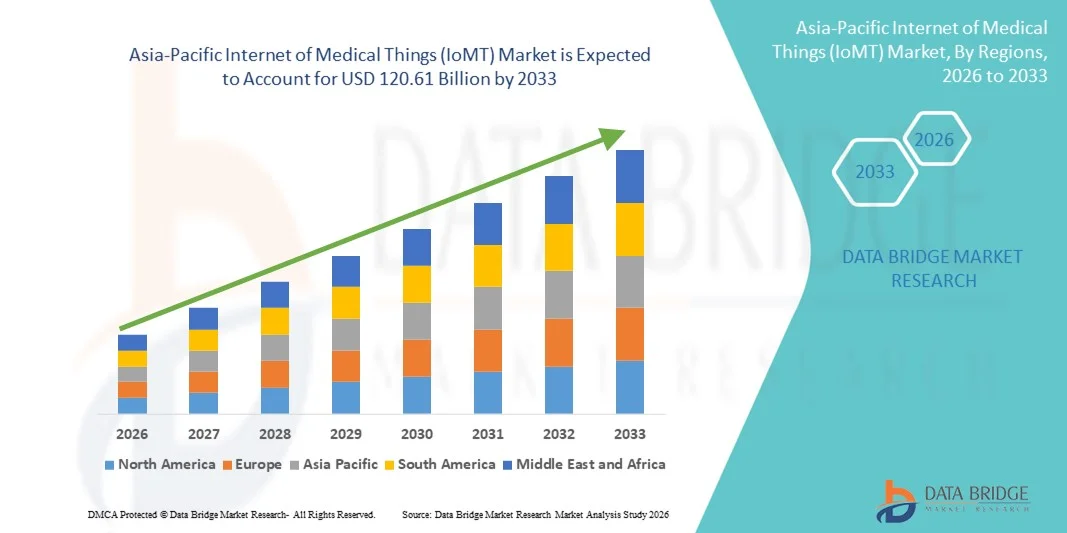
- As per Data Bridge Market Research Analysis the Asia-Pacific Internet of Medical Things (IoMT) market size was valued at USD 21.44 billion in 2025 and is expected to reach USD 120.61 billion by 2033, at a CAGR of 24.1% during the forecast period
- The market growth is primarily driven by the increasing integration of connected medical devices, wearable health monitors, and remote patient monitoring systems, which are enhancing healthcare digitalization across hospitals, clinics, and home care settings
- In addition, rising demand for real-time health data, improved patient outcomes, and cost-efficient healthcare solutions is positioning IoMT devices as critical tools in modern healthcare ecosystems. These factors are accelerating the adoption of IoMT solutions, thereby significantly boosting the region’s market expansion
Market Size and Forecast:
- Market Value (2025): USD 21.44 billion
- Expected Market Value (2033): USD 120.61 billion
- Forecast CAGR (2026–2033): 24.1%
What are the Major Takeaways ofAsia-Pacific Internet of Medical Things (IoMT) Market?
- Internet of Medical Things (IoMT) market, encompassing connected medical devices, wearable health monitors, and remote patient monitoring systems, is becoming a vital component of modern healthcare delivery in hospitals, clinics, and homecare settings due to its ability to provide real-time patient data, remote monitoring, and seamless integration with digital health platforms
- The escalating demand for IoMT solutions is primarily fueled by increasing healthcare digitalization, rising prevalence of chronic diseases, growing focus on patient-centric care, and the need for cost-effective healthcare management across the region
- Japan dominated the Asia-Pacific Internet of Medical Things (IoMT) market with the largest revenue share of 28.4% in 2025, supported by advanced healthcare infrastructure, high adoption of connected medical devices, and strong government initiatives promoting digital health solutions
- China is expected to be the fastest-growing country in the Asia-Pacific Internet of Medical Things (IoMT) market during the forecast period due to large-scale hospital digitization, expanding homecare services, increasing adoption of wearable devices, and government investments in telemedicine and AI-based healthcare technologies
- Hardware segment dominated the Asia-Pacific Internet of Medical Things (IoMT) market with a market share of 41.2% in 2025, driven by the widespread deployment of medical devices and sensors for continuous patient monitoring, diagnostics, and improved clinical decision-making
Report Scope and Asia-Pacific Internet of Medical Things (IoMT) Market Segmentation
|
Attributes |
Asia-Pacific Internet of Medical Things (IoMT) Key Market Insights |
|
Segments Covered |
|
|
Countries Covered |
Asia-Pacific
|
|
Key Market Players |
|
|
Market Opportunities |
|
|
Value Added Data Infosets |
In addition to the insights on market scenarios such as market value, growth rate, segmentation, geographical coverage, and major players, the market reports curated by the Data Bridge Market Research also include in-depth expert analysis, patient epidemiology, pipeline analysis, pricing analysis, and regulatory framework |
What are the Asia-Pacific Internet of Medical Things (IoMT) Market Trends?
Integration with AI, Cloud, and Remote Patient Monitoring
- A key and rapidly accelerating trend in the Asia-Pacific Internet of Medical Things (IoMT) market is the increasing integration of artificial intelligence (AI), cloud platforms, and remote patient monitoring systems, enabling smarter and more efficient healthcare management
- For instance, wearable devices in Japan now leverage AI algorithms to predict patient health risks and send automated alerts to healthcare providers for timely intervention
- AI integration in IoMT allows predictive analytics for chronic disease management, personalized care recommendations, and intelligent anomaly detection, while cloud connectivity ensures secure storage and real-time access to patient data. For instance, some Chinese IoMT platforms provide AI-based analytics dashboards for hospitals to optimize patient treatment plans
- The integration of IoMT devices with mobile apps and hospital information systems enables centralized control over multiple devices, including on-body monitors, home-use medical devices, and hospital equipment, allowing seamless patient data management across platforms
- This trend toward intelligent, interconnected healthcare ecosystems is reshaping patient care expectations. Consequently, companies such as Medtronic and Philips are developing AI-enabled IoMT solutions that allow continuous patient monitoring, predictive health alerts, and remote management for both home and clinical settings
- The demand for IoMT devices that offer AI, cloud, and remote monitoring integration is rising rapidly across hospitals, clinics, and homecare services as healthcare providers increasingly prioritize efficiency, patient engagement, and predictive healthcare capabilities
Asia-Pacific Internet of Medical Things (IoMT) Market Dynamics
Driver
Rising Need Due to Healthcare Digitalization and Chronic Disease Prevalence
- The increasing adoption of digital healthcare infrastructure, along with the growing prevalence of chronic diseases, is a key driver boosting demand for IoMT solutions
- For instance, in March 2025, a major hospital group in China launched an AI-powered remote patient monitoring initiative, integrating IoMT devices for real-time vital tracking and proactive interventions
- As healthcare providers seek to improve patient outcomes, IoMT devices offer features such as continuous monitoring, real-time alerts, and data-driven treatment optimization, providing significant advantages over conventional care methods
- Furthermore, rising demand for home-based healthcare, telemedicine, and connected health ecosystems is positioning IoMT devices as critical tools in modern healthcare delivery
- The convenience of real-time health monitoring, remote clinician access, and integrated data analytics for hospitals and patients are key factors propelling IoMT adoption across Asia-Pacific. Increasing government support for digital health initiatives and growing awareness of preventive care further reinforce market growth
- Technological advancements, such as AI-driven diagnostics and wearable sensors, are driving faster deployment of IoMT devices. For instance, hospitals in Japan are using AI-enabled IoMT devices to assist in early detection of cardiovascular and respiratory conditions
- Collaborations between IoMT manufacturers and telemedicine providers are expanding market reach. For instance, Chinese IoMT firms are partnering with telehealth platforms to offer integrated remote monitoring services for elderly patients and chronic disease management
Restraint/Challenge
Data Privacy, Security Concerns, and High Initial Costs
- Concerns over cybersecurity, patient data privacy, and regulatory compliance present a significant challenge for wider adoption of IoMT solutions. IoMT devices rely on connected networks and cloud platforms, making them potentially vulnerable to data breaches and cyberattacks
- For instance, reports of security flaws in connected health devices in Japan and India have made some hospitals and patients cautious about adopting IoMT solutions
- Addressing these challenges through advanced encryption, secure authentication, and regulatory compliance is critical for building trust. For instance, companies such as Philips and Abbott emphasize HIPAA-compliant systems and end-to-end data security in their marketing
- High upfront costs of advanced IoMT devices, including AI-enabled wearables and hospital-grade monitoring systems, can hinder adoption among smaller clinics or budget-conscious patients, particularly in developing countries
- Overcoming these challenges through enhanced cybersecurity protocols, patient and provider education on privacy best practices, and development of cost-effective IoMT solutions will be essential for sustained market growth
- Infrastructure limitations, such as inconsistent internet connectivity and insufficient digital health literacy, restrict IoMT adoption in rural or semi-urban areas. For instance, smaller clinics in India face challenges integrating IoMT devices into existing systems due to network limitations
- Stringent regulatory approval processes for medical devices in Asia-Pacific countries can delay product launches. For instance, delays in device certification in Japan and China can impact timely market entry for new IoMT solutions
Asia-Pacific Internet of Medical Things (IoMT) Market Scope
The market is segmented on the basis of component, platform, mode of service delivery, connectivity devices, application, and end-user.
- By Component
On the basis of component, the Asia-Pacific IoMT market is segmented into hardware, software, and services. The Hardware segment dominated the market with the largest market revenue share of 41.2% in 2025, driven by the widespread deployment of medical devices such as wearable sensors, diagnostic monitors, and hospital-grade equipment. Hospitals and homecare providers increasingly rely on hardware IoMT solutions for real-time patient monitoring, ensuring accurate data collection and timely intervention. The dominance of hardware is also supported by the rising adoption of AI-enabled devices and the need for seamless integration with other IoMT platforms. In addition, government initiatives in countries such as Japan and China promoting digital health and telemedicine are fueling hardware adoption. Patients and healthcare providers favor tangible devices for reliability and direct clinical impact.
The Software segment is anticipated to witness the fastest growth rate of 22.5% from 2026 to 2033, driven by the increasing adoption of analytics platforms, mobile applications, and AI-based predictive software in healthcare. Software solutions enable real-time patient monitoring, remote diagnostics, and integration with hospital management systems. Cloud-based IoMT software allows healthcare providers to securely store and analyze large volumes of patient data, improving decision-making and outcomes. Growing demand for patient engagement platforms, personalized healthcare recommendations, and telehealth integration further boosts software adoption. Software also enhances interoperability between devices and enables predictive alerts and notifications for chronic disease management.
- By Platform
On the basis of platform, the market is segmented into device management, application management, and cloud management. The Device Management segment dominated the Asia-Pacific IoMT market with a revenue share of 38.9% in 2025, as healthcare facilities focus on efficiently managing connected medical devices across hospitals and homecare settings. Device management platforms enable automated monitoring of equipment status, device calibration, and maintenance schedules, ensuring reliable performance. They allow IT teams to remotely troubleshoot devices, reducing downtime and operational costs. Hospitals in Japan and China widely implement device management solutions to integrate on-body sensors, home-use devices, and clinical equipment. This segment is crucial for maintaining regulatory compliance and ensuring patient safety. The growing number of connected devices further strengthens the demand for centralized device management solutions.
The Cloud Management segment is expected to witness the fastest CAGR of 24.1% from 2026 to 2033, driven by the increasing need for secure storage, real-time data access, and scalable infrastructure. Cloud platforms support remote patient monitoring, data analytics, and AI-driven predictive models, enhancing healthcare efficiency. Cloud management facilitates interoperability between devices and software applications, providing seamless integration for hospitals and homecare providers. Rapid digitalization of healthcare in India and China, along with government initiatives to implement telemedicine and e-health programs, is accelerating cloud adoption. In addition, cloud solutions reduce the burden on on-premise IT infrastructure, enabling cost-effective expansion of IoMT networks.
- By Mode of Service Delivery
On the basis of service delivery, the market is segmented into on-premise and cloud. The On-Premise segment dominated the market with a share of 52.3% in 2025, largely due to healthcare facilities’ preference for secure, in-house data management and control over critical patient information. Hospitals and research institutes often deploy on-premise solutions to meet stringent regulatory compliance and data privacy standards. These solutions allow direct management of connected devices, reduce dependency on external networks, and enable custom integration with legacy hospital systems. In countries such as Japan, where data security regulations are strict, on-premise deployment is preferred for sensitive patient monitoring. In addition, on-premise solutions offer predictable performance without relying on internet connectivity, making them attractive for high-risk or critical care environments.
The Cloud segment is expected to register the fastest CAGR of 25.6% from 2026 to 2033, fueled by increasing adoption of remote patient monitoring, telemedicine, and mobile healthcare applications. Cloud-based IoMT allows real-time data access, scalable storage, and AI-powered analytics, facilitating efficient patient management. Healthcare providers in China and India are rapidly deploying cloud solutions to enable homecare monitoring and chronic disease management. Cloud platforms also reduce infrastructure costs and allow integration with multiple IoMT devices. The flexibility and remote accessibility offered by cloud solutions are driving growth across hospitals, clinics, and home-use settings.
- By Connectivity Devices
On the basis of connectivity, the market is segmented into wired and wireless. The Wireless segment dominated the market with a share of 57.8% in 2025, driven by the widespread adoption of wearable devices, wireless sensors, and Bluetooth-enabled patient monitoring systems. Wireless connectivity allows seamless integration of devices in hospitals, clinics, and homecare without the need for complex cabling. It facilitates real-time data transmission, remote monitoring, and patient mobility, which are critical for chronic disease management. Wireless IoMT devices are especially popular in countries such as China and India, where rapid deployment and scalability are essential. Hospitals increasingly adopt wireless platforms for patient tracking, ICU monitoring, and telehealth services. Interoperability with smartphones and mobile applications further strengthens wireless adoption.
The Wired segment is expected to witness the fastest CAGR of 21.9% from 2026 to 2033, mainly due to its high reliability and low latency in critical care and hospital-based IoMT applications. Wired connectivity is preferred for fixed equipment such as bedside monitors, imaging devices, and central nursing station systems. Hospitals and research institutes in Japan and Singapore often adopt wired solutions to ensure uninterrupted performance in high-acuity areas. Wired connections provide better data security, minimal interference, and stable performance, which are critical for intensive care and surgical monitoring. The increasing integration of hybrid wired and wireless solutions in healthcare networks is driving growth.
- By Application
On the basis of application, the market is segmented into on-body devices, healthcare providers, home-use medical devices, community, and others. The Healthcare Providers segment dominated the market with a revenue share of 44.5% in 2025, driven by hospitals, clinics, and diagnostic centers implementing IoMT solutions for patient monitoring, data collection, and analytics. Healthcare providers rely on IoMT to improve workflow efficiency, enhance clinical decision-making, and optimize patient care. Hospitals in Japan and China extensively adopt IoMT solutions for ICU monitoring, remote diagnostics, and chronic disease management. The integration of on-body devices and software platforms with hospital systems further strengthens adoption. Growing government initiatives supporting digital health and telemedicine amplify demand for IoMT in healthcare facilities.
The Home-Use Medical Devices segment is expected to witness the fastest CAGR of 26.2% from 2026 to 2033, driven by rising demand for remote patient monitoring and self-care devices for chronic disease management. Patients in India, China, and Japan increasingly adopt wearable sensors, smart glucometers, and blood pressure monitors for at-home monitoring. The convenience, real-time data sharing with healthcare providers, and integration with mobile apps fuel rapid adoption. Growing awareness of preventive healthcare and lifestyle management also supports home-use device penetration. Technological advancements in compact, user-friendly IoMT devices are further accelerating growth.
- By End-User
On the basis of end-user, the market is segmented into hospitals, clinics, research institutes & academics, homecare, and others. The Hospitals segment dominated the market with a share of 46.8% in 2025, as hospitals are the largest adopters of IoMT devices for patient monitoring, diagnostics, and integration with electronic health records (EHRs). Hospitals in Japan and China extensively use connected devices to monitor vitals, manage chronic diseases, and streamline clinical workflows. IoMT solutions enhance patient safety, reduce readmissions, and support evidence-based care. The presence of advanced healthcare infrastructure and trained IT personnel further strengthens hospital adoption. Large hospital chains and multi-specialty centers increasingly invest in AI-enabled IoMT devices for predictive analytics and remote monitoring.
The Homecare segment is expected to witness the fastest CAGR of 27.1% from 2026 to 2033, driven by growing adoption of remote patient monitoring, telehealth services, and wearable health devices in home settings. Patients with chronic conditions, elderly individuals, and post-operative patients in China, India, and Japan increasingly rely on IoMT devices for continuous monitoring. Integration with mobile apps and cloud platforms allows caregivers and clinicians to remotely track patient health, improving treatment adherence and reducing hospital visits. Government initiatives promoting homecare and preventive health also support segment growth.
Asia-Pacific Internet of Medical Things (IoMT) Market Regional Analysis
- Japan dominated the Asia-Pacific Internet of Medical Things (IoMT) market with the largest revenue share of 28.4% in 2025, supported by advanced healthcare infrastructure, high adoption of connected medical devices, and strong government initiatives promoting digital health solutions
- Healthcare providers in Japan prioritize the integration of IoMT devices with hospital information systems, on-body sensors, and cloud-based platforms to enhance patient monitoring, improve clinical decision-making, and optimize workflow efficiency
- The widespread adoption in the country is further supported by a technologically advanced population, strong regulatory support for digital health solutions, and increasing demand for remote patient monitoring, establishing IoMT devices as essential tools across hospitals, clinics, and homecare services
The Japan Internet of Medical Things (IoMT) Market Insight
The Japan IoMT Market is gaining significant momentum due to the country’s advanced healthcare infrastructure, high adoption of connected medical devices, and government initiatives promoting digital health. Hospitals and clinics extensively deploy IoMT solutions for real-time patient monitoring, chronic disease management, and AI-driven predictive analytics. The integration of IoMT devices with hospital information systems, wearable sensors, and cloud platforms enhances clinical efficiency and patient care. In addition, Japan’s aging population is expected to spur demand for home-use monitoring devices and telehealth services, further driving market growth in both residential and clinical settings.
China Internet of Medical Things (IoMT) Market Insight
The China IoMT Market is expected to be the fastest-growing country during the forecast period, fueled by large-scale hospital digitization, rapid adoption of wearable devices, and expanding homecare and telemedicine programs. Government initiatives supporting AI-driven diagnostics, remote patient monitoring, and smart healthcare infrastructure are promoting the deployment of IoMT devices across hospitals, clinics, and homecare services. Increasing chronic disease prevalence, rising patient awareness, and demand for real-time health monitoring are further accelerating market growth. The Chinese market also benefits from strong domestic IoMT manufacturers, ensuring the availability of cost-effective and technologically advanced solutions.
India Internet of Medical Things (IoMT) Market Insight
The India IoMT Market accounted for a significant market revenue share in Asia-Pacific in 2025, driven by the expanding middle class, rapid urbanization, and increasing adoption of digital health technologies. Hospitals, clinics, and homecare providers are increasingly implementing IoMT devices for chronic disease management, remote monitoring, and telehealth services. Government initiatives promoting digital healthcare and smart health programs, alongside the availability of affordable IoMT solutions, are driving adoption in both urban and semi-urban regions. Rising awareness of preventive healthcare and the growing popularity of wearable and home-use medical devices further contribute to market growth in India.
Australia Internet of Medical Things (IoMT) Market Insight
The Australia IoMT Market is witnessing steady growth due to the country’s well-established healthcare system, high digital literacy, and increasing adoption of connected medical devices and telehealth services. Hospitals and clinics in Australia are investing in IoMT devices for real-time patient monitoring, chronic disease management, and remote diagnostics. Government programs supporting digital health initiatives and the use of cloud-based platforms are accelerating market adoption. In addition, Australia’s growing aging population and the rise of homecare services are driving demand for wearable health devices and home-use monitoring solutions. The country’s strong regulatory framework and emphasis on patient safety also support the deployment of advanced IoMT solutions.
Which are the Top Companies in Asia-Pacific Internet of Medical Things (IoMT) Market?
The Asia-Pacific Internet of Medical Things (IoMT) industry is primarily led by well-established companies, including:
- Medtronic (Ireland)
- GE HealthCare (U.S.)
- Koninklijke Philips N.V. (Netherlands)
- Cisco Systems, Inc. (U.S.)
- IBM Corporation (U.S.)
- Honeywell International Inc. (U.S.)
- Lenovo Group Ltd. (Hong Kong)
- Boston Scientific Corporation (U.S.)
- Siemens Healthineers AG (Germany)
- BIOTRONIK SE & Co. KG (Germany)
- Unison Healthcare Group (Taiwan)
- Cadi Scientific (Singapore)
- imedtac Co., Ltd (Taiwan)
- Meril Life Sciences (India)
- Omron Healthcare Co., Ltd (Japan)
- Terumo Corporation (Japan)
- NIHON KOHDEN CORPORATION (Japan)
- Lepu Medical Technology Co., Ltd (China)
- Accuster Technologies Pvt Ltd (India)
- iHealth Labs, Inc. (U.S.)
What are the Recent Developments in Asia-Pacific Internet of Medical Things (IoMT) Market?
- In November 2025, Taiwan‑based health tech provider imedtac won the ASOCIO HealthTech Award for its IoMT‑Powered Primary Care Innovation System, integrating IoMT, AI, and cloud analytics for real‑time vital‑sign monitoring and remote consultation across Taiwan, China, and Thailand
- In June 2025, Medical Taiwan 2025 was announced to showcase cutting‑edge IoMT and smart medical technology innovations, with the event scheduled for June 5–7 at Taipei Nangang Exhibition Center, bringing together global exhibitors and fostering advancements in smart connected healthcare devices and digital health solutions across the Asia‑Pacific region
- In February 2025, MediBuddy partnered with Japanese electronics firm ELECOM to launch IoT‑enabled smart health devices in India, expanding digital healthcare adoption. MediBuddy, one of India’s largest digital healthcare platforms, announced a strategic collaboration with ELECOM to jointly develop and introduce IoT‑based health monitoring devices including smart body composition scales and blood pressure monitors that will integrate with digital apps for real‑time health tracking and personalized preventive care
- In June 2024, Medical Taiwan, the ATP‑organized International Medical, Health & Care Expo, highlighted the rapid integration of AI and smart medical devices in Asia‑Pacific healthcare, providing a critical forum for IoMT product launches, networking, and cross‑industry collaboration among IoMT innovators
- In October 2021, Asia‑Pacific research reported the development of a wireless cardiac monitoring system using Internet of Things technology to monitor and analyse heart conditions. This innovation demonstrated early real‑world engineering progress toward IoMT applications in cardiac care, enabling continuous tracking and data transmission of heart signals through a connected sensor network

- Interactive Data Analysis Dashboard
- Company Analysis Dashboard for high growth potential opportunities
- Research Analyst Access for customization & queries
- Competitor Analysis with Interactive dashboard
- Latest News, Updates & Trend analysis
- Harness the Power of Benchmark Analysis for Comprehensive Competitor Tracking
Data collection and base year analysis are done using data collection modules with large sample sizes. The stage includes obtaining market information or related data through various sources and strategies. It includes examining and planning all the data acquired from the past in advance. It likewise envelops the examination of information inconsistencies seen across different information sources. The market data is analysed and estimated using market statistical and coherent models. Also, market share analysis and key trend analysis are the major success factors in the market report. To know more, please request an analyst call or drop down your inquiry.
The key research methodology used by DBMR research team is data triangulation which involves data mining, analysis of the impact of data variables on the market and primary (industry expert) validation. Data models include Vendor Positioning Grid, Market Time Line Analysis, Market Overview and Guide, Company Positioning Grid, Patent Analysis, Pricing Analysis, Company Market Share Analysis, Standards of Measurement, Global versus Regional and Vendor Share Analysis. To know more about the research methodology, drop in an inquiry to speak to our industry experts.
Data Bridge Market Research is a leader in advanced formative research. We take pride in servicing our existing and new customers with data and analysis that match and suits their goal. The report can be customized to include price trend analysis of target brands understanding the market for additional countries (ask for the list of countries), clinical trial results data, literature review, refurbished market and product base analysis. Market analysis of target competitors can be analyzed from technology-based analysis to market portfolio strategies. We can add as many competitors that you require data about in the format and data style you are looking for. Our team of analysts can also provide you data in crude raw excel files pivot tables (Fact book) or can assist you in creating presentations from the data sets available in the report.













