


What is the Asia-Pacific Internet of Things (IOT) Healthcare Market Size and Growth Rate?
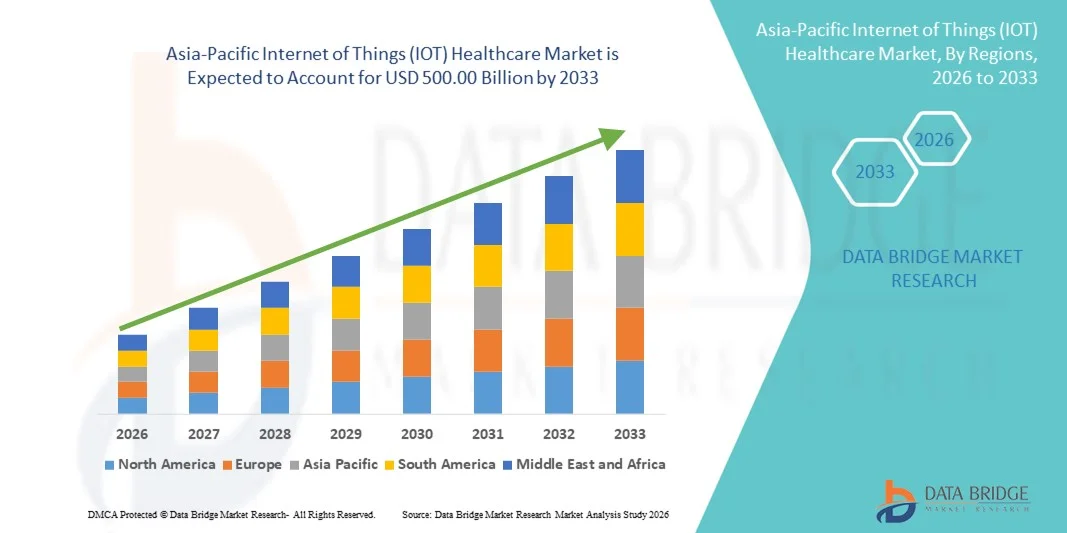
- As per Data Bridge Market Research Analysis the Asia-Pacific Internet of Things (IOT) healthcare market size was valued at USD 59.26 billion in 2025 and is expected to reach USD 500.00 billion by 2033, at a CAGR of 30.55% during the forecast period
- The market growth is largely fueled by increasing healthcare digitization, rapid adoption of connected medical devices, remote patient monitoring solutions, and expanding investments in smart healthcare infrastructure across major economies such as China, India, Japan, and South Korea
- Furthermore, rising healthcare IoT deployment driven by government initiatives for digital health, growing prevalence of chronic diseases, and demand for real‑time patient data and analytics is accelerating uptake of IoT healthcare solutions, thereby significantly boosting the industry’s growth
Market Size and Forecast:
- Market Value (2025): USD 59.26 billion
- Expected Market Value (2033): USD 500.00 billion
- Forecast CAGR (2026–2033): 30.55%
What are the Major Takeaways of Asia-Pacific Internet of Things (IOT) Healthcare Market?
- IoT healthcare solutions, including medical devices, systems and software, and services, are increasingly vital components of modern healthcare infrastructure across China, Japan, India, South Korea, and Australia due to their ability to provide real-time patient monitoring, streamline clinical workflows, and enable seamless integration with digital health ecosystems
- The escalating demand for IoT healthcare solutions is primarily fueled by the widespread adoption of applications such as telemedicine, clinical operations and workflow management, connected imaging, inpatient monitoring, and medication management, growing focus on patient-centered care, and rising need for operational efficiency in healthcare facilities
- China dominated the Asia-Pacific IoT healthcare market with the largest revenue share of 36.5% in 2025, supported by large-scale deployment of connected healthcare systems, government digital health initiatives, and significant investments by key healthcare technology providers
- South Korea is expected to be the fastest-growing country in the Asia-Pacific IoT healthcare market during the forecast period due to rapid hospital digitization, adoption of IoT-enabled monitoring systems, government support for smart healthcare initiatives, and increasing integration of AI and connected devices in clinical workflows
- Wi-Fi segment dominated the Asia-Pacific IoT healthcare market with a market share of 52.6% due to its reliability, cost-effectiveness, and wide compatibility with medical devices, supporting applications in remote patient monitoring, clinical asset tracking, and workflow optimization
Report Scope and Asia-Pacific Internet of Things (IOT) Healthcare Market Segmentation
|
Attributes |
Asia-Pacific Internet of Things (IOT) Healthcare Key Market Insights |
|
Segments Covered |
|
|
Countries Covered |
Asia-Pacific
|
|
Key Market Players |
|
|
Market Opportunities |
|
|
Value Added Data Infosets |
In addition to the insights on market scenarios such as market value, growth rate, segmentation, geographical coverage, and major players, the market reports curated by the Data Bridge Market Research also include in-depth expert analysis, patient epidemiology, pipeline analysis, pricing analysis, and regulatory framework |
What are Asia-Pacific Internet of Things (IOT) Healthcare Market Trends?
AI-Enabled Remote Patient Monitoring and Telemedicine Integration
- A significant and accelerating trend in the Asia-Pacific IoT healthcare market is the deepening integration of artificial intelligence (AI) with remote patient monitoring and telemedicine platforms, enhancing clinical decision-making and patient engagement
- For instance, AI-enabled monitoring devices in South Korea can analyze vital signs in real time and alert physicians to abnormal conditions, improving proactive care delivery
- AI integration allows predictive health analytics, learning patient patterns to suggest interventions and send intelligent alerts for potential health risks. For instance, connected glucose monitors in India adjust insulin recommendations based on AI insights, enabling personalized treatment
- The seamless integration of IoT devices with telemedicine and hospital management platforms facilitates centralized patient care management, allowing clinicians to monitor multiple patients from a single interface
- This trend toward more intelligent, interconnected, and patient-centric healthcare systems is reshaping expectations for care delivery. For instance, hospitals in China are adopting AI-driven IoT platforms for inpatient monitoring and medication management, improving operational efficiency
- The demand for IoT healthcare solutions that integrate AI and telemedicine is rapidly growing across hospitals, clinics, and home care services, as providers increasingly prioritize real-time monitoring and patient-centered care
- Interoperability with electronic health records (EHR) and hospital information systems is becoming a major trend, enabling seamless data sharing and workflow optimization. For instance, Australian hospitals are linking IoT monitoring data with EHRs to streamline post-discharge care
Asia-Pacific Internet of Things (IOT) Healthcare Market Dynamics
Driver
Rising Need Due to Chronic Disease Prevalence and Digital Healthcare Adoption
- The increasing prevalence of chronic diseases and aging populations, coupled with the rapid adoption of digital health solutions, is driving demand for IoT healthcare systems
- For instance, South Korean hospitals are implementing AI-powered patient monitoring systems to manage chronic cardiovascular and respiratory conditions more effectively
- IoT healthcare solutions offer real-time data collection, predictive analytics, and remote monitoring, providing a compelling alternative to conventional healthcare delivery
- Furthermore, government initiatives to digitize healthcare infrastructure in countries such as China, India, and Japan are accelerating IoT adoption across clinical operations and telemedicine
- The convenience of remote patient monitoring, digital dashboards, and automated workflow management is a key factor propelling adoption in hospitals, clinics, and research centers
- For instance, telemedicine platforms in Australia integrated with IoT devices allow clinicians to remotely monitor post-operative patients, reducing hospital visits and improving outcomes
- Increasing healthcare investments from private and public sectors are creating opportunities for IoT deployment in specialized areas such as oncology and intensive care. For instance, hospitals in Japan are deploying IoT-enabled ICU devices to track multiple vital parameters in real time
- Rising awareness among patients regarding preventive care and early diagnosis is pushing healthcare providers to adopt connected medical devices. For instance, Indian clinics are using IoT-enabled diagnostic kiosks to screen chronic diseases in rural populations
Restraint/Challenge
Data Security Concerns and High Implementation Costs
- Concerns surrounding cybersecurity vulnerabilities of connected medical devices and patient data pose a significant challenge to broader market penetration
- For instance, reported security breaches in hospital IoT systems in Japan have made some providers hesitant to adopt connected healthcare solutions
- Addressing cybersecurity through robust encryption, secure authentication, and regular software updates is crucial for building trust. For instance, AI-enabled monitoring platforms in South Korea emphasize data privacy and compliance with regulatory standards
- In addition, high initial costs of IoT healthcare systems compared to traditional devices can hinder adoption for price-sensitive hospitals and clinics
- While costs are gradually decreasing, the perceived premium for advanced AI-enabled IoT devices can still limit widespread adoption, especially in developing regions
- For instance, remote patient monitoring kits in India remain less accessible to smaller clinics due to upfront investment requirements, despite their clinical benefits
- Lack of standardized interoperability among IoT devices and hospital information systems can impede seamless data integration. For instance, some Chinese hospitals face challenges integrating multi-vendor IoT devices with existing EHR platforms
- Limited technical expertise and training for medical staff to operate IoT-enabled devices is also a hurdle. For instance, rural clinics in Australia require additional training to use AI-enabled monitoring systems effectively
Asia-Pacific Internet of Things (IOT) Healthcare Market Scope
The market is segmented on the basis of component, application, connectivity technology, and end user.
- By Component
On the basis of component, the Asia-Pacific IoT healthcare market is segmented into medical devices, systems and software, and services. Medical Devices dominated the market with the largest market revenue share of 45% in 2025, driven by widespread deployment of connected devices such as patient monitors, wearable health trackers, and smart diagnostic equipment. Hospitals and clinics in China and Japan prioritize medical devices due to their ability to provide real-time patient data, improve accuracy in diagnostics, and enhance treatment outcomes. The robust growth of chronic disease management programs and remote patient monitoring in South Korea and India further supports this segment. Medical devices are increasingly integrated with AI analytics and cloud platforms, enabling predictive healthcare and preventive care. The segment benefits from strong government initiatives in countries such as China promoting digital health adoption. In addition, the rising patient awareness of health monitoring solutions is accelerating demand for connected devices across both hospital and home care settings.
Systems and Software is anticipated to witness the fastest growth rate of 21% CAGR from 2026 to 2033, fueled by increasing adoption of telemedicine platforms, clinical workflow management tools, and AI-enabled hospital management systems. Hospitals and surgical centers are investing in software solutions to improve efficiency, reduce manual errors, and optimize patient care. Cloud-based healthcare software allows integration of multiple data streams from devices and IoT sensors, enabling centralized monitoring and reporting. The growth of predictive analytics and AI in software platforms enhances clinical decision-making and resource allocation. In addition, rising government initiatives to digitize healthcare records in India, Japan, and South Korea are driving system adoption. The flexibility, scalability, and interoperability of software solutions make this segment increasingly attractive to both public and private healthcare institutions.
- By Application
On the basis of application, the market is segmented into telemedicine, clinical operations and workflow management, connected imaging, inpatient monitoring, medication management, and others. Telemedicine dominated the Asia-Pacific IoT healthcare market with the largest revenue share of 28% in 2025, driven by the need for remote consultation, especially in rural and semi-urban areas. Telemedicine platforms integrated with IoT devices enable real-time monitoring of patients and provide doctors with actionable insights without physical visits. China and India have seen strong adoption due to government initiatives and the increasing penetration of smartphones and internet connectivity. Hospitals and clinics leverage telemedicine for chronic disease management, post-operative care, and preventive health programs. Integration with AI-enabled monitoring devices enhances predictive healthcare capabilities. Patient preference for home-based consultations and the convenience of remote care are further fueling the segment’s growth.
Inpatient Monitoring is expected to witness the fastest growth rate of 22% CAGR from 2026 to 2033, due to hospitals and surgical centers increasingly deploying IoT-enabled monitoring systems for continuous patient surveillance. Advanced monitoring devices provide real-time alerts for vital sign changes, reducing medical errors and enabling timely interventions. South Korea and Japan are leading in adopting these systems in ICUs and high-dependency units. Integration with hospital management software enhances workflow efficiency and reduces staff workload. IoT inpatient monitoring also supports data-driven predictive analytics, improving patient outcomes. Rising investments in smart hospitals and digital health infrastructure in Asia-Pacific further accelerate adoption.
- By Connectivity Technology
On the basis of connectivity technology, the market is segmented into Wi-Fi, Bluetooth Low Energy (BLE), ZigBee, Near Field Communication (NFC), Cellular, and Satellite. Wi-Fi dominated the market with a 52.6% share in 2025, owing to its reliability, widespread availability in hospitals and clinics, and ability to support high-volume data transfer from multiple connected devices. Wi-Fi-enabled devices allow seamless integration with cloud platforms and telemedicine applications, providing real-time access to patient data. Hospitals in China and Japan favor Wi-Fi for ICU monitoring, imaging devices, and wearable patient trackers. The technology facilitates centralized management of multiple devices across hospital floors. High bandwidth allows video-enabled teleconsultations and connected imaging systems to function efficiently. The segment benefits from compatibility with existing network infrastructure in urban hospitals.
Bluetooth Low Energy (BLE) is expected to witness the fastest CAGR of 20% from 2026 to 2033, driven by low power consumption and ease of integration with wearable and bedside monitoring devices. BLE enables direct device-to-smartphone connectivity, making it ideal for remote patient monitoring and personal health tracking in home care settings. The technology supports localized communication with minimal interference, improving reliability in densely equipped hospitals. Integration with mobile health apps allows real-time alerts and notifications to caregivers. The growing popularity of BLE-enabled health trackers and monitoring bands in India and South Korea contributes to rapid adoption. BLE also enables flexible deployment in temporary clinics and field hospitals.
- By End User
On the basis of end user, the market is segmented into hospitals, surgical centres, and clinics, clinical research organizations (cros), government and defense institutions, research and diagnostics laboratories, and others. Hospitals, Surgical Centres, and Clinics dominated the market with the largest revenue share of 55% in 2025, as these institutions require continuous patient monitoring, telemedicine integration, and clinical workflow optimization. Large hospitals in China, Japan, and South Korea lead in adopting connected devices and IoT-enabled software systems. IoT solutions improve patient care, reduce errors, and enable real-time health tracking across multiple departments. Rising government initiatives for hospital digitization in India and Australia support this segment. Hospitals also integrate IoT solutions with electronic health records for centralized data access. Growing patient awareness of remote monitoring and telehealth further drives adoption in this end-user category.
Clinical Research Organizations (CROs) are expected to witness the fastest growth rate of 23% CAGR from 2026 to 2033, fueled by increasing IoT adoption in clinical trials, remote monitoring of participants, and real-time data collection for research accuracy. CROs in South Korea, India, and China are integrating connected medical devices to enhance trial efficiency and compliance. IoT solutions allow remote patient monitoring for trial participants in rural locations, reducing site visits and operational costs. Integration with AI analytics platforms improves data quality and accelerates drug development timelines. The growing demand for decentralized clinical trials across Asia-Pacific further boosts the segment’s growth.
Asia-Pacific Internet of Things (IOT) Healthcare Market Regional Analysis
- China dominated the Asia-Pacific IoT healthcare market with the largest revenue share of 36.5% in 2025, supported by large-scale deployment of connected healthcare systems, government digital health initiatives, and significant investments by key healthcare technology providers
- Healthcare providers in the region highly value the benefits of IoT healthcare solutions, including real-time patient monitoring, predictive analytics, workflow optimization, and integration with telemedicine and hospital management systems
- This widespread adoption is further supported by rapid urbanization, increasing digital health literacy, rising disposable incomes, and growing awareness among patients and clinicians about the advantages of connected healthcare, establishing IoT healthcare solutions as a preferred choice across hospitals, clinics, and home care services
The China Internet of Things (IOT) Healthcare Market Insight
China dominated the Asia-Pacific IoT healthcare market with the largest revenue share in 2025, fueled by large-scale deployment of connected medical devices, AI-enabled patient monitoring systems, and telemedicine platforms. The government’s strong push for digital health adoption, smart hospital programs, and chronic disease management initiatives is driving adoption. Hospitals and clinics are increasingly integrating IoT solutions for workflow optimization, predictive analytics, and centralized patient monitoring. For instance, ICUs and high-dependency units leverage real-time monitoring devices to reduce medical errors and improve outcomes. Rising patient awareness and urban population growth further accelerate market expansion.
Japan Internet of Things (IOT) Healthcare Market Insight
The Japan IoT healthcare market is gaining momentum due to the country’s advanced healthcare infrastructure, high technology adoption, and aging population. Hospitals are integrating IoT devices with telemedicine platforms and electronic health records for seamless patient monitoring and care management. For instance, wearable health devices and remote monitoring systems are widely used for chronic disease management and post-operative care. Japan’s emphasis on technology-driven healthcare, preventive care, and operational efficiency is fueling adoption. Increasing government support for smart hospital initiatives and AI integration also contributes to the market’s growth. The focus on patient-centric, connected healthcare is expected to drive continued expansion in Japan.
India Internet of Things (IOT) Healthcare Market Insight
The India IoT healthcare market accounted for a significant revenue share in Asia-Pacific in 2025, driven by the country’s expanding middle class, rising healthcare awareness, and rapid urbanization. Telemedicine platforms, connected diagnostic devices, and wearable patient monitors are increasingly adopted in hospitals and clinics across urban and semi-urban areas. For instance, remote patient monitoring solutions are widely used for chronic disease management and preventive healthcare in rural regions. The government’s push for digital health initiatives, smart city programs, and affordable IoT solutions supports market growth. In addition, domestic manufacturers and increasing smartphone penetration are making connected healthcare solutions more accessible to a larger population.
South Korea Internet of Things (IOT) Healthcare Market Insight
The South Korea IoT healthcare market is expected to be the fastest-growing country in the region due to rapid hospital digitization, widespread adoption of AI-enabled monitoring systems, and increasing integration of IoT devices in clinical workflows. Hospitals and surgical centers are leveraging real-time monitoring, predictive analytics, and telemedicine for improved patient outcomes. For instance, ICU and chronic disease monitoring devices provide continuous data streams for clinical decision-making. Government support for digital health initiatives and high healthcare IT adoption further accelerates growth. The country’s focus on innovative, technology-driven healthcare solutions is fostering rapid uptake across both public and private healthcare institutions.
Which are the Top Companies in Asia-Pacific Internet of Things (IOT) Healthcare Market?
The Asia-Pacific Internet of Things (IOT) Healthcare industry is primarily led by well-established companies, including:
- Abbott (U.S.)
- Boston Scientific Corporation (U.S.)
- Siemens Healthineers AG (Germany)
- Medtronic (Ireland)
- Baxter (U.S.)
- NIHON KOHDEN CORPORATION (Japan)
- Cadi Scientific Pte Ltd (Singapore)
- Ultrahuman Healthcare (India)
- GE HealthCare (U.S.)
- Koninklijke Philips N.V. (Netherlands)
- Omron Healthcare Co., Ltd (Japan)
- Drägerwerk AG & Co. KGaA (Germany)
- Cisco Systems, Inc. (U.S.)
- IBM Corporation (U.S.)
- Qualcomm Incorporated (U.S.)
- Honeywell International Inc. (U.S.)
- Microsoft Corporation (U.S.)
- Oracle (U.S.)
- Samsung Electronics Co., Ltd (South Korea)
What are the Recent Developments in Asia-Pacific Internet of Things (IOT) Healthcare Market?
- In February 2026, Assam’s Chief Minister inaugurated the rollout of an AI‑powered IoT‑driven contactless remote patient monitoring platform at Gauhati Medical College and Hospital aimed at continuous real‑time patient monitoring in ICU settings
- In February 2026, GSMA Foundry and Singapore’s National University Health System (NUHS) announced a strategic partnership to advance 5G, AI, and IoT healthcare innovations, aimed at transforming healthcare delivery with applications such as remote surgical assistance, robot nurse companions, immersive XR training, and intelligent hospital‑at‑home systems
- In February 2025, MediBuddy partnered with Japan’s ELECOM to launch IoT‑enabled smart health devices aimed at enhancing preventive healthcare in India, expanding access to connected health tools such as Wi‑Fi and Bluetooth‑equipped health monitors to help users track and proactively manage health data. This collaboration is designed to integrate IoT device data with digital health platforms to provide personalised insights and improve early detection of lifestyle‑related diseases
- In August 2025, health ATMs using IoT technology were launched in Mizoram, India, providing instant, free access to 35 health parameters including blood pressure, blood sugar, and ECG with digital health records sent to users’ phones under the ‘Healthy Lunglei Initiative’
- In August 2025, the Andhra Pradesh government launched the Bharat Biodesign Research and Innovation (Brain) program to boost healthcare innovation and digital health development, focusing on predictive health analytics, AI‑based healthcare solutions, and affordable medical technologies that support IoT integration and global biodesign collaborations

- Interactive Data Analysis Dashboard
- Company Analysis Dashboard for high growth potential opportunities
- Research Analyst Access for customization & queries
- Competitor Analysis with Interactive dashboard
- Latest News, Updates & Trend analysis
- Harness the Power of Benchmark Analysis for Comprehensive Competitor Tracking
Data collection and base year analysis are done using data collection modules with large sample sizes. The stage includes obtaining market information or related data through various sources and strategies. It includes examining and planning all the data acquired from the past in advance. It likewise envelops the examination of information inconsistencies seen across different information sources. The market data is analysed and estimated using market statistical and coherent models. Also, market share analysis and key trend analysis are the major success factors in the market report. To know more, please request an analyst call or drop down your inquiry.
The key research methodology used by DBMR research team is data triangulation which involves data mining, analysis of the impact of data variables on the market and primary (industry expert) validation. Data models include Vendor Positioning Grid, Market Time Line Analysis, Market Overview and Guide, Company Positioning Grid, Patent Analysis, Pricing Analysis, Company Market Share Analysis, Standards of Measurement, Global versus Regional and Vendor Share Analysis. To know more about the research methodology, drop in an inquiry to speak to our industry experts.
Data Bridge Market Research is a leader in advanced formative research. We take pride in servicing our existing and new customers with data and analysis that match and suits their goal. The report can be customized to include price trend analysis of target brands understanding the market for additional countries (ask for the list of countries), clinical trial results data, literature review, refurbished market and product base analysis. Market analysis of target competitors can be analyzed from technology-based analysis to market portfolio strategies. We can add as many competitors that you require data about in the format and data style you are looking for. Our team of analysts can also provide you data in crude raw excel files pivot tables (Fact book) or can assist you in creating presentations from the data sets available in the report.













