


Asia-Pacific Leber Congenital Amaurosis Market Size
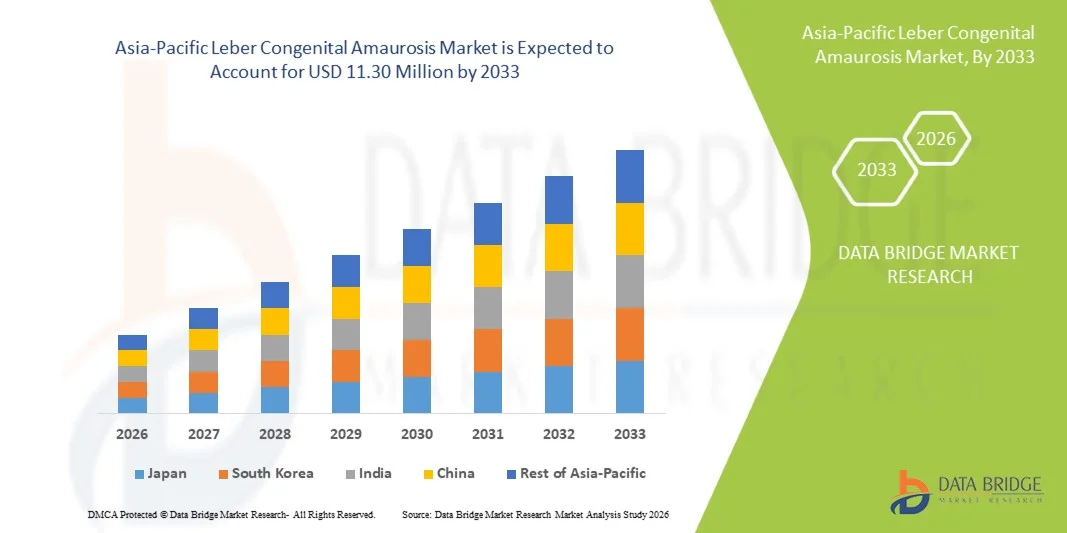
- The Asia-Pacific Leber Congenital Amaurosis market size was valued at USD 8.45 million in 2025 and is expected to reach USD 11.30 million by 2033, at a CAGR of 3.7% during the forecast period
- The market growth is largely fueled by increasing advancements in gene therapy research, rising adoption of next-generation sequencing for early diagnosis, and growing regional focus on rare inherited retinal disorders, leading to improved clinical identification across healthcare systems in Asia-Pacific
- Furthermore, increasing government and institutional support for orphan disease treatment, coupled with expanding access to specialized ophthalmic care and rising participation in clinical trials for retinal gene therapies, is accelerating the adoption of advanced treatment approaches, thereby significantly boosting the industry's growth
Asia-Pacific Leber Congenital Amaurosis Market Analysis
- Leber Congenital Amaurosis, a rare inherited retinal disorder market, is characterized by severe early-onset vision loss, where increasing clinical focus on genetic ophthalmology and expanding adoption of next-generation sequencing are improving early diagnosis and patient identification across major healthcare systems in countries such as China, Japan, and India
- The escalating demand for Asia-Pacific Leber Congenital Amaurosis market is primarily driven by rising utilization of genetic testing for rare retinal disorders, growing awareness among ophthalmologists and pediatric specialists, and increasing clinical research activity focused on gene-based therapies targeting mutations such as RPE65
- China dominated the Asia-Pacific Leber Congenital Amaurosis market with the largest revenue share of 28.6% in 2025, characterized by a large patient base, rapid expansion of genomic medicine programs, strong government support for rare disease research, and increasing participation in global clinical trials for retinal gene therapies
- Japan is expected to be the fastest growing country in the Asia-Pacific Leber Congenital Amaurosis market during the forecast period due to advanced healthcare infrastructure, strong regulatory support for regenerative and gene therapies, and increasing development of precision medicine approaches for inherited retinal disorders
- Therapy segment dominated the Asia-Pacific Leber Congenital Amaurosis market with a market share of 43.2% in 2025, driven by advancements in AAV-based retinal gene delivery platforms, strong clinical outcomes in inherited blindness treatment trials, and increasing regulatory approvals supporting targeted molecular therapies
Report Scope and Asia-Pacific Leber Congenital Amaurosis Market Segmentation
|
Attributes |
Asia-Pacific Leber Congenital Amaurosis Key Market Insights |
|
Segments Covered |
|
|
Countries Covered |
Asia-Pacific
|
|
Key Market Players |
|
|
Market Opportunities |
|
|
Value Added Data Infosets |
In addition to the insights on market scenarios such as market value, growth rate, segmentation, geographical coverage, and major players, the market reports curated by the Data Bridge Market Research also include in-depth expert analysis, patient epidemiology, pipeline analysis, pricing analysis, and regulatory framework |
Asia-Pacific Leber Congenital Amaurosis Market Trends
“Advancements in Gene Therapy and Genetic Diagnostics”
- A significant and accelerating trend in the Asia-Pacific Leber Congenital Amaurosis market is the growing integration of next-generation sequencing and gene-based therapeutic approaches, which is improving early diagnosis and enabling precision-targeted treatment strategies for inherited retinal disorders across key countries such as China, Japan, and India
- For instance, ongoing clinical advancements in AAV-based gene therapy programs targeting RPE65 mutations are being explored in leading ophthalmic research centers in China and Japan, significantly improving therapeutic innovation for severe early-onset vision loss conditions
- Increasing adoption of genomic screening technologies is enabling earlier identification of pathogenic mutations responsible for Leber Congenital Amaurosis, with some hospitals in China utilizing multi-gene retinal panels to support faster and more accurate diagnosis of pediatric patients
- The expansion of specialized retinal research networks and rare disease databases is facilitating centralized data sharing across academic institutions, allowing improved understanding of disease progression and supporting development of advanced treatment pathways in the region
- The rising collaboration between biotechnology companies and academic institutes is accelerating the development of novel retinal gene therapies, with increasing focus on durable vision restoration and long-term treatment efficacy in inherited retinal disorders
- The growing inclusion of Asia-Pacific patients in global clinical trials is improving access to experimental gene therapies, enhancing regional participation in cutting-edge ophthalmic innovation and accelerating regulatory familiarity with advanced treatment modalities
Asia-Pacific Leber Congenital Amaurosis Market Dynamics
Driver
“Rising Genetic Disease Awareness and Expanding Clinical Research Infrastructure”
- The increasing awareness of inherited retinal disorders and rising investment in genetic research infrastructure is a major driver for the Asia-Pacific Leber Congenital Amaurosis market, supported by growing diagnosis rates and expanding rare disease screening programs across major economies
- For instance, in April 2025, several ophthalmic research institutes in China expanded national rare disease registries focusing on inherited retinal dystrophies, strengthening early detection and improving patient enrollment for gene therapy clinical trials
- As healthcare providers become more aware of pediatric vision loss caused by genetic mutations, advanced diagnostic tools such as whole-exome sequencing are increasingly being adopted, enabling faster identification of Leber Congenital Amaurosis cases
- Furthermore, increasing government and institutional funding for rare disease research is supporting development of innovative gene therapy pipelines, encouraging collaboration between biotechnology firms and academic medical centers across Asia-Pacific countries
- The growing availability of specialized ophthalmic genetic testing services and increasing participation in international clinical trials are key factors accelerating treatment innovation and improving long-term disease management strategies in the region
- Expanding partnerships between global pharmaceutical companies and regional hospitals are further strengthening clinical trial networks, improving patient recruitment efficiency and accelerating therapy validation processes
Restraint/Challenge
“High Treatment Costs and Limited Accessibility of Advanced Gene Therapies”
- Concerns surrounding the high cost of gene therapy-based treatments and limited accessibility in developing healthcare systems pose a significant challenge to the Asia-Pacific Leber Congenital Amaurosis market, restricting widespread adoption of advanced therapeutic solutions
- For instance, high costs associated with AAV-based retinal gene therapies and limited reimbursement frameworks in several Asia-Pacific countries have created affordability barriers for patients requiring long-term treatment for inherited blindness disorders
- Addressing these cost-related challenges through expanded insurance coverage, government subsidy programs, and regional pricing strategies is crucial for improving patient access and accelerating market penetration of advanced therapies
- In addition, limited availability of specialized gene therapy centers and trained ophthalmic genetic specialists in certain developing regions further restricts timely diagnosis and treatment of Leber Congenital Amaurosis patients
- While research and clinical trials are expanding, the gap between innovation and real-world accessibility remains significant, particularly in rural and lower-income areas where advanced ophthalmic care infrastructure is still developing
- Regulatory complexities and lengthy approval timelines for gene-based therapies in some countries also slow down commercialization and delay patient access to innovative treatment options
- Overcoming these challenges through cost reduction strategies, improved healthcare infrastructure, streamlined regulatory pathways, and broader public-private collaboration will be essential for sustaining long-term growth of the Asia-Pacific Leber Congenital Amaurosis market
Asia-Pacific Leber Congenital Amaurosis Market Scope
The market is segmented on the basis of disease type, type, end user, and distribution channel.
- By Disease Type
On the basis of disease type, the Asia-Pacific Leber Congenital Amaurosis market is segmented into infantile type, juvenile type, and others. The infantile type segment dominated the market with the largest revenue share of 52.6% in 2025, driven by its early onset presentation within the first months of life, leading to earlier clinical diagnosis and higher detection rates through pediatric ophthalmology screening programs. This segment benefits from increased adoption of genetic testing in newborns and infants, particularly in countries such as China and Japan, where rare disease identification initiatives are expanding. The severity of vision impairment in infantile cases also leads to higher clinical intervention rates, strengthening its dominance across hospital-based care settings.
The juvenile type segment is anticipated to witness the fastest growth rate of 18.9% from 2026 to 2033, fueled by improving awareness among ophthalmologists regarding late-diagnosed inherited retinal disorders. Rising access to genetic counseling and expanded use of next-generation sequencing in adolescent patients are improving detection rates in this category. In addition, increasing participation in gene therapy clinical trials targeting older pediatric groups is accelerating treatment adoption. The growing availability of advanced diagnostic infrastructure in urban healthcare centers is further supporting segment expansion across Asia-Pacific countries.
- By Type
On the basis of type, the Asia-Pacific Leber Congenital Amaurosis market is segmented into therapy and diagnosis. The therapy segment dominated the market with the largest market revenue share of 43.2% in 2025, driven by the increasing adoption of gene therapy approaches targeting underlying genetic mutations responsible for retinal degeneration. Strong clinical advancements in AAV-based gene delivery systems are improving treatment outcomes for conditions such as RPE65-associated LCA. Expanding clinical trial activity across China and Japan is further strengthening therapeutic adoption. Rising investment from biotechnology companies in regenerative ophthalmology is also contributing to segment leadership.
The diagnosis segment is expected to witness the fastest growth rate of 21.3% from 2026 to 2033, fueled by the rapid expansion of genetic screening technologies and increasing use of next-generation sequencing for rare disease identification. Growing awareness among healthcare professionals is driving earlier diagnostic testing in pediatric patients. Expansion of rare disease databases and hospital-based genetic testing programs is further supporting segment growth. Increasing demand for precision diagnosis to enable targeted gene therapy is also accelerating adoption of advanced diagnostic solutions.
- By End User
On the basis of end user, the Asia-Pacific Leber Congenital Amaurosis market is segmented into hospitals, specialty clinics, ambulatory surgical centers, home healthcare, and others. The hospitals segment dominated the market with the largest revenue share of 46.8% in 2025, driven by the availability of advanced diagnostic infrastructure and access to specialized ophthalmic departments. Hospitals serve as primary centers for genetic testing, early diagnosis, and long-term management of rare retinal disorders. Increasing patient inflow for pediatric eye disorders in tertiary care hospitals across China and India is further strengthening dominance. The presence of multidisciplinary care teams also enhances treatment coordination in hospital settings.
The specialty clinics segment is anticipated to witness the fastest growth rate of 19.6% from 2026 to 2033, fueled by rising demand for focused ophthalmic and genetic care services. These clinics are increasingly equipped with advanced diagnostic tools for inherited retinal diseases, improving patient accessibility and turnaround time for testing. Growing preference for personalized treatment approaches and specialist consultations is driving patient shift toward specialty centers. Expansion of private ophthalmology networks in urban Asia-Pacific regions is further supporting segment growth.
- By Distribution Channel
On the basis of distribution channel, the Asia-Pacific Leber Congenital Amaurosis market is segmented into direct tender and retail sales. The direct tender segment dominated the market with the largest revenue share of 61.2% in 2025, driven by strong procurement systems used by hospitals and government healthcare programs for genetic testing services and advanced therapies. Bulk purchasing agreements for diagnostic kits and gene therapy-related services are commonly executed through institutional tenders. Rising public healthcare funding for rare disease management in China and Japan is further strengthening this segment. Centralized procurement also ensures cost efficiency and wider accessibility in hospital networks.
The retail sales segment is expected to witness the fastest growth rate of 17.8% from 2026 to 2033, driven by increasing availability of at-home genetic testing kits and rising digital healthcare platforms. Growing awareness of inherited retinal diseases is encouraging patients to seek direct diagnostic solutions through retail and online channels. Expansion of telemedicine services in India and Southeast Asia is further supporting decentralized access to testing services. Increasing consumer preference for early screening and convenience-based healthcare solutions is accelerating retail channel adoption.
Asia-Pacific Leber Congenital Amaurosis Market Regional Analysis
- China dominated the Asia-Pacific Leber Congenital Amaurosis market with the largest revenue share of 28.6% in 2025, characterized by a large patient base, rapid expansion of genomic medicine programs, strong government support for rare disease research, and increasing participation in global clinical trials for retinal gene therapies
- Healthcare systems in China highly value early genetic diagnosis, advanced ophthalmic imaging, and growing access to next-generation sequencing, which are improving detection rates and enabling earlier identification of Leber Congenital Amaurosis cases in pediatric populations
- This widespread leadership is further supported by strong government funding for rare disease research, increasing participation in global gene therapy clinical trials, and rapid development of specialized ophthalmology centers, establishing China as the key hub for inherited retinal disease management in the region
The China Leber Congenital Amaurosis Market Insight
China dominated the Asia-Pacific Leber Congenital Amaurosis market with the largest revenue share of 28.6% in 2025, fueled by its large patient pool, expanding genomic medicine infrastructure, and increasing investment in rare disease research programs. The country is witnessing rapid adoption of genetic testing platforms in tertiary hospitals, improving early identification of inherited retinal disorders. Strong government initiatives supporting precision medicine and orphan disease treatment are further accelerating market growth. In addition, China’s active participation in international gene therapy trials is enhancing access to advanced therapeutic innovations for Leber Congenital Amaurosis patients.
Japan Leber Congenital Amaurosis Market Insight
The Japan Leber Congenital Amaurosis market is projected to expand at a substantial CAGR during the forecast period, primarily driven by its advanced healthcare infrastructure and strong focus on regenerative medicine. The country’s high adoption of genetic screening and precision ophthalmology is improving early diagnosis of inherited retinal disorders. Increasing investment in gene therapy research and strong regulatory support for orphan drugs are fostering market development. Moreover, Japan’s emphasis on innovation in retinal disease treatment is supporting the integration of advanced AAV-based therapies into clinical practice.
India Leber Congenital Amaurosis Market Insight
The India Leber Congenital Amaurosis market accounted for a significant revenue share in Asia-Pacific in 2025, attributed to its large population base, increasing awareness of genetic eye disorders, and improving access to ophthalmic care services. Growing adoption of affordable genetic testing solutions is enhancing early detection of inherited retinal diseases. Government initiatives promoting rare disease management and expanding healthcare infrastructure are further supporting market growth. In addition, rising participation of Indian research institutes in global clinical trials is strengthening access to advanced therapeutic developments for Leber Congenital Amaurosis.
South Korea Leber Congenital Amaurosis Market Insight
The South Korea Leber Congenital Amaurosis market is expected to grow at a steady CAGR during the forecast period, driven by the country’s strong biotechnology ecosystem and increasing focus on precision medicine. Advanced healthcare infrastructure and widespread adoption of digital genetic testing platforms are improving early diagnosis of rare retinal disorders. Rising investment in gene and cell therapy research is further accelerating innovation in treatment approaches. Moreover, strong government support for rare disease programs and active participation in international ophthalmology research collaborations are enhancing market development in the country.
Asia-Pacific Leber Congenital Amaurosis Market Share
The Asia-Pacific Leber Congenital Amaurosis industry is primarily led by well-established companies, including:
- Novartis AG (Switzerland)
- F. Hoffmann-La Roche Ltd (Switzerland)
- Pfizer Inc. (U.S.)
- Bayer AG (Germany)
- AbbVie Inc. (U.S.)
- Bristol-Myers Squibb Company (U.S.)
- Sanofi (France)
- Santen Pharmaceutical Co., Ltd. (Japan)
- Spark Therapeutics, Inc. (U.S.)
- MeiraGTx Holdings plc (U.K.)
- Regenxbio Inc. (U.S.)
- Editas Medicine, Inc. (U.S.)
- AGTC (U.S.)
- Nanoscope Therapeutics Inc. (U.S.)
- GenSight Biologics (France)
- Alnylam Pharmaceuticals, Inc. (U.S.)
- King Khaled Eye Specialist Hospital (Saudi Arabia)
- Moorfields Eye Hospital NHS Foundation Trust (U.K.)
What are the Recent Developments in Asia-Pacific Leber Congenital Amaurosis Market?
- In April 2025, long-term clinical outcomes of RPE65 gene therapy showed sustained vision improvement in Leber Congenital Amaurosis patients. Clinical research published in 2025 demonstrated durable visual improvement up to 3 years in patients treated with AAV-based gene therapy for RPE65-related LCA
- In February 2025, Opus Genetics advanced its LCA5 gene therapy program for inherited retinal disease including Leber Congenital Amaurosis. Opus Genetics announced updates on its OPGx-LCA5 gene therapy clinical program, targeting LCA caused by LCA5 gene mutations. The therapy is designed as a one-time subretinal AAV-based treatment aimed at restoring retinal function in severely affected patients
- In November 2024, Japan advanced genetic diagnosis research for rare inherited retinal disorders including Leber Congenital Amaurosis. Japanese research institutions identified and characterized novel RPE65 gene variants associated with LCA, improving understanding of genotype–phenotype relationships
- In October 2023, HuidaGene Therapeutics completed patient dosing in the HG004 CRISPR gene therapy trial for Leber Congenital Amaurosis in China. HuidaGene Therapeutics announced completion of patient dosing in its HG004 CRISPR-based gene therapy trial, targeting RPE65-related Leber Congenital Amaurosis. The therapy uses advanced genome editing techniques to restore retinal function in inherited blindness patients
- In April 2023, China approved clinical advancement of CRISPR-based gene therapy (HG004) for inherited retinal dystrophies including LCA. China’s regulatory authority cleared an IND application for HG004, a CRISPR-based therapy targeting RPE65-related retinal dystrophies, including Leber Congenital Amaurosis. This marked one of the first large-scale gene-editing programs for inherited blindness in Asia-Pacific

- Interactive Data Analysis Dashboard
- Company Analysis Dashboard for high growth potential opportunities
- Research Analyst Access for customization & queries
- Competitor Analysis with Interactive dashboard
- Latest News, Updates & Trend analysis
- Harness the Power of Benchmark Analysis for Comprehensive Competitor Tracking
Data collection and base year analysis are done using data collection modules with large sample sizes. The stage includes obtaining market information or related data through various sources and strategies. It includes examining and planning all the data acquired from the past in advance. It likewise envelops the examination of information inconsistencies seen across different information sources. The market data is analysed and estimated using market statistical and coherent models. Also, market share analysis and key trend analysis are the major success factors in the market report. To know more, please request an analyst call or drop down your inquiry.
The key research methodology used by DBMR research team is data triangulation which involves data mining, analysis of the impact of data variables on the market and primary (industry expert) validation. Data models include Vendor Positioning Grid, Market Time Line Analysis, Market Overview and Guide, Company Positioning Grid, Patent Analysis, Pricing Analysis, Company Market Share Analysis, Standards of Measurement, Global versus Regional and Vendor Share Analysis. To know more about the research methodology, drop in an inquiry to speak to our industry experts.
Data Bridge Market Research is a leader in advanced formative research. We take pride in servicing our existing and new customers with data and analysis that match and suits their goal. The report can be customized to include price trend analysis of target brands understanding the market for additional countries (ask for the list of countries), clinical trial results data, literature review, refurbished market and product base analysis. Market analysis of target competitors can be analyzed from technology-based analysis to market portfolio strategies. We can add as many competitors that you require data about in the format and data style you are looking for. Our team of analysts can also provide you data in crude raw excel files pivot tables (Fact book) or can assist you in creating presentations from the data sets available in the report.












